Lhasa, Tibet
5-Day Itinerary:
D1: Fly from Chongqing to Lhasa (check into hotel)
D2: Morning visit to Potala Palace Square and Jokhang Temple, afternoon visit to Potala Palace
D3: Morning visit to Barkhor Street and Ramoche Temple, afternoon join a group tour to Yamdrok Lake
D4: Join a group tour from the White Palace of Potala Palace to Namtso Lake for a full day
D5: Morning shopping on Barkhor Street, afternoon flight from Lhasa back to Chongqing
D1: The 13:00 flight from Chongqing to Lhasa was delayed until 14:40. At the end of September, Lhasa is less crowded than in July and August, and with the fine weather, it was just perfect for admiring the sky. Remember this tip: whenever you go to Lhasa, always wear long sleeves, bring sunglasses, and use sunscreen!
At 19:00, as soon as I stepped off the plane, a chilly wind hit me, so I quickly put on my down vest. Fortunately, I didn't feel any altitude sickness. Sunsets in Lhasa come late—it doesn't get dark until around 20:20, and in summer, not until 21:00. Following the instructions at the airport exit, I scanned my ID card, went out, and bought a 30-yuan airport shuttle bus ticket. That evening, I took the shuttle directly to the hotel I had booked on Ctrip. The hotel was right at the foot of the mountain by the east gate of the Potala Palace—you can enjoy both the night view and the daytime view of the Potala Palace from there!
I didn't do much that evening, just ate some Sichuan food at a small nearby restaurant. Later I found out that a lot of people from Sichuan and Chongqing run businesses here. Considering convenience and other factors, I stayed at this hotel for four nights. I was thrilled to see the solemn, dazzling Potala Palace at night every day, and the determined pilgrims doing their morning kora no matter the weather.
On the day I arrived, all my worries about altitude sickness seemed unnecessary—it felt normal, just the air was a bit cold. No problem, I just washed up and went to bed as usual. I even forgot to turn on the heater.
D2: I had booked Potala Palace tickets early on Ctrip, scheduled for the next afternoon. The afternoon before, Ctrip sent a text message with the exact time and place to pick up the reservation ticket, plus the guide's phone number. I had arrived at the hotel after dark the night before, and when I woke up in the morning, I saw snow-capped mountains not far away. In the morning, I strolled around the square opposite the Potala Palace—there were security checks to enter and exit, with the message 'Big bags, small bags, please proceed through security' playing on a loop at the entrance. I ended up muttering it along for several days! There, I saw a friend's lighter being confiscated at security. Later, I noticed that none of the local shops sold lighters; when I asked, the shop owner told me lighter sales are banned.
I gave myself a pat on the back for being well-prepared—I had brought a precious face mask, which I couldn't have done without over the next few days! Seeing I had some time, I took a pedicab. A 15-minute ride got me to Jokhang Temple for a quick stroll.
In the afternoon, photography isn't allowed inside the palace. The White Palace spreads along the two sides of the Potala and served as the living quarters and political office of the Dalai Lama, while the Red Palace rises in the center and houses the statues of successive lamas. Inside the Potala, there are 999 rooms and a cave built by Songtsen Gampo for studying, where you can see a double-headed statue of Songtsen. The foundations are made of grass, wood, and stone—building such a palace in that era was an incredible feat.
Mondays, Wednesdays, and Fridays are days for Tibetan Buddhists to worship, and they use a different route for their rituals. Tourists only visit the White Palace and Red Palace, which occupy just a small part on the left side of the Potala. Before entering, you can exchange paper money into jiao and yuan notes in the square to use as offerings. Local custom prohibits using coins, incense, candles, or paper offerings!
Entering the Potala involves three gates. The first is the Snowland Scenic Area, which houses a Potala Palace Treasure Hall that doesn't require a ticket. I heard it now mainly sells local products like amber, turquoise, and dzi beads, so I didn't go in.
The second gate is for the White Palace, which opens 10 minutes before the time on your reservation ticket. The guide said you should arrive an hour early and keep an eye on the time—be very careful here, especially if you're an inexperienced independent traveler buying your own ticket, because if your turn comes and your reservation time has passed, you won't get in.
The third gate is for the Red Palace, which costs 200 yuan. The guide exchanges tickets here, and you can take a couple of photos. Once inside the Red Palace, photography is mostly forbidden. Inside, there are Buddha statues, thangkas, stupas, and more. The stupa of the 12th Dalai Lama is said to have required several hundred tons of gold and countless jewels—here, gold is the least valuable thing. Butter lamps were lit, and the smell wasn't pleasant. We climbed the stairs quickly, only able to take a hurried glimpse. It's understandable since the palace is small and crowded with tourists. Some areas are closed to preserve them from damage. The guide mentioned that the 13th floor of the Red Palace used to be open, but due to some tourists' uncivilized behavior, it's now closed, and visitors can only go up to the 12th floor. Directly across, Yaowang Hill is the best spot for taking that classic photo—the one on the back of the 50-yuan note of the Potala Palace.
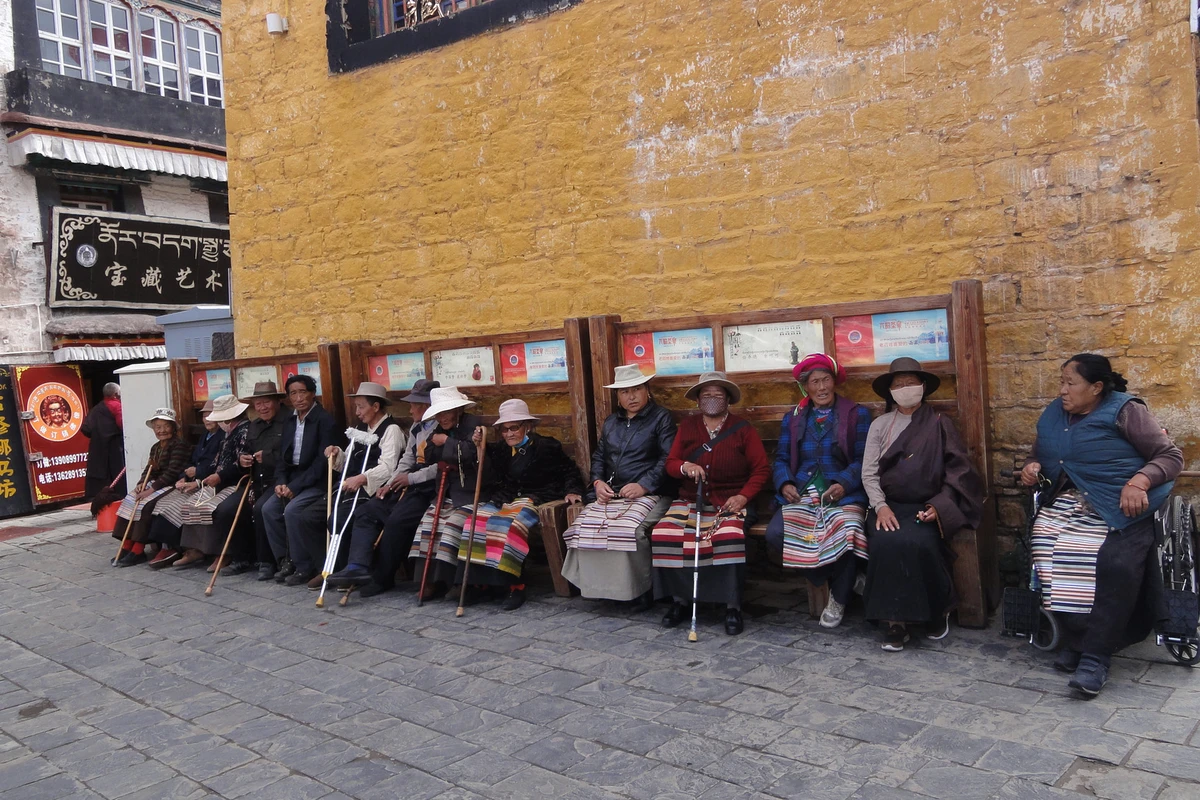
After leaving the Red Palace, exactly one hour had passed. The guide said they'd be fined if we went over time, though I'm not sure if that's true. We descended via the back mountain path. At the rear exit of the Potala, I tried the local highland yogurt—it was very sour, but with sugar and highland barley added, it tasted great. The weather changed, and I was too tired to walk, so I went into a local tea house and had some butter tea and salty tea. For 10 yuan a pot, the tea was warm and steaming. Locals sat chatting and laughing over their tea.
The black curtains are woven from yak hair—they become dense in winter and naturally more porous in summer. The patterns on them symbolize good fortune. Don't mistake them for the China Unicom logo—Unicom certainly can't advertise here!
Local highland yogurt, 10 yuan a cup.
D3: In the morning, I took a taxi from the hotel to Barkhor Street. The fare was 11 yuan, but taxis were hard to come by—I waited for a very long time. I noticed there were many bicycles for rent, but with only five days, my schedule was too tight to try them. The street was full of excellent local products. The blocks of butter were unimaginably huge, stacked up in rolls. Haha, I could actually handle the smell! There were also cheeses in various shapes, dried broad beans, dried apple slices, Tibetan tea bricks, Tibetan leather pouches...
In the afternoon, I joined a group tour to Yamdrok Lake, a saltwater lake and one of the three great holy lakes of the plateau. We passed through Qüxü County to the Yarlung Tsangpo River Bridge—over 170 kilometers in total. The one-way drive took more than two hours, crossing Gampa La Pass at an altitude of 5,030 meters. The mountain road was treacherous and the altitude high. An elderly passenger in the car was extremely nervous and started inhaling oxygen when we crossed the pass; I felt it was mostly psychological.
The car followed the Yarlung Tsangpo River, the clear water mirroring the blue sky. Oh, and remember: along this route, public toilets charge 2 yuan, and taking photos with sheep, horses, yaks, Tibetan mastiffs, or local Tibetans all costs money—yaks by the lake cost 30 yuan each time. The scenery was beautiful all the way, no traffic jams, and the views on the descent were even more stunning.
I picked up a Tibetan tea brick to examine it.
Later, I saw even larger butter containers filling an entire room.
There were all sorts of snowy-white cheeses; I tasted one. Eating local highland food helps your body resist the altitude. At first the taste was strong, but the aftertaste had a milky fragrance.
Looking at the local specialties and these highland barley flowers, truly the flavors of the plateau.
Sheep and yaks are the main livestock here. Guess how much a yak is worth? One yak is worth about 10,000 yuan.
No wonder prices are high, though wages are decent.
Don't be fooled by the treeless mountains—they hide turquoise, agate, and also caterpillar fungus and saffron...
D4: Happy times pass too quickly. On the fourth day, I joined a group tour to the sacred Namtso Lake—a five-hour drive each way. I got up early to catch the bus. Breakfast was right by the White Palace: rice porridge, steamed buns, and more. Plenty of Sichuan vendors ride up on their carts selling breakfast. As a heads-up, group tour buses all gather at the White Palace parking lot next to Potala Square. The driver-guide for Yamdrok was great, but for Namtso, with the long journey, the driver was in a hurry.
Two people changed their plans, so just after 6:00 a.m., six of us set off before dawn. The road was rough at first, jolting violently. Along the way, we encountered a truck carrying soy sauce that had overturned on a bend, causing a huge traffic jam. The whole group joked, 'This time we really are going for soy sauce...' (a pun). Luckily, the driver knew a shortcut, and we bypassed the jam. The road had grasslands, rivers, multicolored earth... While stuck in traffic, I found a single ear of highland barley on the ground!
The driver mentioned you can rent a car in Lhasa for self-driving, costing 300–1,000 yuan per day. Locals especially like renting Toyota off-road vehicles, which can cost over 1,000 yuan per day in peak season, with a deposit required.
The place with the crane was dubbed the 'soy sauce spot.'
Passing Yangbajing, we even stopped to let military vehicles pass first. There I saw a green train speeding by. The large hot springs there can boil eggs, but the hot spring hotel is small and didn't look great now. This route involved several security checks where ID cards had to be shown, but thankfully, unlike the Yamdrok route, we didn't have to repeatedly get out of the car. The driver said tourists from Xinjiang, Hong Kong, Macau, and Taiwan are subject to extra scrutiny. Public security was good.
We ate lunch at the foot of Nagenla Mountain in Damxung County before starting the climb. The driver recommended a Sichuan restaurant—two dishes cost 88 yuan. The owner said all ingredients are shipped in, and cooking rice or noodles requires a pressure cooker, which is a hassle. He said a bowl of noodles near the scenic area costs 50 yuan. Local Tibetan kids were all dark-skinned and mostly dressed in Han Chinese clothing; I rarely saw a knife tucked in their waist. Weapons aren't allowed through security, and fruit must be washed before being brought in. Along the way, we spotted a water burial platform; the driver explained it's where minors or wrongdoers are laid to rest, and a ladder painted on the mountain signifies their ascent to heaven. They practice nine types of burial here.
Considered a relatively normal meal—88 yuan.
Lhasa's weather shifts instantly between sun and rain. Sunshine can feel like it's scorching your skin, while rain turns to sleet and gusts of wind blow, but thankfully I was inside the car. Soon Namtso Lake came into view.
You can wash your face and hands in the sacred lake, but not your feet. I washed my face right there to soak up some spiritual energy!
The lake water lapped playfully against the pebbles without end...
Locals say the snow mountains are the backbone of the local women.
Nagenla Mountain is a huge wind gap at 5,190 meters—so windy I could barely stand!
D5: I walked along with the crowd, doing the kora clockwise. At 11:30, when Makye Ame next to Jokhang Temple opened, I settled in for some sweet tea, leafed through their spiritual books, and bought some Tibetan incense and bracelets for friends on Barkhor Street. Turning back, I gazed once more at the heartfelt devotion...
At last I saw it—beautiful Tibet, the power of spiritual totems!!!


