Escape to Yunnan – Wandering Northwest Yunnan
We set off from Beijing early this morning. After a long, tiring journey, the plane made a stopover in Kunming and landed at Shangri-La Airport in the afternoon. Our chartered driver, Xiao He, picked us up and we headed straight for the county town.
At this time of year, Lashi Lake is past its peak season, with very few visitors.
We stopped at a viewpoint along the way with great vistas. You could look out over Jade Dragon Snow Mountain, Haba Snow Mountain, and the First Bend of the Yangtze River. Surprisingly, there was even a small temple there, and we lingered for quite a while.
There is a stele here inscribed with the origin of the name “Shangri-La – Xiong Gu”: Shangri-La means a paradise where humans and nature live in harmony. “Xiang-ge-li” is a place name, and “la” is an affirmative particle meaning “yes, it is”. Combining the two, it says “This is Xiang-ge-li”. The character “Xiang-ge” comes from the place name Xiong Gu. “Xiong Gu” is a Naxi language term: “Xiong” refers to the fragrant cypress tree, “Gu” means “place” or “location”, so “Xiong Gu” means “the place where fragrant cypress grows”. When transliterated into Chinese with a blend of sound and meaning, it naturally becomes “Xiang-ge”. A map of Lijiang printed in the 21st year of the Republic of China (1932) clearly marked Xiong Gu as “Xiang-ge-li”. At that time in the Xiong Gu area, if someone asked where they were, locals would answer in Naxi: “Xiang-ge-li-la”. Then in 1998, people found this stele, erected in the 34th year of the Guangxu reign (1908), bearing the inscription “Xiang-ge-li Xiong Gu”. This proves that this is indeed the “Xanadu – Shangri-La” that people have yearned for.
The monk in the temple turned out to be a fortune teller. Somehow I fell for it. My first expenditure in Yunnan was right here? Oh dear! Haha!
After dinner we went out for a stroll. I didn’t bring a tripod, so the photos came out a bit blurry.
Songzanlin Monastery was built in the 11th Rabjung Earth-Sheep year of the Tibetan calendar (1679) and completed in the Iron-Bird year (1681). It is said that the site was determined by the Dalai Lama through divination, with the deity proclaiming: “Deep in the secluded woods clear springs emerge; a pair of golden birds from heaven frolic here.” Hence, visitors entering the monastery will see a perennial spring gurgling year-round and often spot a pair of golden plovers coming and going in pairs. The Fifth Dalai Lama personally named it “Gandan Sumtsen Ling”. “Gandan” signifies the lineage of the Gelug founder Je Tsongkhapa’s first monastery, Gandan; “Sumtsen” refers to the playground of the three heavenly gods Indra, Manjushri, and Varuna; “Ling” means “monastery”. The full name can be interpreted as: “All exoteric and esoteric teachings cannot be accomplished at once; this monastery is specially built so that the untainted source of the Dharma may continually benefit sentient beings until they attain perfection.” Upon completion, Songzanlin Monastery became the highest institution of the combined political and religious system in the region, a supreme sanctuary where the “Three Jewels” – Buddha, Dharma, and Sangha – are fully present for the Tibetan regions of Yunnan, Tibet, and Sichuan. Pilgrims from all over come to pay homage here in an endless stream, with incense burning ever brightly. The monastery houses numerous treasures through the ages, including eight gold-clad Shakyamuni statues from the periods of the Fifth and Seventh Dalai Lamas, palm-leaf sutras, exquisite thangkas painted with multicolored gold ink, and golden lamps. The entire temple possesses ten copies of the Kanjur, two of them handwritten in gold ink, as well as various beautiful gilt or silver incense burners, perpetual lamps, and so on.
Currently, Songzanlin Monastery has over 700 monks, divided into two categories: living Buddhas and ordinary monks (zhaba). Apart from the living Buddhas, the monks are organized into various ranks and carry out ten-odd types of duties.
The Jinsha River Great Bend is also known as Moon Bay. As the Jinsha River cuts through mountains and valleys, just before it surges out of this strategic pass between Sichuan and Yunnan, it gracefully draws a grand ‘Ω’-shaped bend around the pyramid-like Rizhui Peak. This is the “First Bend of the Jinsha River”, one of China’s top forty scenic wonders.
Dongzhulin Monastery was built in 1667 (the sixth year of Emperor Kangxi’s reign). Originally named “Chongchong Cuogang Monastery”, meaning the monastery by the crane lake, it was located about 3 km northwest of the present site. In its early days it had only 16 monks and belonged to the Kagyü sect. Later, due to involvement in the anti-Gelug conflict led by Gunqin Monastery, it converted to the Gelug sect and merged with seven smaller temples (gonpas) including Kangsa, Zhiyong, and Shusong, hence renamed “Gandan Dongzhulin”, signifying the monastery that accomplishes “the two benefits” (benefiting both self and others). From then on it expanded continuously; by the late Qing Dynasty the number of resident monks grew to over 700, with 10 living Buddhas, becoming one of the thirteen great monasteries of Kham.
Since we had already visited Songzanlin Monastery in the morning, we just breezed past this one!
This area lies in the middle section of the Hengduan Mountains. The majestic Yunling range runs north to south through the region, with 20 peaks rising above 5,000 meters. Endless peaks are draped in white snow; viewed from a distance, the perpetually snow-capped main summit resembles a galloping white horse, hence the name “Baima Snow Mountain” (White Horse Snow Mountain), also called “Baimang Snow Mountain”. Its highest peak, Zharaqueni, stands at 5,460 meters. In Khampa Tibetan legend, Baima Snow Mountain is said to be the daughter of Kawagarbo.
Meili Snow Mountain lies in the world-famous Three Parallel Rivers region—where the Jinsha, Lancang, and Nujiang rivers run side by side. It is a massive snow mountain range stretching north–south. The northern section is called Meili Snow Mountain, the middle section Taizi Snow Mountain, and the southern section Biluo Snow Mountain, connecting to the Adonggeni Mountain in Tibet to the north. There are 13 peaks with an average elevation above 6,000 meters, known as the “Thirteen Taizi Peaks”. The main peak is Kawagarbo, at 6,740 meters, 98.6°E, 28.4°N.
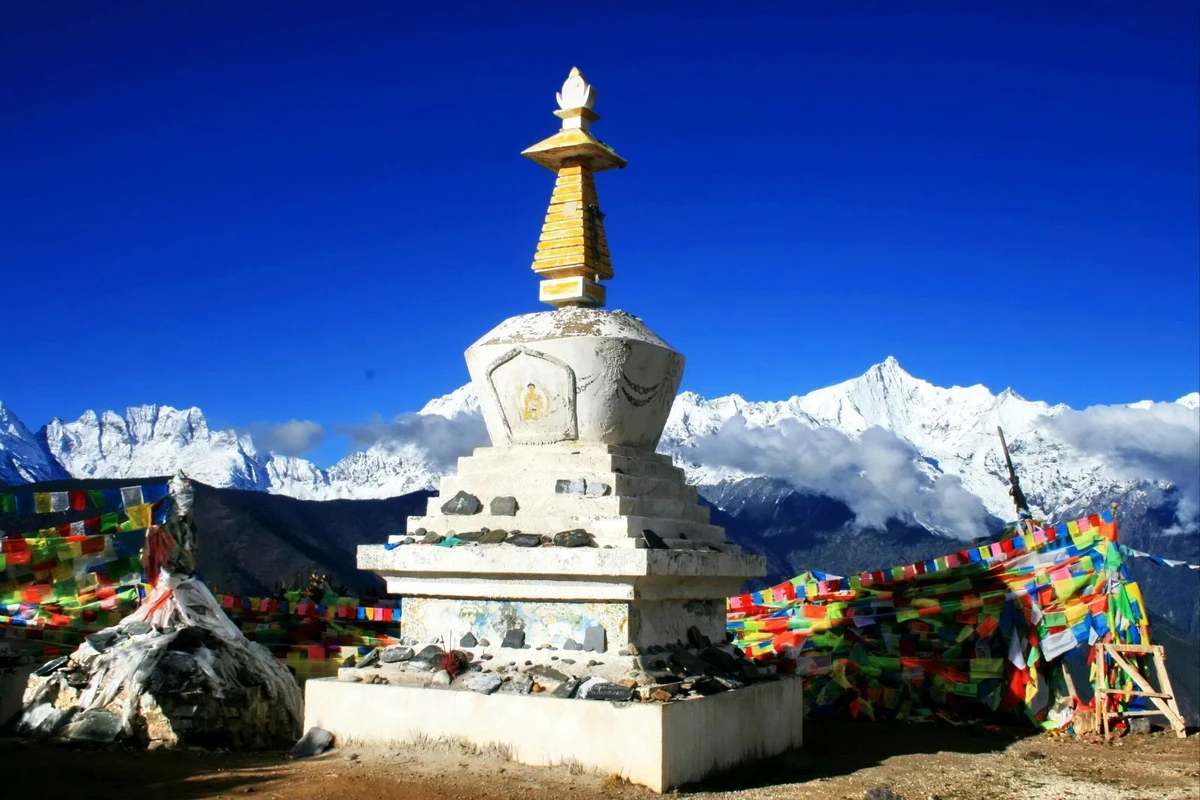
By the time we reached Meili, the sky was overcast, so I could only take pictures of the white stupa at the entrance!
Rain started last night and continued until the morning, so there was naturally no golden sunrise on the peaks. Our plan to trek into Yubeng was disrupted. When the rain was about to stop, we decided to first go up to Mingyong Glacier as a warm-up for Yubeng.
Mingyong Glacier, also called Nainogoru Glacier, is the largest, longest, and lowest-altitude valley glacier in Yunnan, one of the long ice tongues beneath Kawagarbo Peak. In Tibetan it is called “Mingyong Qia”: “Mingyong” is the name of the village at its foot, and “Qia” means the meltwater from the glacier. “Mingyong” also means “fire basin”.
A light rain was still falling and the mountain road was shrouded in thick fog — we were literally moving through the clouds. Visibility was less than 30 meters; it was a bit frightening.
After lunch we arrived at the glacier entrance. Horse rentals were available, but we ignored them, thinking that a 4-km one-way hike would be a piece of cake for us. It turned out to be a huge mistake.
We mustered all our strength and finally reached the observation deck. The glacier was quite spectacular, though a bit dirty. We wanted to look around longer and take a rest, but suddenly a crackling sound came from the glacier. The scenic area was already empty, so we got scared and hurried down the mountain.
After descending we were utterly exhausted, my sweat-soaked outer fleece completely drenched. It was close to evening by then, the temperature dropped, and we felt chilled. Back at the hotel, I immediately took a hot shower. After dinner we resolutely gave up the plan to go into Yubeng.
The reasons for such severe physical exertion are: 1) we didn’t rent horses and were overconfident; 2) we made zero preparations — an 8-km mountain trail with no bottle of water or chocolate bar; 3) we chose to hike after rain, making the trail muddier and more difficult, the forest air was extremely humid; at high altitudes from 3,700 to 4,200 meters, the oxygen level was already low, and the humidity made it worse.
Yesterday the weather was overcast all day, and today showed no improvement. So we kept waiting — and also used this time to recover from yesterday’s fatigue. I slept in until I woke naturally, and after lunch we played cards at the hotel until evening. Sigh!
The devout are naturally blessed by the deities. Our dream of the golden sunrise on the snow peaks filled our eyes! It was my first time witnessing this spectacle, and I was speechless!
The sky was perfectly clear, and the mysterious true face of Kawagarbo revealed itself!
The sacred mountain, the white stupa, prayer flags, and devout people. We sat by the window at Meili Wangshi, a cup of fragrant tea in hand, gazing at everything before us, letting our thoughts wander. An entire day passed like this; we didn’t even leave for dinner. In the evening we watched a documentary at Meili Wangshi about the 1991 mountaineering disaster, a mix of emotions flooding over me, as vivid as if it happened yesterday.
At night, looking up at the sky, the stars were so bright, countless like hairs, seemingly within arm’s reach, and shooting stars streaked past at any moment. Our driver Xiao He and the hotel staff all said that with such fine weather tonight, there would surely be another golden sunrise tomorrow morning.
But a common saying online has it: if you see Japanese people at Meili, there will be no golden sunrise. Unfortunately, in the afternoon at Meili Wangshi, I spotted a few Japanese visitors, and I couldn’t help feeling anxious about tomorrow morning’s sunrise.
Alas! What I worried about last night came true this morning. Despite the perfect weather, as soon as Grandpa Kawagarbo saw the Japanese visitors, the summit that was just beginning to blush instantly lost its color. The photographers with their long lenses, famous for their patience in waiting for the right weather and moment, all unceremoniously packed up in unison, because everyone knows that since 1991, Kawagarbo’s golden sunrise has never revealed itself to Japanese people.
After breakfast, we took one last reluctant look at the sacred mountain on this trip and resolutely decided to break camp. There’s no point idling here with the Japanese. Next stop: Lijiang.
After a night’s rest in Lijiang, we set off early in the morning for the mysterious “Kingdom of Women”.
Lugu Lake, anciently known as Lukuhai Lake and also called Zuosuo Lake, commonly known as Lianghai (Bright Lake), lies between Yanyuan County, Liangshan Yi Autonomous Prefecture, Sichuan Province, and Ninglang Yi Autonomous County, Lijiang City, Yunnan Province. The lake covers over 50 square kilometers, sits at 2,690 meters above sea level, with an average depth of 45 meters and a maximum depth of 93 meters. Its transparency reaches 11 meters and maximum visibility is 12 meters. The water is crystal clear and deep blue. It is the highest-altitude lake in Yunnan and one of the province’s two deepest freshwater lakes. The lake contains five whole islands, three peninsulas, and one causeway-connected islet, each with a distinct shape and as green as jade. The lakeside residents are mainly Mosuo people, along with some Naxi and Pumi communities. The Mosuo still preserve their matrilineal marriage system.
We found a hotel close to the dock and right by the lake to stay in.
We took a large “pig trough” boat to Liwubi Island. Not sure what kind of birds they were, let’s just call them seabirds; they kept circling around us, eager for food.
Liwubi Island lies in the south-central part of Lugu Lake, splitting the lake along with Tubu Peninsula. To the northwest it faces Snake Island. One side of the island forms a natural pier with a stone outcrop. A winding path leads directly to the top of the island, bordered by many azaleas and wild cherry trees. At the end of the flowering path stands the Tibetan Buddhist temple, Liwubi Temple, and atop the island is a white stupa. Liwubi Island, together with Xiewa’e Island and Lige Island, are known as the Three Penglai Islands of Lugu Lake.
After dinner we went to a Mosuo bonfire party. The girls and boys danced so beautifully — definitely worth experiencing.
When we visited, all the buildings on Lige Peninsula were under reconstruction. It’s said that the best rooms on the island now cost over 700 yuan.
Actually, it was the former residence of the controversial Yang Erche Namu.
After breakfast, we bid farewell to the mysterious “Kingdom of Women”.
We had lunch by the Jinsha River and tasted the river fish here.
Shuhe, known as “Shaowu” in the Naxi language, takes its name from the treasure mountain behind the village, which resembles a towering peak. Over time the name evolved to mean “village beneath the high peak”. It is one of the earliest Naxi settlements on the Lijiang plain and a well-preserved important market town on the ancient Tea Horse Road.
Arriving in Shuhe, I felt it retained the charm of Lijiang while shedding its hustle and bustle. With fewer people and a serene atmosphere, I really liked it.
In the evening, dancing at Sifang Tingyin Square.
The Ancient Town of Lijiang, also known as Dayan Town, is nestled against Xiangshan Mountain and Jinhong Mountain to the north, with Lion Mountain to the west, and open fertile fields stretching for miles to the southeast. The town was first built in the late Song and early Yuan dynasties (late 13th century). Located on the Yunnan-Guizhou Plateau at an altitude of over 2,400 meters, it covers an area of 3.8 square kilometers. It has more than 25,000 residents, the vast majority being Naxi. Lijiang Ancient Town, together with Langzhong in Sichuan, Pingyao in Shanxi, and Shexian in Anhui, is known as one of the “four best-preserved ancient towns in China”. It is one of the two ancient towns among China’s famous historical and cultural cities that have no city walls.
Lijiang is a place for sleeping in; I woke up naturally. Everyone did their own thing, and we only gathered at lunchtime. My choice was to laze in the hotel courtyard in the sunshine, casually flipping through a magazine.
Naxi ancient music — whether you understand it or not, it’s worth a listen if you have the chance. I once bought a book by Xuan Ke but haven’t finished it; I’ll definitely find time to finish reading it.
The ancient town is truly beautiful at night! Not because of the neon lights, but because of its charm.
Our Yunnan trip is about to end. In the morning we continued strolling around, and after lunch we’ll head to the airport for the return journey.
The mysterious Kawagarbo, the beautiful Lugu Lake, the leisurely ancient towns — these scenes linger before my eyes. The devout Tibetans, the open-hearted Mosuo, the self-entertaining Naxi — they are indelible imprints on my heart. Yunnan! I will come back again!


