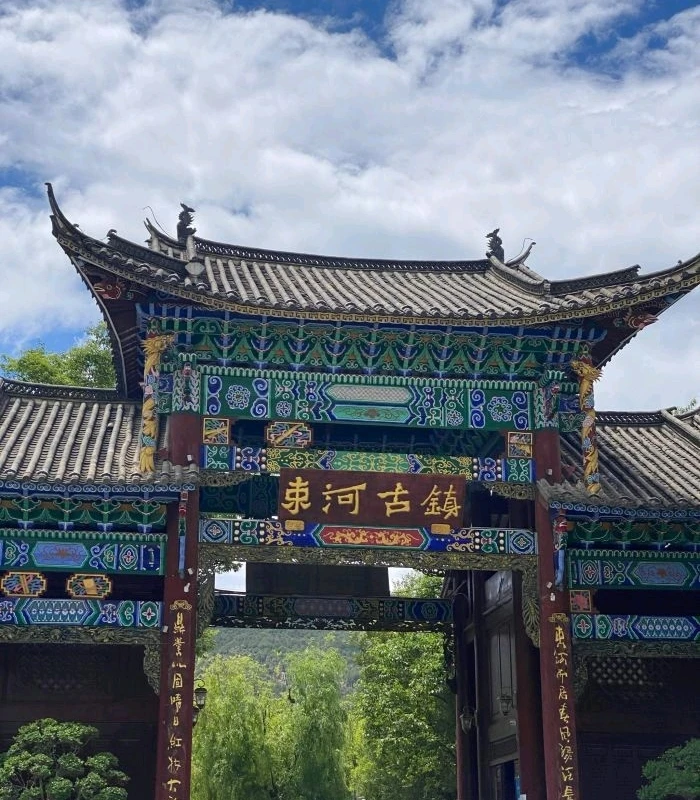
Lijiang's Shuhe and Baisha Ancient Towns: This Is What Ancient Towns Should Look Like, I'm in Love
Lijiang's three ancient towns: Dayan Ancient Town (Lijiang Old Town), Shuhe Ancient Town, Baisha Ancient Town. Lijiang Old Town—needless to say—is highly commercialized, noisy, and crowded. But Shuhe and Baisha are the opposite: beautiful surroundings, peaceful and relaxing. Comparing the three, the latter two retain more of the original charm of ancient towns.
If Lijiang Old Town is most enchanting at night, then Shuhe Ancient Town is most beautiful at dusk. 'In the setting sun, I smell the fragrance, whose girl is that? I walk onto the little bridge, you sit on the stone slab...' I can't help humming this song 'Girl by the Bridge'. At sunset, Shuhe—whether it's the flagstone roads or alleyways, the flying waters or Naxi homes, the bustling town or the quiet pastoral fields nearby—all radiates a golden glow, a pearl beneath the towering Jade Dragon Snow Mountain. I love it here, simply because it is peaceful and serene, yet gilded.
The down-to-earth bustle of Shuhe Ancient Town is what I seek. Shuhe has plenty of delicious food: many street snacks, various fruits, and occasionally you can see a kindly old lady selling vegetables.
A restaurant I stumbled upon this time truly surprised me. Passing by the entrance, I was first drawn by its ambiance, but what ultimately won us over was the food. If you go to Shuhe, give it a try!
So Lijiang also has such a quiet ancient town. Nowadays, when people talk about Lijiang, the first word they associate is 'City of Romance'. I don't know when Lijiang became linked with romantic encounters, but is that really what Lijiang is all about?
Baisha Ancient Town isn't very well-known; many visitors to Lijiang don't even know about it. So it's not a place frequented by tour groups, making it even more peaceful. Actually, it's not far from Dayan Ancient Town, about 10 kilometers, and there are direct buses from the city center. Transportation is quite convenient.
In fact, it has a long history. It is the birthplace of the Mu chieftain family, bordered by Jade Dragon Snow Mountain to the north, Longquan to the south, and Zhi Mountain to the west. Baisha is the ancient capital of the Naxi people and was once the political, economic, commercial, and cultural center of Lijiang. As the cradle of the Mu family, they accumulated experience in town planning here. As early as the Tang Dynasty, when the King of Nanzhao conferred the title 'Northern Sacred Mountain' on Jade Dragon Snow Mountain, the ancestors of the Mu family (then the King of Lijiang) began building Baisha Street and the Northern Sacred Mountain Temple here. Baisha was the ancient Naxi capital and the center of Lijiang's politics, economy, trade, and culture during the Song and Yuan dynasties, until 1383 in the early Ming Dynasty, when the Mu family moved to Dayan Town, the site of today's Mu Mansion.
Arriving here, you'll find many distinctive and charming little shops, but compared to the bustling crowds in Dayan Ancient Town, the streets here are much less crowded. You can also see many locals selling vegetables and the like; strolling here, you naturally slip into local life. Walking the streets of the old town, looking at the mottled tiles and weathered earthen walls, it feels warmer than brand-new commercial streets.
The Baisha Murals are a famous attraction here and the only one that charges an entrance fee—30 yuan. The 'Baisha Murals' are a product of the great opening-up of Naxi society during the Ming Dynasty. Their creation spanned over 300 years from the early Ming to early Qing. The late Ming and early Qing period was the golden age of Lijiang murals, which have a history of 500 years.
The existing Ming Dynasty murals in temples such as Baisha Liuli Hall, Dabaoji Palace, and Dading Pavilion are extremely precious cultural relics. The murals in Dabaoji Palace are the largest in scale among Lijiang murals, painted during the Wanli reign of the Ming Dynasty, with 12 panels depicting 167 figures. The subjects are religious, but what's special is that within the same mural, there are not only Buddhist and Taoist images but also Tibetan Buddhist figures. This fusion of different religious traditions in one painting is very rare.
Travelogue Index: 1. Shuhe Ancient Town, 2. Baisha Ancient Town. Travel Information: Hotel Index, Guide Index, Flight Index, Website Navigation, Travel Index, Cruise Index, Corporate Travel Index, Join Cooperation, Distribution Alliance, Friendly Links, Enterprise Gift Card Purchasing, Insurance Agency, Agency Cooperation, Hotel Joining, Destination & Scenic Spot Cooperation, More Joining Cooperation, About Ctrip, About Ctrip, Ctrip Hot Topics, Contact Us, Talent Recruitment, User Agreement, Privacy Policy, Business License, Security Center, Ctrip Content Center, Intellectual Property, Trip.com Group Algorithm Announcement.


