A Grand Roundup of Sights and Fun in Kunming, Lijiang, Lugu Lake, and Zhaotong
I once spent a month in Kunming, fresh out of college, when my new company sent me there for training. And because of the drama “One Meter Sunshine,” my young bestie and I went to Lijiang looking for a “holiday fling.” So, who hasn’t been to Yunnan in their youth? A huge tourist province like Yunnan still sees crowds of people flocking there every year, chasing some so-called “spiritual cleansing and return to the true self.”
I wouldn’t deliberately set aside time and money to travel in Yunnan anymore, except for a few trips like this in June 2019. Business brought me back, and I squeezed in some free time to revisit old haunts, retracing steps from my younger days, seeing the sights I’d seen before. And, of course, I wanted to tell a few honest truths and do a big roundup.
Here’s an introduction to a four-city Yunnan tour:
I’d never even heard of Zhaotong, Yunnan, before. Then people around me were like, “Zhaotong summer escape, Zhaotong apples, you don’t know?” I... After going, I learned that Zhaotong, Yunnan, is known as the “Autumn City” because it’s a famous summer retreat. At the same time, Zhaotong is the “Home of Apples,” and its “Ugly Apples” are famous for being delicious. So, escaping the scorching July heat of Chongqing, we headed to Zhaotong for a weekend getaway. Turns out Zhaotong is not just cool—the Dashanbao scenic area is stunning, and the city’s infrastructure is excellent, making it a very livable place.
**Dashanbao Black-necked Crane Nature Reserve**
Departure: Yuzhong District, Chongqing – Zhaotong City, Yunnan
Mode: Self-driving, one way: 500 km (about 6–7 hours), toll: 305 yuan one way
Tickets: Dashanbao: 98 yuan/car; Long’s Family Shrine: 10 yuan/person
Friday: Self-drive to Zhaotong, check into Jiangshan Hotel, see Zhaotong night lights, eat Zhaotong small skewers
Saturday: Dashanbao Black-necked Crane Nature Reserve, Long’s Family Shrine
Sunday: Zhaotong Museum, Wanghai Park, return trip
No backtracking!
**Zhaotong Accommodation and Night Views**
Zhaotong is over 500 km from Chongqing, making it one of the top summer destinations for Chongqing residents. They usually drive, taking about 6–7 hours. There are also direct flights from Chongqing to Zhaotong, taking just 1.5 hours.
We stayed at Jiangshan Hotel, right in the city center and very close to the barbecue street where the famous Zhaotong small skewers are sold—less than 1000 m on foot. Good value for money. The room was clean and spacious. Breakfast was varied.
On the 23rd floor of Jiangshan Hotel, there’s a rooftop cafe, as well as foot massage, wellness, chess and card rooms, and other leisure facilities. On the last night, they even gave us two well-sealed peaches, which I loved.
Zhaotong’s cityscape looks grand. The roads are wide, and the night view especially impressed me. And, like many inland people—especially Yunnan locals—who yearn for the sea, all lakes and rivers here are called “seas,” so artificial beaches are built along these “seas.” Lots of kids dig in the sand on these “sea” shores (riverbanks). Kunming does this, and so does Zhaotong.
The river-crossing bridge in Zhaotong is very creative. It was originally a dam, transformed into a bridge. There’s a musical fountain on the river. Walking on the bridge, you can see how the dam used to look, and the water levels differ on either side because of it—pretty cool. The dam no longer allows boats through, and with aquatic plants planted, it has taken on new life. The whole bridge deck uses white tiles, looking quite upscale. A statue of Confucius stands on one side of the bridge, adding a certain flavor.
**Zhaotong – Dashanbao**
Rating: 5 stars
When in Zhaotong, Dashanbao Black-necked Crane Nature Reserve is the first place to visit. As a nature reserve, it retains excellent primordial ecology, and its spectacular scale is breathtaking. It has four sub-areas: Jigong Mountain, Xianren Field, Tiaodun Lake, and Dahai Pond. The sea of clouds at Dashanbao, in particular, makes you feel like you’re in a sky mirror. Dashanbao is an hour’s drive from Zhaotong city, at 3100–3140 m above sea level, with an annual average temperature of 6.2°C. So dress warmly when going up.
We were lucky: it rained and then turned sunny the day we visited, and the changeable weather gave us a multi-layered spectacle. Clouds and mist, blue sky and white clouds—it felt like seeing two completely different Dashanbaos in one day.
Dashanbao is a wintering habitat for the black-necked crane, a first-class nationally protected species, drawing photographers and researchers from around the world, including teams from the International Crane Foundation. In 1990, Zhaotong established the Dashanbao Black-necked Crane Nature Reserve. Among the known 5554 black-necked cranes worldwide, over 1000 now winter at Dashanbao.
I didn’t catch the cranes (they come in winter) during my July visit, but the sea of clouds completely captivated me.
What makes Dashanbao romantic is the crane’s devotion: black-necked cranes are monogamous for life. If one dies, its mate will mourn itself to death—flying high into the sky and then plummeting to break its neck. This “one life, one love” has earned Dashanbao the nickname “Journey of Loyalty.”
Dashanbao offers different vistas each season; July and August are the best months to visit.
It’s also a premier spot for wingsuit flying enthusiasts, hosting an annual tournament and flying experience for challengers from home and abroad.
The classic view here is the sweeping panorama from Jigong Mountain, with a vertical drop of 2600 meters. My favorite spot in Dashanbao is the Jigong Mountain Grand Canyon, where the views are incredibly open. Jigong Mountain stands alone in the clouds, like a golden rooster perched proudly. Buckwheat flowers, oats, and patches of lush grass cover the slopes in layers, creating a dreamy, idyllic scene that softens the rugged landscape.
As a nature reserve, the ecology is well-protected; many areas look utterly pristine, with cattle and sheep roaming freely. So it’s also a paradise for photographers, who can capture spectacular seasonal shots year-round. Jigong Mountain is majestic, ideal for watching the sea of clouds and sunset, while Dahai Pond offers sunrise and cranes. You can climb Jigong Mountain for cloud seas and sunsets.
Looking out from Dashanbao, a classic grassland panorama unfolds: a huge green meadow dotted with horses and cattle, scattered small lakes—it would be a shame not to capture this heavenly scene. Local villagers sell grilled eggs and potatoes, cooked over cow dung! I tried a grilled egg—truly free-range, fragrant and delicious.
Now you tour Dashanbao by getting on a uniform sightseeing bus, costing 98 yuan/person. Set aside: a half-day or full day.
**Zhaotong – Long’s Family Shrine**
Rating: 4 stars
In my book, the No. 2 site in Zhaotong is Long’s Family Shrine, built for ancestor worship by Long Yun, the last “King of Yunnan” during the Republic of China era. The architecture blends Chinese and Western styles and deserves close examination. Construction started in 1930 and finished in 1942; it has defensive walls and Yunnan’s first tennis court. Yunnan has many ancestral halls, but this one’s design is truly unique, with East-meets-West touches everywhere. The complex includes the main shrine and residences, along with a gate tower, granary, crescent pond, garden, watchtower, tennis court, walls, and moat.
In the first courtyard, a tall three-panel screen wall is one of the largest and best-preserved in Zhaotong. Exquisite wood carvings and intricate stonework are worth studying closely. Besides living quarters, wealthy families also had ancestral halls—Confucian spaces for worshipping ancestors and sages, used for ceremonies like weddings, funerals, and celebrations. Clans also met here to discuss important matters. Descendants of the “King of Yunnan” still come back once a year.
Inside, you can learn about Long Yun’s life and his descendants. Long Yun became Yunnan’s governor after his mother’s death; in 1928, to honor her, he moved her coffin to a spot in Zhaotong, and in 1930 began building the shrine at its current site. By interpreting righteousness and filial piety, he wanted to stir family pride, belonging, and national pride, making the shrine the family’s spiritual home. Learning his story, I found him quite remarkable—indeed a famous anti-Japanese hero. The shrine’s enduring charm lies in Long Yun’s openness to both tradition and modernity, blending Chinese and Western arts, minority cultures, Confucian and Taoist ideas with rich historical tales—a reflection of his forward-thinking and inclusive spirit.
Here’s a layout of the shrine:
About Long Yun: Long Yun (1884–1962), original name Dengyun, courtesy name Zhizhou, from Zhaotong, Yunnan, of Yi ethnicity. He was a lieutenant general in the Kuomintang Army, graduated from Yunnan Military Academy, and held various military posts. In 1928 he became governor of Yunnan Province, reigning as “King of Yunnan” for 17 years until ousted in October 1945.
The shrine is a three-courtyard compound forming six courtyards, with a screen wall, gateways, halls, and main hall. The stone carving “Five Dragons Offering a Sage” adorns the front, and the main hall is a single-eave hip-and-gable roof with glazed tiles and dragon decorations on the ridge. The hall houses Long Yun’s ancestral tablets.
With such rich history, Long’s Family Shrine radiates a fascinating glow. There’s a cherry tree brought back by Long Yun’s descendants from abroad that bears fruit every year. A lotus pond sits beside Yunnan’s first tennis court.
The residential compound is a traditional siheyuan, with watchtowers at corners. The architecture is magnificent, with carved beams and pillars depicting stories, lucky beasts, antiques, and painted dragons and birds—showcasing the exquisite artistry of Yunnan woodwork, stone carving, and painting.
The guide said the pond water is changed only once a year, yet remains crystal clear. The whole shrine is enclosed by a quadrilateral “little Great Wall.”
Allow 1.5 hours. Ticket: 10 yuan.
**Zhaotong – Zhaotong Museum**
Rating: 3 stars
To know a city, start with its history. So I check out the museum in every place. The museum’s exterior resembles a big ship paired with an ancient Chinese seal, symbolizing carrying history forward and pioneering spirit. It’s the only comprehensive museum in the city, with over 16,000 artifacts. Here you can trace human civilization in Zhaotong from ancient times to today. Opened in 2011 with free admission, it spans 3722 sq m, with 13,400 sq m of building area and 6500 sq m of exhibition space. The collection includes over 500 artifacts, including 11 first-class, 10 second-class, 258 third-class, and nearly 300 general relics, plus over 2000 other items.
I reviewed the Yunnan King story again here. The museum has five halls: Ancient Footprints & Long History, Old Revolutionary Base & Red Memories, Republican Zhaotong & Bloody Anti-Japanese War, United Homeland & Ethnic Charm, and Brilliant Culture & Talents. I was surprised by Zhaotong’s deep past: human activity here dates back 50,000–100,000 years—a human tooth fossil found in a cave north of town in 1982 proved it. You can see the diversity of ethnic minorities in Zhaotong; I enjoy looking at these displays. I think Zhaotong should put its apples in the museum for everyone to learn about—that would be perfect.
Address: Middle section of Zhaotong Avenue, Zhaoyang District; Hours: Tues–Sun 09:00–17:00, last entry 16:30; Allow 1 hour; Free entry.
**Zhaotong – Wanghai Park**
Wanghai Park is built around Enbo Tower, the landmark here, originally constructed in the 25th year of Qianlong (Qing dynasty), commonly called “Wanghai Tower.” Back then, the area was a vast expanse of water, with waves lapping all around. Yunnan’s governor Ai Xing’a visited and saw willow trees swaying in the breeze, shimmering water, and reflections of Fenghuang Mountain and the tower, like a mirage. He renamed it “Enbo Tower” (“Imperial Grace Tower”) to imply the emperor’s benevolence reaching far. It burned down in the Xianfeng era and was rebuilt with donations in late Guangxu period, with added rooms, corridors, pavilions, and plants. But the two trees in front survived. I saw an old photo of Enbo Tower in the museum—look, those same two trees, so ravishing: The couplet on the gate reads: “Boundless scenes spread over the fields, willow terraces meet the phoenix.” It’s known as one of the “Eight Scenes of Zhaoyang,” the “Enbo Mirage.”
In 2010, Wanghai Park was established, restoring Enbo Tower and creating an artificial lake. It’s now a city park where locals stroll. Wanghai Tower was designated a municipal cultural heritage site in 1983. Address: At the foot of Fenghuang Mountain, Zhaotong city. Allow half an hour; free.
**Zhaotong Small Skewers and Zhaotong Apples**
When in Zhaotong, you must try the small beef skewers. These nationally popular skewers were the subject of the first episode of the documentary “A String of Life.” Here, beef skewers aren’t sold by the piece; you order by the 50s or 100s—only that way is it satisfying. We went to a stylish two-story chain brand called Saiwen Barbecue. Zhaotong has barbecue complexes of varying sizes; eating small skewers at night has become a lifestyle for locals and tourists. The skewers are made with selected yellow beef, grilled until crispy outside and tender inside—once you start, you can’t stop. Paired with Yunnan beer, the open-air night out is wonderfully down-to-earth.
While you eat small skewers there, Zhaotong has another food you can take home: apples. Zhaotong is known as the “Apple City,” thanks to its unique sunshine and soil, producing apples that are brightly colored, crisp, and richly flavored—hot sellers in the market. With nearly 80 years of apple-growing history, the Sayu Apple Base I visited is the largest apple trading hub in Southwest China; you can buy Sayu apples in Yonghui Supermarkets in Chongqing. Some call Zhaotong apples “ugly apples,” but I, a non-apple-eater, gobbled three in a row without stopping. So what if they’re a bit ugly? They taste great.
Well fed and happy, we headed home, ending our two-day Zhaotong trip.
**Kunming Chapter**
**Kunming – Haigeng Dam**
Apart from frequent flights, Chongqing to Kunming now takes just 4 hours by rail. So when I arrived in mid-May, I missed the jacaranda season that went viral, but I was still wowed by the masses of bougainvillea blooms. Kunming’s streets and alleys are draped in bougainvillea. Truthfully, Kunming doesn’t have many fun attractions except the old “Golden Horse and Jade Rooster” Archway (a shopping plaza now) and the more famous Haigeng Dam—because seagulls come here! Of course, when I went, it wasn’t seagull season. The area is open, with the dam stretching three kilometers straight along Dianchi Lake, so wide you can’t see the end. The dam is over 20 meters wide, free to enter. Every winter, countless black-headed gulls fly in from faraway Siberia, attracting millions of visitors to witness the spectacular scene.
Haigeng Dam is close to Haigeng Park. In winter, countless seagulls fly here; Cuihu Park has many gulls but a small lake, while Haigeng Park is very windy—the gulls zip about everywhere. Though we came outside gull season, the wind was really strong, howling. Dianchi Lake, by Kunming, is the hub of Kunming’s scenery, the city’s mother lake and the largest alpine lake in Yunnan, nicknamed “Pearl of the Plateau.” The dam is wide and quite long, parking is easy, and many newlyweds come for photos. During gull season, this would be nice, so spacious. Without gulls, it’s just so-so.
Right across the road from Haigeng Dam is a row of restaurants, mostly mid- to high-end, great for business dinners. Sitting in a second-floor dining room with floor-to-ceiling windows facing Dianchi, you feel uplifted, the view expansive; I swear it doubles the success rate of deals, haha. We chose Sleeping Beauty Restaurant. It’s said to be a genuine old establishment, every detail exuding refinement! Over the years, the exterior shows some patina, with climbing plants adorning the walls. The second floor and above are private rooms, requiring reservation; very discreet, perfect for banquets. Here you can order all kinds of Yunnan specialties. There’s a complimentary salad, dessert, and rice shrimp bar with your meal. Signature dishes include dry-cured beef, milk cake, and cold rice noodles. The place is lush with plants. We ordered a Yunnan specialty tofu that I just couldn’t develop a taste for. And one of Yunnan’s Eighteen Oddities: “insects”—dare you try?
**Kunming – South Asia Style First Street + Stay at Wyndham Hotel**
On this business trip, I stayed at Kunming Wyndham, right next to South Asia Style First Street. It’s actually a shopping mall. Looking at the entrance, I thought I’d been transported to Southeast Asia, but inside, the shops and street-side stores are all Chinese chain brands. The gate at night, though, photographs beautifully. Kunming’s transport is more convenient now with a metro. I remember 10 years ago there was no metro; streets were full of construction sites for it. Being a Southeast Asian-themed street, besides Kunming flavors, it has Southeast Asian snacks. The food street operates from noon till late at night. Multiple buses stop at Fuhai Village Station, right there.
This time, I stayed at Kunming Colorful Yunnan Wyndham Grand Plaza Hotel, just 50 m from the street. I checked the rates—twice as expensive as the Wyndham in Ningbo, averaging over 945 yuan/night. It’s about a 20-yuan taxi ride to Dianchi and Yunnan Ethnic Village, super close. There are plenty of dining and shopping centers nearby. The decor is Wyndham’s signature luxurious palace style. The dressing room has a mirror TV, and free hot milk is provided at night. The breakfast buffet hall is magnificent, with a huge variety. I took a photo because the purple potato congee was literally purple. I quite like having breakfast in the hotel on business trips—it’s convenient, hygienic, clean, and healthy, plus there’s so much choice. Here’s my nutritious breakfast: rich in vitamins and high-quality protein, replenishing what the body needs.
The lobby cafe is also grand. This Wyndham claims to be Yunnan’s only platinum five-star hotel—I can’t verify that. Here’s the seventh-floor restaurant. You can pick fresh seafood and have it cooked; of course, dining at the hotel is pricey.
Ten years ago, I visited the Ethnic Village. Returning after a decade, the place hasn’t changed much, but people’s travel habits have. If it keeps going like this, the village will soon become obsolete. In short, it’s a collection of 26 ethnic groups’ social and cultural flavors. Walking the whole thing takes quite a while; the site is huge, after all, cramming in 26 ethnic customs. So we decided to take an electric cart. There were exactly six of us, and the driver suggested we charter the whole cart for a hop-on-hop-off tour—300 yuan per cart for about 2 hours.
I think the first time I came, fresh out of college with little experience, and given the tourism scene back then, seeing 26 ethnic flavors in one spot was pretty interesting. But ten years on, with booming tourism and shifting markets, this old-school attraction-hopping model no longer satisfies today’s travelers. If I really want to learn about the folk cultures of 26 ethnic minorities, I’d rather go to an authentic minority settlement, not skim through an artificially built park. The village, like Shenzhen’s “Window of the World” and “Splendid China,” miniaturizes the world—a concept doomed to fade. Just like “Window of the World”: if we can now fly to Paris to see the real Eiffel Tower, why crouch to look at a tiny scale model? Outdated—this way of traveling is totally outdated! And the village ticket isn’t cheap, 90 yuan/person. At the entrance, many “guides” offer tours for 100–150 yuan/person. To be fair, the village is well-built in terms of facilities; it’s just the traditional travel mode that’s been cast off by time.
Yunnan is indeed a province of many ethnic groups, which gave rise to this concentrated theme park of 26 ethnic cultures. It includes villages and performances of Dai, Bai, Yi, Naxi, Wa, Bulang, Jinuo, Lahu, Tibetan, Jingpo, Hani, De’ang, Zhuang, Miao, Shui, Nu, Mongol, Bouyei, Drung, Lisu, Pumi, Manchu, Hui, Yao, Achang, and more, along with ethnic dance halls, squares, the Yunnan Ethnic Museum, laser fountains, water-screen movies, etc. I really like each ethnic costume; I remember donning some for photos here 10 years ago. I returned to the same spot for a photo.
I was born in the Year of the Ox, so I snapped a pic with my zodiac sign. The cart driver acted as our guide, narrating along the way and timing our drop-offs so we could catch performances in the “villages.” Guess which ethnic group? And this one? I again watched the “barefoot knife-edge walking” show. I’d wanted to experience the internet upgrade “Visit Yunnan with One Mobile Phone” in the village, but after downloading, it only showed live videos of every corner and offered ticket discounts—hardly the smart tourism that could save an obsolete attraction. So, unless it reinvents itself, the Ethnic Village is headed for extinction.
**Lugu Lake Chapter**
Of the four places in Yunnan, I liked Lugu Lake the most. It’s truly beautiful, perfect for a weekend of zoning out.
**Lugu Lake – Transport Overview**
Chongqing has direct flights to Lugu Lake, so flying there for a laid-back weekend is totally doable. The flight schedule is reasonable, and off-peak ticket prices are fair, as shown: (image description omitted). After the summer peak, round trips should be cheaper, likely under 2000 yuan per person. That’s Ninglang Lugu Lake Airport. From the airport, it’s still nearly 30 km to the lake, requiring a bus. But right from the plane, you feel Yunnan’s clarity, blue skies, and cheerful white clouds. The airport is tiny; after landing, you walk from the tarmac to the terminal. After baggage claim, a small counter sells the only official airport shuttle tickets. Since I was staying in Daluoshui Village, 30 yuan took me directly there. Two routes: Daluoshui–airport and Ninglang–airport.
The panoramic bus from airport to lake is something special—picture a glass roof and windows all around, like riding in a space capsule with 180-degree views! After about 20 km, you reach the main ticket gate of the Lugu Lake scenic area. The driver has everyone get off, buy the 70-yuan entrance ticket, then reboard and pass through the gate—now you’re officially in. As you wind down the mountain, you get a bird’s-eye view of the whole lake. It’s stunning, and the panoramic bus design is really thoughtful.
**Lugu Lake – Daluoshui Village**
Daluoshui Village (aka Daluo Water) is the earliest developed village around Lugu Lake, so staying here is convenient. There are tons of guesthouses, hotels, and inns; basically, the lakeside is all accommodation and eateries, with a strong commercial vibe. But the lake is so beautiful—maybe I lucked out with good weather on my first visit. I felt I didn’t need to go anywhere; just lying by the lake and enjoying this splendid body of water was utterly blissful. No filter needed; every shot looks like a masterpiece. Although I stayed less than a day, I absorbed the essence, very lucky.
Lugu Lake is the highest lake in Yunnan and the third deepest freshwater lake in China. Surrounding it live the Mosuo people, Yi, and Pumi. You can hire a car for a round-the-lake tour; there are some sights like Grass Sea, Lige Island, Viewing Platform, and Walking Marriage Bridge. Daluoshui has many tea houses, cafes, and inns—upstairs for lodging, downstairs for coffee.
Lugu Lake was anciently called Luku Haizi, also known as Zuosuo Sea, popularly Liang Sea. In Mosuo language, “Lu” means mountain gully, “Gu” means inside, so it’s the lake inside the gullies. The scenic area is surrounded by towering mountains, with snow covering them for over three months a year. The Mosuo revere it as the “Mother Lake,” and it’s also praised as a “Penglai fairyland.” In Daluoshui, traditional Mosuo wooden houses line the shore, many now converted into guesthouses. At night, locals don traditional dress and perform songs and dances. After the show, you can head to tents by the lake for a barbecue. Down by the lower village, a winding gravel path is flanked by Mosuo family homes turned inns; the wooden houses are pretty and distinctive, with bars, stores, and souvenir shops. At Luoshui Pier, you can even ride a horse—watching a runaway horse gallop was its own kind of fun, haha. Just strolling the lakeshore, gazing at Lugu Lake, I felt so relaxed and refreshed. Near the shore in Daluoshui are many pig-trough boats; visitors can pay for a lake cruise and visit the two small islands.
**Lugu Lake – Firewood Chicken**
When at Lugu Lake, you must try the local specialty: firewood chicken. I think any random firewood chicken joint here will taste about the same, all delicious. We ate at one called “Dear Firewood Chicken,” near our inn. They cook it on the spot, kind of like the earthen stove my grandma used when I was little. Once the fire blazes, they toss in chicken and seasonal veggies and stir-fry everything in a big iron wok. When it’s ready, it smells heavenly. Underneath, a traditional wood fire burns; in the wok, generous oil and sauce coat the chicken, then flatbread is stuck to the sides to bake. The chicken tastes fantastic; usually two or three people can share a half chicken, and with cumin and other spices, it’s sheer deliciousness. Just look at this pot—makes my mouth water all over again.
Qingke baba, also called Lijiang baba, is a tasty coarse-grain snack. Whether sweet or savory, eaten hot, it’s wonderful, and I doubt any traveler to Yunnan misses it.
Here are more beautiful photos I took at Lugu Lake—truly pleasing, never enough to see.
**Lugu Lake – Mosuo Folklore Museum**
After sleeping in, I had to head to Lijiang at noon the next day. I’d planned to visit Grass Sea in the morning, but a downpour made me go to the nearby Mosuo Folklore Museum instead. It’s a private museum run by local Mosuo people, charging 30 yuan. It was co-founded by villager Weng Jici·Erqing and his friend Ruh Heng·Ciren Duoji, the only museum in China reflecting the matriarchal societal customs. Inside, you’ll find a flower house of the Mosuo women’s kingdom style, a grandmother’s house, a scripture hall, artifact gallery, photo materials, and exhibition halls themed on world intangible cultural heritage. The ticket includes a guided tour. I happened to join a group of four post-90s travelers, forming a squad of five—otherwise, the staff might not have bothered with just me, haha.
If a local takes you in, entry is free. There’s a flower-climbing performance (canceled due to the rain when I went). It’s a decent place to learn about Mosuo culture. The Mosuo are the ethnic group living by Lugu Lake; wooden buildings are their distinct architecture, with a fire pit for cooking, and bacon hung nearby, slowly smoked over the years. The wood carvings in the wooden houses are quite special. The museum is built entirely of logs in a traditional two-story Mosuo style, with a continuous circular corridor on the second floor. But there’s a medicinal herb section—beware: they tout a family herbal tradition and try to con you into buying wild gastrodia (which are actually cultivated). I caught on and left right away.
Here, I learned the “walking marriage” custom. Walk marriage is a unique Mosuo practice in Yunnan and Sichuan. Mosuo society is matriarchal; apart from a few who marry for additional labor, essentially there’s no marriage system. It’s a bond between lovers: men visit women’s homes at night to maintain relationships and produce offspring. Because women head the household, children belong to the mother’s family; the biological father publicly holds a feast when the child is one month old to acknowledge the blood tie. Men call their lovers “A Xia,” women call theirs “A Zhu.” During the day, men and women rarely interact alone; they express interest at gatherings through singing and dancing. If a man fancies a woman, they arrange to meet, and at midnight he goes to her “flower house” (individual room for adult Mosuo women, separate from the grandmother’s house). Traditionally he comes on horseback, doesn’t use the main door, but climbs in through the window, then hangs his hat outside as a sign, telling others not to disturb. He must leave before dawn, this time allowed out the front door. Leaving after sunrise or after the woman’s elders are awake is considered rude. I left after about half an hour.
Address: Luoshui Village, Ninglang Yi Autonomous County, Lijiang, Yunnan; Hours: 8:30–16:00; Price: 30 yuan/person.
From Lugu Lake, I took a bus to Lijiang, about 3–4 hours one way. Along the road, I passed a scenic area whose name I’ve forgotten, but it was lovely:
**Lijiang – Lijiang Old Town**
My second time in Lijiang, there’s now an entrance fee called the Old Town Conservation Fee: 50 yuan. Right inside, the big waterwheel is still there, and that same dense row of wishing plaques. Same spot, another photo. Lijiang Old Town is heavily commercialized now—just walk and it’s all shops, selling either services or tourist goods. I find this style a bit outdated; really, who needs to buy that much? The location is fantastic, and with Yunnan’s signature blue sky and white clouds, it gives off a great vacation vibe. Perfect harmony of nature and man makes Lijiang the poster child of “slow living.” There’s no need to seek anything special; just leisurely roam, eat, drink, maybe buy a bit, and that’s it. The old town is packed with guesthouses; staying inside is a different flavor. Some spots within still charge separate entry.
This time we visited a paid site inside: Lion Hill. Near the entrance to Lion Hill is an Instagram-famous spot because it overlooks the whole old town, so many cafes have sprung up here. This photo of the panoramic old town was taken from one such cafe. Lion Hill is the highest point in Lijiang Old Town, hence the full view. Sipping coffee by the window, gazing at the golden old town under the sun, it’s actually quite pleasant.
**Lijiang Old Town – Lion Hill**
Lion Hill is so named because it resembles a sleeping lion. The old town’s buildings spread along the foothills, making it the best spot to view the full panorama. Ticket: 35 yuan. To enter, you climb a flight of stairs to Wangu Tower. Before climbing, let’s first snap the panoramic town. Because it’s a paid spot, not many tourists come.
Wangu Tower is a five-story, five-eaved all-wood pavilion-style structure. It’s the landmark of Lijiang, 33 meters high, with 16 main pillars that run through 22 meters to the top—China’s first all-wood tower with single pillars spanning the full height without joints. Going inside takes you to the highest, highest point in Lijiang, offering 360-degree unblocked views in all four directions.
Wangu Tower is at the back of Mu Mansion (part of it), the estate of the Mu clan, Lijiang’s native chieftains. The 33 meters symbolize the 330,000 people of the former Lijiang Naxi Autonomous County. Inside the park, there’s Chongcui Pavilion, Heavenly Pool, and other spots, plus commemorative groves. The southern side near the river has a faux-ancient gate. The 22-meter pillars reflect the folk saying “good things come in pairs” and the custom of choosing even-numbered days for weddings. There are 2300 auspicious designs painted inside—representing the 23 stone carvings of Lijiang, meaning favorable weather and bountiful harvests in all seasons. The number of carved and painted dragon patterns reaches 9999, plus a coiling dragon in the ceiling caisson, totaling ten thousand dragons—standing for eternal prosperity and meaning Lijiang is a beautiful homeland for descendants of the dragon.
The tower’s footprint is square, 18 meters wide and 18 meters deep, with four pairs of expressive stone lions at the entrances. The 16 through-pillars reflect the Naxi Dongba pictographic myth of nine brothers creating the sky and seven sisters creating the earth, symbolizing Naxi children jointly building a beautiful world. The murals inside are lovely. “Wangu Tower” in Dongba script means “thousand-year, ten-thousand-generation tower,” and in Naxi, “vun gv lv,” meaning to enjoy the view from the summit; hence the phonetic name.
To the north you can see the distant Jade Dragon Snow Mountain, the old town below, and new Lijiang; to the south are Naxi villages and pastoral fields. I still climbed to the top of Wangu Tower to see the highest panoramic view, mainly for a glimpse of Jade Dragon Snow Mountain. There are six floors. Ticket: 35 yuan; Time: 0.5–1 hour; Location: inside Lijiang Old Town.
Right at the base is an internet-famous cafe. Because it’s so close to Lion Hill, you can of course see the old town panorama. Influencers usually pose on the second-floor “First Viewing Platform” for artsy photos. Keep wandering through Lijiang Old Town. A photo with a minority ethnic beauty in the old town.
**Lijiang Old Town – San Qian Er (叁杄二)**
This is a combo tea and milk tea shop I visited—called San Qian Er. It’s on East Street, less than 100 m into the old town, with two floors. Everything follows a branded approach, with a green color scheme. On the ground floor left is the operation area, a display case for drinks and pastries, a fresh tea room, and a free tasting area. The second floor is a lounge. The display area on the first floor neatly presents various tea products. I bought a tea in book form—one of their “tea book” series—plus six small sachet packs as gifts. Spending a certain amount, I got a beautifully packaged tea gift box (for myself). All for just over 300 yuan, and they can issue an invoice and ship the goods home, so I didn’t have to carry them. The shop also has World War II military motifs, giving it a distinctive flair. The second-floor decor leans ethnic, with colorful canopy fabric over the ceiling, quirky lamps, and bean bags, creating a very cozy, relaxing space. According to the introduction, their “Hump” Selected Black Tea comes from the 3200-year-old tea ancestor trees in Fengqing, Yunnan, a historical origin. From the second-floor window, you get a layered view of Lijiang Old Town. The product area’s highlight is the tea book series—many types: Love Diary, Adam & Eve, Flying Tigers Commemorative Edition, Hell’s Angels, Panda—each with its own character, perfect as a presentable gift, and the price isn’t a rip-off. The sales clerk was enthusiastic and patient, introducing each tea’s features and price. There are also many desserts, reasonably priced. It’s rare to see such a standardized, branded afternoon tea and dessert shop in Lijiang Old Town. Spending: 6.6–70 yuan/person. Address: No. 85, Jishan Lane, Xinyi Street, Dayan Sub-district, Gucheng District, Lijiang (stores 13-15, East Street).
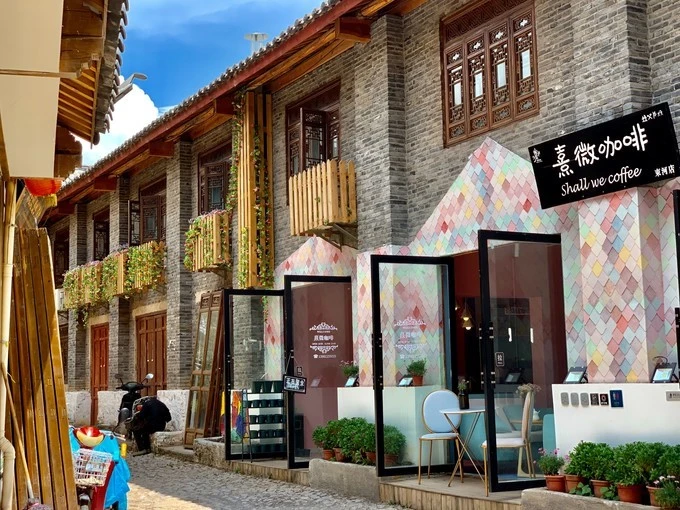
**Lijiang Old Town – Dayan Flower Alley**
Dayan Flower Alley is a new attraction being developed in Lijiang Old Town. It’s an ancient alley integrating Yunnan characteristics, intangible heritage, cultural creative brands, and in-depth experiences—Snowell Culture & Tourism’s first themed tourist town in Yunnan. Basically, you come here for performances. Stripping away the old town’s chaotic, noisy commercial jumble and pouring pure Naxi traditional crafts, food, music, dance, rituals, tea ceremony, jade culture, etc., into the town gives it a refreshing feel. Inside the town, you can experience these: “Encountering Lijiang—The Eternal Caravan” show; “Encountering Lijiang—Caravan Legends Prequel” show; “Caravan Return” Long-table Banquet. The “Eight Bowls” dishes of the long-table banquet were listed as Lijiang’s first batch of intangible cultural heritage in April 2005, embodying Lijiang’s culinary culture and ethnic essence, using locally sourced ingredients and simple cooking methods. Moreover, visitors can watch the street performance “Caravan Return” while dining, sitting and interacting with the caravan actors, soaking in local customs. Yunnan’s gesang flowers really thrive! The tie-dye overhead looks rather beautiful against the blue sky. This staircase is in Lijiang Square, where a signature Naxi-style archway stands. It’s said that to build this archway properly, top Naxi master artisans were specially invited and poured their hearts into it, just to restore the true Naxi flavor. Here, there’s a viewing platform called “Lijiang Eye.” It’s quite pretty, offering another partial panoramic view of the old town. Looking down, you see a dense sea of rooftops stretching endlessly, overlooking the entire Naxi ancient village. In the distance, Wangu Tower stands out clearly, looking exceptionally graceful amid the surrounding green.
**Lijiang Old Town – Caravan Cuisine**
The “Eight Bowls” of the Caravan Long-table Banquet were inscribed as Lijiang’s first intangible cultural heritage in April 2005, distilling Lijiang’s food culture and ethnic essence. They use original Yunnan ingredients, prepared in native, simple ways, resulting in rich, mellow flavors. Dayan Flower Alley’s “Encountering the Caravan” themed restaurant serves authentic Tea Horse Road flavors. The decor mimics a rustic caravan style; the ingredients are the most pristine Yunnan produce; the cooking follows time-honored caravan methods, combining to form a “Tea Horse Road on the tip of the tongue.” I learned that the chef is a descendant of a caravan’s designated cook, overturning my previous impression that caravan food was merely native chicken hotpot—I truly tasted the rugged romance of that ancient trade route. Drink the strongest liquor, eat the most authentic caravan food.
**Lijiang Old Town – Fang Guoyu’s Former Residence**
Right in Lijiang Old Town, inside a key protected residence on Wenzhi Lane, Wuyi Street, with over 70 rooms. Over 1 million yuan was reportedly spent restoring it. Staff went to Kunming and Beijing to track down many of Fang Guoyu’s old friends, students, relatives, and alumni, gathering a wealth of personal items. The residence is divided into eight sections: Path of Study, Diligence Study Studio, Fang Family, Residence Architecture, Academic Achievements, Social Activities, Mourning and Remembrance, and Fang Family School. Fang Guoyu (1903–1983), courtesy name Ruicheng, was a native of Lijiang, of Naxi ethnicity, and a renowned 20th-century historian, ethnologist, bibliographer, linguist, and educator. His name sounded familiar, but I couldn’t quite recall who he was; I toured the house in just 15 minutes.
Fang Guoyu’s former residence is a nearly 200-year-old historic home, divided into upper and lower courtyards. From the street, you first see a fan-shaped arched gate, with a white plaque bearing green characters reading “Fang Guoyu’s Former Residence.” Through the second gate hangs a Qing-era plaque “Shigong Di” (Honored Place). The two courtyards are connected by steps, each forming a “three-bay with a screen wall” layout, with small gardens behind the east and west main buildings—little worlds of their own. In the central hall stands a bronze statue of Fang Guoyu. The six exhibition rooms display over 200 photos from different periods of his life and more than 120 artifacts including manuscripts, monographs, writing brushes, and furniture.
Address: No. 32, Wuyi Street, Gucheng District, Lijiang; Type: Celebrity former residence; Ticket: free.
**Lijiang – Jade Dragon Snow Mountain + Yak Meadow + Blue Moon Valley**
Usually, almost all tourists pick the classic day trip: Jade Dragon Snow Mountain Glacier Park + Blue Moon Valley + “Impressions of Lijiang” show. Most typically, people go up to Glacier Park at around 4500 m altitude on Jade Dragon Snow Mountain. But we arrived so early, with fog still thick, we chose to go halfway up via the Yak Meadow cable car. Jade Dragon Snow Mountain is really a massive area. There are also some tourist routes that take you to Yak Meadow by cable car—I advise caution when booking day tours. Generally, if they put you on the Yak Meadow cable car, you won’t actually reach the snowy part of Jade Dragon Snow Mountain; you’re still some distance away, and there’s no snow. On the morning we went, the fog was so dense you only saw the tips of the mountain.


