Having Seen Countless Scenes, Yet Lijiang Alone Dwells in My Heart
Lijiang is that place in my heart; no matter how many times I visit, I never tire of it. It's become routine for my bestie and me to plan Yunnan trips whenever we can. What starts as a one-week itinerary always stretches to over ten days. So, what's so fun here? Everyone has their own Lijiang, each carrying a different meaning. I love Lijiang's slow rhythm. I once dreamed of opening a guesthouse here, a dream that has gradually faded, but every time I come, I still find a favorite courtyard to zone out and soak up the sun. In recent years, I've kept heading to Yunnan, always spending a few days in Lijiang. This season, the mornings and evenings are still pleasantly cool, and flowers in the courtyards bloom exceptionally well. After dinner, I stroll through the old town. Though it's not the peak tourist season, the streets are still bustling with visitors. I rise early, and a bowl of rice noodles at the guesthouse fills me with energy. There's a cherry tree in the courtyard, its red fruits hanging temptingly. I wanted to pick a few to taste, but all reachable ones had already been plucked by other guests.
Lijiang Old Town is located in Gucheng District, Lijiang City, Yunnan Province, in southwestern China. It sits in the middle of Lijiang Dam, on the Yunnan-Guizhou Plateau. Despite its high altitude, snow-capped mountains are visible year-round, and the four seasons are distinct. Thanks to its convenient transport links, Lijiang serves as a necessary transit city for destinations like Shangri-La, Lugu Lake, and Dali. The streets of Lijiang Old Town are built along the mountains and rivers, paved with red breccia, and feature attractions like Sifang Street, Mu's Residence, Wufeng Tower, the Big Waterwheel, Baisha Residential Complex, and Shuhe Residential Complex. What we usually call Lijiang Old Town actually refers to Dayan Old Town.
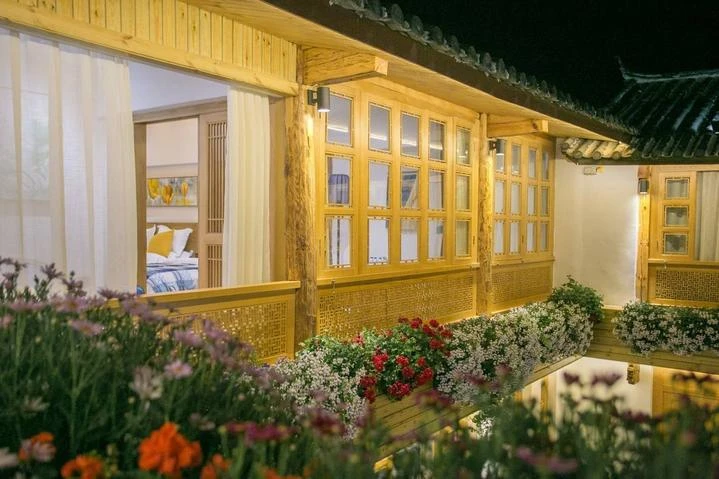
Dayan Flower Lane is a lively street in the old town, with a stream flowing gently from top to bottom. During holidays, flowers are placed on both sides, creating a special scenic line. I remember last time I came to Lijiang, I was in this very courtyard. Waking up early, I saw a different view: the sun turning the snow mountains crimson, then light slowly spilling over the old town, waking up the flowers. That's probably the feeling of the old town's warm light and the refreshing mountain breeze. That day, my friend and I got up early and climbed to the rooftop to watch the sunrise. Seeing the sun paint the snow mountains red, I didn't even need to worry about overexposed backgrounds in photos—just felt content. The datura and roses in the courtyard bloomed exceptionally well; I so wish I had such a large garden. For photos, early morning and evening are best. There's a crystal ball on the rooftop where you can sit and wait for the sunset. With luck, you might even encounter a pink twilight.
Lijiang Old Town is actually quite large, and every alley looks pretty similar. First-timers can easily get lost. There are thousands of guesthouses alone; if you don't figure out the directions, hauling a suitcase over the bluestone pavement is a real struggle. I had planned to wait for a sunset, but after a long while, nothing appeared. However, as night fell, the sky turned deep blue, and the old town's lights lit up one by one. Songs drifted from the bar street, and Lijiang, just beginning to glow with lanterns, became even more enchanting. Coming down from Wenchang Palace and wandering the old town, my friend and I stumbled upon a little clothing boutique. Unlike the ethnic style seen everywhere else, finding clothes I liked here felt like a stroke of luck. Every time I come to Lijiang, I see billboards advertising 'Lijiang Eternal Love—a must-see performance once in a lifetime.' Though the ad seemed over the top, it had piqued my curiosity. With rainy weather and nothing to do, the guesthouse owner recommended my friend and I go watch the Eternal Love show. With time on our hands, we decided to check it out. The Lijiang Eternal Love scenic area is only about 6 km from the old town, a half-hour taxi ride. Ticket: 280-360 yuan/person. Opening hours: Weekdays 13:00–20:30; holiday periods may adjust. Showtimes for 'Lijiang Eternal Love': usually two shows: 16:30 and 19:30. 'Love Song of Lijiang' daily at 17:30 (due to weather, shows may change, be delayed, or canceled without prior notice; please refer to the day's park announcement).
The shops here are quite unique, featuring almost all the specialty stores found in Dayan Old Town. If you arrive early, it's worth a stroll. The Ancient Tea Horse Road is one of the world's most spectacular and culturally mysterious hiking routes in the southwest, beloved by many outdoor trekkers. Starting from the Dai village in Xishuangbanna, it passes through Lisu Village, Tea Horse Ancient City, Mosuo Village, the horse caravan camp, Wa Village, and finally reaches the endpoint at Nacuo Village. Now, Eternal Love condenses the essence of this route onto the path we walk, transporting us back to those prosperous times. The wooden bridge, hung with wishing bells and ribbons, matched our outfits that day, so my friend and I snapped photos on it. The scenic area also has Xishuangbanna-style architecture, great for photo ops. Upon entering, pick up a program guide at the gate; different zones have different shows. The ten major outdoor performances are mainly concentrated around the Caravan Square, Eternal Love Cultural Square, and the Dai Village. These include 'Laughing Capture of Liu Yidao,' 'Street Acrobatics,' 'Hanging by a Thread,' 'Street Singer Performance,' 'Climbing Knife Mountains, Diving Fire Seas,' 'Mu's Residence Son-in-Law Recruitment,' 'Time-Travel Flash Mob,' 'Wa Village Joyful Songs,' 'Shadow Puppetry,' and 'Wa Fire Spitting,' performed sequentially in the park. We seemed to have missed quite a few while playing in the little shops. I spotted a cute tie-dye pouch and really liked it. When I was young, there weren't many entertainment options, and peep shows were a luxury. I never expected to see one here. The peep show master was quite the character, putting on a lively performance to attract tourists. 'Lijiang Eternal Love' is the core product of the Lijiang Eternal Love scenic area, meticulously created by Songcheng Performing Arts, China's first listed performance company. Themed around Lijiang's ethnic and regional culture, the large-scale song-and-dance performance 'Lijiang Eternal Love' showcases Lijiang's millennia-old culture and historical charm. The homecoming scene stirs both joy and sorrow; when the next transport mission arrives, the women once again bravely see off their husbands. The ancient road, touched by modern winds, sees generation after generation of horse caravans enduring. The Tea Horse Road, hailed as the 'Southern Silk Road,' is a civilization route of economic and trade exchange between southwestern Chinese ethnic minorities and foreign lands. Today, Lijiang, a unique transit hub on the ancient Tea Horse Road, welcomes a splendid gathering of Han and minority cultures, merchants, and trade, with music and dance everywhere. Green lights resemble a time tunnel, and a pair of Naxi men and women dance gracefully, their beautiful movements appearing and disappearing amid the lavish stage design. After over an hour, the performance left me longing for more. For me, Eternal Love far exceeded my expectations; the storytelling framework, stage design, and the actors' brilliant performances were all impeccable. We lingered a bit too long, and by the time we got to the Mu's Residence son-in-law recruitment, the show had already ended. A friendly reminder: be sure to check the performance schedule when you come, so you don't miss the great shows. The combination of a fortune-teller and Jigong was quirky enough; my friend and I squeezed in to take a group photo with them, causing a bunch of tourists to line up behind us. Back in the old town, it was very late. After a full day at Songcheng, I was reluctant to leave. Next time, I'll bring my parents to see it.
The summit reachable by cable car is still a few hundred meters from the highest point. From here, you need to hike up; on the surface, this distance looks deceptively gentle. Weather is crucial for visiting Jade Dragon Snow Mountain, and today offered blue skies and white clouds—I felt my luck was on point. The snow wind was so strong it stung my face, and clouds atop the snowy peak raced by in the wind. The afternoon itinerary of the mountain day trip took us to Blue Moon Valley at the foot of the snow mountain. The first time I heard the name Blue Moon Valley, I thought it was so poetic. It was formerly known as the 'White Water River.' On sunny days, the water appears blue, and the valley is crescent-shaped, so from afar, it looks like a blue moon inlaid at the foot of Jade Dragon Snow Mountain—hence the name Blue Moon Valley. There are several waterfalls like this in Blue Moon Valley. Some say it's a mini Jiuzhaigou; with its crystal-clear water, it does have a touch of Jiuzhaigou feeling.
Shuhe Ancient Town, called 'Shaowu' in the Naxi language, gets its name from the mountain behind the village, whose shape resembles a piled-up peak. The name evolved to mean 'village beneath the high peak.' It was one of the earliest settlements of the Naxi ancestors on the Lijiang plain and is a well-preserved important market town on the Tea Horse Road. Shuhe is relatively quiet; if you have time, it's best to stay a few days. The Tea Horse Road Museum is part of the Ming Dynasty Mu chieftain's 'Shuhe Courtyard' complex, housing six murals. Like the Baisha murals, they are precious surviving examples of Ming Dynasty murals in Yunnan, listed as provincial cultural relics. The museum inside focuses on Tea Horse Road culture, local Shuhe customs, and Pu'er tea culture. Several courtyards have this little wooden horse; the owner says it was sourced from Thailand and has become a symbol of Tinghuatang (Listening to Flowers Hall). Last time I took a photo, I accidentally loosened the horse's tail and dared not tell the owner. This time, I found the tail had already heroically perished. My friend and I sipped tea and basked in the sun in the courtyard—stealing a half day of leisure. When I came last year, these flowers had just been planted; this year they're thriving so beautifully. I have to say, time flies. Unfortunately, there were no rooms available this time. Sitting on the rooftop terrace and gazing at the stars—that's probably the most romantic thing to do. Near Shuhe Ancient Town, there's a place called 'Corner of Paradise,' perfect for photography. My friend and I loved it. Entrance is 20 yuan per person; you can take a taxi and spend an afternoon there. Many small photo-friendly spots have been designed here, and for photography enthusiasts like us, it's fantastic. The stone walls are typical of original Lijiang architecture; Corner of Paradise also has a few such backgrounds. I've been to Shuhe many times, and each time brings different scenery. Next to Feishui Chuhua (Flowing Water Touching Flowers), there's a restaurant called Xiaoguofan. My friend raved about their copper pot rice, so we tried it this time. Every meal brings new surprises; this time, the Snow Mountain Shrimp Balls amazed me, and the copper pot rice was as delicious as ever!
Baisha Ancient Town - What I picture old Lijiang to be. The town isn't large; you can finish strolling in just half an hour, with its ancient archways and grid-like streets. Most shops here are run by Naxi locals, so it lacks the commercial feel of Lijiang Old Town. In Baisha, there are several batik dyeing workshops, with prices ranging from tens to hundreds of yuan. Every time I visit, I love photographing these colorful dyed fabrics. About ten kilometers north of Lijiang Old Town, at the southern foot of Jade Dragon Snow Mountain, lies a village called 'Wuluken,' meaning 'village at the foot of the snow mountain.' Legend says that deer herders lived here, preserving a traditional lifestyle and enjoying the blessings of the snow mountain. After many visits to Lijiang, Yuhu Village is a place I often miss. From Yuhu Village, it's a 10-minute walk to Yuhu Lake. Actually, Yuhu is a reservoir at the foot of the snow mountain, but it's also a mecca for photography; many wedding photographers love to shoot here. Qingxi Reservoir is on the northern outskirts of Lijiang, a spot I always pass on the way from Dayan to Shuhe. It's also one of Lijiang's drinking water sources. Last autumn, I came here and took some photos I really liked. I never imagined visiting a place like this as a scenic spot; it's not officially a scenic area, but it surprised me more than any designated site, so I recommend it. In the morning, the dam of Qingxi Reservoir is filled with locals exercising. Ordinary tourists don't come here, but you can really feel the pulse of local life in Lijiang. Every trip to Lijiang brings new discoveries, and this time, Qingxi Reservoir was a delight. On the road of travel, luck and regret often go hand in hand, which makes every unexpected find all the more cherished. The 'Yunduan Bilan Club' (Cloud's End Other Shore) is quite famous in Lijiang. Visiting it with a friend opened my eyes to how people typically experience Lijiang trips. What surprised me about Lashihai was not the resort, but a little spot right outside the wetland park's entrance. Driving to Lashihai Wetland Park, we were stopped far from the gate; a young man told us we had to park outside. After parking, we walked half an hour just to reach the ticket office. That guy could have been upfront about the parking fee—so inconvenient. After buying tickets, the scenery inside was mediocre. Coming out, we saw many people shooting wedding photos, and only then realized the most beautiful scenery was right at the entrance—no ticket needed at all.
Travelogue Contents: 1. Lijiang Old Town 2. Lijiang Eternal Love 3. Jade Dragon Snow Mountain 4. Blue Moon Valley 5. Shuhe Ancient Town - The Most Beautiful Time 6. Baisha Ancient Town 7. Yuhu Village 8. Qingxi Reservoir 9. Lashihai 10. Zhiyun Chan Temple Travel Information Hotel Index Guide Index Flight Ticket Index Website Navigation Travel Index Cruise Index Corporate Travel Index Join Cooperation Distribution Alliance Friend Links Corporate Gift Card Purchase Insurance Agency Agent Cooperation Hotel Joining Destination & Scenic Area Cooperation More Join Cooperation About Ctrip About Ctrip Ctrip Hot Topics Contact Us Careers User Agreement Privacy Policy Business License Safety Center Ctrip Content Center Intellectual Property Trip.com Group Algorithm Announcement


