Yunnan's Most Classic Hiking Routes – Tiger Leaping Gorge, Meili Snow Mountain, and Yubeng Trek (Summer Edition Guide)
Around Lijiang there are many classic hiking routes, such as the Tiger Leaping Gorge trek, the Lugu Lake to Yading trek, the Meili Snow Mountain Yubeng trek, and the Jade Dragon Snow Mountain trek. However, if you’re looking for a route that combines spectacular natural scenery with rich cultural charm, the Tiger Leaping Gorge and Meili Snow Mountain Yubeng trek is probably the best choice. Tiger Leaping Gorge, Meili Snow Mountain, and Yubeng are already so famous that they need little introduction. Tiger Leaping Gorge was named one of China’s ten most classic hiking routes back in the 1990s, while the Yubeng trek has gained immense popularity among outdoor enthusiasts over the last decade. Besides the breathtaking natural landscapes, the region’s religious and cultural atmosphere is another major draw for backpackers. Below is a summer photo travelogue and guide put together by our team leader, which can serve as a reference for hikers planning this route. Itinerary from Lijiang to Meili Snow Mountain and Yubeng: D1: Lijiang – First Bend of the Yangtze – Benzilan – Baima Snow Mountain – Feilai Temple D2: Feilai Temple – Lancang River Grand Canyon – Xidang – Nanzong Pass – Yubeng Village D3: Yubeng – Xiaonong Base Camp – Ice Lake – Upper Yubeng D4: Upper Yubeng – Sacred Waterfall – Lower Yubeng D5: Yubeng – Ninong Grand Canyon – Yila Grassland – Moonlight Ancient Town – Shangri-La D6: Shangri-La – Tiger Leaping Gorge – Lijiang
Day 1: Lijiang – First Bend of the Yangtze – Benzilan – Baima Snow Mountain – Feilai Temple Since the main destinations are Meili Snow Mountain and Yubeng, many people don’t want to waste time on the road and are eager to see the sacred Meili Snow Mountain right away. In the past, this would have been nearly impossible, but in recent years the road from Lijiang to Meili Snow Mountain has been greatly improved, with many bridges and tunnels built, significantly shortening the travel time. Normally it takes six to seven hours; with stops for sightseeing and photos, you can still reach Feilai Temple before dark. Starting point: Lijiang Ancient Town. From any corner of Lijiang, you can look up and see the towering Jade Dragon Snow Mountain. When you first arrive in Lijiang, Jade Dragon seems extremely impressive, but once you see Meili Snow Mountain, it will pale in comparison.
As for Lijiang Ancient Town at the foot of Jade Dragon Snow Mountain, its fame has long spread far and wide. However, negative news about it has also emerged in recent years. More and more travelers now use Lijiang merely as a transit point rather than a main destination—a launching pad for trips to Shangri-La, Lugu Lake, Meili Snow Mountain Yubeng, or even Tibet.
On the way from Lijiang to Shangri-La, you’ll pass two important sights: the First Bend of the Yangtze and Tiger Leaping Gorge. The mighty Yangtze River flows down from the Qinghai–Tibet Plateau, becoming the Jinsha River as it enters Yunnan. It weaves through the high mountains and deep valleys of the Hengduan Range alongside the Nujiang and Lancang rivers, creating the magnificent Three Parallel Rivers landscape. At the border between Lijiang and Shangri-La, the river suddenly makes a sharp turn of more than 100 degrees, heading northeast and forming a rare V-shaped bend. “Here the river reverses its course, rushing into the Central Plains in a grand spectacle” — this wonder is known as the First Bend of the Yangtze.
Between Lijiang’s Jade Dragon Snow Mountain and Shangri-La’s Haba Snow Mountain lies a vast gorge, one of the world’s deepest and most famous: Tiger Leaping Gorge. But as mentioned, Meili Snow Mountain and Yubeng are the focus of our trek. To conserve energy, we recommend placing Tiger Leaping Gorge on the return journey rather than hiking it on the first day. We will cover Tiger Leaping Gorge in detail on the last day.
After passing Tiger Leaping Gorge, you enter Shangri-La, officially stepping into the Tibetan region. The first stop is Xiao Zhongdian in Shangri-La, where a vast sea of alpine rhododendrons in full bloom will surely make you linger and forget to leave.
On the way to Xiao Zhongdian, you’ll catch sight of the second snow mountain en route to Yubeng — Haba Snow Mountain. In the Naxi language, Haba means “flower of gold.” Formed by the intense uplift of the Himalayan orogeny and subsequent Quaternary tectonic movements, Haba rises to 5,396 meters. Although 200 meters lower than Jade Dragon Snow Mountain, its snow line is lower, making it appear even more imposing. It is an entry-level peak for summit attempts.
Shangri-La sits at an altitude of 3,300 meters, with long, cold winters. In summer, the grasslands have cast off their thick winter coats, and everywhere near and far, the landscape is vibrant and full of life. The pastures are ablaze with wildflowers competing in beauty.
This is Napahai, a highland wetland lake in Shangri-La. In fact, Napahai and Yila Grassland are connected. During the rainy season, when water is plentiful, much of the grassland is submerged, turning it into a lake. In the dry autumn and winter, with less water and more grass, the lake recedes and becomes grassland again.
In spring, from May to October, new species of wildflowers bloom nearly every ten days in Shangri-La. The flowers bloom freely and profusely, covering the grasslands like a floral carpet — a sea of flowers everywhere. Whether you are on a chartered car or self-driving along the Yunnan–Tibet Highway, you can enjoy the blossoms along the way.
Along the Yunnan–Tibet Highway, you can also see the largest Tibetan Buddhist monastery in Yunnan — Songzanlin Monastery. Since most people focus on the Yubeng trek, it’s common to just gaze at Songzanlin from the roadside. Those interested in Tibetan Buddhism can schedule a special visit on the return trip.
After passing Songzanlin Monastery, continue driving along the Yunnan–Tibet Highway for about an hour to reach Benzilan, an important town on the ancient Tea Horse Road. Benzilan lies on the banks of the Jinsha River, facing Ganzi in Sichuan across the water. The scenery here is nothing particularly special, but its geographic location is crucial — it is a vital post station before crossing Baima Snow Mountain. In the past, horse caravans would rest and replenish here before tackling the great snow mountain. When we arrive, it is usually around noon, so most people have lunch in Benzilan before crossing Baima Snow Mountain.
After lunch, drive about twenty minutes from Benzilan and you will see the big bend of the Jinsha River — Moon Bay. Since it is summer and the rainy season, a lot of muddy water flows into the river, so Moon Bay appears red at this time of year.
From Benzilan, the altitude steadily rises along the Yunnan–Tibet Highway until you reach the Baima Snow Mountain Nature Reserve. Along the roadside, you can see the towering, majestic Baima Snow Mountain under the blue sky. This stretch of road exceeds 4,000 meters in altitude — the highest highway in Yunnan on the way into the Tibetan region.
In summer, Baima Snow Mountain is also covered with vibrant alpine rhododendrons, creating a stunning tableau of white snow peaks alongside brilliant flower seas.
This is the new marker at the Baima Snow Mountain Pass, its 4,292-meter altitude standing out vividly against the blue sky. It is the first snow mountain pass above 4,000 meters on the Yunnan–Tibet Highway.
After crossing the 4,292-meter pass, the road descends all the way to Deqin County at 3,400 meters, the highest county town in Yunnan. You may not have a strong impression of this ordinary Tibetan county, but it is home to the highest peak in Yunnan — Meili Snow Mountain. With its majestic shape and profound religious significance, Meili Snow Mountain holds a pivotal place among the sacred mountains of the Tibetan region and has been an important pilgrimage site for Tibetan Buddhists since ancient times.
Arriving at Feilai Temple around dusk, if you are lucky, you may witness a spectacular sunset over Meili Snow Mountain. But what is even more eagerly anticipated is the brilliant starry sky over Meili Snow Mountain at night.
To enjoy the magnificent Meili Snow Mountain, most people choose to stay at Feilai Temple. At an altitude of 3,500 meters, the air is clear and visibility is excellent — ideal conditions for astrophotography. Star photography generally starts after 10 p.m., when the highland night has completely fallen. Head to the rooftop of your hotel; when you look up at the sky filled with countless stars, the awe is no less than seeing the golden sunrise on the mountain the next morning.
In addition to good weather conditions, photographic equipment is also crucial for shooting the starry sky. A DSLR camera is a must, along with a tripod. If you want to capture star trails, a remote shutter release is necessary. Once you set up your tripod and adjust the parameters for star photography, a masterpiece is born when you press the shutter and wait a few seconds. If the first shot isn’t perfect, try a few different combinations of shutter speed and exposure — you’re bound to get a stunning starry-sky photo.
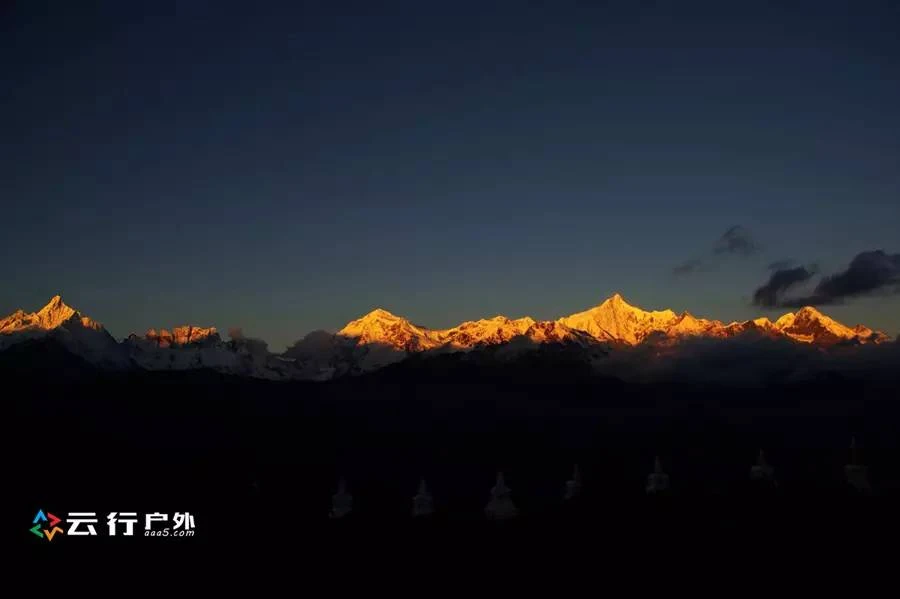
Day 2: Feilai Temple – Lancang River Grand Canyon – Xidang – Nanzong Pass – Yubeng Village To witness the breathtaking spectacle of the golden sunrise, you must get up early today. Wait on the Feilai Temple viewing platform or the hotel rooftop for the first rays of sunlight to illuminate the main peak of Meili Snow Mountain. In fact, Meili Snow Mountain lies to the west, while the sun rises in the east. The first light touches the tip of the main peak, Kawagebo, and then the golden hue slowly moves downward, eventually bathing the entire mountain in gold.
A stunning panorama of the golden sunrise over the Thirteen Peaks of Meili Snow Mountain.
The golden moment is very brief, so be sure to take photos quickly. Before long, the golden mountain turns into a silver mountain.
Soon after, the silver fades and the snow mountain returns to its natural color, becoming a silvery-white peak. The entire golden sunrise process is over, lasting only about half an hour.
At this moment, a group photo in front of the magnificent Meili Snow Mountain is also very memorable.
After enjoying the stunning golden sunrise, we set off on the main part of our journey — hiking to Yubeng. Feilai Temple, where we stayed, is still over an hour’s drive from Xidang, the starting point for the Yubeng trek. Along the way, you’ll pass the Lancang River Grand Canyon at the foot of Meili Snow Mountain, one of the deepest canyons in China. On both banks are pristine Tibetan villages, dotting the high mountains and deep valleys like beautiful green oases.
Xidang is the starting point for the Yubeng trek. Before setting off, the group members usually appear excited, as if they will reach Yubeng Village the moment they start walking.
From Xidang, you begin hiking into Yubeng. From the starting point to Nanzong Pass, it is about 12 kilometers of gentle uphill. At a normal pace, it takes about four hours to reach.
If your physical strength is really lacking, you can consider riding a horse. However, horses can only be rented from the very start; once you set out, there are no horses available midway. So you must decide in advance — if you walk for a while and then want to ride, it’s almost impossible.
On the 12 kilometers of uphill, there are three rest stops where simple food is sold (instant noodles, butter tea, biscuits, etc.). Though the prices are not cheap, it’s advisable to eat if you’re hungry, as today’s hike covers twenty kilometers and you need energy.
Most of the trail into Yubeng is in decent condition, relatively wide, and used by both people and horses. As long as you follow the main group, there is little chance of getting lost.
Of course, the journey to the pass isn’t just hard work — the scenery along the way is also quite beautiful.
When the roadside becomes filled with prayer flags, you have reached Nanzong Pass. These are hung by Tibetan pilgrims, and the flags stand like colorful walls on both sides, pointing the way to Yubeng.
Reaching Nanzong Pass means the 12 kilometers of tough uphill hiking are over. Everyone can have a small celebration, having completed the hardest part of the day.
At the pass, you can already see Shennu Peak and Wuguan Peak up close, and they appear even more majestic than when viewed from Feilai Temple.
From the pass, Yubeng Village is not far away. Although there are still eight kilometers to go, it’s all downhill, so the walking feels much easier.
During the hike from the pass to Yubeng Village, there is a viewing platform that offers the only spot where you can see the main peak Kawagebo of Meili Snow Mountain. Don’t miss the photo opportunity.
On the downhill trek, you’ll catch glimpses of Tibetan-style houses surrounded by green fields. This is actually Lower Yubeng, seen from an unusual angle.
After about two hours of hiking from Nanzong Pass, the first thing that comes into view is Upper Yubeng. A few white Tibetan houses stand on the green hillside, harmoniously blending with the natural surroundings to form a beautiful and tranquil scene.
Not far away, glaciers on the snow mountains tower into the clouds, giving off a silvery-white glow and a feeling of extreme cold, while the village beneath the mountains basks in the evening sunlight, brimming with vitality. This sharp contrast between sunlight and snow further accentuates the warmth and serenity of Yubeng.
A magical play of light in Upper Yubeng at sunset.
From Upper Yubeng, you can see the full panorama of Lower Yubeng. The tranquil village sits in a green equilateral triangle, surrounded on three sides by valleys, dotted with small white houses — the homes of local Tibetans. Nowadays, most have been converted into guesthouses.
A beam of sunlight illuminates Yubeng Village, making this little village at the foot of the snow mountains even more charming.
If your plan for the next day is to visit the Base Camp and Ice Lake, it is recommended to stay overnight at a guesthouse in Upper Yubeng. This saves time and energy.
In Yubeng, you are even closer to the snow mountains. If you have free time in the evening, you can shoot a series of starry-sky photos over Yubeng. Of course, besides good photographic skills, it also requires the cooperation of the weather.
Day 3: Yubeng – Xiaonong Base Camp – Ice Lake – Upper Yubeng Early the next morning, capturing the golden sunrise on Meili Snow Mountain is once again an exciting prospect. In Yubeng, you are closer to the mountains and the angle is different, so the golden sunrise photos will feel quite distinct from those taken at Feilai Temple. Because the surrounding hills block the main peak Kawagebo and its satellite peaks, you cannot capture all thirteen peaks of Meili. Only three peaks can be photographed, but since you are nearer, you will need an ultra-wide-angle lens.
This is the golden sunrise on Shennu Peak, its morning glow like blazing flames, dazzling and brilliant in the dawn light.
The Sixteen Arhats Peak also shines like a burning golden mountain, splendid and resplendent.
As the golden glow fades, the snow mountain returns to its natural beauty, still elegant.
After enjoying the golden sunrise in Yubeng, it’s time to head to another important destination — Xiaonong Base Camp and Ice Lake. The one-way distance is 12 kilometers, making it a 24-kilometer round trip. The striking white stupa in Upper Yubeng can serve as the starting point.
Before entering the primeval forest, you pass through an alpine meadow. During major Buddhist festivals, various religious ceremonies are held here. Behind the meadow is a dense primeval forest and pure white snow peaks. Ice Lake at the foot of the snow peaks is our destination today.
A rushing stream in the primeval forest, which is also the source of drinking water for Yubeng.
To reach Xiaonong Base Camp, you must also cross a pass at around 3,800 meters. The trail is all uphill at first and relatively tiring, but luckily the dense ancient forest provides ample shade, so you won’t get too much sun.
After hiking for about three hours and crossing the pass, you can see the pure white glaciers on the Sixteen Arhats Peak. Ice Lake lies in the mountain hollow beneath the glaciers.
From Upper Yubeng, it takes about four to five hours to reach Xiaonong Base Camp. In fact, this has been a summer alpine pasture since ancient times, with flat terrain and lush grass. In 1991, during the famous mountaineering event, it served as the base camp for the Sino-Japanese joint expedition. Later, all seventeen members of the team perished. To commemorate this tragedy, Xiaonong Pasture was renamed Xiaonong Base Camp.
The base camp usually has Tibetans selling butter tea and instant noodles. After a short rest here, you continue hiking to today’s final destination — Ice Lake. The lake is about two kilometers from the base camp, but it’s all uphill, and the path becomes steeper and more strenuous the higher you go. These last two kilometers are a real test of physical fitness.
After hiking for forty minutes from Xiaonong Base Camp and seeing the beautiful Ice Lake, you’ll realize that all the hard work was worth it. In summer, the water of Ice Lake is a vivid emerald green, like a piece of jade set in a snowy canyon.
This is the year-round glacier above Ice Lake, shining silvery-white under the blue sky.
Although Ice Lake is today’s destination, it is not the end of the trek. You need to return the same way, another 12 kilometers. To make it back to the guesthouse before dark, you can’t linger too long at the beautiful lake. Tonight, it’s best to stay in Lower Yubeng. Although it adds about half an hour of walking, it saves precious time for tomorrow’s visits to the Sacred Waterfall and the Ninong Grand Canyon.
Day 4: Upper Yubeng – Sacred Waterfall – Ninong Canyon – Lancang River – Feilai Temple Staying in Lower Yubeng has the advantage that, when you wake up early, you can see the two pure white snow peaks in the U-shaped valley right from your room. These two peaks are Shennu Peak and Wuguan Peak.
In Lower Yubeng, you can not only capture the golden sunrise but also, in the pond at the village entrance, photograph the magical reflection of the golden peaks. This is the only place in Yubeng where you can capture the reflection of the snow mountains.
Snow mountains, temples, blue sky, and reflections — you can find them all in Lower Yubeng.
Tranquil Lower Yubeng, alpine meadows in the primeval forest, bathed in the golden morning light. Clear streams flow quietly through the meadows, yaks and horses graze peacefully on the grass — a poetic painting of nature unfolds before your eyes.
In fact, most Tibetans who come to Yubeng only go on pilgrimage to the Sacred Waterfall in Lower Yubeng and generally don’t consider visiting the Base Camp or Ice Lake. These elderly Tibetan women’s main destination is also the Sacred Waterfall, which is likewise the most important destination for us in Yubeng.
This is the primeval forest on the way to the Sacred Waterfall. The water flowing down from the waterfall runs through the forest like a blue ribbon, serving as the main water source here!
To reach the Sacred Waterfall, you must pass through lush primeval forest. Hiking in this unspoiled forest and breathing the purest air at the foot of the sacred mountain is a truly enjoyable experience.
These tall, straight trees are fir, a characteristic species of the plateau. Walking the pilgrimage path beneath these thousand-year-old trees brings a special sense of happiness. These trees are spirits of the sacred mountain, offering blessings to pilgrims at every moment.
After about two hours of hiking from Yubeng Village, you will see a waterfall cascading down a thousand-meter cliff — this is the Yubeng Sacred Waterfall. In spring and summer, as the ice and snow melt, streams of water pour down the rock face like countless white ribbons fluttering down, a truly magnificent sight.
In summer, glacial melt increases the volume of the waterfall dramatically. Plunging vertically from over 3,800 meters, it truly gives the feeling of “a cascade plunging three thousand feet, as if the Milky Way were falling from the sky.”
The Sacred Waterfall is the pilgrimage endpoint for Meili Snow Mountain. Those who make the pilgrimage will receive the waterfall’s sacred washing, cleansing away a lifetime of sins beneath the sacred mountain. Here are the devotees worshipping under the waterfall, hands clasped, eyes closed, continuously reciting sutras, making wishes with utmost devotion before the sacred mountain, and praying for family and friends.
After reciting the scriptures, they prostrate themselves in worship toward the waterfall, seeking its blessings.
After worship, they offer pure white khada scarves to the waterfall. The rocks in front of the waterfall are already wrapped in scarves of many colors.
After the prostrations, the most sacred ritual follows: receiving the baptism of the holy water from the Sacred Waterfall. The water is regarded as the nectar of Meili Snow Mountain, capable of cleansing the five poisons of body and mind. You must not use an umbrella or wear a hat during the circumambulation; the more drenched you get, the better. Usually, it is done three times. The devout may do it thirteen times, and the most devoted up to 108 times.
Sometimes even newborn babies are brought by their parents to receive the holy water’s baptism, said to eliminate disasters and bring joy.
The Yubeng Sacred Waterfall is the very soul of Meili Snow Mountain. Anyone on a pilgrimage must come here for it to be complete. It is said that the waterfall is the holy water brought from heaven by the deity Kawagebo. It can foretell one’s fate, eliminate disasters, and bestow blessings. All pilgrims to Meili Snow Mountain must receive its baptism.
After completing the pilgrimage, retrace your steps to Lower Yubeng. After lunch, continue the trek out of Yubeng. The usual arrangement is to walk from Lower Yubeng to Upper Yubeng, then cross Nanzong Pass to Xidang and return to Feilai Temple. But there is another beautiful canyon at the foot of Meili Snow Mountain — Ninong Grand Canyon. Hiking out of Yubeng through Ninong Canyon is all downhill, saving energy, and offers different gorge scenery, avoiding retracing your steps.
With abundant water in the canyon, the primeval forest is especially lush and green all year round.
Hiking on the forest trail is easy and pleasant.
In summer, the primeval canyon is also dotted with little red unknown wildflowers, and large patches of purple wildflowers bloom profusely, standing out vividly against the green forest.
It’s like stepping into a beautiful fairy-tale world.
Crossing a clear stream in the canyon.
Hiking among streams and waterfalls, fully experiencing the magical charm of the grand canyon.
A pristine village in the canyon.
Traveling through a sea of green, enjoying the beauty of nature to the fullest.
As if hiking in a beautiful fairytale world.
Ancient trees everywhere make the air incredibly fresh.
The entire canyon from Lower Yubeng to Ninong Village is about 20 kilometers. Once you emerge from the primeval forest in the canyon, the trail quickly turns into a gentle, flat path. Arriving here means you’ve completed roughly one-third of the route. From then on, it’s a flat path all the way to Ninong Village.
In the past, this last six kilometers of the path was the most dangerous section of the Ninong hike. The trail was very narrow, with a stream on the left and a bottomless canyon on the right. Water from the cliffside often flooded the path, making it extremely hazardous. For tourists’ safety, the local government has rebuilt the irrigation channel so water no longer overflows, and the path has been widened to over a meter. Now walking this trail is no longer dangerous.
Following the path beside the channel, you will soon see a great river — the famous Lancang River. The Ninong Canyon hike is now effectively over. The canyon you see now is the Lancang River Meili Snow Mountain Grand Canyon.
In summer, with more rain, the Lancang River water is red. It flows through the great canyon, all the way east, and when it reaches Vietnam it becomes the famous Mekong River.
This picturesque little village by the Lancang River is Ninong Village. Arriving at this beautiful hamlet marks the end of the trek.
A suspension bridge spans the Lancang River, used by local villagers to cross to the other side. The bridge is small, only for pedestrians.
Walking on the swaying bridge gives you one last taste of thrill and excitement on the journey. With that, the Yubeng trekking trip comes to a complete end. You can catch a ride on the opposite bank back to Feilai Temple.
Day 4 is the longest day in terms of hiking distance and time, passing the most places and offering the most spectacular scenery. The round trip to the Sacred Waterfall plus the Ninong Grand Canyon crossing totals 36 kilometers. Fortunately, most of the route is downhill, and the scenery is breathtakingly beautiful, so it’s not exhausting to the point of collapse.
Days 5 & 6: Feilai Temple – Shangri-La – Tiger Leaping Gorge – Lijiang The itinerary is designed this way so that you spend two nights at Feilai Temple, doubling your chances of seeing the golden sunrise. If you miss it the first time, you have another opportunity. After all, coming all the way to Meili Snow Mountain is no small feat, and having two chances is very precious.
Today you return to Shangri-La via the same route. I won’t repeat the scenery, but will focus on the Tiger Leaping Gorge trekking guide. Located on the border of Lijiang and Shangri-La, Tiger Leaping Gorge is a classic Chinese hiking route. The main peak of Jade Dragon Snow Mountain on the south bank is 5,596 meters, and Haba Snow Mountain on the north bank is 5,396 meters. The gorge is only 30–60 meters wide in the middle. The upper gorge is at 1,800 meters and the lower at 1,630 meters, with the vertical drop from the snow peaks to the river reaching up to 3,900 meters — making it one of the deepest gorges in the world.
Tiger Leaping Gorge stretches nearly twenty kilometers and is divided into upper, middle, and lower sections, with a total water drop of over 200 meters. The mountains are high, the valley deep, long, and spectacular!
Middle Tiger Leaping Gorge (not recommended in the rainy season). After entering the Tiger Leaping Gorge scenic area gate at Qiaotou Town, you need to drive about another half hour to reach the Middle Gorge. The hike starts from Teacher Zhang’s Trail, which is well-known online. Because it was built by Teacher Zhang, a toll is charged. Teacher Zhang’s mother now sits at the entrance collecting ten yuan per person.
From Teacher Zhang’s trail to the bottom of Middle Tiger Leaping Gorge is about two kilometers, all steep downhill, so careful steps are needed.
When hiking Tiger Leaping Gorge, it’s best to wear hiking shoes or boots for better grip, making the trek easier.
The Middle Gorge hike is very short and not at all on the same level as Yubeng trekking. Although there are simple railings built by Teacher Zhang, you still need to be very cautious on the way down.
After half an hour, you reach a viewing platform where you can enjoy the spectacular sight of the gorge narrowing to a sliver of sky.
Walking on the steep and precarious cliffside trail is also quite thrilling.
In about one hour, you reach the bottom of the gorge. A photo in front of the Middle Tiger Leaping Gorge stone marker is a great memento.
The Tiger Leaping Gorge hike is not a round trip; you take another route back up via the ladders to Teacher Zhang’s place.
This is the famous “Brave Man’s Ladder,” consisting of three sections with a total of 168 steps. Climbing all of them takes about twenty minutes. The whole process is thrilling, challenging, and exciting. After finishing the Tiger Leaping Gorge hike and returning to Lijiang, our entire trip essentially draws to a close.
Self-guided travel guide from Lijiang to Meili Snow Mountain and Yubeng trek: Yubeng is about 400 kilometers from Lijiang. There is only one direct bus per day. If you want to visit Shangri-La along the way, you must take buses in segments. Below is a detailed travel guide from Lijiang to Yubeng.
Day 1: Go to Lijiang Bus Station very early to catch the bus to Deqin, as there is only one per day. It is recommended to book your ticket the day before. Since the bus picks up passengers along the way and is large and slow, it may take eight to nine hours to reach Deqin Bus Station. By then, it will be close to dark, but it is advisable to find a vehicle or taxi immediately to head to Feilai Temple. You may still catch the sunset on Meili Snow Mountain, but the key reason is to be in position to enjoy the spectacular golden sunrise the next morning. Note: Although Deqin County is near Meili Snow Mountain, the town lies in a valley where you cannot see the snow mountain at all — not even a little. You must stay at Feilai Temple.
Day 2: After enjoying the magnificent golden sunrise in the morning, find a shared car to Xidang, the starting point for the Yubeng trek. If you are lucky to get a shared ride, it’s about 40 yuan per person. If not, you’ll have to charter a minivan to Xidang for about 200 yuan per vehicle, even if it’s full. The distance is about 60 kilometers. After reaching Xidang in about an hour, don’t delay. If you want to reach Yubeng before dark, you must start hiking immediately. Don’t worry about getting lost. By the afternoon, many tourists are coming out of Yubeng, so you can ask along the way and won’t lose your way. The hike from Xidang to Yubeng is 20 kilometers, crossing Nanzong Pass at 3,700 meters. If you have decent fitness, you can reach Yubeng in six hours. You may arrive around 8 p.m. Find a small guesthouse, have a hearty meal, then rest for the next day’s trek.
Day 3: After breakfast, set out for the Base Camp and Ice Lake, a round trip of about 24 kilometers. It’s all uphill on the way there, crossing a 3,500-meter pass. You typically arrive at Xiaonong Base Camp around noon. The base camp was once the camp of the Sino-Japanese joint expedition and is now a rest stop on the way to Ice Lake. Here you can have butter tea sold by local Tibetans or a bowl of instant noodles. After a short rest, continue to Ice Lake, which lies at around 4,100 meters. The hike from the base camp to the lake is all uphill. The toughest section is the final steep slope of about one kilometer. Those last kilometers feel never-ending, but when you finally stand before the emerald-green sacred lake, you’ll find all the effort worthwhile. Even if you don’t know the way, just follow other hikers’ footsteps — you won’t get lost.
Day 4: It is recommended to stay in Lower Yubeng on the third night, so on Day 4 you save time and energy walking from Upper to Lower Yubeng on the way to the Sacred Waterfall. In the morning, hike from Lower Yubeng to the Sacred Waterfall. The trail is very easy to follow — just walk along the Sacred Waterfall River; there’s only one path, so it’s impossible to get lost. After about two kilometers along the river, you start an uphill climb through the primeval forest. The scenery is extremely beautiful. The uphill is about six kilometers, and the hardest part, like the Ice Lake trek, is the final stretch — a steep, gravelly path that can be quite grueling. It’s about eight kilometers from Lower Yubeng to the Sacred Waterfall, taking roughly two hours. After receiving the holy water’s baptism under the waterfall, you head back downhill. The descent is very easy, and remarkably, your clothes soaked from the waterfall will quickly dry, leaving you feeling refreshed. Return to Lower Yubeng in about two hours. By now, you’ll be very hungry, so eat a fried rice or noodles at your guesthouse. Then head from Xidang to Feilai Temple. Actually, there is another route out of Yubeng: following the Sacred Waterfall River out through Ninong Grand Canyon. However, Ninong Canyon is an undeveloped route within Yubeng, used mainly by local Tibetans. The forest is dense with many branching paths, so it is advisable to hire a local guide. Without a guide, you can still find your way out, but you may take many wrong turns, wasting time and energy. From Lower Yubeng, the hike through Ninong Canyon is all downhill. The canyon is filled with ancient trees, cascading waterfalls, and exotic flowers, earning it the nickname “Yubeng’s Back Garden.” It is a very worthwhile route. Once out of Ninong, you reach the banks of the Lancang River, where many minivans solicit passengers. It’s usually 200 yuan per vehicle to Feilai Temple. Arriving in the afternoon, it’s best to rest for the night at Feilai Temple. Another important reason is to be able to enjoy the magnificent golden sunrise panorama over Meili Snow Mountain the next morning.
Day 5: After enjoying the golden sunrise, take a bus from Feilai Temple back to Shangri-La (about 4–5 hours). In the afternoon, you can visit Songzanlin Monastery, and in the evening, stroll through Moonlight Ancient Town. Theoretically, you could make it to Lijiang today, but to hike Tiger Leaping Gorge tomorrow, it’s better to stay an extra night in Shangri-La.
Day 6: Early in the morning, take a bus to Qiaotou. Today’s focus is hiking Tiger Leaping Gorge. After arriving at Qiaotou, with over twenty kilometers still to the Middle Gorge and no public buses available from the scenic area entrance, you’ll need to charter a car. A round trip usually costs 200 yuan; it’s more economical if shared among a group. Hiking the Middle Gorge takes about three hours. Returning to Qiaotou by afternoon, catch a bus back to Lijiang, which takes about two hours. This concludes the entire six-day journey. Though tiring, it is very fulfilling.
Estimated total cost: Bus from Lijiang to Tiger Leaping Gorge 50 yuan, Tiger Leaping Gorge entrance 65 yuan, Middle Gorge charter and tolls 150 yuan, bus from Tiger Leaping Gorge to Shangri-La 30 yuan, Songzanlin Monastery ticket 115 yuan, fare from Shangri-La to Deqin/Feilai Temple 100 yuan, charter from Feilai Temple to Xidang 200 yuan, Yubeng entrance 80 yuan, return bus from Feilai Temple to Lijiang 120 yuan, five nights’ accommodation around 400 yuan, plus guide fees, bringing the six-day cost to approximately 1,500 yuan. This excludes meals and horse rental fees; if everything is included, it will be close to 2,000 yuan. This fully self-guided approach is suitable for experienced, hardcore backpackers who travel extensively, not for beginners or novices.
If you want convenience and safety, the best way is to choose a reliable, professional outdoor club. With experienced drivers, comfortable vehicles, and professional outdoor guides, everything you might need—and even things you haven’t thought of—is arranged by the professional team, allowing you to enjoy high-quality travel services while gaining a fresh outdoor travel experience. Original text and photos provided by Lijiang Yunxing Outdoor Club.
Classic six-day pilgrimage to Meili Snow Mountain and Yubeng trek itinerary
Day 1: Lijiang – First Bend of the Yangtze – Benzilan – Moon Bay – Feilai Temple
Day 2: Feilai Temple – Lancang River Grand Canyon – Xidang – Nanzong Pass – Yubeng Village
Day 3: Yubeng – Xiaonong Base Camp – Ice Lake – Upper Yubeng
Day 4: Upper Yubeng – Sacred Waterfall – Ninong Grand Canyon – Ninong – Feilai Temple
Day 5: Feilai Temple – Baima Snow Mountain – Yila Grassland – Shangri-La
Day 6: Shangri-La – Tiger Leaping Gorge – Lijiang


