Return to Lijiang
In early July 2020, Yunnan had few visitors.
Lijiang Ancient Town, situated in the Gucheng District of Lijiang City, Yunnan Province, is also called Dayan Town. Nestled in the middle of the Lijiang basin, it was first built during the late Song and early Yuan dynasties (late 13th century) and lies on the Yunnan-Guizhou Plateau. Covering an area of 7.279 square kilometers, it is home to attractions such as Sifang Street, Mu's Residence, Wufeng Tower, Black Dragon Pool, Wenchang Palace, Wang Pixian Memorial Hall, Xueshan Academy, Wangjiazhuang Christian Church, Fang Guoyu's Former Residence, White Horse Dragon Pool Temple, Gu Peter's Former Residence, Jinglian Temple, and Puxian Temple.
Also known as Dayan Town, Lijiang Ancient Town was a well-known stop on the ancient Tea Horse Road. TV dramas like “One Meter Sunshine” and “Mu's Residence Storm” were filmed here. Standing on East Street of the old town, you can gaze up at Jade Dragon Snow Mountain in the distance – the scenery is truly beautiful.
The ancient town is built along the mountains. From Sifang Street, four main roads branch out: Guangyi Street, Qiyi Street, Wuyi Street, and Xinhua Street. These streets then give way to a labyrinth of crisscrossing lanes, forming a town centered on Sifang Street. Mu's Residence, the chieftain's manor celebrated by the traveler Xu Xiake, is near Guanmenkou on Qiyi Street. Here you can feel the architectural essence of the Naxi people.
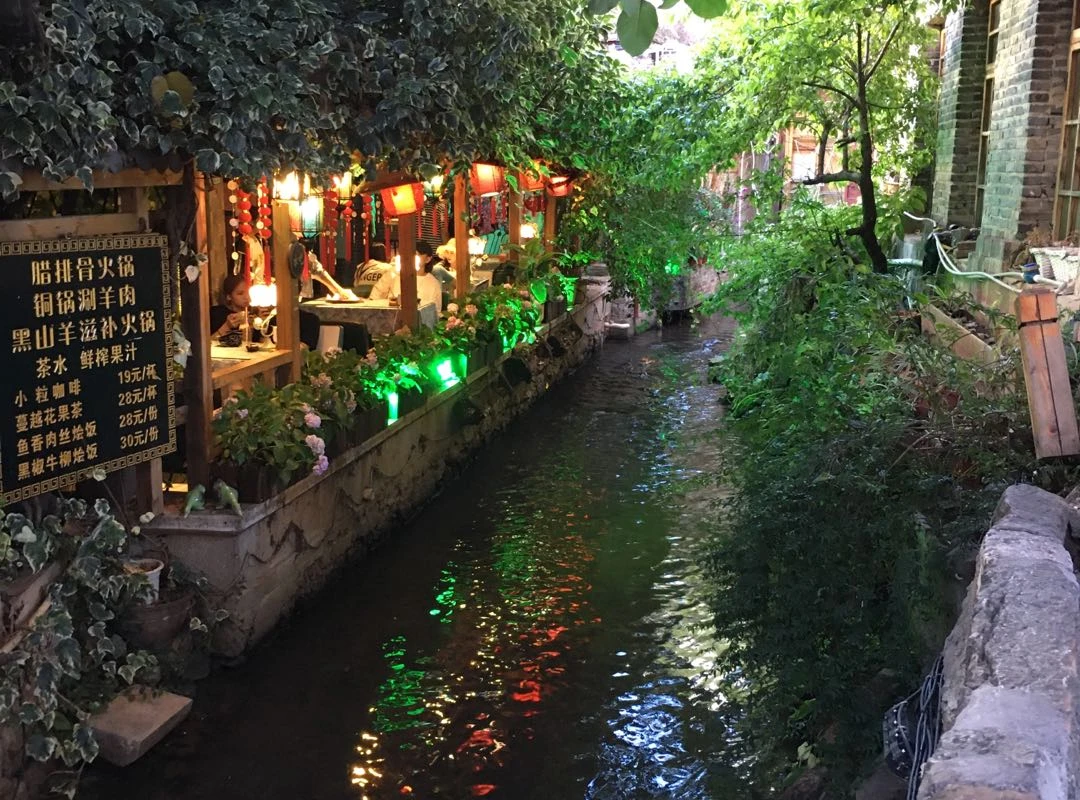
The Yuhe River splits into three channels in the town, then those three divide into nine, and finally into countless waterways, creating a layout where main streets hug the river and small alleys run beside canals, filling the old town with vitality.
Lijiang Ancient Town boasts rich local ethnic customs and entertainments: Naxi ancient music, Dongba rituals, divination culture, ancient town bars, and the Naxi Torch Festival, all uniquely charming. The town embodies the achievements of ancient Chinese urban design and is a distinctive and characteristic example of Chinese residential architecture.
Lijiang Ancient Town isn't far from Lijiang Airport – you can even spot it from the terminal. The airport bus costs just 20 yuan and conveniently takes you downtown, then a taxi ride for 8 yuan brings you to the north gate of the old town. Wandering Lijiang's streets is a perfect way to relax and unwind.
In early July 2020, I traveled solo to Lijiang. I booked accommodation on Ctrip, where choices were abundant. A standard room was just over one hundred yuan, and once I checked in, it felt spotless and cozy.
For days I roamed the old town, taking in the tiny, homemade vignettes in front of dwellings – each one a one-of-a-kind personal creation, each so endearing that I couldn't help snapping photos. The town has been tidied up exceptionally well; flowers were everywhere, truly living up to its name as the city of blossoms.
Over on Bar Street, I heard many shop owners have changed hands in recent years. Often, people from first-tier cities, tired of the urban hustle for a while, come here to open a laid-back little bistro and live some peaceful days – then, like in the story of the “fortress besieged,” they dash back to the city again. Due to the pandemic, I did see transfer notices posted on some shops. A restaurant owner told me that most are out-of-town proprietors who look down on the small profits they're making now, as they once made big money quite happily.
The dreadlocks so popular among foreigners are all the rage in the old town. At many scenic spots, you can get a small braid for one yuan – that's the lowest price! Here, a multitude of colors and styles come at different prices. One small shop was dazzlingly adorned with multicolored ribbons! Some braids cost five yuan each, and they looked gorgeous! Watching the stylists' fingers dart rapidly through the hair, you realize the skill is worth every penny. One couple spent three hundred yuan in a single go.
During the day, the old town's lanes are nearly empty; at night, there are more visitors, though nothing like the packed crowds I witnessed over a decade ago. The items in the various small shops aren't expensive. A handmade tie-dye dress, finely crafted, cost just over two hundred yuan after a fifty percent discount. At Yunxueli Restaurant, a cold-water fish meal for two cost just over a hundred yuan.
When dusk falls, Lijiang Ancient Town turns brilliant with flowing lights and glowing lanterns, showcasing its splendor and liveliness. Enjoying the night view here is an absolute delight. Then add some authentic local cuisine – it's the perfect choice for a relaxing getaway. Chickpea jelly, Lijiang baba, cured rib grilled rice cakes, crispy tofu, rice sausage... as long as your stomach has room, don't overlook any of these delicacies!
The old town is filled with shops selling regional specialties: ethnic jewelry, tea, silverware, shawls, and more. My companion bought two shawls as gifts for friends – 30 yuan each, pretty and warm!
We asked the guesthouse owner to arrange a two-day Lugu Lake tour. Prices ranged from 160 yuan (by bus) to 480 yuan by private vehicle. Essentially, the price difference came down to the vehicle and accommodation. We chose the 360-yuan tier, a 13-seater business vehicle and a first-line lake-view room.
The next day, the driver picked us up right on time and very conveniently. The journey of over one hundred kilometers took more than four hours. The scenery along the way was lovely, and the driver pulled over six or seven times for everyone to get out and enjoy the views. Lunch was a specialty hot pot – a whole fish simmered into a delicious soup, plus some potatoes and vegetables. The younger travelers weren't keen on it. After 2 p.m., we went to the lakeside to take a boat punted by Mosuo people for over two hours. The landscape was stunning: blue skies, white clouds, emerald water, and thick cloud layers spared us the harsh sun.
Dinner was quite good! We'd been looking forward to photographing the sunset, and it certainly didn't disappoint!
The next morning's sunrise was equally breathtaking! Each person got a small bowl of rice noodles for breakfast – not bad at all!
Then we checked into a lakeside hotel. It was perfect – we could capture photos of the sunset and the next day's sunrise! A row of small boats moored by the shore served as our props. It felt wonderful to take pictures in such a leisurely setting. Infinite beauty, endless photos!
At noon the next day, the driver picked us up, and we ate a mediocre lunch at the same restaurant as the day before. Then back to Lijiang! In the evening, we went to Yunxueli Restaurant for the cold-water fish – delicious! The trip back to Lijiang was smooth. That night, while strolling, we booked a visit to Lashihai for the following day.
Early in the morning, we hopped into a vehicle on the street. At Lashihai, we first went horseback riding, then toured the park. This spot is really just a poverty-alleviation project, as there's little else to do. It came with various sales pitches from herders: gloves, tea, fruit, photos, and the like. By noon, we returned to Lijiang Ancient Town and visited Mu's Residence.
Though I've seen many gardens, Mu's Residence still overwhelmed me with its grandeur. The overall size and layout, the all-wooden structures, the interior furniture and furnishings, the history of the mansion...
When people mention “Lord Mu,” it's with the familiarity of speaking about our own ancestors. Lord Mu was once the master of this vast estate. Simply put, five or six hundred years ago, Mu's Residence was the “Forbidden City” of Lijiang Ancient Town.
It's one of the most outstanding chapters in Naxi history. As some scholars say, “To miss Mu's Residence is to have never been to Lijiang.” The surviving Ming and Qing dynasty buildings are majestic in architecture, splendid in palace design, exquisite in carvings, delicate in structural components, and resplendent in paintings – truly magnificent and beyond compare.
Mu's Residence is the common name for the government office of the Mu chieftains in Lijiang. The Mu family ruled through the Yuan, Ming, and Qing dynasties. At its peak, Mu's Residence occupied over one hundred mu of land with nearly a hundred buildings, and it was the heart of the 800-year-old Dayan Ancient Town. Although it was merely a chieftain's mansion, its luxury and grandeur rivaled any noble's palace.
Located in Lijiang Ancient Town, Mu's Residence was the palace of the Mu chieftains. Since 1253, the Naxi chieftain Mu family held hereditary rule over Lijiang for 22 generations spanning 470 years across the Yuan, Ming, and Qing dynasties, making the residence the political and cultural center of the region. In 2013, it was designated a national AAAA-level scenic spot. The TV drama “Mu's Residence Storm,” which tells the story of the Mu chieftains, was filmed here.
Lijiang's Mu's Residence is a “grand garden” of Lijiang culture.
After the devastating earthquake in 1996, the World Bank, recognizing its value, provided a substantial loan to rebuild the residence. Skilled local artisans meticulously designed and constructed the project, and after three years, Mu's Residence reemerged like a phoenix from the ashes. Among southwestern chieftain estates, it was famed for “knowing poetry and letters, honoring rites, and guarding righteousness.”
By the late Ming dynasty, it reached its zenith, with architecture of great splendor. Xu Xiake, the renowned traveler of old, sighed at the residence: “The beauty of these chambers rivals that of royal palaces.” The entire Mu's Residence covers 46 mu, with a central axis 369 meters long. The complex faces east, “greeting the rising sun and gaining grandeur.” On the wooden memorial archway, four characters read “Heavenly Rain Flows with Fragrance,” a homophone in the Naxi language for “Go read books,” reflecting the Naxi people's reverence for knowledge and their spirited wisdom.
On May 1, 1999, Mu's Residence officially opened to the public. After hearing guide explanations and touring the residence, visitors exclaimed, “We never knew there was such a place in Lijiang. From now on, visiting Lijiang without seeing Mu's Residence would be like going to Beijing and missing the Forbidden City.”
In April 2012, a three-month refurbishment began with an investment of 10 million yuan. Besides restoring the main structures, a new stone tablet was erected, inscribed with an inscription by Comrade Jiang Zemin from his 1999 inspection: “Lijiang Ancient Town, a World Cultural Heritage Site.” The restoration followed the principle of “repairing the old as it was,” preserving the overall architectural style.
After seeing Mu's Residence, we went to browse for clothing and seek out delicious food!
On July 13, 2020, we returned to Nanjing! This visit left us with a deep impression of the new beauty of Lijiang Ancient Town. It is a place worth visiting again and again!


