Back to Lijiang: Chasing Romance Beneath the Colorful Clouds of Yunnan
I've lost count of the times I've visited Lijiang. In memory, I come back every year. No matter how commercialized others say Lijiang has become, I still love coming here to veg out, zone out, and pet some dogs. Though the old streets buzz with noise, there's still a pocket of peace. After too long in the city, I always long to spend a few simple days in Lijiang.
China has countless tourism-driven cities, but many are one-time sights. A place that draws you back again and again must have a multifaceted appeal. For me, that place is Lijiang, nestled in the 'South of Colorful Clouds' (Yunnan). Lijiang holds so many deep memories. Since my first visit four years ago, I've returned nearly every year to stroll this familiar old town.
Somehow Lijiang became synonymous with romantic encounters, though nowadays the chances of a serendipitous fling are slim. These days, more people come to stay at a guesthouse, bask in the sun, and do nothing. When the weather cools, they'll wander to nearby sights; when tired, they'll sip tea and read in their inn. In Lijiang, I never rush to check off sights—I just watch the clouds drift by in the most relaxed state.
On Sifang Street square, the Naxi people sing and dance; their unique moves always draw thick crowds of tourists. It seems the performers change each year—this year, there were noticeably more Naxi aunties and grannies.
Whenever I need a break, I come to Lijiang. No matter how commercial it feels, the old town's pace remains languid compared to the city. Drifting against the current of time, the people I met here and the stories that unfolded have all faded. In the unusual year of 2020, I returned to Yunnan, to Lijiang, not just to seek old memories but to truly unwind. This trip wasn't about ticking off sights—it was about a leisurely holiday. Some places are destined to be revisited.
This time, I discovered a new spot in Lijiang Ancient Town: Dayan Flower Lane, a recently popular Instagram-worthy locale. Bougainvillea bloomed while folk songs drifted by—in Dayan Flower Lane, I encountered the real Lijiang. I hadn't noticed it on my previous two visits, so it must have been built in the last year or two, adding a fresh splash of color to the already well-established old town.
Dayan Flower Lane is at the north gate of the old town, themed 'Encounter Lijiang.' It's a cultural lane blending sightseeing, entertainment, leisure, and cultural experience. At the north gate, you'll see a large plaque reading 'Dayan Flower Lane,' but to put it plainly, it's a new photo-op hotspot packed with decorative elements perfect for snapping pictures.
The brightly painted staircase is the most eye-catching feature upon entering. The designs likely symbolize Naxi folk culture. It was swarming with people taking photos. While I was snapping away, a cleaning lady in traditional local attire passed by, so I invited her to sit and take a photo together. For me, rather than standing out alone, it's nicer to blend in with the locals.
Wish plaques of all kinds cover one wall. Visitors to Lijiang are diverse—couples, families, close friends, solo travelers—yet all share a romantic spirit. The plaques let us inscribe the blessings and poetic lines we can't help but express, hanging them forever in a corner of Dayan Flower Lane.
Dayan Flower Lane is a fairly artificial attraction, decked out with man-made decor. Some love it, others grumble. But it does have the 'Eye of Lijiang,' a panoramic viewing platform for the old town—so you don't need to pay an entrance fee at Lion Hill to see the whole town. From the high platform of the Eye of Lijiang, a sweeping view of the ancient city unfolds.
Dayan Flower Lane is also a haven for folk musicians. In summer, a folk music festival fills the square with crowds, gathering poetic, wanderlust-filled singers who make visitors forget worldly worries. The stage remains, and occasionally resident musicians strum guitars and sing—not necessarily for money, but more to share their talent on a proper stage.
Flowers still dominate Dayan Flower Lane, with bougainvillea being the most common—it's practically a symbol of Lijiang. In early spring, you'd also see cherry blossoms, hydrangeas, and wisteria; that's when the lane is at its loveliest.
Lijiang Boxin Yunshu
Every time I head to Lijiang, I thoroughly research guesthouses and inns—after all, comfort is key in the old town. This time, one glance at Boxin Yunshu at the foot of Lion Hill and I was sold. Perhaps drawn by its descriptions and photos, I quickly decided.
Boxin Yunshu is a courtyard—I prefer to call it a courtyard rather than an inn. Located beside the Mufu Palace in Dayan Ancient Town, it's very close to Sifang Street yet utterly quiet. Outside, the world bustles, while inside reigns a pocket of serenity. It's a 10-minute walk from the old town gate; cars aren't allowed inside, so Uncle Yang from Boxin comes with a tricycle to fetch guests and luggage.
Stepping into Boxin Yunshu's courtyard, the lofty Chinese garden with Naxi touches stunned me—it's huge! In my previous stays, inns were tiny due to fierce competition. But Boxin Yunshu's first impression is space: vast common areas, a large courtyard, big rooms.
Boxin Yunshu feels more like a garden, with flowers, trees, bird song. There's a wading pool with a swimming pool inside—the two appear connected but are separate: an outer ring of clear water and an inner pool for swimming. On hot summer days, guests can cool off. At night, under soft yellow lights, the rippling water is especially beautiful. Water seems to be the soul of Boxin Yunshu; every Boxin home features such a clear-water pool.
The courtyard brims with succulents and colorful blooms, full of vitality. Every step reveals flowers; every glance is a scene. Living here is like staying in a botanical garden. Amid the blossoms, photos turn out beautifully—girls would adore it. When I was snapping pictures, some tourists wandered in thinking it was a sightseeing spot; the staff warmly welcomed them.
At Boxin Yunshu, I felt right at home. The staff call you 'little sister' or 'little brother,' instantly closing the gap. There's no formal front desk—not a traditional hotel or inn, but like stepping into your own family courtyard. I especially loved the central atrium, with a whole wall of books; reading and sipping tea there was supremely cozy.
The natural wood style looks very Jiangnan, yet blends in many local Naxi elements. Boxin's homes merge so seamlessly into the local culture. In many details—the side tables, the lighting—you can see the owner's pursuit of quality.
The atrium doubles as an open-plan restaurant—you might not even notice at first glance. The breakfast buffet is generous, with standard fare plus local treats like rice noodles, er kuai (grilled rice cakes), roasted rushan (milk fan), and Lijiang baba (flatbread). On my first Lijiang morning, I finally had the er kuai and rushan I'd been craving, and suddenly memories of my very first trip to Lijiang flooded back.
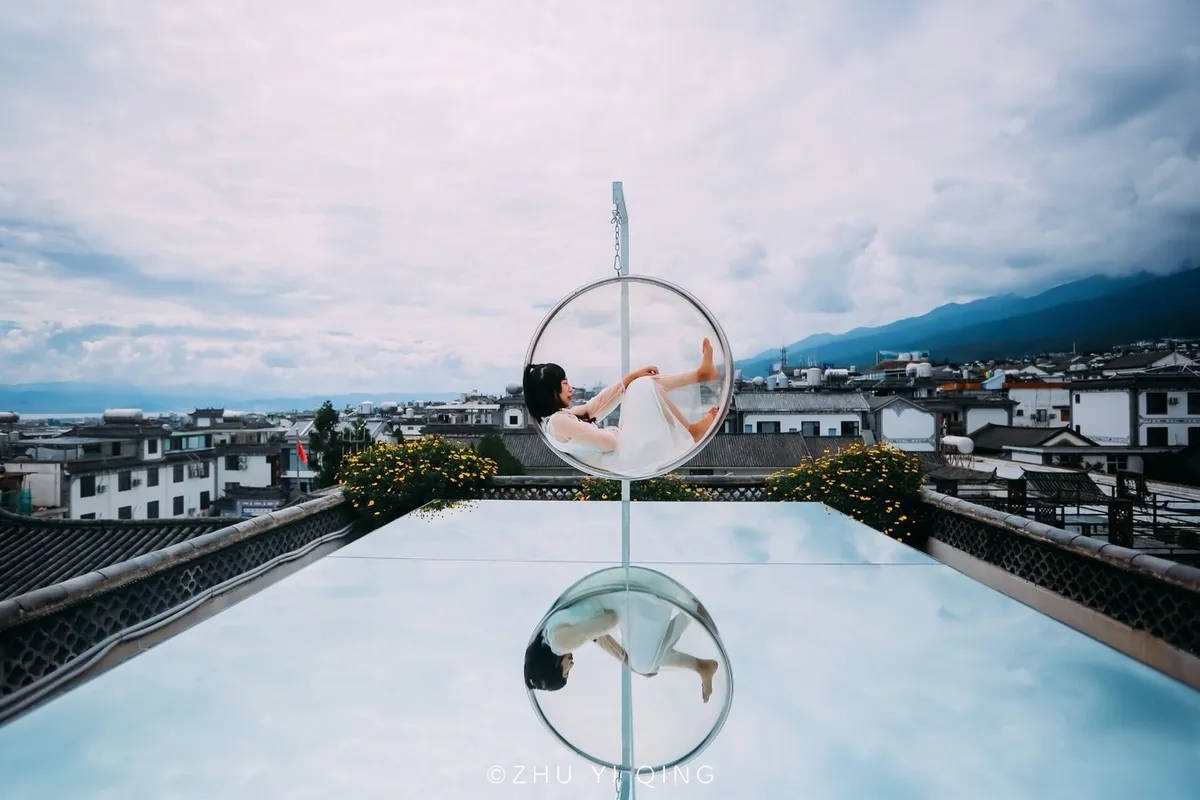
On clear days, the rooftop terrace offers views of Jade Dragon Snow Mountain and the whole ancient town. I loved going up there at dusk just to feel the breeze.
There's also a huge mirror on the terrace, creating a 'sky mirror' effect—if the weather cooperates. If not, you can still capture a moody shot.
A Private Master Suite
Ultimately, a guesthouse's impression rests on the room—the place where you actually rest. Boxin's private master suite gave me a VIP experience.
I stayed in the standalone courtyard suite called 'San Duo,' named after the Naxi San Duo Festival. The room had high ceilings. Here are a few delightful surprises: 1) The linen slippers and bamboo-fiber towels are yours to take home. 2) The peach wood comb was handpicked by the founder, Mr. Xiangzi—also a take-home souvenir. 3) Given the dry plateau climate, there's a humidifier. 4) A dedicated towel dryer. 5) Face wash, hand soap, laundry detergent, and body lotion are all provided. 6) A full tea set on the table—perfect for tea lovers.
In the elegantly Chinese-styled room, one small design caught my eye: the bedside lamp. Its round fan shape is vintage and graceful, with a feminine touch that pairs perfectly with the gauze canopy. I wanted to buy the same one.
There are two sinks, so a family can freshen up without fighting for space. The marble backsplash instantly ups the style.
The bathroom is somewhat open-plan, and there's a small bathtub for those who enjoy a soak. Bath covers and bath salts are thoughtfully provided, and the towel dryer is my absolute favorite.
Beside the nightstand are controls for the Bluetooth speakers. When you insert the key card, soft music starts playing. I have to say, music has a magical power—my tired body instantly relaxed.
Staying in Lijiang was so comfortable that I spent the days either strolling the old town or just zoning out in my room—that's the real Lijiang holiday rhythm!
An Ancient Town
In September, I hit the rainy season. Walking through the old town in the drizzle had its own charm. I love street photography there. At three in the afternoon, some people were still eating lunch—I guess that's the Lijiang rhythm.
Flowers were everywhere; though not as lush as in June, they still brightened the old town. Even in the unusual year of 2020, the old town had plenty of visitors—likely all like me, enjoying a slow-paced escape.
Travel isn't about rushing. In Lijiang Ancient Town, pick a cozy spot. At Boxin Yunshu, watch flowers bloom and fade, clouds gather and disperse. Time here seems to pass slowly—every task is leisurely—yet it also flies, and you don't want to leave. So, do you like holidaying in Lijiang? What places do you love most? Share your thoughts—maybe in June?
Wandering the ancient lanes, letting loose in bars, getting addicted to doing nothing under the blue sky—that's how I find myself. Lijiang's nights always enchant me. Sleepless, Lijiang at night: in the old town, brightly lit restaurants are packed with people. A gentle breeze brings a cool chill. After dark, Dayan is at its most comfortable—and most authentic.
Walking the flagstone streets, I noticed one difference from before: the hand-drum music from 'Little Baby' is gone. That was once Lijiang's hottest tune. Street food might have celebrity prices and plain flavors, but often it's not about buying—just about strolling for the sake of it.
But this year, Lijiang gained new fame for one spot: the unique Cherry Blossom Restaurant. More than a restaurant, it's the year's hottest Instagram location. Flowers overflow the canal, and at night yellow lights glow—very bourgeois.
There are tables for two or four, but even without dining, you can wander in. Outside, flowers and inside, wooden tables and chairs create a natural, elegant setting. In full bloom, the flowers are unquestionably beautiful.
It's full of photo ops—picture-perfect scenes at every step. You've got to admire the owner's sense of aesthetics and marketing savvy. This spot draws the biggest crowds in the whole old town—so packed you can barely move.
Old town restaurants aren't winning on taste anymore but on ambiance. Decorate the place beautifully and crowds flock for photos. As for flavor, I can't say much for it—I found better food outside the old town.
Just a few steps from Cherry Blossom Restaurant is Oil-Paper Umbrella Street. The inn's clerk told me it's also new. The whole street is draped with oil-paper umbrellas painted with various patterns; under the lights, they're beautiful and vivid. If Lijiang's fickle weather brings a drizzle, they offer some shelter.
I've wandered Dayan, been to Shuhe, but few have heard of Baisha—and I don't mean white sand, but Baisha Ancient Town. Lijiang's old town comprises three parts: Dayan, Shuhe, and Baisha. Most tourists just visit Dayan. But for those who love peace and authenticity, Baisha is the best choice.
Why is Dayan no longer the Dayan of old? Too many tourists, rising commercialism, and locals moving out—that's why. Baisha, by contrast, is pristine and undisturbed, the most authentic Naxi-style town. Out of curiosity for Dongba culture and a desire to experience a more untouched Naxi village and people, I traveled from Dayan to Baisha.
Though only 10 km from Dayan, Baisha feels far more primitive. And the famous Mu family, the Lijiang chieftains, originated right here in Baisha. The town sits at the foot of Jade Dragon Snow Mountain; from anywhere, you can look up and see its stern face.
Compared to the overheated Dayan, Baisha is a haven of quiet. No noise, no glitz. Entering Baisha, you feel a quiet strength. Unspoiled, it perfectly preserves the simplicity and tranquility a Naxi town should have.
Elders sit by the roadside chatting and selling vegetables, but not too seriously—it's more of a pastime since their children support them. The village has little contact with the outside world, still living a life of farming and weaving, even more laid-back than Dayan.
Before coming, I'd heard Baisha is famous for tie-dye. Everywhere, dyed cloths hang to dry. Tie-dye is a folk craft and drying method; many households rely on it, creating Baisha's most picturesque scenes.
Tie-dye is a traditional and unique Chinese folk dyeing technique. Threads are tied into knots on the fabric before dyeing, then removed to reveal patterns. It's said that even among thousands of knots, no two dyed patterns are identical—a truly unique art effect.
Tie-dye patterns are relatively simple: butterflies, wintersweet, crabapple blossoms. There are also full designs like 'fish roe valance' with tiny white dots or 'agate valance' with larger dots. This craft is now a national intangible cultural heritage, and several dyeing workshops in Baisha carry on the tradition.
The workshops offer hands-on tie-dye experiences, letting you create a small piece in a short time. I arrived a bit late, past the best drying time, so I just took photos with the cloths and chatted with the owner. Baisha's tie-dye mostly uses Isatis root (banlangen) and indigo as dyes—yes, the same banlangen used for colds. Compared to chemical dyes, these plant dyes give natural, fade-resistant colors, are gentle on fabric, durable, and importantly, non-irritating to the skin—even anti-inflammatory and soothing, so the clothes feel great.
The seemingly simple patterns carry auspicious meanings—'wind, flower, snow, moon,' 'prosperity fills the hall,' and so on. I asked the owner; a plain blue tie-dyed cloth is just over 200 yuan. Multi-color costs extra, but even the blue cloth price is a steal only found in such a rural paradise.
There are few tourists. Walking the flagstone paths, only colorful cloths flap in the wind, displaying the town's vitality in its quietude. Step into any dyeing room, and it feels like a tie-dye museum. Sunlight caresses the rainbow fabrics, telling stories of ancient craftsmanship and the history of dyeing. The artisan spirit silently lives on in this rustic town.
Baisha's houses retain their original appearance, though interiors are renovated to suit the owners. Even if the exterior looks shabby, inside you'll find many Naxi elements.
I ordered a homemade yogurt at a street-side café (don't ask why yogurt at a coffee shop…). Looking up, I saw multi-colored cloths on mottled walls, flapping against each other in the wind. Little birds perched on beams chirping leisurely. The slight bustle in this old-timey setting had charm; once I sat down, I didn't want to move.
Wenhai, a Hidden Gem of Lijiang
After hearing too many horror stories about tourists getting ripped off at Lashihai, I decided to escape the crowds there and head to another beautiful, little-visited lake: Wenhai. It's a hidden gem of Lijiang, even less crowded than Sangu Shui.
Driving from the old town to Wenhai takes an hour, crossing a mountain, so most hire a car or rent a motorbike—I even saw some cyclists. The inconvenient access means few Lijiang visitors make it here, missing the most beautiful flower sea in Lijiang.
Wenhai is part of the Lashihai Plateau Wetland Reserve, but far less crowded. It's a seasonal lake perched over 3,000m on a Jade Dragon Snow Mountain ridge. In autumn and winter, it's full, with migratory birds; Jade Dragon Snow Mountain reflects in the mirror-like water, serene as a fairyland. In spring and summer, it's dry, with grasses, irises, and blooming flowers—like being in a sea of blossoms.
Everything in Lijiang ties to the Ancient Tea Horse Road, and Wenhai is no exception. It was once a key stop for horse caravans to rest and graze; now, it's more common to see local cattle herds.
Due to the high altitude, Wenhai's flowers bloom for only about a month, in late spring to early summer. The hillsides are covered with all kinds of flowers, turning Wenhai into a floral sea—vibrant clusters dotting the wilderness. I was fortunate to come in June, just as the meadows were in bloom, perfect for photos.
A few scattered houses sit by the meadows, vast and quiet with hardly a soul. No worries about finding a good photo angle—there's no one in the way from any angle!
Now blooming on the meadow is one of Yunnan's Eight Famous Flowers: the primrose. Vast stretches of purple-red, visible from the winding mountain road, like scattered rosy clouds on the grass. Getting out of the car, I tramped through hay and cow pats to the lake's edge. Up close, the primroses are clusters of eager blossoms, as if cherishing a hard-won spring.
Herds of cattle and horses graze on the grassland. In spring and summer, though flowers bloom, the lake water recedes, so you can't fully enjoy the blue expanse. That's why Wenhai must be visited twice: once for the flowers, once for the blue water.
Wenhai is truly a hidden corner of Lijiang: vast, lonely, the sky and earth boundless. At that moment, a tiny me stood on this huge planet, and that tiny me wanted to dream a big dream.
Dali: Ancient Town and Erhai Lake
If Lijiang is Yunnan's city of romance, then Dali is the city of healing. I still remember seven years ago, as a naive girl, my first trip to Yunnan took me to Dali Ancient Town. The unique Bai-style houses and the aroma of grilled rushan in the streets deeply etched this town in my memory. Later, after another quick visit, I knew I'd return.
With its ancient town, Cangshan Mountain, and Erhai Lake, Dali brims with romance. It's become my favorite place in Yunnan. Sometimes, doing nothing but gazing at Erhai Lake feels utterly comfortable.
Nestled at the foot of beautiful Cangshan Mountain, Dali Ancient Town was the capital of the ancient Nanzhao Kingdom and later the Dali Kingdom. The climate is pleasant, architecture quaint, and the streets are lined with colorful blooms.
Looking back on Erhai Lake, the biggest regret was not seeing it under a clear blue sky. Perhaps this leaves a reason to return next time.
How to best enjoy Erhai? Young people's way: rent a sports car and circle the lake. The lakeside road is well-paved and smooth, easy even for novice drivers. I saw one flashy car after another, with handsome guys and pretty girls standing up. Now I knew why the old town seemed empty of youngsters—they were all here.
Many come to Erhai for those stunning Instagram shots. In the past year or two, a spot in Wase—Luwuo Hill, also called Cliff Shoal—has been discovered by photographers. Down a small trail, it offers many photo props: a cave, an abandoned window frame.
But! I arrived during Dali's rainy season, and the water level had risen, submerging the path to the 'cave.' Moreover, once the spot went viral, endless crowds came to replicate the same photos. There were queues by the window frame, and with people constantly arriving, I could only snap a couple of quick shots. Not a great experience. So I ended up just taking a few photos by the lake, catching the brief sunshine when it peeked through.
Actually, if not for photo stops, driving along Erhai East Road is the most pleasant. Speeding on this endless coastal road, under the vast sky, you feel an openness unimaginable in the city. The breeze scatters my thoughts and makes me savor the moment even more.
Leaving Dali isn't the end but a beginning. Next time, I hope to see a sun-drenched Dali.
In China, every city has a temple—be it a developed metropolis or a remote village, there's at least one for prayers. Temples are usually filled with incense smoke and solemnity. But on Cangshan Mountain in Dali, there's a fascinating temple: no incense burning, spotlessly clean, yet surprisingly adorned with many kinds of flowers, even specially arranged colorful potted plants.
This romantic temple is Jizhao Nunnery in Dali. Rather than a temple, it feels like a garden. Though small, it's planted full of flowers everywhere—along the paths, under the eaves, with colorful blooms and succulents. If not for the Buddha statues, you might think you're in a garden. Jizhao Nunnery is known as China's most artistic nunnery—no typical solemnity, no incense clouds, more like a courtyard where you casually tend to flowers.
Built in the early Ming Dynasty, destroyed, then rebuilt in the Republican era, Jizhao Nunnery is surrounded by diverse plants, exuding fresh, elegant air. Besides flowers, you'll notice a striking feature: loads of succulents, outnumbering everything else. Thanks to the prime location and ample sunlight, plus Yunnan's big day-night temperature swings, the succulents here grow plump and healthy.
It's said there are over 200 succulent varieties here, each different in type, size, color, and form—like a succulent expo. On the ground, assorted pots; overhead, seasonal Yunnan flowers in suspension. Many visitors come specifically to see the flowers and succulents, even though the nunnery is halfway up the mountain and requires a walk after driving. Despite the hassle, a steady stream of visitors come to admire.
Without incense, the air and environment are lovely; the whole nunnery is spotless yet retains a temple's dignity. Towering old trees, flowers everywhere, lush greenery—people call it China's most beautiful, romantic temple. Many might wonder: why doesn't it have the typical incense-burning, deity-worshipping scene?
Jizhao is actually a nunnery. The abbess once said Buddha lacks nothing and cares not for incense but for a devout heart. So they don't practice or worship formally, hence no incense. But for tourists, there's a room set aside for incense burning. If you wish, you can go in, but group burning is discouraged—hence the cleanliness.
Also, being in the mountains with lots of plants and nearby forest, burning incense could cause fires, so it's unsuitable. Surprisingly, the nunnery's buildings were designed and built entirely by the nuns themselves. They gathered stones and wood to construct each house, using natural materials or recycled items, giving the nunnery its vintage feel.
The plants and flowers we see today weren't achieved overnight; they've been slowly cultivated over decades, creating this garden-like temple full of life on Cangshan Mountain. What began as the nuns' hobby has now drawn crowds—not just to worship, but to see this unique nunnery. Some female visitors even want to stay after visiting.
Besides flowers, the vegetarian meal here is also excellent. Many come for the 20-yuan all-you-can-eat lunch. It's like home cooking but with carefully selected ingredients, lightly seasoned with minimum salt and oil, no MSG—so you taste the original flavors. Without heavy seasonings, the meal is distinctive, drawing hundreds to queue daily.
Dali Boxin Yunshu
Good morning, Dali! Crossing thousands of kilometers just for this reunion. This time in Dali, having seen the sights before, I decided to slow down, pick a guesthouse, take photos, lie around, zone out, and enjoy Dali's slow pace. Boxin Yunshu, which I stayed at in Lijiang, has a Dali branch—right outside the old town gate, a 5-minute walk. I chose it without hesitation.
Walking in, I felt like I'd entered another world. A huge wading pool sits in the courtyard's center. Compared to Lijiang's, Dali's pool feels bigger and more classical, shimmering with reflections of the sky. The greener area in the middle is a swimming pool; though they seem connected, they're separate. This spot is perfect for photos.
Like in Lijiang, Dali's Boxin Yunshu embraces 'largeness.' The common area opens right up to the second floor. It could be a tearoom, a dining room, or a café—but you'd never guess it's the reception. To make you feel at home, there's no typical front desk with POS machines. Upon entering, you're offered tea, and the young staff greets you warmly with 'little sister.' The cozy service begins at the door.
Curled up on the sofa in the front hall, watching the pitter-patter of rain outside, I couldn't go out, but staying at Boxin had its own charm. The elegant Chinese style is full of photo-worthy corners. Since I couldn't go out, I'd just shoot to my heart's content in the courtyard.
If you want, the girls can make a cup of coffee, letting you savor Dali's unique lazy vibe against the floor-to-ceiling window view.
The barista's latte art skills are incredible—she not only wrote 'Bo Xin Yun She' but also drew an image of the courtyard on the coffee. I took photos for ages, reluctant to drink it.
The girl taking photos said my outfit matched the throw pillows perfectly—maybe it's fate!
Having stayed at Boxin in Lijiang, I knew each guest has a dedicated suite. In Dali, I stayed in the 'Cangshan Room.' Just the name raised my expectations. The moment I opened the door, I was blown away—so full of local character!
Each room at Boxin has a different theme, with unique design elements. My Cangshan Room had pebbles on the floor to evoke the mountain; the doorframe lines echoed mountain ridges. It was a vintage-style space for relaxation.
The bedding is meticulous: Simmons mattress, latex pillows. Press a button, and the curtains and gauze close automatically. No matter how tired, you'll sleep soundly.
Since the old town climate is dry, there's a thoughtful humidifier to keep my skin from drying out.
The tea set is professional; tea lovers can sit by the window, gaze at Cangshan and clouds, and sip in relaxation.
From design materials to small details, each room blends Dali's ethnic culture and customs, offering a unique experience. You feel Dali's atmosphere the moment you check in. Again, bamboo-fiber towels, linen slippers, and peach wood comb are souvenirs to take home—so you bring Boxin memories with you.
After resting, I went to the terrace. Dali's Boxin terrace is much larger than Lijiang's, and there are two, planted with flowers like a small garden. Even more beautiful, behind is a sea of clouds and snow mountains—the vast scene made me start snapping away.
The common area is fully equipped, with a tea room and an open kitchen. If a family wants to cook, it's no problem at all.
At night, Boxin Yunshu exudes a different tranquility. Lights come on in the courtyard, their reflections dancing on the wading pool—stunning. In the front hall, elders play cards and chat; others sip drinks in the shade, lost in Dali's evening, troubles forgotten. It couldn't be more pleasant.
Awakened by birds at dawn, the rain had stopped, and I could see a corner of Cangshan peeking through the window. Downstairs for breakfast, a variety of Dali specialties to sample. Dali's iconic xi dou fen (pea porridge) is the local favorite. You must have it with a youtiao (fried dough stick), cut into pieces and mixed in—absolutely delicious! I guarantee you'll love it.
Rice noodles are my must-order at Yunnan breakfasts. They say every Yunnan morning starts with a bowl of mixian. Minced meat, greens, a slice of tomato—that's the taste of Yunnan.
Of course, in Dali, you can't miss er kuai, rushan, and Xizhou baba. These Yunnan treats turned my breakfast into a hearty brunch.
Dali: Xinghui Xiaoxiannv
In the evening, I waited for sunset but didn't get one. A friend recommended a modern Yunnan restaurant, Xinghui Xiaoxiannv (Meeting the Little Fairy), outside the old town. From afar, its lights were bright; up close, it was lively with many couples dining.
The signature is steam-pot chicken, made without a drop of water. We three also ordered xi dou fen, double-pepper fresh porcini, mini tofu, yak meat, wooden barrel rice, black pepper mountain ribs, and the little fairy white fungus soup. ① The chicken dish comes two ways; the soup is the highlight—intensely savory, not from seasonings but from the chicken itself. Good to have several bowls. ② Porcini is another star; in a few days, they'll be out of season, so you have to come at the right time. Incredibly fresh, worth trying. ③ The mini tofu, best eaten hot, was my favorite: crispy outside, tender inside. ④ Xi dou fen, a Yunnan specialty, is thick chickpea paste—you can customize it with chili, scallions, and dried fish. ⑤ Bamboo tube rice, traditional glutinous rice; when cut open, the fragrance wafts out. ⑥ The yak meat and ribs were tender; though they looked spicy, they weren't.
The restaurant has a romance theme; the ambiance is romantic, and they have interactive 'love certificates' to play with—perfect for couples, though friends can gather too.
Lijiang: Er Ge Rice Noodles
Highly recommended! Probably the best food I had in the old town. Must-try is the signature chicken broth rice noodles. The local chicken series is the star, using black-bone chicken, meticulously prepared. The broth is naturally savory, and the noodles are smooth and satisfying.
No matter the hour, the place is packed. I went at 3 p.m. and it was still full—amazing popularity. The window seats are semi-open; I sat there with my rice noodles, watching the world pass by. Life in the old town is leisurely and delicious.
Old Town: Dianxi Wangzi
This one was a bit of a letdown. Although highly rated on a certain review app, I find most old-town restaurant ratings unreliable. The decor is Naxi-style, and the staff wears ethnic costumes.
We ordered three dishes, all billed as signatures: lotus leaf-wrapped beef tenderloin, Dai-style hand-grabbed rice, and a lamb dish. Overall flavor was just average, not as stunning as the reviews claimed.
We also ordered a drink, Pao Lu Da, which was a total miss—just coconut milk with some bread crisps on top, not worth the price.
The End
Lijiang: sunny one moment, rainy the next. At the airport before dawn, it started to rain—as if reluctant to let me go. I lingered, hesitant to enter the departure lounge, just wanting to imprint Lijiang's mountains deeper into my memory. I once dreamed of wandering the world with a sword, to see its splendors. Lijiang and Dali are faraway places I can't forget. Perhaps someday, I'll long to return, to live that slow life in the distance again.


