Yunnan Lijiang-Dali 7-Day Free Travel Guide (Jade Dragon Snow Mountain, Lijiang Ancient Town, Cangshan Mountain, Erhai Lake, Dali Ancient City, Xizhou Ancient Town)
Originally, I had planned to go to Northern Xinjiang this year, but due to pandemic control measures, I rerouted to Yunnan, a place I'd been wanting to visit for a long time. I booked tickets in July, prepared in August, and traveled in September. I'll try to recount the trip in detail for friends' reference.
Dates: September 5 (Saturday) – September 12 (Saturday)
September 5: Fly from Shanghai to Lijiang; explore Lijiang Ancient Town in the afternoon and evening.
September 6: Morning, Yuhu Village; afternoon, Jade Dragon Snow Mountain.
September 7: Jade Dragon Snow Mountain.
September 8: Morning, bus from Lijiang to Dali; afternoon, Xizhou Ancient Town.
September 9: Erhai Lake.
September 10: Morning, Dali Ancient City; afternoon, Cangshan Mountain.
September 11: Cangshan Mountain.
September 12: Morning, Xizhou Ancient Town; afternoon, fly from Dali back to Shanghai.
Cost: About 15,000 RMB (for two people), I'll break down the costs at the end.
Accommodation: In Lijiang, stayed at the foot of Jade Dragon Snow Mountain; in Dali, stayed in Xizhou Ancient Town. After introducing the sights, I'll briefly share some accommodation tips.
Now for the main part~~~
Before the trip, we decided we wanted to focus on natural scenery and chose Dali and Lijiang. We wanted to 'take a closer look,' so we planned a week (in the end, we found a week was a bit long for these two places; we could have cut 1–2 days). Before departure, we had planned to visit Jade Dragon Snow Mountain, Lijiang Ancient Town, Cangshan Mountain and Erhai Lake, and Dali Ancient City; the rest we'd figure out on the spot, no rush, take it slow.
The flight from Shanghai to Lijiang arrived at noon. The hotel was at the foot of Jade Dragon Snow Mountain; driving from the airport to the hotel took one hour. We had lunch at the hotel, rested a bit in the afternoon. Considering there wasn't enough time to go up the mountain, and hearing that Dayan Ancient Town is beautiful at night, we set off to Dayan Ancient Town.
Dayan Ancient Town is one of the main ancient towns in Lijiang, no need for much introduction. My husband wasn't originally very interested in ancient towns, but I felt that when in Lijiang, we ought to check it off the list. Fortunately, September is not too crowded; it wasn't packed, so strolling around was quite pleasant. We arrived at the old town at 4 p.m. and headed straight to a high point, Lion Hill and Wangu Tower, which offers a panoramic view of the old town. In the distance, rolling mountains stretched out, though we couldn't make out which one was Jade Dragon Snow Mountain. From the tower, we could see the Mu Mansion. Since it was late, we didn't go inside Mu Mansion; I thought just looking from the tower was fine.
After descending Lion Hill, we looked for a place to eat, following online reviews. We ordered local specialties: tofu coated in a crispy shell, mushroom and chicken soup, and corn cakes. All were delicious, though not cheap—spending over 200 RMB. After dinner, we strolled slowly along the flagstone paths, waiting for nightfall. Lijiang is beautiful at night because thousands of lights come on, bright and warm. Many shop fronts are decorated with fresh flowers, looking even more charming under the lights. In Sifang Street, there's a bonfire dance, a local characteristic. Well-fed and content, on a night that wasn't too noisy, we ambled along the flagstone roads, taking in the shops with their own scenes on both sides, the gurgling water flowing by our feet, and the occasional cat stretching on a rooftop when I glanced up—truly a delightful experience.
Early the next morning, we first visited a village near our lodging called Xuesong Village, known in the Naxi language as 'Wuluken,' meaning 'at the foot of the snow mountain.' There's a lake called Jade Lake, so it's also known as Jade Lake Village. The area around the lake is a meadow. We walked from our lodging to the village and took a leisurely loop, spending the entire morning. The village is built in the Naxi style and even preserves the former residence of Joseph Rock, the Austrian-American explorer known as the 'father of Naxi studies,' who lived here. Jade Lake Village is an off-the-beaten-path spot; compared to Lijiang Ancient Town, it's very quiet, not large, and the Naxi architecture is distinctive. If you have time, it's worth a look. Almost every household here keeps horses and will offer you a ride. We wanted to walk, but all along the way we were asked about horse riding, which slightly dampened our mood.
On the afternoon of the second day and all of the third, we explored Jade Dragon Snow Mountain. Its main spots are Blue Moon Valley, Spruce Meadow, Yak Meadow, and Glacier Park. On the second afternoon, we only had time to visit Blue Moon Valley and Yak Meadow. On the third day, we re-entered the mountain to see Spruce Meadow and Glacier Park. If you try to cover all these sights in one day, you can only get a fleeting glance at each. The spots are some distance apart, but there are convenient shuttle buses in the scenic area. Blue Moon Valley can be visited on the return trip after seeing other attractions; the buses all pass by and stop there. It's a blue lake, very beautiful, and many people take wedding photos there.
Glacier Park, Yak Meadow, and Spruce Meadow each have a cable car going up the mountain, with altitudes descending in that order. After the cable car, there are boardwalks to walk along; go as far as your energy allows.
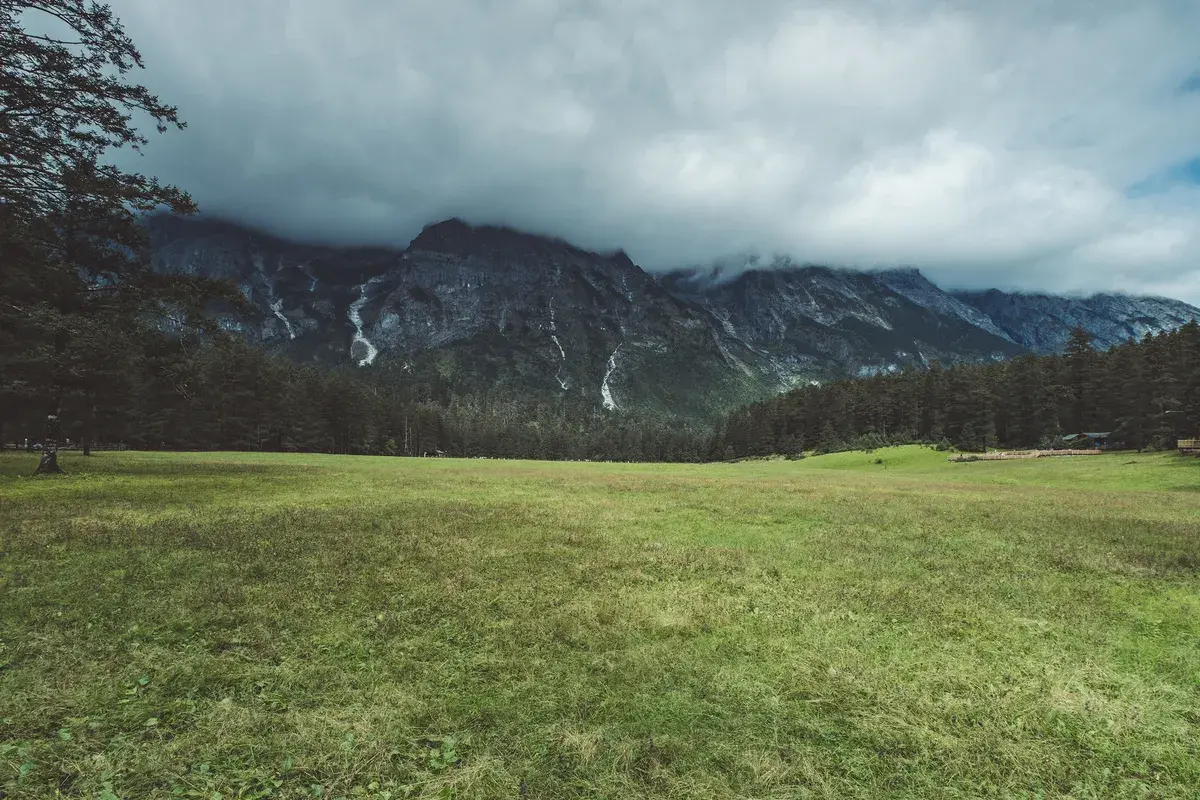
Glacier Park is at the highest altitude, over 4,000 meters. Its cable car is called the Big Cable Car. It's cold on the mountain; bring warm clothes, or you can rent down jackets at the site. We were there during the rainy season, so there was no snow cover; instead, clouds and mist swirled around like a dreamscape. When the clouds parted, the massive rocks appeared majestic and imposing.
Yak Meadow's highlight is a vast alpine grassland, very open, with yaks grazing in the distance.
Spruce Meadow is an old-growth forest, lush with ancient trees, a natural oxygen bar. Although we had to pay the entrance fee twice, it felt worth it!
On the fourth day, we traveled from Lijiang to Dali. We took a minibus from Lijiang bus station along the Dali-Lijiang Expressway; the scenery along the way was beautiful. Since our hotel was booked in Xizhou Ancient Town, we got off early there. The journey took 2 hours. If you go all the way to Dali Ancient City, it's about 2.5 hours.
Lijiang is about Naxi culture, Dali about Bai customs. Xizhou is a typical Bai village. We stayed on the edge of the village; just outside was a large rice field. If it were summer, I imagine you could 'hear a symphony of frogs.' Compared to Dali Ancient City, Xizhou developed later and has a less commercial atmosphere, making it a great place to experience Bai culture. The center of Xizhou is Sifang Street (many old towns have a central Sifang Street), with lots of snacks like Xizhou baba. There's a famous Bai courtyard called the Yan Family Compound Museum—note it's the 'Yan Family Compound Museum,' because there's another courtyard also called 'Yan Family Compound'; they are different places. The museum is older. You can admire Bai architecture while a Bai girl tells the story of the legendary tycoon's rise, and then sip a cup of fragrant tea, letting your mind relax.
On the fifth day, we visited Erhai Lake. If you look at a map of Erhai, you'll see that on the west side are Dali Ancient City, Cangshan Mountain, and Xizhou Ancient Town; on the east side are Shuanglang, Wase, Little Putuo Island, and other sights. A friendly reminder: when we were there, many areas on the west side of Erhai were under road construction, making it difficult to get around, so we just toured the east side. 'Just toured' still took us most of the day. We rented an electric scooter, starting from Shuanglang and riding south along the east-side lake circuit road. Whenever we saw beautiful scenery, we stopped. We set out from Shuanglang at noon, reached Wase, then Little Putuo Island just in time for dusk to watch the sunset over Erhai. These places all have many restaurants and guesthouses. If you're not in a hurry, I highly recommend a loop tour of the lake, either by self-driving or renting a vehicle. Besides the Instagram-famous spots, there are many places to stop and enjoy.
On the morning of the sixth day, we first went to Dali Ancient City. It was very crowded, so we just walked along the main street, checking it off the list. There are plenty of snacks in the city. Originally, we had planned to spend the whole day in the ancient city, but with so many people, we lost interest after half a day. In the afternoon, we headed to Cangshan Mountain. The taxi ride from the ancient city to Cangshan takes 20 minutes. Cangshan has three cable cars, starting from three different locations. The one that goes to the highest point, Ximatan (Horse Washing Pool), is called the Big Cable Car. It has two sections: the lower section goes halfway up to Qilongnu Pool (Seven Dragon Maidens Pool), where you get off and transfer at the same spot to the upper section to Ximatan. At nearly 4,000 meters elevation, Ximatan didn't feel very cold because we had already been to Jade Dragon Snow Mountain. The landscapes of Jade Dragon Snow Mountain and Cangshan each have their own characteristics. Jade Dragon Snow Mountain gives a sense of grandeur, with majestic boulders everywhere in Glacier Park. Cangshan offers more in terms of diverse vegetation and rock formations. The other two cable cars are Gantong Cableway and Zhonghe Cableway, both going up to the halfway point. It's worth mentioning that at mid-mountain, there's an 11.5-kilometer-long walking trail called the Jade Belt Road. One end of the road is at the Gantong Cableway's terminal, Cangshan Grand Canyon, and the other end is at the Zhonghe Cableway's terminal, Zhonghe Temple, with the Big Cable Car's Qilongnu Pool station in the middle. The Jade Belt Road connects the stations of all three cable cars. From Cangshan Grand Canyon to Qilongnu Pool, the Jade Belt Road is about 4.5 km; from Qilongnu Pool to Zhonghe Temple, it's about 7 km. The road condition is excellent, so you can breathe fresh air while enjoying the beautiful mountain forest scenery, which is very pleasant and comfortable. However, the length of this road is also challenging; if you're hiking, be sure to note the latest downhill cable car time so you don't miss it. With only half a day, we only had time for one cable car. We took the Gantong Cableway and visited Qingbi Stream and the canyon. There's a popular spot, Jizhao Nunnery, that we didn't have time to visit; I heard it has beautiful succulents and delicious vegetarian food.
On the seventh day, we re-entered the mountain. We took the Big Cable Car up to Ximatan, spending 2–3 hours there. Then we came down from Ximatan to Qilongnu Pool and walked along the Jade Belt Road to the Gantong Cableway terminal. We walked pretty fast, about one hour, then took the Gantong Cableway down.
On the eighth day, getting ready to return, we spent the morning still wandering around Xizhou Ancient Town. As mentioned earlier, there's a large rice field near the old town. In September, it was just starting to turn from green to yellow, and many people were taking photos. In the afternoon, we headed back home.
Alright, that's basically the tour. Finally, I'll share some insights about the climate, accommodation, food, and costs.
Climate: When we arrived, the rainy season hadn't ended yet. Basically, it rained a little every day, but not continuously, so going out was still possible. However, the mountains were often misty and drizzly. Sometimes, it would be sunny at the foot of the mountain when we took the cable car, but raining at the top. Travel is about mood; the rainy season has its own beauty. October brings clearer weather. If you want to see snow, come in winter; for flowers, come in the third lunar month.
Accommodation: We booked two places this trip: in Lijiang, it was Chijiu Snow Mountain Kiss Art Hotel; in Dali, it was Dali Sky Valley Heritage Boutique Hotel. Both were nice. Chijiu Snow Mountain Kiss is a warm and casual guesthouse. Staying at the foot of the snow mountain, it was hard to get a taxi, so the hotel provided pick-up and drop-off services. Their meals were also quite good; we ate several meals there and settled the bill for food and car service together at the end. Dali Sky Valley Heritage is managed in a hotel style, polite and courteous. A big feature is that the entire hotel is converted from a Bai-style courtyard, with traditional architecture on the outside and modern decor inside, offering both visual enjoyment and clean, comfortable accommodation. These two places are at the foot of Jade Dragon Snow Mountain and in Xizhou Ancient Town respectively. I chose them based on a quiet environment. In terms of transportation, the Lijiang hotel was quite far from Lijiang Ancient Town but close to the snow mountain; the Xizhou hotel, located northwest of Erhai Lake, was some distance from both Cangshan Mountain and Shuanglang. These days, we spent quite a bit on taxis. Next time, I might consider staying inside lively scenic areas for easier access.
Food: Local specialties tend to be spicy. Meats mainly include fish and chicken. I like sweet flavors, and I recommend a dish called carved plum spare ribs, which is sweet and sour. For vegetables, various flowers are used in cooking; we tried pomegranate blossoms, jasmine, azalea, and 'water-nymph flowers' (seaweed), just for a taste of something new. Of course, there are also various insects, which we looked at but didn't dare eat. Snacks include baba and erkuai.
Cost: The two of us spent about 15,000 RMB in total: air tickets 6,400 RMB (for two), accommodation 3,400 RMB, transportation, meals, and entrance tickets about 4,000 RMB. We didn't skimp. Areas where we could have saved: airfare—we flew on Saturday and returned on Saturday; weekday flights would be cheaper. Also, we flew into Lijiang and out of Dali; a round trip to one place would be cheaper. Accommodation was over 400 RMB per night. The trip was a bit long; if we packed it tighter, we could have saved 1–2 days. For local transportation, we took taxis everywhere, costing from tens to over a hundred per ride, so about one or two hundred a day. And we paid the mountain entrance fee twice, but we did visit many scenic spots.
That's the account of our Yunnan trip. Thank you all for reading to the end; I hope it provides some useful reference!!


