Southeastern Yunnan Self-Drive Tour (Continued)
After nearly ten hours of bumpy driving, we finally arrived at Caicun, on the shores of Erhai Lake in Dali. By the time we got to our lodging, it was already evening and the lights were on (though there’s a two-hour time difference with Shanghai, so it gets dark later). Caicun was pitch dark with almost no street lamps; driving into the village, we could barely find the way. Once we reached the guesthouse, parking was another issue. I looked around and there were only a few mediocre spots around the building. The landlady came out to guide us, and we finally managed to park.
We stayed at a local guesthouse, 'Yiduo Yun Inn.' The owner is a local, and his wife came from elsewhere. She was very polite, but the rooms were somewhat small, and the toilets were all squat toilets—hard for us southerners to get used to. A few of the ladies in our group complained a bit, but luckily everything was sorted out quickly. Our Dali itinerary had four days, which should have been enough. On the first day after arriving, we rented seven e-bikes, ready to ride along Erhai Lake. The first stop: Chongsheng Temple's Three Pagodas.
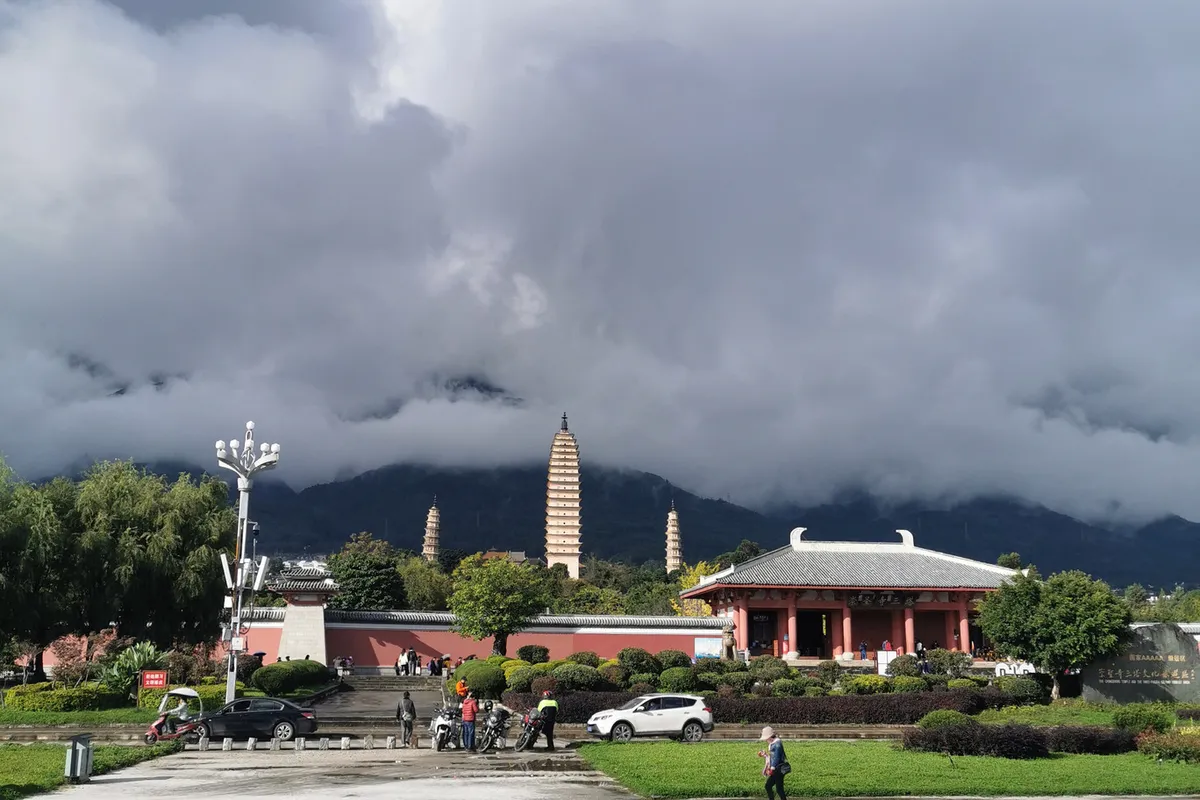
Chongsheng Temple's Three Pagodas are located northwest of the Dali Ancient Town, facing Cangshan's Yingyue Peak to the west and Erhai Lake to the east, about 1,500 meters from the mountain’s foot. The three pagodas consist of one large and two small structures. The large pagoda is called Qianxun Pagoda, known locally as the 'Wenbi Pagoda' (Literary Brush Pagoda). The three stand like tripod legs: Qianxun Pagoda in the center, flanked by the two smaller ones to the north and south. After the Nanzhao period, the Dali Kingdom saw Buddhism flourish even more, earning the names 'Buddhist Kingdom' and 'Land of Fragrance.' Once built, Chongsheng Temple became the center of Buddhist activities during the Nanzhao and Dali periods. Among the 22 emperors of the Dali Kingdom, nine reportedly became monks at Chongsheng Temple. These nine monk-emperors were: Duan Siying, the second king; Duan Sulong, the eighth; Duan Suzhen, the ninth; Duan Silian, the eleventh; Duan Shouhui, the thirteenth; Duan Zhengming, the fourteenth; Duan Zhengchun, the fifteenth, father of Duan Yu in Jin Yong's 'Demi-Gods and Semi-Devils'; Duan Zhengyan, the sixteenth, who is Duan Yu himself; and Duan Zhengxing, the seventeenth king. Our second stop was Xizhou Ancient Town.
Xizhou is located 18 kilometers north of Dali Ancient Town, with Erhai Lake to the east and Cangshan Mountain to the west. It’s an important Bai ethnic town, home to the largest and best-preserved traditional Bai residential complexes. Architecturally, they follow the typical Bai courtyard layout of 'three rooms and a screen wall' and 'four courtyards with five skylights.' The heart of Xizhou is Sifang Street, a small square surrounded by shops. There stands a stone archway, the recently built 'Wenming Fang' (Civilization Arch). Xizhou also serves as the administrative seat of the township. Even before the Nanzhao moved to the Erhai area, this was the settlement of the 'He Man,' ancestors of the Bai people. The third stop was Butterfly Spring.
Butterfly Spring features a pool of water as clear as a mirror. Every year during the Butterfly Gathering, thousands of butterflies flutter in from all directions, dancing over the spring. Some are as large as a palm, others as small as a copper coin. They hook legs and antennae, head to tail, forming chains that hang from the silk trees down to the water’s surface—a dazzling, spectacular sight. Butterfly Spring is a famous scenic spot with beautiful scenery, crystal-clear water, and this unique natural wonder (the Butterfly Gathering). With the classic Bai-themed film 'Five Golden Flowers,' the fame of Butterfly Spring spread far and wide. However, despite its fame, once you actually arrive, it can be a bit of a letdown. The butterfly spring you see in the movies differs vastly from reality. The spring is small (though surprisingly deep at 7 meters), not as crystal-clear as depicted, and crowded with people taking photos. Still, the surrounding scenery is pleasant, making it a fine spot for quiet retreat. Oh, a friendly tip for friends from Shanghai Pudong: entry is free for you! The fourth stop: Shuanglang Ancient Town.
Shuanglang is in the northeast of Dali City, on the northeastern shore of Erhai Lake, with Binchuan’s Jizu Mountain to the east, Wase Town to the south, Erhai Lake to the west, Shangguan Town to the north, and Huangping Town of Heqing County to the northeast. It is named 'Shuanglang' (Double Corridors) because Luoshi Curve lies to its north, Lianhua Curve to its south, and the two islets, Jinsuo and Yuji, nestle between them. Standing on the high ridge east of town, you can gaze down at the deep blue Erhai Lake, with Shuanglang town and Nanzhao Customs Island spread before you. In the distance, Cangshan Mountain is especially beautiful against blue sky and white clouds. Here, water and sky merge, green mountains layer, and guesthouses shimmer with lakeside views. Jinsuo Islet’s brocade, the 'two isles and two curves,' combined with the elegant, Bai-flavored old town, create a perfect picture. Shuanglang is celebrated as one of the most livable towns, praised with the saying, 'The best scenery of Dali is between Cangshan and Erhai, and the best of that is in Shuanglang.' On the Customs Island, the Duan Prince Mansion and dancer Yang Liping’s villa are must-see spots for visitors. Because of time, we only had a quick tour and headed back. On the way back, one of the ladies in our group accidentally fell off her e-bike, giving us all a huge scare. Fortunately, she only had some scrapes and a sprain, so she’d probably need to rest for a couple of days. The full loop around Erhai Lake was about 150 kilometers. It was my first time riding such a long distance. We set off at daybreak and returned after dark—truly exhausting!
The second day in Dali, we headed to Cangshan, Dali Ancient Town, and the Tianlongbabu Film City. To visit Cangshan, we took the 'Ximatan Cableway.' The weather was absolutely uncooperative—thick fog again! I almost suspected we’d been transported to Chongqing, the fog capital. The cableway ride took over an hour, and while it was sunny and warm at the foot, once we got up, we could see nothing. It was windy and cold. Cangshan's altitude is 3,962 meters; a few of us made it to the 3,920-meter mark but decided not to go further. It was freezing, and there was no point—the fog blocked everything. Forget about Ximatan Lake; we probably wouldn’t even find the boardwalk. So we gave up and took the cableway down. At the midway transfer platform, the sun was shining brightly, and we excitedly took photos. The Tianlongbabu Film City wasn’t much to look at. It was built for the 1987 TV series 'Demi-Gods and Semi-Devils,' and admission was included with the round-trip cableway ticket. As we were leaving, we stumbled upon a performance and watched for about five minutes—nothing special. As for Dali Ancient Town... sigh, what a disappointment. I’d heard it was more fun than Dayan Old Town, but once there, I realized it couldn’t compare. It was just too modern, utterly lacking any old-town charm. We gave up on it.
On the second day in Dali, we went to Lijiang. A quick note: Lijiang was a last-minute addition—not in the original plan. But since we were already in Dali, and Lijiang wasn’t far, we figured we might as well tick it off. So off we went. For me, it was my second visit; I’d been there in 2014 and stayed about a week, so this time I could act as a 'tour guide,' hehe. In our group, four had been before, but most hadn’t. I led them from the South Gate through Sifang Street to the highest point in Lijiang, where we could see Jade Dragon Snow Mountain and a full view of the ancient town. Then we hit the iconic 'Big Waterwheel' for photos. No matter what, at least we could say we’d been to Lijiang!
With the Dali leg behind us, we drove 350 kilometers back to Kunming’s Fuxian Lake. This turned out to be a pleasant surprise—the best accommodation of the whole trip, and the scenery (Moon Bay Wetland Park) was fantastic, very much like Sanya in Hainan. With sandy beaches, coconut trees, and lapping waves, it was incredibly pleasant—romantic yet full of charm. Couples were everywhere taking wedding photos, especially shooting sunset silhouettes, which got us all incredibly excited! I highly recommend Fuxian Lake to future travelers, and stay at Shangjia Hotel (Fuxian Lake Lake View Branch).
The final stop (originally we’d planned to visit Jiaozi Snow Mountain, but we canceled because it wasn’t cold enough yet and there was no snow) was Dongchuan Red Land. It wasn’t far from Fuxian Lake—about 200 kilometers—though after reaching Dongchuan, we had to take around 30 to 50 kilometers of mountain roads, which made us feel a bit carsick. Once at the Red Land, we set out to explore. The owner of Red Land Summer Inn was wonderful. We hadn’t even arrived yet but had already gotten in touch because we didn’t know the roads inside the scenic area. She guided us over the phone and sent us her location—super helpful. Sadly, the weather was once again against us: thick fog. Up close, things looked okay, but anything in the distance was invisible. Fortunately, the weather improved a little in the afternoon, and we managed to take some photos, though we missed the sunset we’d hoped for. The innkeeper is the only college graduate in the village; after her studies, she returned to help her family run the guesthouse. She’s smart and down-to-earth, genuinely kind. I highly recommend staying at her place if you visit. Seriously, think about it—we came in the off-season, when there were barely any tourists in the village, yet her inn (a four-story building with about a dozen rooms) was fully booked. Doesn’t that say it all!
As our trip neared its end, we returned to Kunming and visited Cuihu Park and the adjacent 'Yunnan Military Academy.' The Yunnan Military Academy was the starting point of Marshal Zhu De’s military career, and it also houses precious historical records and photos of the Chinese Expeditionary Force. The seagulls at Cuihu Park were a second encounter for me; on my last visit in 2014, I’d only seen them at night when they’d already returned to their nests. This time, I finally got to see them during the day and took loads of photos, hahaha!
One last thing: the dog with a bell and the old man you might see in photos were local internet celebrities. Sadly, the dog is still there, but the old man is no longer with us. We actually stayed right next door to where that famous old man lived.


