A Road Trip through Northwest Yunnan
Photos and text by Meng Xi
The journey began at Jade Dragon Snow Mountain. To be honest, I’ve never really felt drawn to Lijiang over the years. I guess it’s because my impression of Lijiang has always been its old town packed with noisy bars. As someone who enjoys solitude, a life of bright lights and late nights just doesn’t appeal to me, so I’d never put Lijiang on my travel list. That changed this April when a quick work trip took me there. A hurried glance was enough to show me that beyond the old town, the natural scenery around Lijiang was equally dazzling. Time was tight then, so I planted a wish deep in my heart: I had to come back and do a road trip around Lijiang. Now, that wish has finally come true.
Since Jade Dragon Snow Mountain was the whole reason for this trip, I chose to stay on the tourist road leading to the mountain rather than in the old town. I found a hotel inside the Dongba Valley Scenic Area, which was within my budget and as close to the mountain as possible. Dongba Valley is a stop on the tourist circuit, but I wouldn’t really recommend it – it felt like a place overtaken by tour groups, and the scenery and facilities were a bit underwhelming.
The hotel, though, was styled like an old town and offered a direct view of Jade Dragon Snow Mountain right from the property. Unfortunately, the first few days after my arrival, the weather was utterly uncooperative; the mountain was rarely visible, and I could only pass the time taking photos around the hotel.
Since flying drones is forbidden in Lijiang Old Town, these buildings here let me finally get some aerial shots.
Especially when the lights came on at dusk – it looked like a scene straight out of a TV drama.
Getting thoroughly bored hanging around the hotel, I decided to take the car out for a spin. I picked Baisha Ancient Town, only a ten-minute drive away – the one and only ancient town I visited on this trip to Lijiang.
Baisha Ancient Town lies about 10 kilometers north of Lijiang proper, with Jade Dragon Snow Mountain to its north, Longquan to the south, and Zhi Mountain to the west. It’s the ancient capital of the Naxi people and a world-class “Ancient Naxi Kingdom,” once the political, economic, commercial, and cultural heart of Lijiang for the Naxi.
As one of the crucial cradles of Naxi culture, it was here that the Mu clan of Naxi chieftains honed their town-planning skills. What’s more, Baisha is considered the birthplace of the Mu family’s regime in Lijiang. This ancient town preserves the strongest flavor of Naxi heritage – it’s the most authentic and unspoiled Naxi village.
The “Three Dog Brothers” of the old town.
Out of Lijiang’s three ancient towns, Baisha is probably my favorite. It sees very few visitors, parking is easy and free just outside, and even though I hadn’t planned on visiting any old towns, I was so bored on those cloudy, rainy days with no mountain view that I drove over since it was so close.
From 9 a.m. to 5 p.m., vehicles are not allowed inside the town. Combined with the sparse visitors, you get the feeling of having the whole place to yourself. Along the main street, many local elderly women sell mountain goods. There are pine cones bigger than my hand, packed with pine nuts, for just ten yuan each. You can also sample all sorts of snacks like rice noodles and bean curd chicken – at prices way cheaper than in other old towns.
After wandering for a while, I found an open space and flew my drone over Baisha Ancient Town. It turned out to be quite large – the rows of intensely local architecture scattered about had a truly captivating feel.
You could just about make out a trace of the snowy mountain, and it was easy to imagine how happy the people living here must be seeing that view every day.
Towards evening, the clouds began to part, but shy Jade Dragon Snow Mountain still refused to show itself. A thick layer of cloud sat on top like a hat, and the mountain absolutely would not take it off in front of me. I had no choice but to head back to the hotel, get cleaned up, and go to bed, hoping for a surprise the next morning.
The next day, the mountain did reveal itself to me. I went straight into the scenic area, took a shuttle bus, then a cable car to the halfway point to admire it up close. To be honest, seeing a snowy mountain from nearby is not nearly as impressive as from a distance. It was freezing up there too. Watching hordes of tourists in rented red down coats, oxygen bottles in hand, taking group photos at the Jade Dragon Snow Mountain monument – that’s not how I like to travel. So I decided to head back down and just enjoy the view from afar.
This was where the cable car reached; you could keep hiking up, but since I’m not much of a hiker, I passed.
Clouds rolled back in quickly at the foot of the mountain. That’s when I chanced upon my first rainbow in Yunnan. The odds of seeing one here are pretty high, but I still excitedly captured it.
I parked on some open ground, sat on the grass, and watched cows and sheep grazing lazily, feeling the shifting light and shadow as the wind moved the clouds. I comfy-basked in the sun, far from the crowds. That’s the way I like to travel, and it’s one of the reasons I love road trips – you can enjoy the journey at your own ease and convenience. I picked a favorite playlist on the car’s infotainment screen, reclined the seat, and lay back comfortably for a while.
From the screen, you can see that the 2021 VV5’s intelligent connected system really suits young people’s habits. The interface is highly design-conscious, with a youthful, dynamic theme. Mainstream video apps like iQIYI are integrated into the system too, significantly boosting the entertainment factor.
Having seen Jade Dragon Snow Mountain, I decided to head towards Shangri-La, to see that ‘sun and moon of the heart.’
The various lakes at the foot of Jade Dragon Snow Mountain, all different sizes, are quite intriguing. I kept wondering if they were natural or man-made. Later, a local explained that they were artificially created to help regulate Lijiang’s climate – a bit mysterious but impressive.
Actually, the reflections in these lakes are stunning, but you usually have to photograph them in the early morning; afterwards, the wind blows all day and reflections are impossible to catch.
From Lijiang to Shangri-La, you currently can only take the national highway. They say the Lijiang–Shangri-La expressway will open by the end of the year, so then you won’t need to drive cautiously along the winding highway. Departing from Lijiang, switch from National Highway 355 to National Highway 214; it takes about four hours to reach central Diqing. With only one route available, traffic can be heavy. Especially the first half of 355 goes uphill and the second half downhill – never speed or change lanes recklessly. On 214, the road widens considerably, but if it’s raining, low clouds can envelop certain mountain pass sections, cutting visibility drastically. Drive with extreme care.
Sure enough, I ran into dense fog on this stretch. I saw with my own eyes a sedan drive off the road ahead – luckily it was the inner side; if it had been the cliff side, the consequences would have been unthinkable. Since visibility was so poor, I simply pulled over in a safe spot, launched my drone, and started taking aerial photos. The fog drifted through the mountains, and the autumn-colored hills peeked in and out of the mist. Before my eyes appeared a painted landscape of vibrant colors.
When the fog lightened a little, I drove on. Another surprise struck: a full rainbow stretched across my path. I quickly pulled off to photograph it.
Initially, I rolled down the window to snap the rainbow with my camera, but rain was still falling, and the interior was getting soaked. I had to close the window and send the drone up instead.
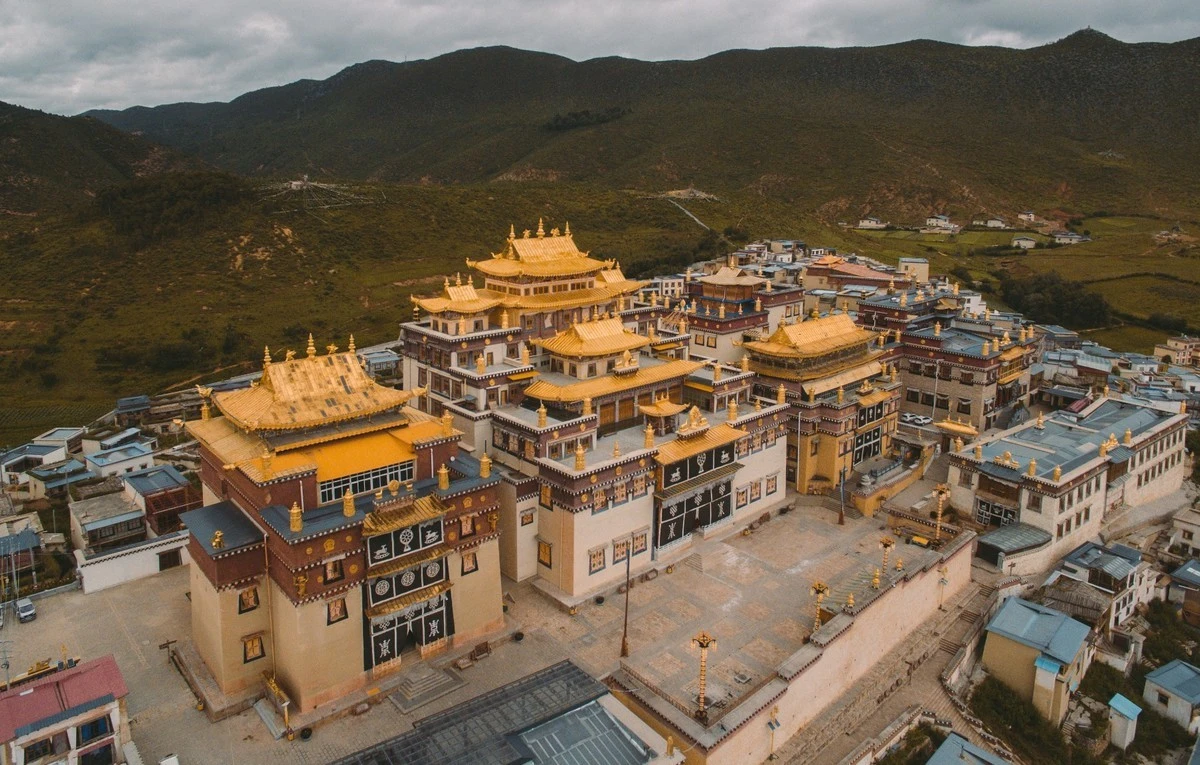
After photographing the rainbow, I arrived in Shangri-La. When you mention Shangri-La, you have to talk about Songzanlin Monastery, the largest Tibetan Buddhist monastery in Yunnan Province. It’s also one of the famous monasteries in Kham and the centre of the Gelug (Yellow Hat) school in the Sichuan–Yunnan region. Holding significant status across the Tibetan world, it’s often called the ‘Little Potala Palace.’ Built into the mountainside, the monastery resembles an ancient fortress – a masterpiece of Tibetan plastic arts, earning it the nickname ‘Tibetan Art Museum.’ Songzanlin is now within the no-fly zone of Diqing Airport, so you can’t fly drones here anymore. Here are a few aerial shots I took many years ago.
This is the Songzanlin Hotel behind the monastery.
The golden roof of Songzanlin Monastery.
The monastery compound is enclosed by an oval wall. The main hall is majestic and gorgeous, with vividly coloured interior murals executed in fine brushwork, mainly depicting historical events and promoting Buddhist teachings. The two main temples, Zhacang and Jikang, sit at the highest point, at the heart of the complex. Facing south, the five-storey building is a Tibetan-style carved-wood structure. The upper part of the main hall has gilded copper tiles, and the roof corners feature Han-style animal-shaped ornaments and upturned eaves, blending Han temple architecture. The ground-floor hall is held up by 108 pillars – an auspicious Buddhist number – and can accommodate 1,600 people. The left and right walls are lined with ‘Ten Thousand Scroll Cabinets’ of scriptures. In the front of the main hall is a bronze statue of the Fifth Dalai Lama, with stupas containing the remains of eminent monks arrayed behind. On the top floor, a special sutra room and Buddha hall houses statues of the Fifth and Seventh Dalai Lamas, along with palm-leaf scriptures, thangkas, and ancient ritual objects.
Songzanlin photographed from the direction of Songzanlin Hotel.
Though drone flights are banned now, I can tell you the best vantage point for viewing Songzanlin: from Diqing, drive towards Napa Lake, and you’ll find an area under construction on the hillside. It’s the very best spot for a high-angle shot of the monastery.
As great as this spot is for seeing Songzanlin, the smell there is something else entirely. Cow dung or something else – a weird odour. But I stayed in my car the whole time. The 2021 VV5 is equipped with a CN95-grade air-conditioning filter that can screen out 99% of germs, creating a clean cabin environment and letting you breathe safely. After pulling over and getting out to shoot, I used the WEY app on my phone to remotely turn on the cabin-cleaning function before I got back in, so after putting up with the strange smell outside, I had fresh air to enjoy.
If the weather had been perfect, I would have loved to shoot a sunset time-lapse from here.
The 2021 VV5’s steering wheel is just the right size; holding and turning it while driving feels extremely natural.
A ten-minute drive from this viewpoint brought me to Napa Lake.
The lakeside road along Napa Lake.
Napa Lake is the largest grassland in Diqing County. Thanks to the reserve’s humid climate, grass grows faster here than in similar areas. By May, other grasslands may just be sprouting tender shoots, but Napa’s meadows are already lush and green. At the start of June, all sorts of wildflowers bloom, competing in colour across the vast prairie. Herds of cattle and sheep bob amid the grassy waves, as if floating on the sea. Everywhere on these boundless fields is the classic steppe scene: “the wind blows low, revealing cattle and sheep.” To the west, the Shika, Shika, and Xinyala snow mountains proudly stand. Snowy peaks, grasslands, and livestock form a slice of northern-border scenery in the far southwest. At this season, the hillsides are a riot of colours; though the grassland has yellowed, the hues are still spectacular. Plus, there are very few people at Napa this time of year. Driving along the lakeside road, windows down, letting the cool autumn breeze slap my face – the feeling is wonderfully freeing.
The scattered red leaves on the mountain and the Tibetan-style houses complement each other beautifully.
This is a completely different kind of scenery from Erhai Lake in Dali. On the grassland, cows and horses graze at leisure. You can also accept an invitation from local herders to go galloping on horseback towards the lake – for a fee, of course. But for someone who has never ridden, it’s a great experience, and during the low season, you can bargain; for a reasonable price, the herder will let you have a go.
Above Napa Lake there’s also a road leading to a botanical garden that is equally beautiful, with a viewing platform where you can overlook the whole lake.
I really adore the front grille of the 2021 VV5. The imitation electroplated finish makes it look shinier and more youthful.
As for the gear shifter design on the 2021 VV5, I have a minor gripe. While shifting is comfortable, I’m very much not used to the P (Park) being a separate button. Several times when parking, I mistakenly put it in R (Reverse) thinking it was P. Thankfully, the reverse camera image pops up on the centre screen instantly, so I could quickly catch my mistake.
This road winds for several kilometres up to a mountain village – hugging the mountain face the whole way.
My road trip through Northwest Yunnan is now only half told. In the next chapter, I’ll share a story full of legend and take you to an utterly breathtaking secret spot. Stay tuned.


