A Return Trip to Northwest Yunnan
Before the 2018 Spring Festival, A Li kept pondering: How should I spend the holiday? Should I just buy groceries, cook, do laundry, mop the floor, watch TV and sleep the days away like before?
She consulted her grown-up daughter, who suggested going traveling!
This suggestion was exactly what A Li’s heart desired! It fully proved that a daughter is her mother’s warmest little cotton jacket!
But where to go? There were simply too many places A Li yearned to visit!
Her little cotton jacket mentioned the places A Li had toured with colleagues after the 2017 Spring Festival—Lijiang, Shangri-La, Lugu Lake—and brought up the log cabin built by the Mosuo people that A Li wrote about in her travelogue ‘A Tour of Northwest Yunnan: Traveling in a Painting, in a Dream’, especially the whole cured fat pig placed in front of the cabin door! —She really wanted to see that wooden house with her own eyes, and that huge fat pig beneath it!
Alright, we’ll go to Northwest Yunnan then, to see that wooden house and that cured fat pig!
On New Year’s Day 2018, A Li booked a seven-day, six-night group tour covering Lijiang, Shangri-La and Lugu Lake online.
Late at night on February 13 (the 28th day of the twelfth lunar month), A Li and her little cotton jacket took a red-eye flight direct to Lijiang, arriving in the wee hours of February 14. After checking in at the hotel and resting just a few hours, they boarded a tour bus and headed toward Lugu Lake.
1. Revisiting Lugu Lake
On the afternoon of February 14, 2018 (the 29th day of the twelfth lunar month), we arrived at Lugu Lake.
The sky remained breathtakingly azure, the sunshine still dazzling; Lugu Lake still resembled a sapphire set among the mountains, white gulls and black wild ducks still frolicked on the water; the Gemu Goddess Mountain still lay quietly on the northern shore, guarding her people; the Mosuo people still lived in log houses and rowed their brightly colored, flamboyant pig-trough boats across the lake.
The difference was, last year when we went boating on Lugu Lake, gentle breezes stirred barely a ripple. We circled the Liwubi Island once and easily landed, visited the Liwubi Temple, and from the island’s highest point overlooked the colorful pig-trough boats gliding across the lake, leaving silver ripples on the blue surface. This year, however, as we rowed out, a strong wind whipped up green waves. Though the white gulls enthusiastically circled us, snatching bread thrown by tourists, the local rowers at the bow and stern soon discussed with everyone whether to turn back: The wind was too strong, and all the other boats had already turned toward shore! Safety first—we could only gaze at Liwubi Island from afar before heading back.
Although we didn’t fully enjoy the boat ride, our later strolls along Lover’s Beach and the Lige Peninsula more than made up for it. Lover’s Beach is said to be the meeting place of the local Goddess Gemu and her lover, the God Houlong. And this day happened to be Valentine’s Day, with several couples in our tour group—strolling along Lover’s Beach couldn’t have been more fitting. The sandy beach was flat and pristine, the lake stretched out in full view, and a tall tree by the shore was abloom with flowers. Couples posed for photos on the beach, while A Li and her little cotton jacket lingered underneath the flowering tree, dipping their hands in the water.
Lige Peninsula lies in the northwest corner of Lugu Lake, like a giant crocodile swimming from the shore toward the center, its slender tail still touching the bank while its head and body float on the water. Except for its top, the peninsula is densely packed with houses. Last year, A Li, like most tourists, simply gazed at Lige Peninsula from the observation platform by the road, feeling it was stunning enough. This time, however, she wasn’t content with a distant view alone. She followed a small path down to the lakeshore and admired it from various angles—and every angle presented a flawless ink-wash painting.
That night we stayed in Xiaoluoshui Village on the northern shore of Lugu Lake, right at the foot of Gemu Goddess Mountain, facing the vast lake. Last year we had lodged in Daluoshui Village on the southwestern shore, opposite the goddess mountain. After enjoying the lively Mosuo walking-marriage feast, A Li and her little cotton jacket skipped the bonfire party they had watched the previous year. Instead, they wandered along the tranquil lakeshore, soaking in the serene elegance of the ink-wash landscapes unfolding before them, and marveling at the vast, starry sky!
February 15 was Chinese New Year’s Eve. After breakfast, the guide took us for a Mosuo home visit.
Last year A Li also joined a Mosuo home visit, which was simply lunch at a Mosuo family’s house by the roadside. During that visit, she admired the local log houses and saw the cured fat pig placed under the window outside. This year’s home visit offered no meal but lasted an entire morning. A beautiful young woman in ethnic attire, who claimed to be a cultural representative of the local village, greeted us at the parking lot. She led us into the village, into a two-story wooden house with “XXX Home Visit Garden” written on the door. We entered the grandmother’s room on the ground floor and each sat primly on the small stools already arranged inside.
The cultural representative, who spoke excellent Mandarin, first explained Mosuo culture, focusing on the walking-marriage custom. Then she shared local remedies: using silver bowls, cups, chopsticks, combs, belts, bracelets and other silver items could cure many diseases—no need for hospitals at all. Next she demonstrated on the tourists: She scraped the faces of willing female group members with her silver bracelet—a few beauties’ faces instantly showed black streaks, and the representative said their cosmetics contained lead. She combed a male traveler’s head with a silver comb, and he immediately felt refreshed and invigorated. She soaked the back of a silver comb in silver-infused water from a pot with a silver cup and scraped the neck of an older woman suffering from cervical spine issues—her neck quickly turned red and black. Everyone listened with rapt attention, occasionally exclaiming in wonder; but A Li grew more and more confused: How could this cultural representative’s words and actions be so strikingly similar to the cultural representative she had encountered at the Tibetan village in Duji Water Village on the Jiuzhaigou–Huanglong route two years earlier?
On the morning of June 23, 2016, A Li and her tour group were taking a bus from Jiuzhaigou back to Chengdu, when the guide led them to Duji Water Village for a Tibetan home visit to learn about Tibetan culture. The parking lot was packed with tour buses, and before each bus stood a young woman in Tibetan attire, fluent in Mandarin, who served as a cultural representative welcoming visitors from various regions. A Li couldn’t help but marvel: This Tibetan village was truly remarkable, with so many dignified, graceful girls! The representative assigned to A Li’s group was a not-too-tall but very fair-skinned Zhuoma. She led everyone into a brand-new house—she said it was her family’s new home, but they hadn’t moved in yet and were still living in the old one. In the ground-floor living room, stools were likewise neatly arranged. After the group sat, Zhuoma began to explain Tibetan culture, emphasizing the culture of almsgiving: Tibetans donate one-third of their annual income to temples—how can one receive without giving? Then she started sharing various Tibetan home remedies: using silver bowls, cups, chopsticks, combs, belts, bracelets and other silver items could cure many diseases! The arguments were clear, the evidence abundant, the reasoning rigorous, and the emotion sincere. Afraid she might not remember all these miraculous and effective remedies, A Li quickly took out her phone and started recording for future reference (Zhuoma had instructed everyone not to take photos indoors to avoid blasphemy, but hadn’t prohibited recording). After finishing the remedy lecture, Zhuoma demonstrated by scraping several tourists with a silver bracelet, drawing gasps from the crowd. Finally, Zhuoma led the believing tour group to a large house not far away, filled with all kinds of silverware said to be meticulously handcrafted by local artisans—there, Zhuoma instantly transformed into a warm and attentive saleswoman. Tourists vied to buy silver bowls, cups, chopsticks, bracelets and more. A Li, whose pocketbook was thin, was merely pulled in to try on a few silver bracelets. She watched the bustling scene without spending a single penny, failing to contribute even slightly to the local economy! She felt deeply ashamed.
A Li, however, never imagined that on November 3 and 4, 2016, CCTV News would expose the tourism scams along the Jiuzhaigou–Huanglong route for two consecutive days! She then learned that Duji Water Village, Dejimeduo Folklore Street, the Tibetan medicine shop and the local specialty shops on this route all belonged to the same parent company. The silverware was bought cheaply in Yunnan and sold at high prices to tourists. All purchases yielded kickbacks to the travel agency and guides, and the kickback system was entirely controlled by the company’s headquarters sales department. A Li therefore guessed those beautiful cultural representatives were merely employees of that company, not ordinary girls from a local Tibetan village.
Last year, when A Li visited Lugu Lake, she hadn’t met a local cultural representative, so she hadn’t gained an in-depth understanding of Mosuo culture. This time, however, the remedies shared by this Mosuo cultural representative were identical to those from the Tibetan cultural representative in Duji Water Village. Would she next pitch silverware to the group just like that Tibetan Zhuoma?
As A Li was recalling the Duji Water Village story, the beautiful Mosuo girl, after over an hour of cultural presentation, lifted the cloth on a large table beside her, revealing all manner of gleaming silver bowls, cups, chopsticks, combs, belts, bracelets and more! Tourists rose to their feet, examining the treasures and haggling. Her little cotton jacket tugged at A Li’s sleeve, gazing eagerly at her mother, her eyes full of longing for the silverware! (Later, she said she had especially wanted to buy a silver comb and a pair of silver chopsticks!) A Li quickly pulled her up, asking her to accompany her to find the restroom outside. Once out of that bustling grandmother’s room, A Li told her little cotton jacket the story of Duji Water Village, then took out her phone and played the recording of those Tibetan remedies from before—A Li had always thought those remedies were gems of Tibetan medicine and had been reluctant to delete that passionate recording. After listening to the recording, her daughter resisted the lure of the silverware and began to notice the exquisite craftsmanship of the wooden house, the tempting rows of cured meats, sausages and trotters hanging under the eaves, and—on a table below those rows—a whole cured fat pig! Everything the little cotton jacket had longed to see appeared before her at once. The temptation of silver bowls, cups, chopsticks, combs, belts and bracelets quickly vanished from her mind; she simply admired the wooden house and the cured fat pig. A Li, meanwhile, browsed the local specialties at the courtyard stalls and chatted with Mosuo aunties, girls and young men whose Mandarin was not fluent. In the end, she bought a few jin of walnuts and two packs of buckwheat tea, contributing a small effort to the local economy.
The intriguing Mosuo home visit lasted from around eight in the morning until nearly eleven. Everyone came away with something; the guide was beaming and happily led the group to visit the Walking-Marriage Bridge on the Grass Sea.
When A Li visited the Grass Sea last year, the sun hid shyly behind the clouds, refusing to show itself. Today, revisiting the same spot, the sun warmly welcomed her along with blue skies and white clouds, making the lake waters shine deep blue and the dead grass glow golden. Everything in sight was a vibrant oil painting. The Walking-Marriage Bridge, known as ‘the number-one lovers’ magpie bridge under heaven,’ is not straightforward like others: it spans the Grass Sea from bank to bank, its 300-meter-long body curving in an S shape, just like a graceful dancer twisting her waist.
How could A Li not be utterly enchanted?
Lugu Lake is well worth a return visit!
After lunch, our tour bus headed back to Lijiang, bringing the Lugu Lake journey to a perfect close! A Li now eagerly looked forward to tomorrow’s tour of Lijiang.
Lijiang, how would you welcome us?
2. Revisiting Lijiang
February 16, 2018, the first day of the Lunar New Year. Simple and hospitable Lijiang treated us with its beautiful scenery, rich activities and warm service, making A Li and her little cotton jacket thoroughly joyful for the whole day and laying a solid foundation for a whole year of happiness.
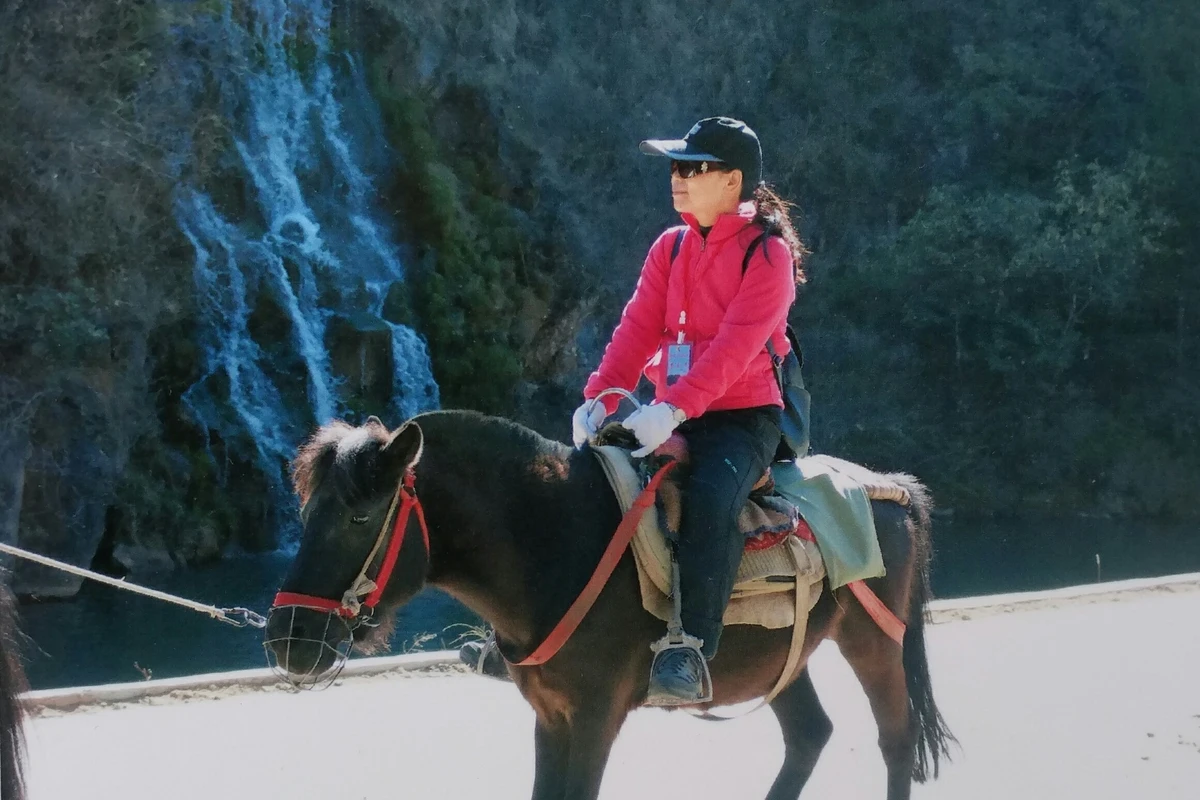
In the morning, we rode horses along the Ancient Tea Horse Road and enjoyed the delight of horseback riding.
Even though it was the first day of the new year, the number of tourists who came to ride was huge, so we had to wait a while at the equestrian ranch. In films and TV, horses leave an impression of being tall and handsome, but the Yunnan ponies before A Li were small and gentle—the horse handlers explained: Yunnan is mountainous, and smaller horses are better suited for carrying loads along steep, narrow mountain paths. It was the first time for both A Li and her daughter to ride, but their mounts were very obedient and walked steadily. Over the hour-long ride, even when climbing, descending or threading through dense forests, the horse never caused a moment of fright.
After horse riding, we went boating on Lashi Lake and experienced the joy of rowing. Again the place was packed with visitors, but we didn’t wait long before boarding a boat smoothly. Sailing against the spring breeze and cutting through the waves on the emerald Lashi Lake was truly refreshing.
In the afternoon, we visited Shuhe Ancient Town to savor its charm. Having learned from last year’s experience, A Li led her little cotton jacket upstream along the canal directly toward the west part of the town. All along the way, water burbled, flowers bloomed in profusion, and trees formed pleasant shade, until we finally reached Jiuding Longtan (Nine-Dragon Pool).
After Shuhe Ancient Town, we rushed to the Old Town of Lijiang. Last year, at every entrance to the old town, staff members stood checking whether tourists had paid the eighty-yuan Old Town Preservation Fee. This time, A Li didn’t see any fee collectors, only endless streams of visitors—Could it be that because it was New Year’s Day, the staff had the day off? No answer!
Last year, A Li and her friends stayed four nights near the Old Town and managed to stroll through it three times in the early morning, afternoon and evening during spare moments, but each visit was hurried and she failed to see the famous Mu’s Residence. The Mu’s Residence at the foot of Lion Hill had been the mansion of the Mu family, who served as hereditary local chieftains of Lijiang for over two hundred years. Hailed as the ‘Grand View Garden’ of Lijiang Old Town culture and the filming location of the hit TV series ‘The Storm of Mu’s Residence,’ it is even said: ‘To visit Lijiang without entering Mu’s Residence is not to have truly visited Lijiang!’
This time, A Li didn’t want to leave with that regret again. So she and her daughter weaved swiftly through the crowds in the old town and finally arrived at Mu’s Residence before it closed. The ticket sellers hadn’t taken a holiday, but due to the Spring Festival, the admission was discounted—originally sixty yuan, now twenty percent off.
Stepping into Mu’s Residence felt like entering the Forbidden City—the mansion was modeled after the Forbidden City in Beijing. The grandeur of its architecture, the splendor of its halls, the intricacy of its carvings, the delicacy of its components and the brilliance of its paintings made visitors marvel and linger in awe!
By the time we finished touring Mu’s Residence, it was around six in the evening. The main gate was closed, and we exited through a side door. The afterglow of the setting sun spread a golden sheen over the wooden structures. Accompanied by the sunset, we threaded through ancient lanes, following flagstone paths and small canals out of the old town, back to Red Sun Square and to our hotel behind the tall, kindly statue of Chairman Mao, waiting for tomorrow’s journey to Shangri-La.
Shangri-La, how would you welcome us?
3. Revisiting Shangri-La
February 17, 2018, the second day of the Lunar New Year. Before half past six in the morning, we arrived at Red Sun Square to wait for the tour bus. The streets were nearly empty; only the benevolent statue of Chairman Mao still stood on the square, waving to us.
The bus soon arrived and whisked us off toward Shangri-La!
Around ten in the morning, we reached Tiger Leaping Gorge. The sunshine was just as brilliant as last year, the sky just as blue, and Haba Snow Mountain and Jade Dragon Snow Mountain still wore their caps of snow. But the wind was different! It was no longer as balmy as last year—it was fierce, biting and merciless! The moment we got off the bus, it pounced on us with a huge, icy bear hug, sending everyone scurrying back to the bus to put on the cotton overcoats handed out by the guide over our own jackets. When we got off again, we all looked like tightly wrapped big red dumplings, clumsy and heavy! A Li and her daughter walked arm in arm, afraid that if they let go, the wind would blow them into the air. About one-third of the way down the gorge, the little cotton jacket suggested stopping and just overlooking the gorge from the viewing platform. A Li had descended to the bottom last year and seen the raging river and the man-made tiger statue, so she immediately agreed. So the two of them simply took a few ‘I-was-here’ photos on the platform before heading back.
Around two in the afternoon, we reached Pudacuo National Park. Shudu Lake was as charming as ever, but Militang Pasture and Bita Lake were already closed to visitors—the guide said it was to protect an endangered fish species there. A Li didn’t feel regret because she had visited them last year; her daughter didn’t feel regret because she had never been there and didn’t even know those places existed. Inside the park, the sky was blue, the water clean, the forests lush, patches of snow remained on the ground, and the boardwalk was level. Walking there, tourists were already mesmerized, not to mention a beautiful bird bouncing along the boardwalk, pecking at crumbs dropped by visitors!
Around five in the afternoon, we finished visiting Pudacuo National Park. As we walked out the gate, two cheerful little black pigs came grunting to greet us as if we were old friends, begging for food. The little cotton jacket, who naturally loved small animals, beamed and immediately took out bread to offer them. The little pigs, after all, had never gone to school or learned manners; unaware of the need for a good image, they impatiently and agilely leaped up to snatch the bread from her hand, almost biting her fingers. A Li reminded her daughter to drop the bread on the ground and not feed them by hand. After the bread was gone, the piglets still lingered for more, and the little cotton jacket was reluctant to leave too. But we had to attend the Tibetan chieftain banquet and experience Tibetan food culture! Little black pigs, we could only bid you farewell!
The Tibetan chieftain banquet that evening was truly sumptuous—the richest group meal of our entire trip: on the ground floor of the former chieftain’s mansion, a stage sat in the center, surrounded by dozens of tables, eight people per table, each with a personal small hot pot, and the table piled with hot-pot ingredients: yak meat, napa cabbage, tomatoes, tofu skin, vermicelli, etc. You could drink all the barley wine and yak butter tea you wanted, and eat as much tsampa and flatbread as you liked—as long as you enjoyed them! Waiters also frequently came by with extra dishes asking if you wanted more. It was a pity we couldn’t fully savor all these flavors; we only tried a little and stopped.
The song and dance performance after the meal was very lively. The host was a chubby, swarthy guy with braids, earrings and a short skirt. He was a good talker and singer, adept at interacting with the tourists and stirring up excitement. Not only handsome young men and beautiful women performed, but also a local elderly lady. Her powerful song drew thunderous applause and prompted countless guests to go onstage and present her with khata (ceremonial scarves)—as each tourist had received a khata from local beauties upon entering the chieftain’s house. The white khatas piled high around the lady’s neck, almost about to topple over. The bonfire party after that we skipped, as we were eager to return to the hotel and rest. In short, that night in Shangri-La was truly unique.
February 18, the third day of the Lunar New Year. The morning guide first took us to visit the splendid Shambhala Kalachakra Mandala, then to Dukezong Ancient Town. On the way to the ancient town, the guide spoke frankly and candidly to everyone, saying that he would soon take us to a Tibetan medicine shop for a visit and learning experience; those who needed could buy some precious local medicinal herbs. The items were absolutely genuine, just a bit pricey; buying them would contribute to the local economy and also bring him some income—he thanked everyone on behalf of the people of Shangri-La! Afterwards, the guide also shared some methods for distinguishing authentic herbs.
Arriving at the ancient town, we were led directly into a sizable Tibetan medicine shop. First, each of us was offered a complimentary cup of expensive saffron tea, then guided by numerous sales assistants to learn about the wondrous effects of various rare herbs. A Li and her daughter, wearing matching black caps, moved slowly with the crowd, listening and observing with unusual earnestness, unwilling to miss this once-in-a-lifetime opportunity to expand their medical knowledge.
Suddenly, someone tapped A Li on the shoulder. Thinking she had met an old friend far from home, she looked up in happy surprise—no old friend in sight, only a stern middle-aged man with a bluish birthmark on his face studying her. The man first introduced himself in fluent Mandarin as the resident Tibetan doctor of the medicine shop, then pointed at the girl and said, “Are you her mother? How can you be a mother like this? Your daughter’s complexion looks so unhealthy, and you do nothing?” Without waiting for A Li to answer, he led them away from the learning group to a vacant corner, asked the girl to sit down, checked her pulse, looked at her face, and shaking his head said to A Li, “Your daughter is extremely weak; she needs to be regulated immediately.” A Li nodded repeatedly, frankly saying her daughter studied very hard and often stayed up late. The Tibetan doctor immediately seized on it: “I can tell at a glance your daughter often stays up late. Staying up late is very damaging to the body; many celebrities have died suddenly because of it. Your daughter must be regulated quickly. If you trust me, I can write a prescription for you. Buy the medicines right here in the shop, and a few courses will restore her health!”
A Li could see the anger rising in her daughter’s eyes—the ‘divine doctor’ saying celebrities died from staying up late was basically cursing her! Before the doctor could finish his miraculous prescription, A Li resolutely interrupted him: “Thank you, but if my daughter is weak and needs to be regulated, I will take her to our local traditional Chinese medicine hospital!” The doctor was just about to write the prescription, never expecting such uncooperativeness from A Li. Shock spread over his face, and the bluish birthmark seemed to turn even bluer. Without caring about protocol, A Li made the excuse of needing to find the restroom, pulled her daughter along and walked straight out of the medicine shop, bringing the shop learning session to an early end.
In the ancient town, walking on the flagstone roads, we admired the ornately carved wooden houses on both sides while laughing about that strange encounter. The little cotton jacket was still somewhat irritated: That Tibetan doctor was so nasty—casually cursing others! A Li consoled her: That doctor must be regretting it now; he’d finally found a chance to make a big profit, and it fell through at the last moment!
After lunch, we were to return to Lijiang. The guide bid a reluctant farewell to everyone, thanking the group for supporting his work, as he himself was about to go on leave. A new guide who would take over tomorrow’s group accompanied us on the return trip.
On the way back, A Li suddenly remembered that the guide had collected their identity cards the day before and hadn’t returned them. She hurriedly asked other tourists; everyone then realized their IDs weren’t with them. They asked the driver, who didn’t know; they asked the new guide, who also didn’t know. Fortunately, one tourist had saved the previous guide’s phone number and quickly called him. The guide answered, saying the IDs had been sent along with the tour bus following behind us. Before reaching Lijiang, our bus stopped for a water break and wash; the bus behind finally caught up with us, and the IDs were safely returned to each of us!
In the evening, we arrived back safely in Lijiang, marking a perfect conclusion to our return visit to Shangri-La.
On February 19, 2018, the fourth day of the Lunar New Year, A Li and her little cotton jacket transferred via Guiyang and smoothly returned to their home in Wuhan.
The seven-day, six-night tour of Northwest Yunnan was over! Because of it, A Li’s 2018 Spring Festival was colorful, full of twists and turns, and brimming with delightful surprises.
What will future Spring Festivals be like?
Worth looking forward to!
2018/5/27


