Yunnan | Four-Day Tour of Lijiang Old Town, Shuhe Ancient Town, Baisha Ancient Town, and Jade Dragon Snow Mountain
Schedule: February 12, Kunming to Lijiang, afternoon tour of the ancient town.
February 13, Jade Dragon Snow Mountain, Blue Moon Valley.
February 14, Baisha and Shuhe ancient towns, return to Lijiang (Dayan) Old Town in the afternoon.
February 15, Lijiang back to Kunming, trip ends.
Accommodation: Hotel near the South Gate of Lijiang Old Town.
Expenses: 4100 yuan per person (round-trip high-speed train Kunming–Lijiang 350×2, hotel 750×3, tickets and electric carts at scenic spots 450, Didi/taxi fares 300, food 400). Hotel costs were quite high. Inns inside the old town would be cheaper, but they might be noisier. Most of the time we were out wandering, going back to sleep at midnight and leaving at 8 am, not sitting by the window enjoying the scenery.
Transportation: Didi, taxis...
Shopping: Not really recommended, prices are on the high side and quality is sometimes just average.
Tips: The air humidity is low, very dry, causing nosebleeds. UV rays are strong, so pay attention to sun protection, and sunglasses are a must. There is a big temperature difference between morning and evening; even during the day when the sun is shining, it's still cold in the shade, and the wind is chilly.
On the first day of the lunar new year, after lunch we rushed to catch the high-speed train, arriving in Lijiang at 4 pm. There is a bus from the train station directly to Lijiang Old Town, very convenient, only 7 km away.
We stayed near the South Gate of the old town. All buildings in the old town are restricted to two stories. The first-floor rooms have a small courtyard where you can enjoy the courtyard view; from the second-floor rooms the view is not far, just across a lane to other houses.
After putting down our luggage, we went into the old town to explore. No entrance fee was required; we just scanned a code at the gate to enter. I thought it was just a few streets and could be easily covered. But the old town is quite large, with intersections and alleys everywhere, and in the end, I had to open the navigation. On the first day of the lunar new year, there weren’t many people. The old town’s maximum capacity is 80,000, and on the afternoon of the first, there were only 5,900, less than 8%.
We had pan-fried dumplings at home at 11 a.m., so by this time we were hungry. Walking along, we smelled the free-range chicken rice noodles—so appetizing!
After eating and drinking our fill, we continued wandering.
Sifang Street: Located in the center of Lijiang Old Town, it is a hub with streets extending in all directions and peaceful alleys. It is said to have been laid out by the Mu chieftain during the Ming Dynasty in the shape of his seal. It was the most important hub on the Tea Horse Road. Since the Ming and Qing dynasties, merchants from everywhere gathered here, and cultures of various ethnic groups mixed and thrived, making it the center of economic and cultural exchange in Lijiang.
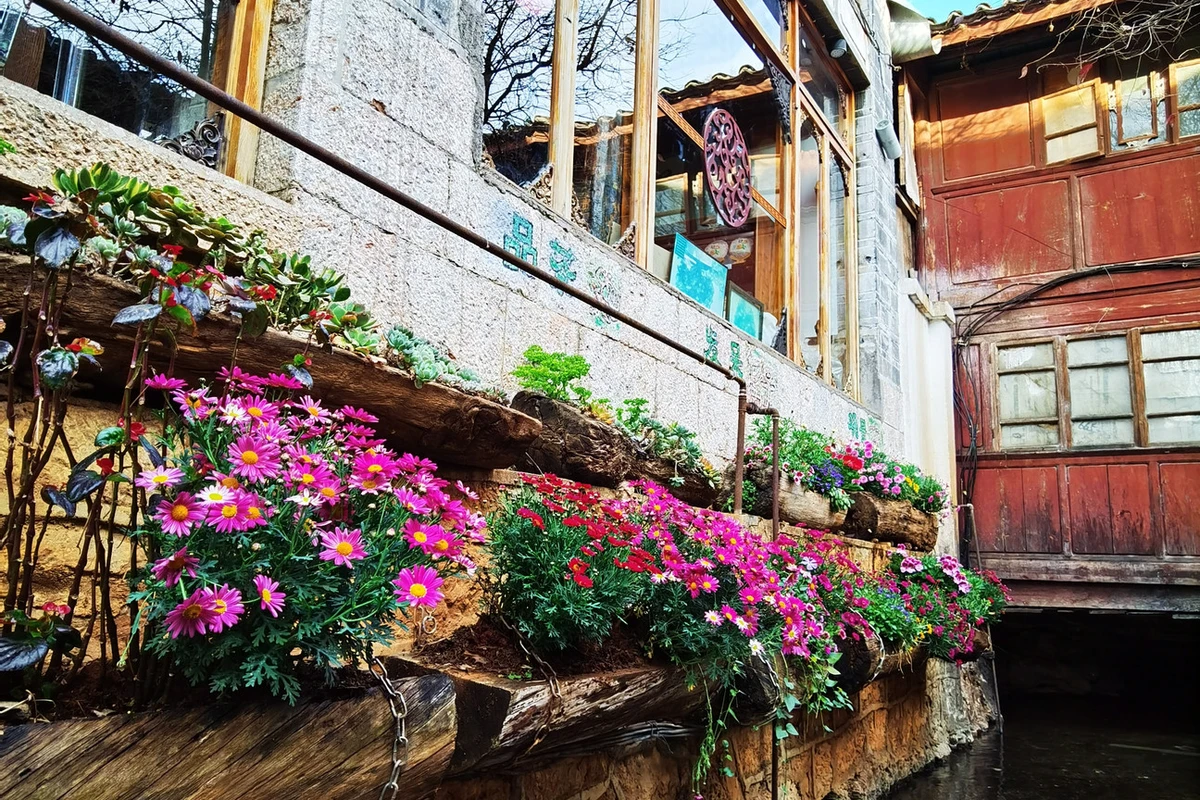
All the buildings are two-story, planted with flowers and plants, succulents everywhere that are hard to take your eyes off. Starting from the South Gate, we walked all the way to the Dayan Viewing Platform at the North Gate, which took about two hours (including photo stops). The well-known Granny’s Preserved Ribs is also in the north; if you want to eat there, line up early. As for the taste, it’s a matter of personal preference.
After eating, we climbed the Dayan Viewing Platform again to digest.
The brightly lit Dayan Ancient Town (on the first day of the lunar new year, many shops were closed. The area with green light opposite is Shizishan (Lion Hill) and Wangu Pavilion, which was closed at night).
Of course, what Lijiang can’t lack is bars. Music emanates from everywhere; we just passed by the entrances to take a photo.
Lion Hill: Originally called Yellow Mountain, located in the center of Lijiang Old Town in Gucheng District, Lijiang, Yunnan. It’s an important part of the World Cultural Heritage Lijiang Old Town and a major scenic spot. The hill is named because it resembles a sleeping lion. The old town buildings are nestled along the base of the hill, making it the best spot to enjoy a panoramic view of Lijiang Old Town. Lion Hill, shaped like a crouching lion, together with Elephant Hill and Black Dragon Pool, creates the scenic “Lion Playing with Sleeping Elephant.”
We wanted to go in to see the ancient cypress trees and Wangu Pavilion, but it was closed. We climbed up panting, only to find it closed (entry 35 yuan).
Three-Eyed Well: The first pool is the spring source, clear and clean, used for drinking. Water overflows from the first pool into the second, which is clean and used for washing vegetables and kitchen utensils. Water from the second pool then flows into the third, which is exclusively for rinsing laundry. Finally, water from the third pool is discharged into the drain. In this way, the three pools are connected in sequence, each performing its own function.
On the second day of the lunar new year, the sunshine was just right.
Someone was too lazy to have breakfast; finally, after reading online that you could see Jade Dragon Snow Mountain from the hotel restaurant, they agreed to get up. It was already 10 o’clock and we nearly missed it (the breakfast was good).
After breakfast, we headed to Jade Dragon Snow Mountain (there is a bus to the visitor center). Along the way, we listened to the driver go on and on about how Blue Moon Valley at the foot of the mountain is more beautiful than Jiuzhaigou. Hmm, well… let’s finish climbing the mountain early and then check it out...
On the way to Jade Dragon Snow Mountain, you pass Shuhe Ancient Town, Tinghua Valley, and Baisha Ancient Town. We had originally listed Tinghua Valley as a must-see, but gave up after hearing that. The road into Tinghua Valley is not great, unpaved and dusty, and the entrance fee is 120 yuan. There’s no real need to visit in winter.
Outside the visitor center, staff guided us to buy tickets at 130 yuan per person (mountain entrance fee? It’s a combo ticket covering all scenic spots in the mountain area). You also need to buy the Jade Dragon Snow Mountain cable car ticket plus the bus from the visitor center to the cable car point, totaling 140 yuan per person. Once you buy the Jade Dragon Snow Mountain ticket, you don’t need to buy a separate ticket for Blue Moon Valley—it’s included. However, for visiting several lakes in Blue Moon Valley, if you don’t want to walk, you need to buy an electric cart ticket for 50 yuan per person (didn’t seem too necessary; we bought it but only used it for a short stretch; we walked the rest to see the lakes. Going back from the lakes to the bus stop was a bit far).
Note: Pre-book your cable car and entrance tickets well in advance, otherwise you might arrive at the foot of the mountain only to find no tickets and have to turn back.
We arrived at Blue Moon Valley after 4 pm, with the light against us, and the White Water River and White Water Terraces were just so-so, not impressive (morning light is better). Blue Moon Lake was okay, and the two lakes downstream were alright.
The bus back was crowded, and at the first parking lot the driver refused to go on. He insisted we get off and take a "black pig" (unlicensed minivan) for 25 yuan per person back to Lijiang Old Town. It was fine. When we reached the big waterwheel in the old town, I realized that the shawl I bought the previous night was shedding fuzz everywhere—I was covered in fuzz. We found a supermarket, bought a lint roller, and started rolling off the fuzz right on the street. It was so embarrassing! While rolling off the fuzz, we thought about what to eat. On the way back from the mountain we’d seen a street with several Dali-style sour and spicy fish restaurants, so we backtracked to eat sour and spicy fish... The fish was okay.
After breakfast, we set off again to Baisha Ancient Town, a 45-yuan taxi ride. The town is small, with very old houses. We went into a coffee shop to try Yunnan small-bean coffee.
We strolled around for an hour and bought a few tie-dyed scarves and canvas bags. Passing a handmade leather shop, I spotted a dark green bag that I loved—over 1000 yuan? I was hoping my partner would haggle, but he saw a belt he liked and, completely ignoring the price, told me to pay. Total: 1750 yuan. I have no idea if that was expensive or not. (That evening back in Lijiang Old Town, we walked into a handicraft shop, and the owner asked if the bag was bought in Baisha. Turns out both shops were his, and because he handcrafted the bags himself, he recognized it.)
When we got home, an elder told us that Zhu Yuanzhang (the first Ming emperor) once exiled a group of craftsmen to Shuhe, which is why Shuhe’s handmade leather goods are so famous. (There is a big Honggu shop in Shuhe; we didn’t notice the others.)
We didn’t go see the Baisha murals—we’re not the artsy type. The ancient town itself doesn’t require a ticket, but the murals require a separate ticket (30 yuan).
We strolled around and then left.
To go from Baisha to Shuhe Ancient Town, you pass by Tinghua Valley. With not much time, we finally gave up on that and went straight to Shuhe. Shuhe requires an entrance fee of 30 yuan. (Secretly: I never understood why the taxi driver asked several times whether we wanted to go to the Main Gate or some other side gate, and my partner answered “Main Gate.” While wandering, we discovered that the side gates had no ticket check, you could just walk right in...)
Similarly, many shops in the old town were closed, and there were few tourists. In Shuhe Ancient Town, there is a Qinglong Bridge, built during the Wanli era of the Ming Dynasty, over 400 years old. The stones on the bridge surface have been worn smooth; even flat shoes slip on them. Sitting by the bridge, I thought about how people hundreds of years ago also rested here, and I was reluctant to leave. Could a cloud suddenly cover the sun and then, just like that, I would travel back to the Ming dynasty? →_→
Right next to this sign, in an alley, there was a stall selling fried potato cakes. →→
Sifang Street, the center of the old town.
In the alley next to Qinglong Bridge, the fried potato cakes and cold-tossed chicken bean jelly tasted great. My partner squatted on the ground and ate two potato cakes and a bowl of chicken bean jelly (the chicken bean jelly was too spicy).
Three-Eyed Wells could be seen everywhere in the residential area.
We returned to the hotel after 4 pm and then headed back to Lijiang Old Town. This time, with someone pointing the way, we went to the Mu Mansion. We learned that the Guanmenkou (official gate) was actually the entrance to the Mu Mansion; sedan chairs would enter through Guanmenkou and then arrive at the Mu Mansion.
In the afternoon, the Mu Mansion was quite crowded, with an entry fee of 45 yuan. We didn’t go in then, planning to come back later when there were fewer people, but when we returned, it was closed.
Our legs were exhausted again.
We saw wish plaques of all kinds, hoping everything goes well for everyone.
One special thing to mention: the water in Shuhe is really clear.
Our original dinner plan was to go eat fish after wandering the old town. But on our way back to the hotel, we were seduced by the aroma of grilled meat. Without a reservation, we had to queue from 7 pm until 9:30 pm to be seated. Mushrooms were not in season, so we had frozen ones. The porcini mushroom was a bit sour. The grilled meat tasted okay, but the oil splattered everywhere—our clothes and phones were covered in oil spots (and probably our faces too -_-||)
After breakfast, we strolled around the hotel a bit. At noon, we took a Didi to Lijiang Station. There were few people and no traffic; we arrived in 20 minutes.
After being away for a few days, Kunming was already very warm when we returned. We could go visit the flower market.
There are more than 3,000 photos; choosing among them was dazzling—what did I even include?
Travelogue menu
1. Laze in Kunming during Spring Festival, think of going to Lijiang on the first day of the lunar new year
2. Day 1, February 12, Kunming to Lijiang
3. Day 2, February 13, Jade Dragon Snow Mountain, Blue Moon Valley
4. Day 3, February 14, Baisha Ancient Town, Shuhe Ancient Town, Lijiang Old Town
5. Day 4, February 15, return to Kunming
Travel Info
Hotel Index
Guide Index
Flight Index
Site Navigation
Travel Index
Cruise Index
Corporate Travel Index
Partnerships
Affiliate Program
Links
Corporate Gift Card Purchase
Insurance Agent
Agent Cooperation
Hotel Joining
Destination & Scenic Spot Cooperation
More Partnership
About Ctrip
About Ctrip
Ctrip Hot Topics
Contact Us
Careers
User Agreement
Privacy Policy
Business License
Security Center
Ctrip Content Center
Intellectual Property
Trip.com Group
Algorithm Disclosure


