Strolling Through Enchanting Lijiang: Savoring Shuhe
Head north from Dayan Ancient Town for about four kilometers, and you'll reach Shuhe, known as the Land of Clear Springs. When Xu Xiake visited Zhishan Jietuo Lin, he once walked this path, and in his travelogue he wrote: 'Crossing a dry stone bridge over a ravine, looking west at Zhonghai, willows dark and ripples swirling, a large settlement stands by the water; this is Shiheyuan.' 'Shihe' is the ancient name for today's Shuhe.
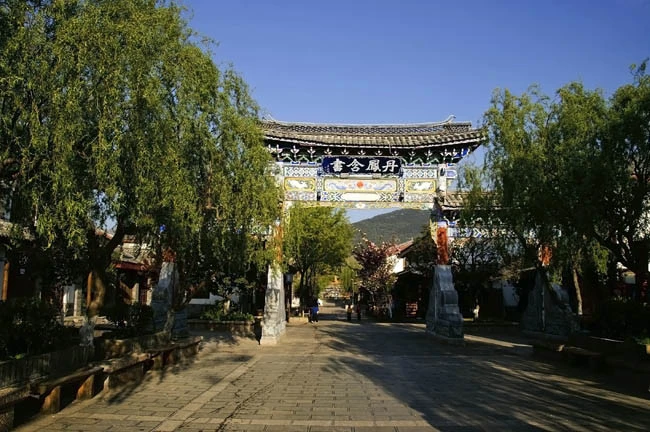
Shuhe, called 'Shaowu' in the Naxi language, takes its name from the Jubao Mountain behind the village, which resembles a towering peak. The name evolved from the mountain's name, meaning 'the village beneath the high peak.' It is one of the earliest settlements of the Naxi ancestors on the Lijiang plain, the birthplace of the Mu clan of Lijiang, a well-preserved important market town along the Ancient Tea Horse Road, and a living specimen of the Naxi ancestors' transition from agricultural to commercial civilization. Shuhe is an integral part of the World Heritage site of Lijiang Old Town, and in 2005 it was named one of CCTV's 'China's Charming Towns.' Shuhe Ancient Town faces west, sheltered from the wind and open to the sun. The woods behind the village are the southern offshoots of Yulong Mountain, with graceful shapes and dense vegetation. At the foot of Baisha Yanjiao stands Fenghuang Mountain; as the terrain changes at Shuhe, it takes on an auspicious appearance. Feng shui masters call it the 'Danfeng Hanshu' (Red Phoenix Holding a Book) site, predicting a flourishing culture and prosperity. Not far into the town stands a memorial archway inscribed 'Danfeng Hanshu.'
As a key town on the Ancient Tea Horse Road, Shuhe has always been lined with shops.
Some businesses are decorated with strong ethnic features.
Shuhe's style is very similar to Dayan Town. Adjacent to Yulong Snow Mountain, it is embraced by hills and water. The water of Longquan Pool is even clearer than that in Dayan Ancient Town, and springs flow through streets beside the village. Although local wastewater is discharged into the river, the villagers have established stringent rules for water use: no throwing rubbish into the water, no children playing by the water, no washing clothes or shoes upstream, and so on. Every morning is the time for drawing drinking water; at other times, the flowing water in front of the houses is only for laundry. This ensures the water quality is not polluted. There are no harsh penalties, but everyone follows the rules consciously.
Shuhe Ancient Town is another part of Lijiang's World Heritage site. Today, Dayan Town is heavily commercialized, while Shuhe is like a miniature version of Dayan Ancient Town—less bustling but more tranquil. Thus, some say that to truly savor Lijiang today, you must go to Shuhe, best to find an inn here and stay for a few days.
Shuhe also has a Sifang Street, just over 30 meters in length and width, with five roads leading in all directions. Encircled by water, it served as a daytime market and is one of the oldest marketplaces on the Lijiang plain. In ancient times, Shuhe's Sifang Street had a night market. People strolled along as modern city dwellers do, pausing at will, marveling at novelties, snacking on whatever they fancied, and joining in fun games. Night market visitors carried flashlights, moving along the banks of the Qinglong River like fireflies on a summer night—a scene known as 'Night Market Fireflies,' one of the Eight Sights of Shuhe.
In the center of Sifang Street lies the 'Sifang Tingyin' (Four-Square Listening) Square. The Sifang Tingyin Building in the square is magnificent, fully embodying the architectural features of the Naxi, Bai, and Tibetan peoples, similar to the Mu Mansion in Lijiang Old Town. The building faces east, and the square in front is 65 meters long east to west and 55 meters wide north to south. The square and streets are paved with the common Naxi five-flower stone slabs, rough and solid. The square is surrounded by flowing water, weeping willows, and fragrant osmanthus flowers. It seems this is a place for Naxi song and dance performances.
Many restaurants in Shuhe are also built by the water. Waterwheels turned by small streams creak, adding special charm to diners' experiences.
Qinglong Bridge was built during the Wanli reign of the Ming Dynasty, with a history of over 400 years. To its west lies Jubao Mountain, and the bridge's central axis aligns perfectly with the mountain—a design by the Mu chieftains, and a landmark of their golden age. The bridge is 25 meters long, 4.5 meters wide, and 4 meters high, built entirely of stone blocks, and ranked as the finest ancient stone bridge in Lijiang. In early spring, willows by the bridge sprout new buds, misty and gauzy, as if a green wave is about to wash onto the bridge deck. This is another of Shuhe's Eight Sights: 'Misty Willows Over a Calm Bridge.' Qinglong Bridge's surface, weathered by centuries of wind and rain, has become mottled and aged, yet it retains its heroic spirit and solemn weight. Standing here, you may hear the echo of horse hooves. In the morning spring sunshine, the mottled stones on the bridge seem to tell tales of bygone times.
The area around Qinglong Bridge is the old part of Shuhe Ancient Town. Compared to the newer areas, these narrow streets better reflect the original look of ancient towns in the Lijiang region.
In the old area, there are many tasteful Naxi-style inns.
By the side of 'Jiuding Longtan' (Nine-Dragon Pool), there is a waterside pavilion with upturned eaves built during the Qing Dynasty, called 'Sansheng Palace,' also known as Longquan Temple, nestled among green trees.
The temple originally housed statues of Guanyin, Manjusri, and Samantabhadra, and later also enshrined Xuanyuan Emperor, Sun Mo, and White-Eyebrowed Monk. The plaque in front reads 'Half a Day of Leisure,' taken from 'stolen once more a half-day of leisure from this floating life.' Leaning on the railing, looking up and down, you can gaze far across the fields and lanes, or watch fish swimming in the clear water nearby—soothing to the heart. You can enter Sansheng Palace through this gate.
This charming cherry tree and wisteria are wrapped with red ropes. It is said that the TV drama 'Chen Yuanyuan' was filmed here.
All the streams in Shuhe originate from Jiuding Longtan. Not far from the pool is a 'Three-Eyed Well,' which is the source of water for the whole town's residents. The so-called 'Three-Eyed Well' was built along the direction of the stream, dividing the well water from top to bottom into three sections according to different uses: drinking, washing vegetables, and washing clothes. This ensures sanitation for drinking and conserves water. A wooden board beside the well catches the eye, inscribed with: 'Water benefits all things without contention...' The hardworking and wise Naxi people have integrated the 'Three-Eyed Well' culture into their local customs and regulations, reflecting their reverence for nature and the virtue of harmonious interpersonal relationships. I had seen several such wells in Dayan Ancient Town, but this one left the deepest impression.
In Shuhe Ancient Town, I had a meal at the popular and time-honored specialty restaurant Fuxian Xiaoguo Fan, which I consider the best food I've tasted in Lijiang. Not only is the ambiance excellent, the service good, and the dishes delicious, but the prices are so affordable, and it's right within the scenic area. It's hard to imagine finding such a cost-effective specialty restaurant. No wonder so many celebrities have dined there. This reputation is not hype; it's earned through quality. A must-recommend!
After staying in Lijiang's Dayan Ancient Town for three days, I departed early on the fourth morning. The waterwheel by the square creaked in the spring sunrise, as if time were ceaselessly passing. Perhaps because it was too early, the usual hubbub of the past few days was absent.
The statue of the Ancient Tea Horse Road tells the stories of the past in minute detail.
How memorable everything in Lijiang is! Farewell, Lijiang—breezy and sunny in April, rich in charm!


