Yunnan Travel: Three Times In and Out of Lijiang Ancient Town (Photos)
Lijiang Ancient Town in Yunnan was the second major stop after the reporter’s four trips to Dali. On the evening of March 21, 2021, the reporter took the K9627 train from Dali, arriving smoothly at Lijiang Railway Station after a journey of over two hours. A Didi car ordered over the phone during the train ride arrived right on time. The ride-hailing car picked us up and soon headed toward Lijiang Ancient Town.
Headed to Lijiang (Photo: Feng Ganyong)
In fact, Lijiang was no stranger to the reporter. Twenty-three years earlier, on November 29, 1998, the reporter had come to Lijiang twice—first to shoot a large-scale TV documentary series “Chinese Ethnic Sports – Naxi Chapter,” and then again on October 30, 2005, accompanying a China Railway special tour. On those visits, the reporter stayed at Lijiang Hotel outside the old town and at Yangji Fuxinglong Hotel.
Arriving in Lijiang (Photo: Feng Ganyong)
This third visit to Lijiang Ancient Town included trips to Shangri-La and Lugu Lake, both of which are located to the north of Lijiang, with Shangri-La to the northwest and Lugu Lake to the northeast, forming a triangle. Since there is no direct road between the two, Lijiang lies just below them in the triangle, making it an ideal transit base. Hence, the journey was planned as a three-times-in-and-out trip of Lijiang Ancient Town.
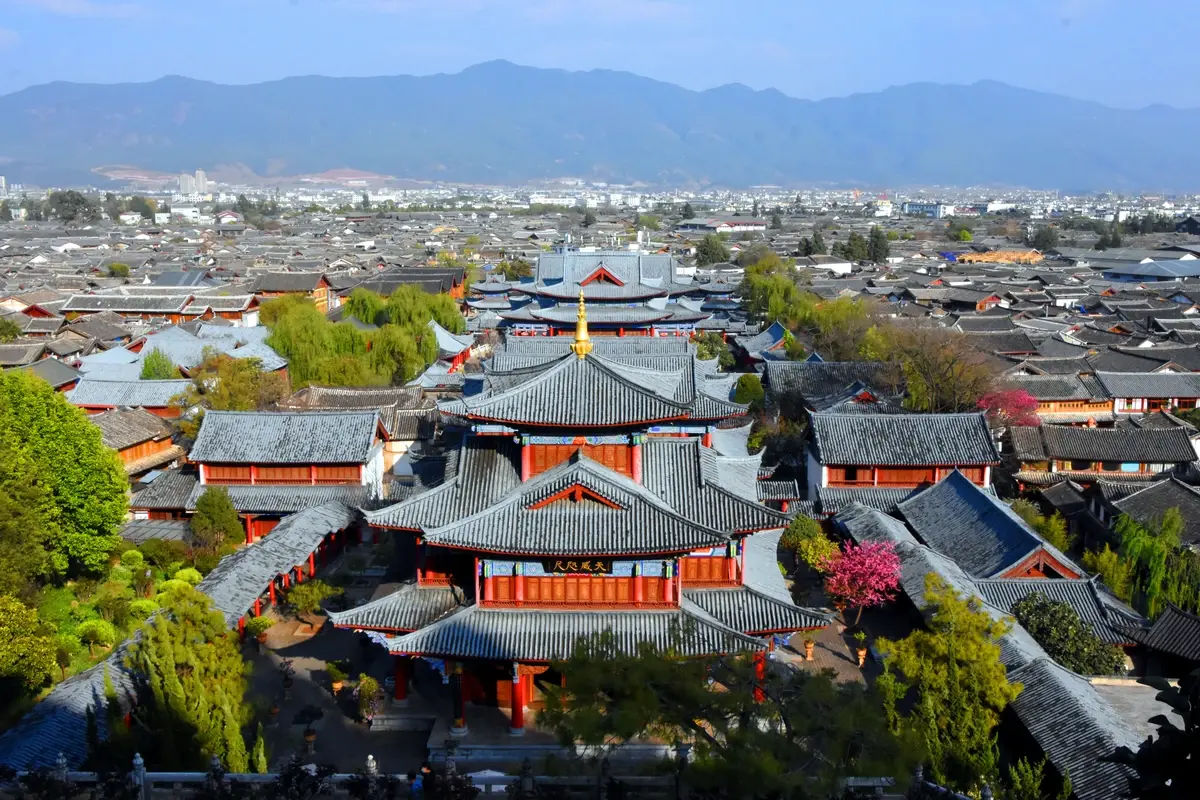
Overlooking Lijiang Ancient Town (Photo: Feng Ganyong)
Lijiang Ancient Town was first built during the Song Dynasty. After the Mu chieftain moved his ruling center from Baisha Old Town to Lion Hill, houses and city walls were constructed here. Over hundreds of years, it evolved into today’s Lijiang Ancient Town. Visitors can still see the imposing Mu Mansion; from its highest point, you can overlook the whole ancient town.
Entering Lijiang Ancient Town (Photo: Wang Jue)
After a drive of over 20 minutes, we arrived at the InterContinental Lijiang Ancient Town Resort. That night, Xue Zhijie, owner of the Shuipanju Inn where we would stay, was already waiting for us. On my two previous visits I had lodged outside the old town, but this time, to be closer to its atmosphere, I deliberately chose accommodation inside. However, since cars are not allowed inside the ancient town, Xiao Xue enthusiastically got a tricycle to carry our luggage. We walked for over ten minutes before reaching the Shuipanju Inn.
Shuipanju Inn (Photo: Wang Jue)
Entering the room full of local character on the inn’s second floor, I had just put down my bags when I heard a knock on the door. Xiao Xue had brought us two bowls of steaming tremella soup and several warm flower-patterned pastries. Tasting them, I instantly felt a warm sense of welcome typical of the ancient town.
Night view of the old town (Photo: Wang Jue)
The Shuipanju Inn is centrally located in the ancient town. After a short rest, we stepped out of the inn’s alley and wandered along the flagstone streets. Right outside the door, the bright lights of the old town’s nightscape stretched out endlessly. Although it was my third visit, more than twenty years had passed. The passage of time made the transformation here seem enormous. What greeted me was a vast scene of bustling crowds reveling in the brightly lit, twinkling old town.
Night at the Sakura Restaurant (Photo: Feng Ganyong)
Not far away was the Sakura Restaurant, a must-see spot for the old town’s night views. The two-story restaurant by the water was filled with diners on both floors, and under the illumination, it looked truly beautiful. Besides diners, even more tourists were drawn by its reputation, making it exceptionally popular.
Glittering lights by the water (Photo: Feng Ganyong)
Here, it was almost impossible to take a photo without someone in the background; one could only try to avoid the crowds and find a passable keepsake shot. A small creek wound through, dotted with all sorts of flowers, plants, and decorative features, with mist blanketing the water, like a fairyland. Especially set against the brilliant night lighting, it was dreamily enchanting and captivating.
Dreamy Great Stone Bridge (Photo: Feng Ganyong)
Following the water’s edge, we came to the Great Stone Bridge. The night view of the Great Stone Bridge is considered one of the most beautiful sights in the old town. A netizen once vividly described it: A breeze rustles the leaves, playing the prelude to an autumn symphony, while the lights, like ink, bleed onto the bridge and reflect in the lake, creating a sublime masterpiece.
Old town shopping street (Photo: Wang Jue)
By the Xiushui River, the water mirrors the town. Only in this settled nightscape of the ancient town can one’s body and mind truly relax in the most pleasant way. Taking a soft breath, the air carries a gentle moisture mixed with a faint floral fragrance, distant yet refreshing, filling the heart.
Dusk lights (Photo: Feng Ganyong)
The night deepened in the old town. The town’s lights, like fireflies flying into the distance, grew dimmer and dimmer, as if the whole city were shrouded in a dream. Light shows and water shows became the most beautiful scenes in Lijiang’s late night, scattered light screens across the city stirring the heartstrings like sparks. It was so romantic. On my first night entering Lijiang Ancient Town, I savored a sequence of splendid night views and deeply felt the trip was already worthwhile.
Early morning in the old town (Photo: Feng Ganyong)
Some alleys in the ancient town are decorated with big red lanterns, paired with characteristic Naxi-style architecture. Beyond the antique buildings, the small courtyards in Lijiang Ancient Town are unique. Each guesthouse creates its own little garden—perhaps a few emerald bamboos, some blossoming flowers, a wooden table, a few chairs, and a movable swing. After exploring the town, you can sit down, have a cup of tea with the innkeeper, and chat. The atmosphere at the Shuipanju Inn, where the reporter stayed, conveyed exactly this flavor.
The reporter and He Yang (Photo: Wang Jue)
I woke up at 7 a.m. on March 22, stepping out of my room at Shuipanju Inn to gaze into the distance; a faint rosy cloud tinted the horizon. After breakfast, the streets and lanes were still empty, extraordinarily quiet. Ten minutes later, we walked out of the old town and met our local guide and driver, a handsome, free-spirited young man born in the 1990s named He Yang. The car started and headed toward Shangri-La.
Sangu Shui (Photo: Feng Ganyong)
On March 23, after satisfactorily completing the Shangri-La trip, He Yang drove us back into Lijiang Ancient Town for the second time. On the way back, he took us to a scenic spot called Sangu Shui (“Three-Valley Water”), described as “a place so beautiful it’s quintessential Lijiang.” The area lies along the Jinsha River. We took a sightseeing shuttle into the scenic area and strolled along a plank walkway in the gorge—it was truly a world of water.
A corner of the ancient hamlet (Photo: Feng Ganyong)
From the observation deck at Sangu Shui’s highest point, a sweeping view of the Jinsha River and the ancient hamlets along its banks unfolded. The area includes spots like Desheng Village and the Tea Horse Road. Desheng Village, at the First Bend of the Yangtze, was once a four-way fork on the Tea Horse Road. It is renowned for the last horse caravan and the most complete remains of the ancient Tea Horse Road.
Sangu Shui Waterfall (Photo: Feng Ganyong)
While the Tea Horse Road tells of the tea-horse trade, it also conveys the truth that has allowed the route to survive for thousands of years: harmonious coexistence between people, namely “virtue” (De). “De” demonstrates the unity, friendship, mutual assistance, and valuing integrity and loyalty above life that are cherished by ethnic minorities—the essence of the Tea Horse Road through millennia.
Jinsha River scenery (Photo: Feng Ganyong)
Arriving in Desheng Village, most merchants would stop for several days to trade goods, drawn by the honest, hospitable villagers, a fine tradition maintained to this day. Traders were willing to conduct fair and just transactions here, taking what each needed. The original meaning of “De” is to act in accordance with nature, society, and objective human needs. There is also a saying: “Virtue begets gold,” hence the name Maojindi (Gold-Emerging Land).
Tea Horse Road Commemorative Stone (Photo: Feng Ganyong)
After finishing our tour of Sangu Shui, we drove to Shigu Town west of Lijiang Ancient Town. This was the very place where, on December 1, 1998, the reporter had previously filmed the Naxi sports program “Swinging” for the TV documentary. At my request, He Yang drove me here for a second look, to revisit a memorable time from the past.
Pose by Jinsha River (Photo: Feng Ganyong)
Before reaching Shigu Town, we first came to the famous First Bend of the Yangtze River. The Yangtze, rushing down from the “Roof of the World,” the Qinghai-Tibet Plateau, enters Yunnan from northwest Yunnan and flows alongside the Lancang and Nujiang rivers through the high mountains and deep gorges of the Hengduan Range, creating the world-rare magnificent spectacle of “Three Parallel Rivers.”
Photo at the First Bend of the Yangtze (Photo: He Yang)
Not far from the First Bend of the Yangtze lies Shigu Town. An important transport hub linking Yunnan and Tibet in ancient times, it saw fierce battles in the late Southern Song Dynasty when Kublai Khan’s western army invaded the Dali Kingdom against local Mosuo forces. During the Yuan Dynasty, Lijiang Road’s government office was once set up here. In the Ming Dynasty, an inspection office was established at Shimen Pass near Shigu Street; in the Qing Dynasty, a Shigu guard post was set up. Shigu Town was also one of the five crossing points for the Second Front Army of the Chinese Workers' and Peasants' Red Army to cross the Jinsha River.
First Bend of the Yangtze scenery (Photo: Wang Jue)
On the west side of Shigu Town, there is a hillside overlooking the river bend—a great spot to photograph the First Bend. Back then, we set up a large wooden frame on that very hillside, and several Naxi women gave the production team a brilliant display of the Naxi swinging sport.
Photo from the swinging shoot back then (Photo: Feng Ganyong)
The roughly 100-kilometer road from Shigu to Tacheng hugs the west bank of the Jinsha River all the way. Entering this stretch immediately immerses you in picturesque riverside scenery, while the ancient sites and age-old ferries lining both shores unveil a long corridor of history and culture, infusing the whole journey with a sense of depth.
Shigu Pavilion (Photo: Feng Ganyong)
Walking into Shigu Town, we strolled to a small pavilion named after a vertically placed stone drum. Seeing the stone drum again stirred great excitement, bringing back memories of the production team working there. The drum face bears an inscription recording the military exploits of the Lijiang native magistrate who led troops north against Tibet and returned victorious. Even more intriguingly, on the nearly human-height drum surface, there is a visible crack that has knitted together.
Close-up of the stone drum (Photo: Wang Jue)
It is said that this crack opens and closes on its own, foretelling the rise and fall of dynasties. Mr. Guo Moruo, who visited in 1963, marveled at it and left behind calligraphy, which the villagers now use as a couplet on the pavilion: “The people’s support records the history of rise and fall through the ages; the stone drum’s opening and shutting determines the world’s order and chaos.”
Shigu Town lanes (Photo: Wang Jue)
Revisiting the First Bend of the Yangtze and Shigu Town filled me with elation. Twenty-three years had passed in the blink of an eye. While the natural scenery had changed little, the surrounding environment was vastly different now…
Entering Lijiang for the third time (Photo: Feng Ganyong)
Around 4 p.m., we returned smoothly to Lijiang. He Yang dropped us off at the Ivy Resort Hotel inside the ancient town, our accommodation for the night. The spacious suite was cozy and comfortable. Since the hotel is very close to Mu Mansion, after putting down our bags we headed straight there for a visit.
A corner of Ivy Resort Hotel (Photo: Feng Ganyong)
Though I had come to Lijiang Ancient Town several times before, I had never visited Mu Mansion. Today, my wish finally came true. Located at the foot of Lion Hill, Mu Mansion is the colloquial name for the government office of the Mu chieftains of Lijiang, and it is a “grand garden” of Lijiang ancient town culture. There is a saying: “In the north, there is the Forbidden City; in the south, Mu Mansion.” It is a splendid architectural art complex, fully reflecting the Ming Dynasty Central Plains architectural style while retaining the ancient, bold charm of Tang and Song structures. The whole building complex faces east, with jade-like canals running through it and living waters flowing continuously, embodying the spirit of traditional Naxi culture.
Entrance of Mu Mansion (Photo: Feng Ganyong)
According to historical records, the Naxi people originally had no Han surnames. When Zhu Yuanzhang established the Ming Dynasty, the Naxi chieftain A’jia A’de in far-off northwest Yunnan judged the situation and “led his people to pledge allegiance” in 1382, performing rites of court. This greatly pleased Zhu Yuanzhang, who removed a stroke from his own surname and bestowed the Han surname “Mu” (meaning wood). From then on, the traditional Naxi father-son linked-name system was replaced by Han-style surnames and given names.
Mu Mansion courtyard (Photo: Feng Ganyong)
The Mu chieftains built a large-scale palatial complex, Mu Mansion, which at its zenith covered over 100 mu (about 16.5 acres) with nearly a hundred buildings, forming the heart of the 800-year-old Dayan Ancient Town. Although it was merely a chieftain’s residence, its luxury and grandeur rivaled any noble abode and served as the political and cultural center of Lijiang during the Ming Dynasty. The Ming traveler and geographer Xu Xiake marveled in his “Diary of a Yunnan Journey,” “The beauty of the palace buildings is comparable to those of a king.”
Mu Mansion sceneries (Photo: Feng Ganyong)
According to the “Lijiang Prefecture Gazetteer,” the original Mu Mansion featured towering halls and a strict layout, with the central axis alone measuring 369 meters long. Along this axis stood the Council Hall, the Ten-Thousand-Volume Tower, the Dharma Protection Hall, and other main halls, flanked by countless pavilions, towers, and chambers. The winding garden corridors displayed a unique style. The overall architectural style was “modeled after the Forbidden City.”
Yiran Pavilion in Mu Mansion (Photo: Feng Ganyong)
Entering Mu Mansion today, one first sees a wooden archway inscribed with four large characters “Tian Yu Liu Fang,” a homophone in the Naxi language meaning “Go and read books,” reflecting the Naxi people’s deep respect for knowledge. The stone archway, made entirely of stone and three tiers high, is a masterpiece of domestic stone architecture.
Council Hall (Photo: Feng Ganyong)
Further inside, the Council Hall is dignified and spacious, magnificent in atmosphere, serving as the chieftain’s governing hall. The Ten-Thousand-Volume Tower collects the essence of two thousand years of cultural heritage: thousands of Dongba scriptures, hundreds of volumes of the Tripitaka, poetry collections of six chieftains, and numerous calligraphies and paintings by famous scholars—all rarities and academic treasures. The Dharma Protection Hall, also called the Rear Council Hall, was where the chieftain discussed family matters. The Guangbi Pavilion is the gateway to the rear garden, historically praised as “the finest structure in western Yunnan.” The Yuyin Pavilion was where imperial edicts were received and where feasts and music were enjoyed. The Sanqing Hall reflects the Mu chieftains’ reverence for Daoist philosophy.
Overlooking from Yuyin Pavilion (Photo: Wang Jue)
Scholars note that “without visiting Mu Mansion, you haven’t truly been to Lijiang.” Viewing the surviving Ming and Qing ancient buildings of Mu Mansion—their grand architecture, splendid halls, exquisite carvings, delicate structural elements, and brilliant paintings—is truly an experience of breathtaking beauty beyond compare. One cannot help but feel profound respect for the breadth and depth of Chinese architectural art in ancient Lijiang. This was the greatest gain from the reporter’s second entry into Lijiang Ancient Town.
Photo before Mu Mansion (Photo: He Yang)
On the morning of March 25, the reporter’s Lugu Lake trip ended perfectly. After over four hours of driving, we returned to Lijiang Ancient Town for the third time shortly after 1 p.m. Xiao Wang from Shuipanju Inn was already waiting at the entrance of InterContinental Lijiang Ancient Town Resort to escort us back to the inn’s waterside room.
The Flower Bridge in the old town (Photo: Feng Ganyong)
Following the previous two visits, after a midday rest at the inn, with nothing pressing to do, I again strolled along the streets. Setting off from Qiyi Street, I followed the water’s edge through lanes and alleys, passing Gongmenkou, the Great Stone Bridge, taking Chongren Lane, passing Baishuifang (Hundred-Year-Old Archway), reaching Wuyi Street, and finally arriving at Sifang Street (Square Market)—a complete loop.
Photo at Sifang Street (Photo: He Yang)
Sifang Street sits at the heart of Lijiang Ancient Town. From here, six colorful stone-paved streets radiate outward, following the terrain, with lanes interconnected. Known for its unique street scenes—colorful stone pavement, clear water washing the streets, bustling markets at midday, and thorough washing at dusk—Sifang Street is widely renowned. The surrounding alleys are quiet and secluded; it is said the layout was designed by the Ming Dynasty Mu chieftain in the shape of his official seal. This was the most important hub on the Tea Horse Road. Since the Ming and Qing dynasties, merchants from various regions gathered here, where diverse ethnic cultures met and thrived, making it the center of Lijiang’s economic and cultural exchange.
Shooting at Sifang Street back then (Photo: Guo Gang)
Sifang Street is also the spot the reporter is most familiar with in Lijiang Ancient Town, full of fond memories. Early on November 30, 1998, Naxi villagers from all over the old town flocked here to participate in our Naxi documentary shooting. Over 500 people performed brilliant ethnic sports dances like “Da Tiao” and “Li'erbacuo” before our cameras.
Old town scenery (Photo: Feng Ganyong)
Back then, Sifang Street’s entire area was filled with open-air eateries, bustling and thriving daily. Yet for that day’s filming, the vendors shut down their businesses for a full half-day, which deeply moved the production team.
Entrance to Shuhe Ancient Town (Photo: Feng Ganyong)
On the morning of March 26, the final leg of the reporter’s three-times-in-and-out journey of Lijiang Ancient Town, He Yang first drove us to Shuhe Ancient Town. In the early morning, the town was sparsely crowded; strolling its streets felt exceptionally peaceful.
Photo in the ancient town (Photo: He Yang)
Shuhe Ancient Town is called “Shaowu” in the Naxi language, meaning “the village beneath the peak,” named after the treasure-stacked shape of Jubao Mountain behind the village. It is one of the earliest settlements of the Naxi ancestors on the Lijiang plain.
Shuhe scenery (Photo: Feng Ganyong)
Shuhe is a well-preserved important market town on the Tea Horse Road, a living specimen of the Naxi people’s transition from agricultural civilization to commercial civilization, and a model settlement formed through external exchanges and horse caravan activities. Shuhe, an integral part of the Lijiang Ancient Town World Heritage site, was named a “China’s Charming Famous Town” by CCTV in 2005.
Black Dragon Pool scenery (Photo: Wang Jue)
After the Shuhe tour, we headed to the nearby Black Dragon Pool. This was my third visit, though so much time had passed that I had almost no memory of it. Lijiang’s Black Dragon Pool Park features what people call the “Four Beauties”: a Han-dynasty ancestral hall, Tang-era plum trees, Song-era cypresses, and Ming tombs. A deep pool of water gushes from underground, crystal clear and serene, exquisitely elegant.
Lake and mountain scenery (Photo: Feng Ganyong)
Legend has it that long ago, ten flood dragons wreaked havoc on the human world. Lü Dongbin subdued nine of them and suppressed them beneath the ancient Tuodong Pagoda in the city, leaving one small black dragon to stay here and serve the people. Hence the name Black Dragon Pool.
Photo at Black Dragon Pool (Photo: He Yang)
With the visit to Black Dragon Pool, the reporter’s Yunnan journey of three times in and out of Lijiang Ancient Town came to a perfect close. He Yang drove us to Lijiang Sanyi Airport, where we boarded Capital Airlines flight JD5216 back to Beijing. Thus, the eight-day Yunnan trip covering Dali, Lijiang, Shangri-La, and Lugu Lake reached its satisfying conclusion. (Text & photos: Feng Ganyong)


