A 5-Day Trip to Lijiang, Yunnan (Oct 25–29, 2021)
In 2021, spontaneous travel still felt risky, as the pandemic narrowed our range and made us ultra-cautious. Yet after the National Day holiday, many people were venturing out, going farther and farther… We, a bit slow on the uptake, joined the travel trend in late October. We’d originally planned to go to Gansu, but worried it’d be too cold in late October, so we switched to Lijiang, Yunnan—and dodged a bullet. Three days after we booked our flights, news broke of an outbreak in Zhangye, Gansu. Lijiang, being a low-risk area, let us sail through smoothly; thank God!
Day 1: Suzhou Railway Station to Shanghai Railway Station (about 30 min by train); took Shanghai Metro Line 1 three stops to People’s Square, then transferred to Line 2 for 21 stops to Pudong Airport Station (about 2 hours total metro ride). Flight from Shanghai Pudong Airport at 14:05 to Lijiang Sanyi Airport at 17:50 (approx. 3 hr 45 min). Our hotel had arranged a paid airport pickup (80 yuan/car) that met us on time, about a 30-minute drive to Xue Yue Hotel in Lijiang Ancient Town. (Booked first night on Ctrip: 216 yuan/night; extended three more nights at 209 yuan/night.)
Day 2: Jade Dragon Snow Mountain & Blue Moon Valley (The hotel manager helped us book a tour with Lijiang Hidden Land Travel Agency, a pure sightseeing group at 438 yuan/person. Our group had only four people, and the driver doubled as the itinerary coordinator—free and easy, totally enjoyable.)
Day 3: Jinsha River & Tiger Leaping Gorge (Also chose a pure sightseeing tour at 260 yuan/person). In the evening we climbed Lion Hill in Lijiang Ancient Town to watch the sunset glow on the snow mountain and the night view. On the way back we passed Sifang Street, where we saw Naxi people singing and dancing around a bonfire. We impulsively joined in, holding hands with the locals and dancing, soaking up their folk customs…
Day 4: Free roaming in Lijiang Ancient Town’s neighbourhoods, Black Dragon Pool, Mu’s Residence, Sifang Street, etc. We savoured the World Cultural Heritage site—Lijiang Ancient Town—including the unique blend of mountain-town scenery and little bridges over flowing streams, and Naxi culture like Dongba music, Dongba script, and Dongba papermaking.
Day 5: Return from Lijiang to Suzhou. Flew to Shanghai; changed metro route to Line 2 from Pudong Airport Station for 28 stops to Hongqiao Railway Station (about 1.5 hours metro), then train from Hongqiao to Suzhou.
The hotel booked on Ctrip is located north of Lijiang Ancient Town, near the ancient town parking lot and very close to the Big Water Wheel, which made it super convenient for travellers hauling large suitcases—step into the old town and you’re at the inn. Though a guesthouse, it was quiet and clean. On our first day, the lobby manager even treated us to warm, freshly baked flower cakes… The place was cosy; here you could sip Pu’er or Yunnan black tea, chat, zone out, and just relax.
Day 1: Jade Dragon Snow Mountain & Blue Moon Valley
This is the parking lot at the Jade Dragon Snow Mountain scenic area. Though snow cover was light, the mountain looked all the more layered! Entering the area, we prepared to take a shuttle bus to the lower station of the Jade Dragon Snow Mountain cableway. The shuttle took us to the foot of Jade Dragon Snow Mountain, the lower station of the big cableway, at an altitude of 3,356 meters. From here the cableway ascends; the scene before us was lush and green, with not a hint of autumn!
Here is the upper station of the cableway, right below the main peak, Shanzifeng, at 4,506 meters above sea level. Clouds blocked the sunlight, making the rocks in front look rather grey, but I noticed their colour resembled accumulated snow, so I dubbed them ‘snow stones’. The uphill boardwalk had very few visitors (we didn’t even queue for the cableway—no legendary 1–2 hour wait). Probably a perk of the off-season and sensitive times! As the clouds drifted, a corner of the icy mountain revealed itself hazily—this natural spectacle mesmerised me! Standing above 4,000 meters, we let the swirling mist surround us. On the way up, heading for 4,680 meters! In the distance, a line of people in red coats became an eye-catching splash of scenery!
Sunlight pushed through the clouds, casting light and shadow on the boardwalk, creating a richly layered scene. Mountains and stratocumulus intertwined! Mist parted, peaks reappeared, set against the blue sky! A bird’s-eye view of the cableway upper station shrouded in cloud! Looking down on the uphill boardwalk! Below, simple little wooden huts, struck by sunlight, unexpectedly became the visual focal point! Look at those peaks amid the clouds! After just a few minutes, the sky darkened. Snow could be glimpsed further up; the red flag marked the highest point of the boardwalk, at 4,680 meters. This time I didn’t dare climb up there—I felt a bit of altitude sickness! The swirling mist on the viewing platform made us feel as if we’d stepped into a fairyland! A few barely visible figures on the bare hilltop brought the photo to life.
Above 4,500 meters on Jade Dragon Snow Mountain, there was only snow and cold ‘snow stones’. Here was a couple who didn’t seem to care about the cold! The summit was bare; because it wasn’t extremely cold, we didn’t get to see the glaciers of Jade Dragon Snow Mountain this trip. From the upper cableway station we descended back to the lower station and waited for the scenic shuttle to Blue Moon Valley.
This is Blue Moon Valley at the foot of Jade Dragon Snow Mountain. Within Blue Moon Valley are Mirror Pond Lake, Blue Moon Lake, Tingtao (Listening to the Waves) Lake, Jade Liquid Lake, and Hongxian Inn, among other sights.
Blue Moon Valley autumn scene 1
Blue Moon Valley autumn scene 2
Blue Moon Valley autumn scene 3
Blue Moon Valley autumn scene 4
Blue Moon Valley autumn scene 5
Blue Moon Valley autumn scene 6
Blue Moon Valley autumn scene 7
This is Mirror Pond Lake in Blue Moon Valley! Look how beautiful the water is—from this angle it’s a true jade green, and the light cast different hues across the surface! Mirror Pond Lake looked like an emerald right then! Change the angle and the lake water became sapphire blue!
Legend has it that Blue Moon Valley was the prototype for the Blue Moon Valley in James Hilton’s novel Lost Horizon. The solitary, straight tree trunk in the water evokes awe at the tenacity of life; the reflection of white clouds in the lake makes you feel nature’s magic! The emerald waves among the valleys were so beautiful! ‘A Drop of Water Travels Through Lijiang’—a fitting piece of writing! The lake water was especially clear, as if we were visiting Jiuzhaigou! Mirror Pond Lake looked dainty and exquisite, yet exuded perfect tranquility. Snapshots at Mirror Pond Lake! Snapshots at Mirror Pond Lake! Snapshots at Mirror Pond Lake!
As it flows, the river in Blue Moon Valley is blocked by the mountains, forming four larger water surfaces known as Jade Liquid Lake, Mirror Pond Lake, Blue Moon Lake, and Tingtao Lake. Here is Blue Moon Lake in Blue Moon Valley! Snapshots at Blue Moon Lake! Snapshots at Blue Moon Lake! Snapshots at Blue Moon Lake! In this spot, the surface of Blue Moon Lake was green verging on blue, the sky and the water in harmonious serenity! Here, Blue Moon Lake was embraced by green hills and trees, and under the brilliant sunshine, its jade-like surface shimmered with… Snapshots at Blue Moon Lake! Walking on the lakeside boardwalk was like strolling through a landscape painting gallery!
This is Tingtao Lake in Blue Moon Valley. Because of the large drop, the stream cascades like a waterfall; standing by the lake, you can hear the whoosh of the water. When this photo was taken, my friend was pretending to listen to the waves and I accidentally captured a tiny rainbow in the frame! Snapshots at Tingtao Lake! This is Jade Liquid Lake in Blue Moon Valley! Snapshots at Jade Liquid Lake! Snapshots at Jade Liquid Lake! Snapshots at Jade Liquid Lake! Hongxian Inn sits between Jade Liquid Lake and Mirror Pond Lake.
Here is a high-altitude meadow at the foot of Jade Dragon Snow Mountain, at 3,100 meters. It was once a lake wetland but later dried up into a lush alpine meadow, hence the name Ganhaizi. From here, you can see over a dozen peaks of Jade Dragon Snow Mountain in the distance! I, who usually dislike being photographed, even let a snap be taken while resting.
Day 2: Jinsha River & Tiger Leaping Gorge Canyon
The First Bend of the Yangtze River lies between Shigu Town in Lijiang and Shasongbi Village in the southern part of Xianggelila County, in northwestern Yunnan. The Jinsha River, coming from the northwest, takes a sharp turn here and flows northeast, forming the First Bend. This photo shows the Jinsha River rushing in from the northwest. This one shows it turning northeast. Only an aerial shot would truly reveal the ‘First Bend of the Yangtze River’ wonder! On this stretch of the Jinsha River, we rode a rubber raft for about 20 minutes, experiencing the swirling eddies and surging undercurrents. The side of this rock was carved with ‘Red Army Land’, probably related to the Long March in some way… Rural charm along the Jinsha River! A small canyon within the Three Streams Scenic Area beside the Jinsha River! The folk culture corridor in the Three Streams Scenic Area!
Lunch was at the Ancient Tea-Horse Ferry Water Village on the Jinsha River. The countryside eatery was very clean. Our group of only four (20 yuan per person meal) ate from a big iron pot over an earthen stove, almost like hotpot: chicken plus seven or eight kinds of fresh seasonal vegetables and bean products. The chicken was so tender and fresh—impossible to find in the city. The freshly baked baba bread was also wonderfully fragrant. This down-to-earth stove meal was absolutely worth the price! This is the pastoral scenery along the Jinsha River, photographed from the Tea-Horse Ferry Water Village in Lijiang territory; opposite the river belongs to Xianggelila! The Dongba Sky-reaching Divine Pillar seen at the water village!
Today’s must-see was Tiger Leaping Gorge. This is the ticket for Tiger Leaping Gorge—the angle isn’t something a typical tourist would choose, and it was taken in high-water season. Look at the raging, earthy-yellow waters of the Jinsha River, incredibly beautiful and spectacular! This is the roaring river I captured myself. It may lack the unique muddy colour of torrential rapids and fall far short of the previous photo’s grandeur, but standing between these deep mountains and steep gorges, facing the surging river, I was still deeply shaken! And I felt the trip was so worth it….
A man-made feature in Tiger Leaping Gorge—a giant stone tiger! Tiger Leaping Gorge, famed for its precipitousness, is one of China’s deepest gorges. The Jinsha River travels thousands of miles to this spot, suddenly blocked by two snow mountains—Jade Dragon Snow Mountain and Haba Snow Mountain—turning the previously calm, peaceful waters instantly furious. Here, all you can hear is the water roaring and raging! At its narrowest, the river is only about 30 meters wide. Legend has it that a tiger, leaping down the mountain, just needed to push off this boulder in the river and soar across—hence the name Tiger Leaping Gorge. The triangular boulder is called the ‘Tiger Leaping Rock’. The place with people in the photo is Haba Snow Mountain in Xianggelila; the precipitous cliff opposite is Jade Dragon Snow Mountain in Lijiang! Locals say the river is even more torrential and spectacular in summer! The impression Tiger Leaping Gorge left me: deep valley, towering peaks, majestic and treacherous! The sprawling snow peaks of Jade Dragon Snow Mountain opposite appear indistinctly. The slopes of Jade Dragon Snow Mountain facing the gorge are steep and precipitous, almost sheer cliffs with no path to seek.
Rarely do we encounter so few tourists in a Chinese scenic spot, so I was able to rest on this somewhat ‘scenery-spoiling’ swing for a moment, hehe. The section of Tiger Leaping Gorge we visited lies in Shangri-La County and is known as ‘Upper Tiger Leaping’. The tour was extremely comfortable: the well-built boardwalk lets visitors appreciate the grandeur of the canyon while reducing the danger. But for those who love trekking and adventure, it may be a bit of a let-down (since it lacks some raw, unspoiled elements). Such travellers (reportedly more foreign hikers) prefer a 2–3 day hard but joyful hike through the undeveloped ‘Middle Tiger Leaping’ and ‘Lower Tiger Leaping’ sections…
Back at the Xue Yue Inn just after 4 p.m., we sat here, sipping Pu’er tea, gazing at the streetscape through the glass curtain wall, and chatting idly—so pleasant! The ginkgo tree outside the inn had already turned yellow, bathed in golden sunshine, truly beautiful! In the early evening we went up to Lion Hill in Lijiang Ancient Town to watch the sunset over the old town! The architecture of Lijiang Ancient Town merges the essence of Han, Bai, Yi, Tibetan, Naxi and other ethnic groups; tomorrow we’d focus on roaming the old town further! Through the lens, a closed courtyard dwelling! The houses built along Lion Hill are mostly of timber and rammed-earth construction. Lijiang Ancient Town leans on Xiangshan Mountain and Jinhongshan Mountain to the north, and pillows on Lion Hill to the west—the view from here fully reveals its mountain-town beauty! The streets of Lijiang Ancient Town follow no rigid rules, nor does the whole town have imposing city walls, yet the layout uses the three hills as screens, linked by a single waterway.
Standing at this residential leisure bar, we gazed at Jade Dragon Snow Mountain in the distance (left peak) with its top veiled by clouds—the snow on it was pure white. We each ordered some fruit or snacks, quietly watching the sunset upon the snow mountain. Gradually, the setting sun dyed the snow on the peak and the white clouds pink! Unique lamps! The sun finally set, the lamplight fell on my companions, and the scene looked so beautiful! This place was also a filming location for the TV drama Beijing Youth. Inside, a guitarist was singing ‘About Winter’. Night gradually descended. The old town was already ablaze with thousands of lights.
Day 3: Lijiang Ancient Town (also known as Dayan Town)
Lijiang Ancient Town, also called Dayan Town, was first built in the late Song and early Yuan dynasties. It successfully applied as a World Cultural Heritage site with the entire old town! The Unity Pavilion (built 1950) at Jade River Square. Photo taken near the Dongba wishing wind chimes at Jade River Square! Autumn chrysanthemums at Jade River Square! Walking north along the Jade River within the old town, you can see Jade Dragon Snow Mountain! This was taken around 7:30 a.m., with dawn light touching the snow mountain! The Big Water Wheel in Lijiang Ancient Town is driven by water from Black Dragon Pool flowing into the Jade River. To the right of the wheel is a screen wall inscribed by former President Jiang Zemin!
Walking upstream along the Jade River northwards, about 5–6 minutes out of the old town, you reach Lijiang Black Dragon Pool Park. Jade Dragon Snow Mountain photographed at Black Dragon Pool around 7:45 a.m. The Moon-Embracing Pavilion, standing in the water on all sides, was first built in the second year of the Guangxu reign of the Qing Dynasty (1876) and rebuilt in 1963. The ‘Moon-Embracing Pavilion’ plaque and the couplets on the front are in Mr Guo Moruo’s own handwriting. Black Dragon Pool, at the foot of Xiangshan Mountain, was first built in the second year of the Qianlong reign (1737). The five-arched stone bridge like a rainbow over the waves divides the pool into two. The crystal-clear spring water is actually the source of drinking water for Lijiang Ancient Town’s residents! At dawn, Black Dragon Pool was incredibly tranquil! Half of Xiangshan Mountain was reflected in the water, presenting a scene of mountains in the water and water in the mountains. A natural oil painting of autumn landscape! Photo taken around 9 a.m., with bright sunshine—same spot as the 7:45 a.m. photo but a completely different feel! (We spent over two hours at Black Dragon Pool. There are some large ancient buildings from the Ming and Qing dynasties worth seeing, plus a Lijiang photography exhibition—a feast for the eyes!)
The whole old town is paved with flagstone paths like this. Dongba script on the wall—the only living pictographic script in the world. Today’s Naxi people still use and learn these characters! The phrase ‘Tian Yu Liu Fang’ on the wooden archway is a homophone in Naxi for ‘Go and read!’ Mu’s Residence is the commonly used name for the Mu clan’s chieftain government office in Lijiang. Located at the foot of Lion Hill in Lijiang Ancient Town, it is now the Lijiang Ancient Town Museum. The council hall of Mu’s Residence feels quite imperial! The Wan Juan Lou (Hall of Ten Thousand Volumes) in Mu’s Residence is one of the largest libraries in Yunnan. The long corridor of Mu’s Residence; turning left at the end leads to the family quarters (where the Mu chieftains’ families lived). Orchids in the family courtyard—a unique orchid variety I’d never seen before! One wall in the courtyard showcases Naxi women’s clothing (the natural white material is made of sheepskin). The Dharma Protector Hall of Mu’s Residence! The Guangbi Lou is the gate tower of the rear garden. The Yuyin Lou is where imperial edicts were received and where feasts and musical performances were held! Looking down from above at Yuyin Lou! Standing at the Sanqing Hall on Lion Hill, looking over the entire Mu’s Residence complex, it felt like viewing the Forbidden City from Jingshan Park. No wonder Xu Xiake once exclaimed: ‘The beauty of the palace rivals that of a king.’
This is Kegong Fang, built in the Daoguang period of the Qing Dynasty in Lijiang Ancient Town. Here is Sifang Street, located at the heart of Lijiang Ancient Town. Streets radiate in all directions, with winding lanes; legend says it was designed by the Ming dynasty Mu chieftains in the shape of their official seal. It was once the most important hub on the Tea Horse Road and a gathering place for merchants since the Ming and Qing dynasties. We with the Naxi people (photo taken at Sifang Street). Lijiang ancient music, commonly called Naxi ancient music, is a heritage preserved in Lijiang Ancient Town and surrounding Naxi settlements. Research indicates it originated in the 14th century, making it the oldest music in Yunnan and one of the oldest in China or the world! This is the Naxi ancient music performance hall—a converted ordinary courtyard, rustic and simple. Unfortunately, performances were suspended due to the pandemic, so we couldn’t hear it live; a bit of a regret!
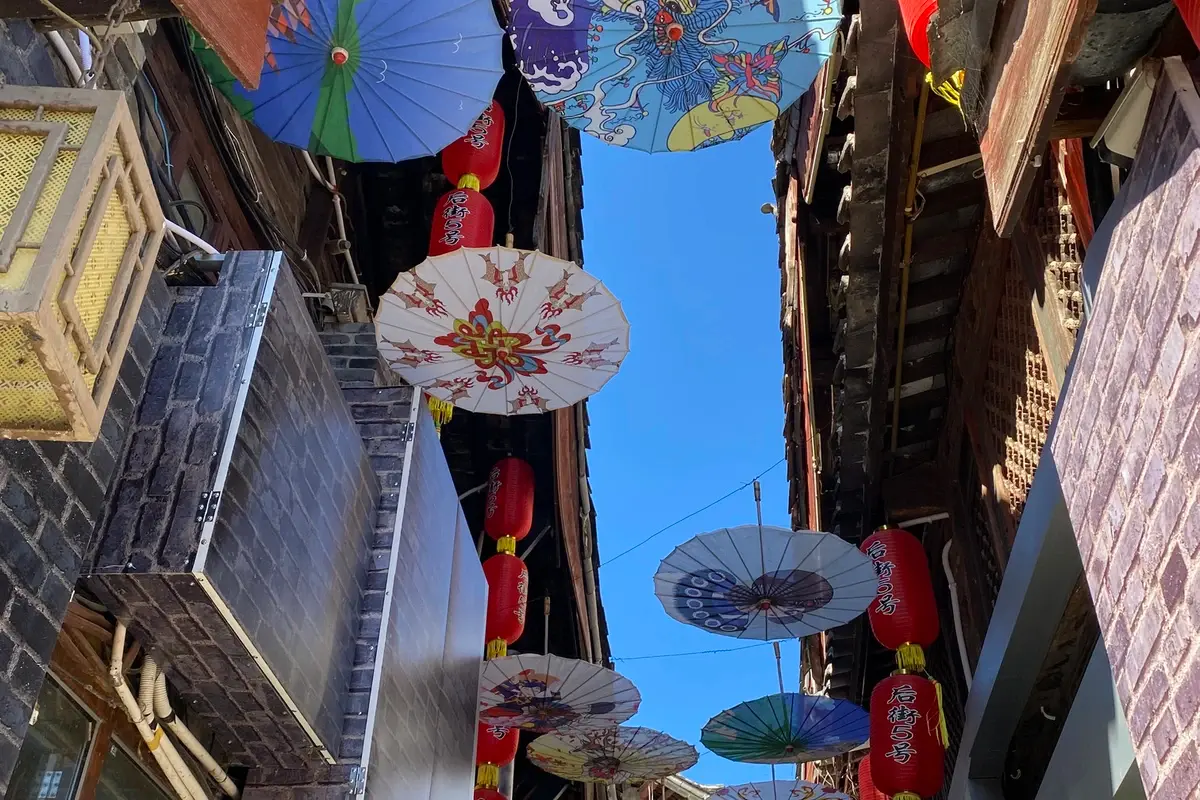
Water lies at the core of Lijiang Ancient Town, and through flexible use of water, the town presents its unique spatial layout of waterways. Most streets in the town are built by the hills and along the water. A narrow lane, artfully decorated, with the blue sky peeking through—the visual effect was stunning! Here, the blue sky and white walls were reflected in the clear stream. Potted flowers everywhere (Lijiang people really love flowers), the morning lane almost empty of visitors—beautiful, plain, and pure! This old town of little bridges and flowing streams, at over 2,000 meters altitude, is truly rare in the world. No wonder it’s one of only two ancient towns in China to be inscribed as World Heritage sites with the entire urban fabric. Different from Suzhou’s own bridges and flowing water, but it felt incredibly intimate! A casual shot could capture ancient stone carvings like this on the steps! In this part of Lijiang, the waterway is very narrow; its water comes from Black Dragon Pool at the foot of Xiangshan Mountain in the north. This area is liveliest at night—the bar street that young people love!
On the Jade River water system within Lijiang Ancient Town, more than 300 bridges have been built, with the Big Stone Bridge 100 meters east of Sifang Street being the most distinctive. But when I passed it, both hands were full of cured pork ribs I’d bought, so I didn’t photograph it. Thinking back now, what a pity! We ate Yunnan Crossing-the-Bridge Noodles here; the restaurant had a castle-themed photo studio, which would really appeal to people who like staged plus real settings. This is the portion for one person. This was a stone pot with four mushrooms including matsutake and chicken we ate in the old town. I also recommend that in Lijiang Ancient Town you must go to Apo’s Cured Ribs shop for the cured rib and matsutake (a local Yunnan mountain delicacy) hotpot. After having the ribs there (forgot to take a photo) we found them wonderfully aromatic and the meat tender and smooth. Adding matsutake and local wild greens to the broth truly made it a feast of mountain treasures.


