A Spontaneous Trip to Shangri-La: A Three-Day Self-Drive Getaway
Shangri-La has always been a place I yearn to visit. Whether it’s the unique highland landscapes or the rich ethnic and religious culture, it has always fascinated me deeply. I don’t know when or why, but it holds a sacred place in my heart. I always feel that my current self is too restless, my mind coated with dust, aimlessly wandering through the world. To some extent, going to Shangri-La expresses the desire of a corporate drone like me for freedom, a longing to escape worldly vulgarity and find inner peace. We had been talking about a trip to Shangri-La for ages, but it never materialized because we lacked the courage to just go. Finally, on the eve of this weekend, egged on by my girlfriend, I made up my mind – a spontaneous trip it was.
I took Friday off. Since we were starting from Kunming, we bought sleeper train tickets for 9:30 p.m., so we could sleep and arrive in Lijiang by 7 a.m. the next day. I had pre-arranged a rental car delivery to the station, but we arrived so early that when I called the rental company, the driver was still getting up. We waited at the station for over half an hour. The osmanthus flowers near the station were almost finished blooming, but clusters of blossoms still lingered with their fragrance.
Traveling on a budget, we rented a Jetta. With insurance included and paying for our own gas and tolls – it was the off-season, so the rental was just over 400 yuan. After getting the car, we thought about driving into town for a breakfast of soy milk and youtiao, but after circling around we couldn’t find any. Sticking to the belief that the best food hides in little unassuming alleyway shops, we eventually found a mom-and-pop shop in an alley across from the city hall. An elderly couple ran it; the grandma recommended rice noodles in a small pot. My girlfriend and I each ordered one, plus a steamer of xiaolongbao. The rice noodles were really tasty – rich broth with pickled veggies, the noodles capped with a savory topping, absolutely fragrant. I never expected the xiaolongbao to be layered flaky pastry, which was a novel experience. Overall, a five-star review; both my girlfriend and I were very pleased. If we ever come back, we’ll likely eat here again.
By the time we finished breakfast and hit the road, it was already 11 a.m. We set our destination, fired up the GPS, turned on some music – Tongyang’s “Highway Song” was first on the playlist – and the joyful road trip officially began. We took the national highway instead of the expressway, partly because the scenery along the back roads is better, and partly because my girlfriend and I had decided at the start that we wouldn’t rush. Passing Lashihai, we drove through a village, with orchards stretching along the roadside. Many elderly locals set up stalls selling fruit. Lijiang’s Xueli peaches are famous – big, juicy, and honey-sweet. My girlfriend loves peaches, so we stopped to buy a few for the road. We approached a stall run by a very simple old man, with pears, apples, and peaches on display. He said the fruit was from his own field, picked that very morning. Since it was just the two of us, we only wanted a few peaches. He told us these weren’t Xueli peaches yet – those come in November or December. We took four or five peaches, over 1 kg in total, and he charged just 6 yuan. The old man was too old to have a QR code for payment, but luckily I’d deliberately tucked some cash into my wallet before leaving. As we turned to go, he pressed a few pears and apples on us. We were delighted, not because we’d gotten a bargain, but because of his warmth and honesty – qualities that feel so precious after spending too much time in the city. We tasted the fruit along the way, and each type was incredibly good, especially the apples with their natural aroma that lingered on the lips. My girlfriend and I decided we’d stop again on the return trip to buy more to take home.
Our first stop was Tiger Leaping Gorge. It took just over an hour from Lijiang. When we arrived, though, the place was packed. The scenic area was diverting vehicles, and we had to wait nearly an hour outside. Once inside, the steep mountains and surging river instantly dissolved our impatience. Tiger Leaping Gorge sits between Haba Snow Mountain and Jade Dragon Snow Mountain, with sheer, towering slopes on both sides. The gentle Jinsha River gathers through the valley upstream, then rushes down with the terrain, creating a thunderous spectacle. At that moment, we felt so small before nature. Gazing into the gorge from the viewing platform gave me a dizzy spell; the churning waves threw mist onto my face, and the roar echoed through the canyon as if it could easily tear everything apart in the next instant. What a magnificent sight!
Invigorated by the rushing waters, we continued on. The national highway followed the contours of the mountains, ascending gradually from Lijiang to Shangri-La. We drove sometimes deep in valleys, sometimes high on ridges. Occasional streams and waterfalls tumbled down the hillsides, distant peaks rolled away, and clouds and mist swirled beneath our feet. This stretch of road felt otherworldly – what troubles could possibly remain? I only felt my heart and mind expanding. “Heaven and earth are the inn for all creation; time is a passing traveler through the centuries.”
Mountains, valleys, forests, and meadows accompanied us. Nature always heals, reminding you how beautiful the world is.
We arrived in Shangri-La around three in the afternoon. Driving into the city, we saw a tall white stupa standing in the distance. Only when we got close did we realize it was the famous Harmony Pagoda, a stupa within a stupa, but our immediate priority was food, so we didn’t stop and headed straight for Dukezong Ancient Town. Dukezong, also known as the Moonlight City, is a vital part of the urban area and a unique carrier of Shangri-La’s history and culture. In the town, many pretty young men and women were dressed in traditional Tibetan clothing taking photos. It was astonishing to see so many people in the off-season; their good looks added vitality to the ancient town. We found a top-rated little restaurant on a review platform and ordered a 168-yuan set meal: a yak meat hotpot, several side dishes, highland barley cakes, and a pot of butter tea. Of course, you have to try yak meat in a Tibetan area. The texture was a bit chewy, and the two lightly bitter leafy vegetable side dishes suited me perfectly. I’d always imagined highland barley cakes to be coarse, but they turned out entirely different – delicate with a hint of sweetness, pairing wonderfully with the salty butter tea. Very nice.
After eating, we rested for a bit until almost five, then decided to visit Napa Lake. An online search showed it wasn’t far – just half an hour from town. We’d originally hoped to drive the road that gets flooded, but the water level had already dropped, so it wasn’t the right season. Napa Lake is also the Yila Grassland. During the rainy season, water from the mountains gathers at the foot to form a huge lake, called Napa Lake. But because of the geology, the water seeps underground, and grass grows, turning it into the Yila Grassland. When we visited, there was both water and grass. The clear, jade-green Napa Lake mirrored the green hills, blue sky, and white clouds. Livestock grazed around, and horses galloped at the water’s edge from time to time, painting a picture-perfect scene.
We circled around Napa Lake, passing numerous prairie pastures. The grasslands were dotted with many Stellera flowers; in this season their leaves turn a fiery red, clustering like blazing fires blooming across the green meadow, taking on a seductive beauty in the twilight sunset. Occasionally, a fine horse would bolt through them with untamed freedom.
We had booked a hotel in Dukezong Ancient Town in advance. By the time we returned to town, the sun had completely set, and the moon was rising over the rooftops. We went to see the Harmony Pagoda, but the staff had left for the day so we couldn’t enter. We took photos outside; it had a special feel under the moonlight.
From afar, we could see the massive prayer wheel halfway up Guishan Park glowing golden in the night, so we decided to investigate. Guishan Park is right in the Dukezong Ancient Town. The prayer wheel on the hillside is Guinness-certified as the world’s largest, standing over 20 meters tall and requiring over a dozen people to spin it together. We began climbing from Moonlight Square. I wasn’t rushing, but I unexpectedly felt a touch of altitude sickness – shortness of breath, a slight headache and dizziness. I had to stop on the steps to rest. Before this, I’d always thought that as someone who grew up on the Yunnan-Guizhou Plateau and occasionally hiked, altitude sickness wouldn’t hit me. Seeing others on the trail inhaling oxygen had always surprised me. Yet here I was, cursing myself. I really wanted to borrow a breath of oxygen, but after resting a few minutes, I recovered. At the prayer wheel, many people gathered, circling it. Legend says that spinning the prayer wheel can dispel disasters and bring blessings. I’ve always considered myself an atheist and don’t much believe in such things, especially since my heart wasn’t truly in it. I figured with so many disciples before Buddha, he probably wouldn’t notice me anyway, so I almost didn’t join. But my girlfriend persuaded me – no matter what, it’s nice to have a beautiful hope. So we pulled together with others and turned it three times. In that moment, I sincerely wished for health and happiness for us.
Back at the hotel, it was past nine. Normally, as a city drone, going to bed before midnight feels disrespectful to time, but it had been an exhausting day. So we showered early and fell asleep, sleeping until we woke naturally the next morning.
The next morning’s itinerary was to visit Ganden Sumtseling Monastery. We arrived at the scenic area entrance past ten. The monastery is tucked behind a village, built into the hillside. The scenic area has a checkpoint far outside the village; unless you’re driving a local vehicle, private cars aren’t allowed in. You can only take the shuttle bus from the entrance, which takes over ten minutes to reach the foot of the mountain. Sumtseling Monastery is the largest Tibetan Buddhist monastery in the southwest. Like the Potala Palace, it clings to the mountain, with the main temple at the top and various khans and monks’ quarters spread below – it’s often called the Little Potala Palace. From the entrance, a long stairway leads directly to the main hall. On the way, devout worshippers knelt and prostrated, praying. Inside the halls, golden statues of Buddhist figures were enshrined, while a guide explained Buddhist culture and stories.
After we came out, my girlfriend asked what I felt. She said she felt as though her spirit had been cleansed. I just admired the magnificent golden architecture and the profound religious culture. She teased me for lacking Buddha nature, saying my visit was as good as not having come at all, which left her speechless.
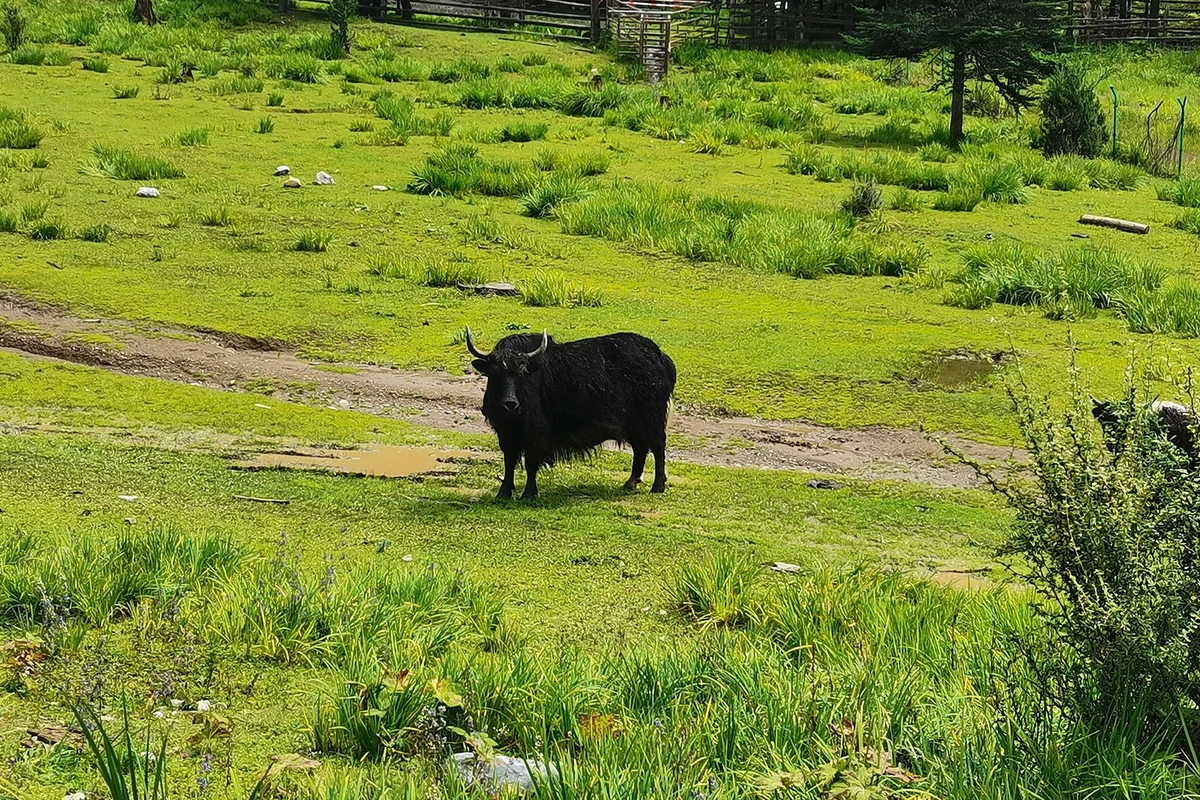
We had a mushroom hotpot for lunch, and our afternoon plan was to hike to Abuji Cuo. Diqing is a hiker’s paradise. The unique geography endows it with a rich variety of natural landscapes – highlands, snow mountains, grasslands, forests, lakes, valleys, waterfalls, plus rare high-altitude flora and fauna. And because many places are rarely visited, much of the pristine scenery remains well preserved. There are famous trekking routes like Balagezong, Baima Snow Mountain, Nanjiluo, Shika, Meili, and Yubeng – places inaccessible by ordinary transportation, where their mysterious beauty can only be discovered on foot. Abuji Cuo is a relatively new hiking route. We drove off the main road and into the mountains. The government plans to develop this into a scenic area, so the road heading in was full of potholes and ruts. Bumping along at barely over ten kilometers per hour, I felt as if my internal organs had been scrambled. The sole consolation was the truly beautiful scenery on either side. In the unique alpine conifer forest, long strands of parasitic mycelium hung from treetops to the ground because of year-round mist and rain. All sorts of rare plants grew freely. A stream gurgled happily down the valley. Local herders let their yaks roam the mountains; occasionally a herd would greet us across the stream. A couple of small pastures sat on wider, flatter meadows. The towering, silent mountains in the distance watched us outsiders approach with a cool, detached air.
We reached the foot of the mountain, where the road ended. It was time to measure the world with our own feet. Because of the altitude, you can’t get cocky and do anything too vigorous; you must approach nature with awe. We walked slowly into the mountains, climbing gradually. We hadn’t prepared, just planning to stop by for a look, so we were in casual clothes, traveling light. As a result, our irreverence was punished. Mid-hike, a sudden downpour soaked us through. I shivered under a tree, terrified a lightning bolt might strike. Fortunately, the rain came as suddenly as it left. My body suffered, but my spirits were high. After the rain, the air felt even fresher; apart from the high peaks still looking solemn, the surrounding forest gleamed a more vivid green, and the mountain stream ran faster and danced livelier.
We walked and rested for almost an hour before reaching a simple campsite at the foot of the mountain. Only then did I realize that all that climbing hadn’t even gotten us onto the real mountain. At the campsite, some hikers who had started early and already descended were drinking tea, resting, and sheltering from the rain. Looking at their gear – waterproof jackets, hiking boots, trekking poles, backpacks – and then at my own shorts, sneakers, and shirt, I felt increasingly disrespectful toward nature. It was getting late and we still had to return, so after a quick chat with my girlfriend, we decided to head back. Next time, with better preparation, we’ll explore deeper. On the way back, we picked several types of mushrooms in the woods – some we recognized, some we didn’t – just for fun.
By the time we got back to the city, it was dinner time. We went for a local Tibetan specialty: a clay-pot chicken feast around a hearth. Meat sizzled on the grill, chicken simmered in the pot, and we drank butter tea. It was thoroughly satisfying, body and soul. Another early shower and sleep that night.
The third day, we had to think about heading home. We slept until eight, had breakfast at the hotel, packed up, and set off. We bid farewell to Dukezong, to the great stupa, and to butter tea, then took the road back to Lijiang. We had considered a detour to Baishuitai, which looked stunning online, but checking the map showed we didn’t have enough time, so we saved it for next trip. Returning along the same route, the scenery looked different on the way back, still surprising us with breathtaking views that made me marvel at our country’s magnificent landscapes. Along the way, we stopped again to buy a bag of apples from the fruit-selling old man to take back to Kunming. I have to praise the apples one more time – unbelievably delicious, with that unique, rich fragrance and crisp sweetness that lingers in your thoughts. We arrived in Lijiang Ancient Town around two in the afternoon. The town wasn’t too crowded during the day, perfect for leisurely soaking in the old architecture, flowing canals, narrow lanes, and all the atmospheric touches. My girlfriend took me to Zhongyi Market to try chickpea jelly – how did it taste so good? I’ve been to Lijiang Ancient Town twice before and never knew about it; I’d been missing out. But as we walked, the crowds thickened. We ordered an iced Americano at a café near the official gate, sat by the second-floor window, and watched more and more people: couples wrapped in each other, families taking photos, tour groups of seniors listening to a guide’s introduction. It was a kind of scenery in itself. I suddenly realized that on previous trips, I’d only visited the old town at night, swept along with the crowds, rarely sitting quietly to deeply appreciate its charm.
After a while, we followed the lanes deeper in. Passing Sifang Street, it was packed. I guess I’m not very comfortable with lively crowds; I just wanted a quiet spot. We quickened our pace along a lane and found ourselves climbing – checking the map, we were heading up Lion Hill. At the edge of the old town, a high wall blocked the view so you couldn’t overlook the town from above. There was a gate in the wall, and getting closer, I saw it was a guesthouse, advertising that you could pay to go inside for the panoramic view and photo ops. Seeing that long, high wall, I felt a wave of disgust. Luckily, we found some steps on the hillside; climbing up, we could still see the old town spread below beyond the wall. A light breeze blew as I gazed at the rooftops, my mind growing calm and peaceful.
We had booked a train back to Kunming at just past eight in the evening. After a meal of hotpot skewers in Lijiang, we parked the car near the station as the rental company required, returned it, grabbed our apples, and boarded the return train in delightful spirits. Sleeping through the night, we arrived in Kunming at five the next morning. Though time was short and we missed many places, overall, the journey was full of surprises and joy. The mountains, rivers, and landscapes along the way continuously cleansed my inner world, leaving me deeply content. I used to always think I had no time for this or that, but once you actually do it, you realize your greatest enemy is yourself. Imaginary fears only hinder you from meeting the future. A journey of a thousand miles begins with a single step, and the wonders lie always on the road.


