Riding the High-Speed Train to Shangri-La: A New Way to Retrace the Ancient Tea Horse Road
Travel is a relaxation for body and mind, an exploration of the soul. In our busy lives, we need to give ourselves some time to seek out beautiful scenery and experience unique cultures. The name Shangri-La originated from James Hilton's novel 'Lost Horizon,' symbolizing people's yearning and pursuit of a beautiful life. This is a real-life 'paradise on earth,' with snowy mountains, meadows, lakes, ancient towns... all the scenery you can imagine is here!
Back then, the Tea Horse Road was rugged and perilous, and this hidden paradise was out of reach for ordinary people. Although there has been an airport in recent years, flights are often affected by weather. Earlier this year, when I came to Shangri-La via Kunming, a sudden heavy snowfall caused the flight to be canceled, and I had to drive 7 hours from Kunming. Now, with the opening of the high-speed railway to Shangri-La, the journey from Lijiang to Shangri-La takes just 1.5 hours, adding a new mode of transport to the Tea Horse Road. This time, we first flew to Lijiang, then took the inaugural high-speed train from Lijiang to Shangri-La, and then self-drove back to Lijiang, enjoying the sights along the way.
Itinerary: Day 1: High-speed train from Lijiang to Shangri-La, evening stroll in Dukezong Ancient Town. Day 2: Dukezong Ancient Town – Napa Lake – Songzanlin Monastery. Day 3: Balagezong. Day 4: White Water Terraces – Haba Snow Mountain – Tiger Leaping Gorge – Lijiang Ancient Town.
I had the privilege of boarding the Fuxing high-speed train from Lijiang to Shangri-La on November 26. Passing through meadows, forests, and lakes, from Jade Dragon Snow Mountain to Meili Snow Mountain, the journey took only an hour and a half. Now there’s a brand new way to get in and out of Shangri-La!
On the inaugural high-speed train, many Tibetan locals from Shangri-La were dressed in festive attire, singing and dancing, their joy evident in their faces.
Upon arrival at Shangri-La Station, local girls presented each passenger with a special souvenir. It was a truly memorable day. Diqing Prefecture has finally ended its history without railway access and is now connected to the national rail network. From Kunming or Dali to Shangri-La Station, the fastest travel times are now 4 hours 30 minutes and 3 hours 58 minutes, respectively. The dream of touring all of Yunnan by high-speed rail is close to becoming a reality.
Dukezong Ancient Town, nestled against snowy mountains, is the best-preserved and largest Tibetan residential complex in China, less than 10 kilometers from Shangri-La’s high-speed railway station.
Dukezong Ancient Town is steeped in history and culture. It was once a key hub on the Tea Horse Road. Its architecture, streets, and customs reflect the wisdom and emotions of the Tibetan people.
The architectural style is unique, mostly Tibetan wooden structures, brightly colored and beautifully arranged. As I strolled through the ancient streets, I soaked in the sense of history.
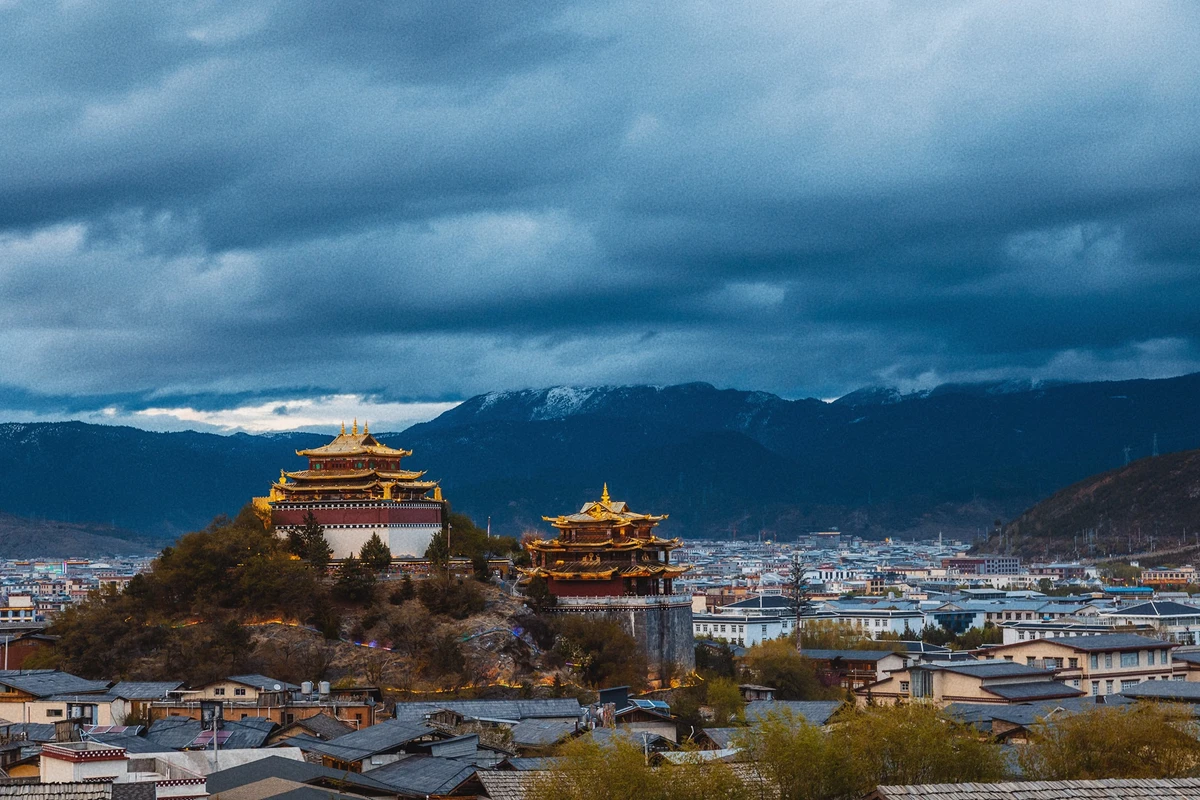
At the center of the old town is a large Buddhist temple, whose architecture uniquely blends cultural elements from Tibetan, Han, and Naxi traditions. Inside the temple stands a giant golden Maitreya Buddha statue, 21 meters tall, solemn and sacred. Many Tibetan devotees were praying devoutly around it. After leaving the temple, I headed to the highest point of Dukezong Ancient Town – Guishan Park. The night view was spectacular, offering a perfect vantage point to overlook the entire town. From the hilltop, I could see all the buildings spread out, well-proportioned and layered. In the distance, rolling mountains formed a beautiful tableau together with the old town.
The golden prayer wheel listed in the Guinness World Records is a must-see. Made of pure copper and towering tens of meters high, it takes more than a dozen people pushing together to turn it. Locals say that rotating it three times dispels misfortune and brings blessings. As night fell, Dukezong Ancient Town glowed with brilliant lights. The night scenery had a special charm, with lanterns, colorful lights, and neon signs dressing the old town in dazzling hues.
Along the cobblestone streets, rows of shops sold various specialty items, such as Tibetan silver jewelry, thangkas, and Tibetan rugs.
I stepped into a Tibetan-style bar with a very cozy atmosphere. I ordered a glass of barley wine and sat quietly in a corner, enjoying the dreamy music.
The next morning, we drove 30 minutes from the old town to nearby Napa Lake, where lake and mountains created a stunning scene. Snowy peaks were reflected on the water, and a gentle breeze sent ripples shimmering across the surface, forming a beautiful picture that felt like stepping into a fairyland.
Beside the lake lay a vast grassland, lush and green, with herds of cattle and sheep grazing leisurely. Walking along the grassland, I breathed in the fresh air and felt completely at ease.
At the edge of the grassland, peaks rose shrouded in mist, their summits capped with snow. From a high vantage point, you could enjoy a panoramic view of Napa Lake, taking in all the beauty of the lake and mountains—it was truly refreshing.
The wetland reserve of Napa Lake is a habitat for many rare animals. Depending on the season, you can spot black-necked cranes, white swans, wild ducks, and more playing by the lake, giving you a sense of nature’s wonder and beauty.
Not far from Dukezong Ancient Town stands Songzanlin Monastery, the largest Tibetan Buddhist monastery in Yunnan. Built in Tibetan style along the hillside, its layered structures resemble a golden fortress. It is hailed as the 'Little Potala Palace' of Shangri-La and is one of the thirteen great monasteries in Tibetan regions.
Its history dates back to 1679, when it was originally named Ganden Sumtseling Monastery. Walking around and exploring, you can learn about its culture and history and feel the power of faith.
Inside the monastery, exquisite murals and sculptures showcase the pinnacle of Tibetan plastic arts. The murals are so stunning that it’s also known as a 'Tibetan Art Museum.' The atmosphere is immersive—definitely worth a visit. Even ordinary visitors can easily be captivated by the charm of its architecture, art, and culture.
At Songzanlin Monastery, you can immerse yourself in rich Tibetan culture while enjoying beautiful natural scenery. When in Shangri-La, be sure not to miss it.
Photo spots: Many young people dress up in Tibetan costumes—there are plenty of great angles, just explore and you’ll easily get beautiful shots. 1. On the road where the bus arrives, there's a white pagoda square, offering a full panorama of the monastery. 2. At the foot of the hill after entering, crouch down and shoot upward to capture the steep staircase merging with the architecture. 3. The yellow walls after reaching the top are perfect for portraits, a favorite of many. 4. Turn left from the yellow walls and look for a sign marking the best photo spot—just shoot there. 5. The main gate, the few windows on the white walls, and the corridors are all great for framing shots. 6. In front of the monastery, by the lake, you can capture a full panoramic view with reflections—morning mist makes it even more magical. Tips:
Transport: Very close to the old town; if you’re not in a hurry, just take a bus.
Tickets: The combo ticket includes admission and shuttle bus. You can also buy an entrance-only ticket with your ID card if you prefer to walk in, which takes about 15 minutes.
On the third day, Balagezong is a relatively off-the-beaten-path and mysterious destination, but the scenery is absolutely spectacular! Here you’ll find gorges, rivers, snowy peaks, grasslands… plus activities like a glass walkway and rafting. Staying inside the scenic area, I witnessed the golden sunrise on the snow-capped mountains in the morning. The drive from Songzanlin Monastery to Balagezong takes about 1 hour and 30 minutes.
Most hidden paradises are out of reach. Deep in Shangri-La lies a place that once didn’t even appear on maps, with spectacular gorges, crystal-clear streams, ancient villages, and bizarre geological wonders. Now it bears a magical name: Balagezong.
Origin: Legend has it that Gezong Snow Mountain is the guardian deity of Shangri-La, while Balagezong was a sacred land everyone longed for but none could reach—isolated for centuries. As a child, Sina Dingzhu left the mountains for the first time due to an eye injury. After achieving success, he spent his fortune and took on enormous debts, spending ten years building this plateau sky road, allowing the world to finally see Balagezong. Exploring the hidden paradise: Take a sightseeing bus from the entrance up the mountain. The road features dozens of hairpin turns, a testament to the sheer difficulty of the construction—viewed from above, it is even more astonishing. Recommended route: Thousand-Year Bodhi Tree – Echo Wall – Shambhala Stupa (optional) – Bala Village – Shangri-La Grand Canyon.
Shambhala Stupa: The mountain is the stupa, and the stupa is the mountain. Here, cliffs, stupa, snowy peaks, wilderness, and prayer flags merge into one, a hidden paradise deep on the plateau at 4,000 meters. After a snowfall, it becomes a pristine white wonderland, especially sacred.
Bala Village: A Tibetan village with over 1,300 years of history, surrounded by towering mountains, preserving traditional ethnic charm. A small museum records bits of the Tea Horse Road. The 'Hidden Mountain Wilderness' café’s yak butter dirty coffee is a hit; looking out the window, you see a stupa beneath the mountains, with a few cats lounging leisurely. There are several hotels in the village, the best spot to watch the golden sunrise on the snow peaks.
Shangri-La Grand Canyon: With its precipitous terrain, dramatic elevation drops, and diverse ecosystems, this natural plateau canyon is a gift from heaven to Balagezong. You can hike along the boardwalk to admire sheer cliffs, cascading waterfalls, and deep gorges, or raft down for a fresh and thrilling experience, feeling the heartbeat of nature.
Thousand-Year Bodhi Tree: At the entrance stands a welcoming bodhi tree of a thousand years. Despite the ravages of time, it remains vibrant, its small trunk sprouting a vast canopy of leaves that covers an entire cliff face.
Echo Wall: This vast natural hollow is named for its resounding echoes. Walking the suspended walkway along the cliff face, you can gaze into the distance at Shangri-La Grand Canyon and the snowy mountains. At the end, the Sky Mirror resembles a blue high-altitude swimming pool—looking down is thrilling. You can also experience the high-altitude zip line, flying above the plateau.
In Balagezong, you can feel the grandeur and mystery of nature and learn about the depth and diversity of minority cultures. It’s a stop well worth adding to your Shangri-La journey. Transport & Tickets: Driving from Dukezong Ancient Town takes about 2 hours. The admission ticket is 170 yuan, or 165 yuan online. A combo ticket costs 225 yuan, including admission, a bus from Dukezong Ancient Town to the scenic area, and shuttle buses inside. To visit Shambhala Stupa, you need to buy an additional ticket at the Echo Wall area for 75 yuan—highly recommended.
From Balagezong to White Water Terraces takes about a 3-hour drive. White Water Terraces are a natural wonder formed by calcium carbonate dissolved in spring water, creating tier upon tier of white travertine steps, like white terraced fields. Under the sunlight, the water surface reveals different hues, truly like a fairyland—you can feel nature’s magic and beauty. The landscape closely resembles Turkey’s Pamukkale. It’s perfect for drone photography.
This is the birthplace of the Dongba religion of the Naxi people and a sacred site for them. On the eighth day of the second lunar month each year, the Naxi people come to White Water Terraces for sacrificial ceremonies.
White Water Terraces is a great place for photography. A drone is best to capture the full panorama. Wearing bright colors makes you stand out in aerial shots, while pastel tones give a fresh, subtle look for close-ups.
Transport: Driving is recommended, about a two-hour drive from Dukezong Ancient Town. There are also buses available.
Tip: Many locals offer horse rides at the foot of the mountain, 50 yuan to the top, but 10 yuan gets you only a five-minute walk. Climbing up can be a bit steep.
Tip: If you have a drone, be sure to bring it—the scenery is completely different.
Note: Stay on the artificial walkways and do not damage the natural travertine steps.
From White Water Terraces to Haba Snow Mountain is only a half-hour drive. From the observation deck, the 5,396-meter-high snow mountain looks sacred and solemn. If you love the outdoors and have the courage to challenge yourself, you can try the trekking routes—it would be an unforgettable experience. Haba Village at the foot of the mountain is quite rustic, a good place to rest and eat.
The last stop, Tiger Leaping Gorge, is one of the deepest gorges in the world, located on the upper reaches of the Jinsha River. It gets its name from a legend that a tiger leaped across the river from a giant boulder in the middle of the gorge. I didn’t see any tigers this time, but I did experience the gorge’s breathtaking beauty and thrills.
Tiger Leaping Gorge is situated in Tiger Leaping Gorge Town, Shangri-La City, stretching about 20 kilometers and divided into Upper, Middle, and Lower sections. The peaks on both sides soar into the clouds, and the river rushes and roars—truly awe-inspiring. The Upper Gorge is the most precipitous.
The Lower Gorge is just a quick viewpoint stop. The Middle Gorge is relatively calmer, with the river meandering along the mountainside. Walking down the boardwalk to the riverside, you can get up close to the flowing water and the gorge scenery. The river rushes through the canyon, crashing against rocks and sending up countless splashes.
Upper Tiger Leaping Gorge is a ticketed area; you can walk or take an elevator down to the river. Getting close to the water, I was awestruck by the sight before me. The Jinsha River thunders down, crashing against giant boulders, sending spray flying with a deafening roar. The water is a deep, dark green, like a jade ribbon dancing through the gorge. The narrowest part of the Upper Gorge is called 'Tiger’s Mouth,' where the river is squeezed into a thin, long cascade plunging from above. On one side, a sheer cliff; on the other, an abyss—it sends a shiver down your spine.
The roar of the river echoed in my ears, like a stirring symphony, making me feel the raw power and majesty of nature.
From Tiger Leaping Gorge back to Lijiang, the drive takes about two hours. This trip, combining high-speed rail and self-driving between Shangri-La and Lijiang, greatly reduced travel time and significantly enhanced the travel experience—a real blessing for friends with tight vacation schedules.


