Looking West to Chang'an, East to Luoyang: Tracing the Origins of Chinese Civilization — July 2020 Northwest China Family Road Trip
China has a continuous civilization history of over 5,000 years and is the only ancient civilization that has endured to the present day. I have always wanted to take my child to see the brilliant origins of Chinese civilization, to help him understand the history of our country and nation. In previous years, my child was still young, and this cultural topic was quite dry, not easily sparking his interest or attention, so the plan was temporarily shelved.
In early May, taking advantage of the short holiday, I first took my child to Henan, the birthplace of the Yellow River civilization. We visited Shangqiu, Xiuwu, Dengfeng, Nanyang, and Zhumadian, allowing my child to experience up close the long history and magnificent natural landscapes of the Central Plains. The trip received a very positive response from my child, which strengthened my resolve to take him on a self-driving tour of the Northwest in July this summer, to explore ancient Chinese civilization and experience the essence of traditional Chinese culture firsthand.
Unlike previous trips, this time I didn't prepare a detailed itinerary in advance. Having traveled to Gansu, Shaanxi, and Shanxi before, I was already familiar with the local culture and history, so arranging this trip was effortless.
Based on my child's current developmental stage, I carefully selected some classic scenic spots and historical cultural sites. I hoped that through this road trip, my child could gain more exposure to and understanding of the origins of Chinese civilization and the historical process of over 5,000 years, inspiring him to ponder philosophical questions such as "Where do we come from and where are we going?"
Once the itinerary was set, I started booking flights, hotels, attraction tickets, and car rentals. With the pandemic still ongoing, flight prices were incredibly cheap: the ticket from Shanghai to Xi'an was only 400 RMB per person.
Our trip ran from July 5 to July 17, starting from Xi'an, the starting point of the Silk Road, passing through Tianshui, Huayin, Yan'an/Linfen, Xinzhou, Anyang, and finally returning to Luoyang, totaling 13 days (12 nights).
The route for this self-driving trip was:
Shanghai → Xi'an (Ancient City Wall / Giant Wild Goose Pagoda + Eastern Route: Terracotta Warriors / Huaqing Pool) → Tianshui (Maijishan Grottoes) → Xi'an (Shaanxi History Museum / Western Route: Famen Temple) → Huayin (Mount Huashan / Muslim Quarter) → Xi'an (Yongxing Square) → Yan'an (Mausoleum of the Yellow Emperor / Hukou Waterfall) → Xinzhou Mount Wutai (East Terrace / North Terrace / Dragon King Temple / Wansheng Bathing Pool Temple / Middle Terrace / West Terrace / South Terrace + Qingliang Temple / Longquan Temple / Great Manjushri Temple + Shuxiang Temple / Luohou Temple / Great Xiantong Temple / Tayuan Temple / Five-Ye Temple / Bodhisattva Peak / Nanshan Temple) → Anyang (Yinxu / Anyang Museum / Yue Fei Temple) → Luoyang (Mount Laojun / Jiguan Cave + Guanlin / Luoyang Museum / White Horse Temple + Longmen Grottoes) → Shanghai.
The total distance was 3,469 kilometers, spanning five provinces: Shaanxi, Gansu, Shanxi, Hebei, and Henan, over 13 days.
D01 (05/7): Fly from Shanghai to Xi'an, visit Xi'an Ancient City Wall / Giant Wild Goose Pagoda, eat Jia San Steamed Soup Dumplings in Muslim Quarter, stay at Novotel Xi'an Bell Tower.
Shanghai Pudong Airport → Xi'an Xianyang Airport, taking 2 hours.
On the morning of July 5, I got up early at 6:00 AM, drove straight to Pudong Airport, and took the CA1216 flight at 8:30 AM. The plane was delayed by 45 minutes before taking off.
We arrived smoothly at Xianyang Airport at 11:30 AM, collected our luggage, hailed a taxi outside, and headed directly to the booked Novotel Xi'an Bell Tower.
We arrived at the hotel around noon, checked in, had lunch at the nearby famous Wei Jia Liang Pi (cold noodles), completed the formalities for the pre-booked Chevrolet 5-seater car at a nearby rental shop, and then went out to play.
Originally, we planned to visit the Shaanxi History Museum on the afternoon of the 5th, but unfortunately we hadn't reserved tickets in advance, so we had to change plans on the spot and headed straight for the Xi'an City Wall. To understand a city's history, the ancient city wall is a great witness. Having stood silently for centuries, it can tell us the stories this city has experienced.
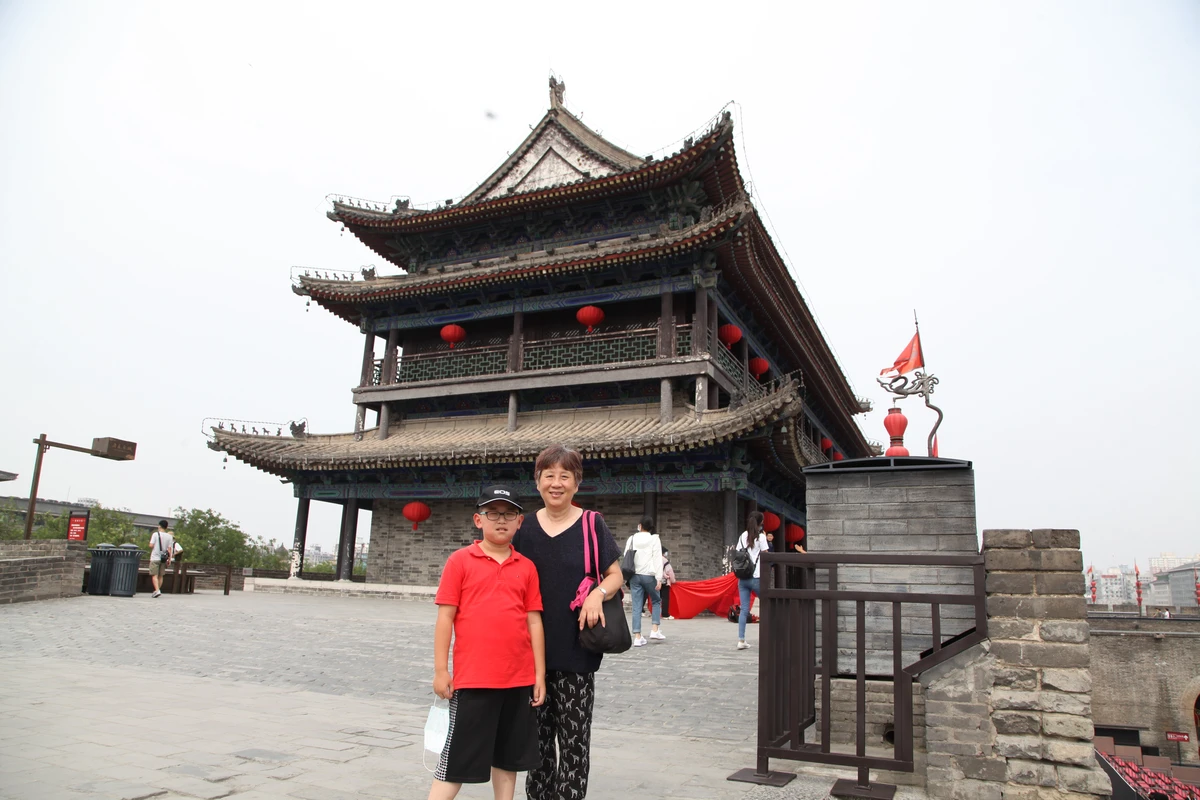
At Yongning Gate (South Gate), we ascended the tall and majestic ancient city wall, which was rebuilt during the Ming Dynasty and has stood for over 600 years. Standing on the wall, we could overlook Chang'an, one of China's four great ancient capitals, and gaze at the scenery in all four directions of Xi'an.
We walked along the wide and flat road paved with bluish-gray bricks, chatting as we went, slowly making our way towards the East Gate (Changle Gate).
The heat was unbearable that day, with temperatures on the wall reaching 36-37°C. Even with an umbrella, my child kept complaining about the heat. There weren't many tourists on the wall; a few scattered groups were walking, and young couples on bicycles glided past us. I introduced my child to several major ancient city walls in China, including the World Heritage-listed Pingyao Ancient City and Lijiang Ancient City, as well as the Shou County Ancient City, which we had visited in May and which is currently applying for World Heritage status.
After walking for a while, my child was eager to visit the Giant Wild Goose Pagoda. Having read "The Treasure Hunt in Shaanxi" thoroughly, he was worried that if we went too late, the pagoda might close. He shared his concern with me, and I reassured him, "We'll make it." We walked a bit further, but perhaps due to the heat, my child didn't want to go to Changle Gate anymore. So we turned back to the parking lot, got the car, and followed the GPS route to the Giant Wild Goose Pagoda.
The Giant Wild Goose Pagoda is a famous scenic spot described in "The Treasure Hunt in Shaanxi." My child had a strong interest in the stories from that book and hoped to learn about the past and present of this ancient pagoda from the Tang Dynasty's Daci'en Temple through a personal visit. Entering the Giant Wild Goose Pagoda scenic area, we walked through the pagoda forest and the pagoda itself, paying homage to the court where Master Xuanzang lived and translated scriptures after returning from his journey to the West, as well as the translated scriptures.
Like Henan Province, Shaanxi is a cultural province with splendid culture, deep history, numerous historical relics, and a long-standing civilization. It holds a crucial and irreplaceable position in the history of Chinese civilization. From ancient times—the Xia, Shang, and Zhou dynasties, through Qin, Han, the Three Kingdoms, the Wei, Jin, Southern and Northern Dynasties, all the way to the peak of Chinese civilization—the Sui, Tang, and Song dynasties—many capitals were established here.
To truly understand China's enduring civilization history, one cannot do without Henan and Shaanxi. This trip to the Northwest with my son was meant to give him a more systematic understanding and a more感性 touch of the origins of Chinese civilization in the Yellow River basin of Henan, Shaanxi, Gansu, and Shanxi.
In the evening, we drove to the famous Muslim Quarter, which was only about 1 kilometer from our hotel, Novotel Xi'an Bell Tower, so we could walk. At the famous Jia San Steamed Soup Dumplings headquarters, we thoroughly enjoyed the steaming-hot soup dumplings—juicy, thin-skinned, soft, and sweet, which my child loved. Paired with a sweet and sticky eight-treasure porridge, which contained walnuts, raisins, and various nuts, my son drank two bowls.
After dinner, it was already 10:20 PM. We drove back to the hotel in no time, washed up, and went straight to sleep.


