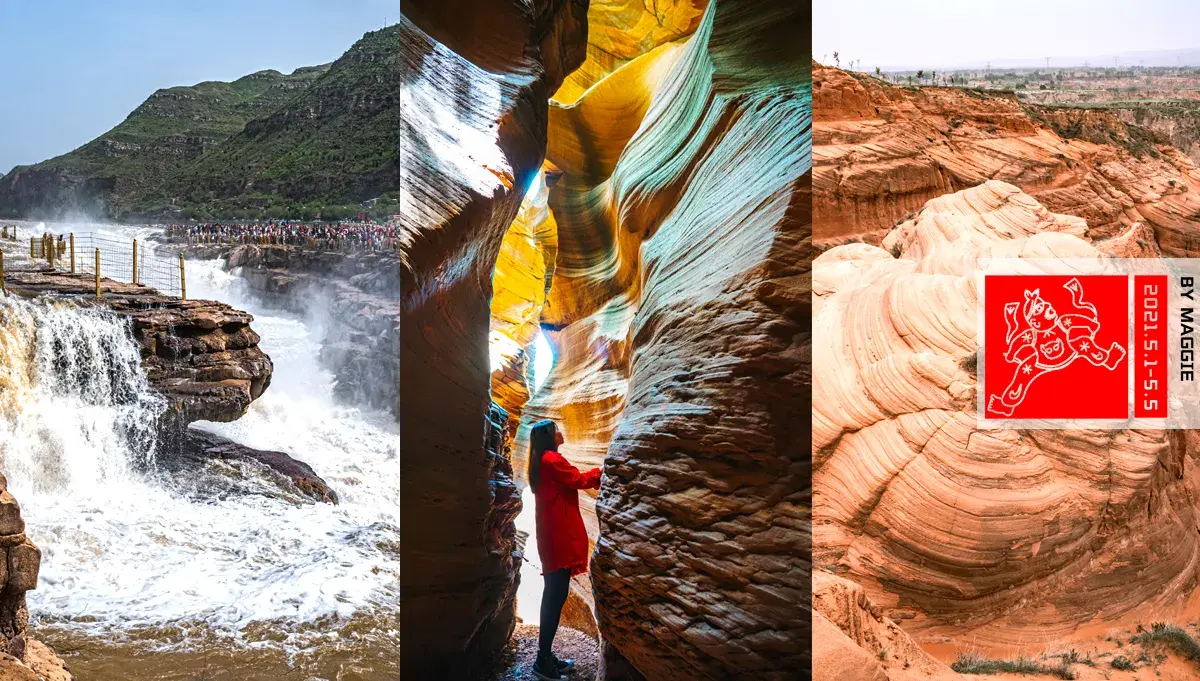
【37° North Latitude, Dreamlike Loess Plateau】2021 May Day Trip to Yucha Grand Canyon, Wave Valley, Qiankun Bay, Hukou Waterfall in Northern Shaanxi
China's cultural landscapes are 'vast and profound, extensive and deep'
Only by truly setting foot in every place can one feel these eight words.
'Northern Shaanxi embraces the Loess Plateau, while Guanzhong is full of historic sites'
I've been to Xi'an countless times, but I'd never been to the Loess Plateau in northern Shaanxi, and I'd brushed past the Yellow River several times.
By chance, I saw photos of several grand canyons, whose scenery is no less than that of Arizona's Antelope Canyon and Horseshoe Bend.
I quickly checked the locations of these attractions on a map; they were scattered around Yan'an.
Thus, I quickly decided on the destination for this trip—Northern Shaanxi.
The 2021 May Day holiday was destined to be a crowded one.
Experience told me that choosing relatively less crowded and 'large' scenic spots was the right way to enjoy domestic travel during holidays.
The grandeur of the canyons and the Yellow River rushing westward, blowing the dry wind of the Loess Plateau, the scenery along the way would make one's mind drift into the movie 'Yellow Earth.'
April 30: Nanchang to Xi'an (overnight transfer)
May 1: Xi'an high-speed rail to Yan'an, Yucha Grand Canyon + Yongning Ancient Village
May 2: Wave Valley
May 3: Qiankun Bay, Liangjiahe
May 4: Hukou Waterfall, Nanniwan
May 5: Hanyangling, return via Xi'an
Four directions, four days~ ~
The best plan would be to take a loop, sleeping in a different place each day to save time.
We landed in Xi'an at 23:55, but the driver forgot to refuel, so the car stopped on the highway for 30 minutes waiting for rescue.
We didn't get to bed until 2 AM, and had to get up at 5:45 AM the next morning to catch the high-speed train....
It's tough being a working stiff, trying to minimize leave time~
At Xi'an North High-Speed Rail Station on the morning of May Day, traffic and crowds were already at peak.
At 9:20 we arrived at Yan'an station, and the driver picked us up to start the trip.
Yucha Grand Canyon is located in Ganquan County, about 1.5 hours drive from Yan'an, in Yucha Village, Xiasigou Town.
The scenic area has officially started selling tickets: entrance 98 yuan, shuttle bus 70 yuan.
(Seniors over 65 are free. We bought tickets from the driver: adults 90 yuan, children half price 40 yuan.)
The shuttle bus is mandatory; it connects the various gullies, the farthest being a 40-minute ride (speed 40 km/h). Private cars are not allowed in.
Each gully takes about 1 hour to visit and photograph.
For lunch, you have to bring your own snacks and dry food, as the only things sold inside are corn and cold noodles by local farmers at the exit.
Whether the scenic area is open and how many spots are open depends entirely on the weather and management.
(On the 1st we saw three spots; on the 2nd it closed for half a day due to rain.)
This May Day holiday, the scenic area kindly offered two routes. See the picture below.
The stones are reddish-brown, the 800-meter gully bottom is the longest, stunning to the naked eye. The first half has no moss, strong lines, great visual impact; the second half has moss with rich colors—red, yellow, green, and cyan.
The stones are yellow with moss. The whole gully is 2.5 km, but currently only the first 500 meters are open. Looks average to the naked eye, but after color correction, it's quite beautiful, with yellow-green interweaving.
The stones are yellow+cyan-gray with moss, 200 meters long. Beautiful to the naked eye, and photos can show colorful effects.
☆ Huabao Gully: Not open
☆ Butterfly Valley: Locals can take you to undeveloped wild canyons.
To be honest, after visiting three gullies, I had serious visual fatigue. They were basically similar, and I took nearly 300 photos.
So I had no interest in Huabao Gully or Butterfly Valley anymore.
It's best to enter the gully between 11:00 AM and 1:00 PM, when sunlight shines directly into the bottom, the best viewing time.
On the first day of May Day, there weren't many people at the bottom. If you wait a bit for people ahead to move, you can get photos with no one.
We officially entered Birch Gully at 11:46. The picture below shows the entrance.
The three gullies are similar in experience:
Go down the stairs to the bottom,
Walk a boring initial section,
The highlights are concentrated in the middle and later parts,
After exiting the gully, staff guide you to climb back to the top,
Then walk about 1 km back to the drop-off point to board the shuttle,
And head to the next gully.
Hundreds of millions of years ago, a major earthquake occurred here, splitting the loess rock into countless cracks. After hundreds of millions of years of plateau rainstorms causing flash floods, and hundreds of years of rain erosion and weathering, the surface was cut and washed to gradually form a unique canyon landform. The canyon interior is uneven, with smooth lines like curved crescent moons. The official name for Yucha Grand Canyon is 'Loess Plateau Natural Ground Fissure Wonder.'
Personally, I think it rivals Arizona's Antelope Canyon.
Antelope Canyon is in a desert, drier, with no moss on the rocks.
Here, because it's in a cool and humid environment, moss grows on the rock surfaces, and there are dense trees at the top of the canyon. Sunlight filters through the leaves into the canyon, creating a colorful visual feast.
Yucha Grand Canyon is low-lying; if it rains, water easily accumulates inside. After rain, you must rent rain boots to enter, otherwise your shoes will be ruined by mud. Rain boots cost 5 yuan, available from locals at the entrance.
Before coming, I thought the online photos might be heavily edited.
But actually, walking inside the canyon, it truly lives up to its reputation. Though not as saturated as in photos, it's incredibly beautiful.
Even my elderly parents kept exclaiming 'wow' nonstop.
Most of Birch Gully has no moss. Many trees at the top have been cut to allow more light into the bottom.
So most photos in Birch Gully are pure reddish-brown.
Only in the middle and later parts, with moss and cyan-gray rocks, after color adjustment, can show blue-green effects.
Only by being there can you feel the magic of nature.
Sunlight shines through the cracks onto the smooth, wavy rock walls.
Red sandstone, moss, leaves, refracting brilliant colors. The colors vary from different angles inside the canyon.
Remember: let others go ahead, and stay behind to look back~
The surprise when looking back is a dreamlike world of light and shadow.
In the wide parts, two or three people can walk side by side; in the narrow parts, only one person can pass.
So, fewer people is important.
While I was taking photos, strangers waited behind me. After I finished, they silently raised their phones and clicked, sharing a smile.
Most of the views at the bottom are seen by 'looking up.'
It's best to bring a wide-angle lens. The light at the bottom is very dim; a large aperture is also necessary.
You can tell the bottom has been artificially leveled, with gravel paths laid. Charging an entrance fee is reasonable.
I think this place is definitely worth 98 yuan.
Carefully examine the curves on the rock walls inside the canyon; each section has unparalleled beauty.
The rocks inside the canyon have been washed by flash floods into dreamlike shapes.
The seemingly weakest force—water—has created Yucha and various caves, carving the hardest beauty.
After exiting the gully, climb a few steps back to the top.
See the picture below: top-down view, showing the path we walked at the bottom. No wonder the scenic area closes on rainy days.
To be honest, if it's cloudy or rainy, just skip this spot.
Without the sunlight boost, you can't see its true face.
Walking back to the pick-up point is about 1 km. You can also take a horse-drawn carriage for 10 yuan.
After a 20-minute drive, we arrived at Longba Gully. Again, a staircase leads down to the bottom.
The front part of the gully is uninteresting.
Compared to Birch Gully, Longba Gully has more moss. To the naked eye, it's not as beautiful as Birch Gully.
But after color correction, the 'true fragrance' law appears.
I'm too greedy; when editing photos, I can't bear to delete any. Please be patient and look at the photos.
When crowded, you have to queue a bit.
Here we exited Longba Gully. Walk back to the drop-off point and take the bus for about 10 minutes to Peony Gully.
After finishing Longba Gully, I was a bit visually fatigued. It was already 14:30. I thought Peony Gully would be ordinary,
but surprisingly, Peony Gully looked much better than Longba Gully to the naked eye.
The canyon is narrower, with more oddly shaped rocks, but the distance is short.
The picture below shows the signature rock of Peony Gully.
Climbing this small staircase means exiting the gully. Peony Gully is only about 200 meters long.
Birch Gully combines the best of all. If you're short on time, you can just visit this one.
After leaving Yucha Grand Canyon, we rested in the parking lot for a while, then drove to Yongning Ancient Village, about 30 km away, which takes about 1 hour.
Zhidan County is named in memory of General Liu Zhidan and is known as the Red Capital of the Chinese Revolution.
Yongning Ancient Village is located on Yongning Mountain.
Looking up from below gives the best view. See the picture below. You can drive to the bottom first to see it, then return to the parking lot and walk up the mountain.
No entrance fee, no shuttle bus—completely free~
The scenery here is steep, with red rocks. Some stone steps spiral down through caves and cliffs, very perilous, truly 'one man can hold the pass against ten thousand.'
The ancient village is embedded in the cliffs among the Loess Plateau hills.
Yongning Ancient Village has three levels:
The upper level dominates the mountain top.
The middle level tilts outward, very steep.
The lower level winds down to the Luo River for water, accommodating up to a thousand people.
Due to the extremely dangerous terrain, people built the ancient village here as early as the Song Dynasty to avoid wars.
The Luo River Bridge is also a great viewing spot. See the picture below.
Since we came in the afternoon, the uphill path was at the back of the village.
The village looks beautiful from many angles, bearing traces of different eras~
The picture below shows our viewing position from below up.
The picture below is the Luo River Bridge.
Climbing up Huining Mountain and looking down,
The entire Luo River canyon landscape unfolds before your eyes.
To be honest, I had a physical reaction of weak legs up there.
Only a chain, with very narrow and steep steps, swaying—very thrilling.
The driver took a relatively easier path to the middle level.
I didn't dare climb higher.
A rock that looks like a tiger~
We saw several stone caves, mostly preserved in their original state, composed of red sandstone.
In some caves, there were chairs and beds used by people in the past.
In 1928, the first Communist Party branch and Communist Youth League branch in Baoan County were formally established on Yongning Mountain, the first party branch in northern Shaanxi.
So several caves displayed items related to the party branch.
When we descended, it was nearly 19:00. In May, it gets dark after 19:30 here.
We set off from the hotel at 7:10 AM, driving from Yan'an to Jingbian, 150 km, about 2 hours.
There wasn't much highway; on the national road, there was a dangerous bridge closed to traffic. We left early and didn't encounter traffic jams, but those behind were stuck for about half an hour.
When traveling on holidays, leave early rather than late~
Jingbian Wave Valley is located at Yanjia Village, Longzhou Township, 22 km southeast of Jingbian County, Shaanxi Province, commonly called Yanzhaizi.
The scenic area has officially started charging tickets.
Adults 100 yuan, children half price, seniors over 65 free.
The most conscientious thing: no shuttle bus!!!!
There is a glass bridge costing 50 yuan (detailed below). If you're reasonably fit, you can skip it.
The picture below shows the main entrance, with a huge parking lot outside.
Bring snacks and dry food; you won't be able to leave for lunch.
Online versions say there are three areas: A, B, C. After careful study, my personal opinion:
Land Danxia (B+A area), Water Danxia (C area)
Land Danxia is the main scenic area, with all walking paths built, connecting the original A and B areas. Enter from B and exit from original A.
Water Danxia is a separate area; you have to drive another route to get there.
Believe me, after seeing the land area, you won't want to go to Water Danxia—visual fatigue.
I entered at 9:40 and exited at 13:20.
With elderly and children, taking photos and playing, the whole walk took 3 hours 40 minutes.
Plain-language introduction to the park scenery:
☆ Flame Danxia: On the mountain top, see a large area of wavy rocks.
☆ Red Cliff Danxia: Down to the river valley, with reeds, rivers, and red grand canyon.
☆ Core Danxia: Stand high on the mountain top, overlooking the grandeur of the distant canyon.
☆ Thousand-Meter Gallery: Walk among the valleys of red wavy rocks.
Just take a loop. Personally, I found the most beautiful scenery in the later Core Danxia + Thousand-Meter Gallery.
The rocks of Jingbian Wave Valley are called red sandstone, academically known as 'Pisha sandstone.'
The weather was not good—overcast, no sunlight—so we couldn't see the most beautiful Danxia.
As soon as we entered the scenic area, there was the glass bridge, 50 yuan separately.
The middle ten meters of glass were not installed yet, so it was a wooden board, not transparent.
If you don't take the bridge, you go down to the valley bottom via the path below the bridge, then climb back up. See the picture below.
The distance is definitely much longer than directly crossing the bridge, but it's not that difficult to climb.
For elderly with limited stamina, it's recommended to take the bridge.
The valley bottom has no scenery—just walking.
After climbing up from the valley bottom, we reached the first scenic spot: Flame Danxia.
The red stones flow like mudslides, forming circles, lumps, and curves rushing into the gullies.
This rock is a kind of sandstone, severely weathered.
All rocks in the area cannot be stepped on; there are monitors with loudspeakers.
But I still saw some elderly women in red clothes jumping on the rocks. Sigh... national quality.
In recent years, I've been trying to take my parents out.
My dad is 70, my mom 67. Taking them around the world is currently a bit difficult, but traveling around China should be achievable.
After seeing Flame Danxia, we began descending again into the valley.
So this scenic area involves constant climbing up and down.
When descending, there were several spots with particularly clear rock textures, with viewing platforms.
Following the red rock trail, the view suddenly opened up, revealing a river gorge-like valley ahead.
At the bottom, small streams and the green-covered mountain tops in the distance formed a beautiful realistic painting.
This is the second scenic spot: Red Cliff Danxia.
The wind in the valley was quite strong. There were restrooms here, so we rested and had some snacks.
Continuing along the valley boardwalk, this section was quite long, all flat. After passing an unfinished 'time tunnel,' we saw the picture below:
The combination of water and valley.
On the opposite cliff, five caves stood side by side, with no stone steps or bridges. It's hard to imagine how ancient people built them.
The caves are called 'Yan Family Bandit Lair.' If bandits really lived there, they must have lived like immortals. How did they survive?
The picture below shows an unfinished restaurant, with restrooms next to it.
After using the restroom, came the toughest climb.
The stairs were very steep and long. The picture below shows me halfway up.
An escalator was being built nearby to reach the top without climbing; probably a paid item in the future.
After reaching the top, we arrived at the third scenic spot: Core Danxia.
This section was the most impressive in the whole scenic area.
I took a panoramic photo.
The layered rocks looked like a large batch of red cloth spread out on the ground, dyed and dried—layer upon layer, roll upon roll, stack upon stack.
After a short flat walk, we reached the fourth scenic spot: Thousand-Meter Gallery.
Essentially walking through a rock canyon.
The hardest climb was the previous section; this one had not too many stairs, only the steep part shown below.
You can click to enlarge the picture below; it shows the approximate scope of the entire scenic area.
The picture below is the exit.
At the exit, the rocks looked better than Flame Danxia to me. That is, the original area A was better than area B.
After breakfast at the hotel, we set off at exactly 7:10 AM. 120 km, about 2 hours drive.
From Yan'an city, we drove all the way to higher altitudes, officially onto the Loess Plateau.
The driver said this scenic spot is the least popular, but its construction and management are the best. Our experience confirmed that.
The scenic area is huge; tickets can be used for 2 days.
Ticket price 80 yuan, online 72 yuan. The driver got us adult tickets for 50 yuan, children 40 yuan, seniors over 65 free.
At the ticket window, it said 'buy 2 get 1 free,' not sure if it's a current promotion.
Shuttle bus 60 yuan.
The scenic area is divided into seven or eight small spots, connected by shuttle buses. The distances are long, so you can't skip the bus.
During May Day, private cars are not allowed inside.
I only chose three relatively essential spots: Qiankun Bay, Qingshui Bay, and Huifeng Fort.
We entered at 9:15 and exited at 16:45, spending 7 hours 30 minutes. There were very few people, and we didn't waste time waiting for shuttle buses. The Yellow River boardwalk was closed that day due to 'falling rocks.'
Even with just these three spots, we played for so long. The scenic area is really large; it's suitable to stay overnight and play for 2 days.
The ticket price is not expensive, and the shuttle bus is cheap—a conscientious scenic area.
Plain-language summary of each spot:
☆ Qiankun Bay: View the Omega-shaped super bend of the Yellow River from the mountaintop; two small viewing platforms.
☆ Yellow River Boardwalk: Usually, when crowded, they shut it down under the pretext of 'falling rocks.' We encountered that and didn't go.
☆ Fuxi Pier: You can take a speedboat to 'Love Island' in the middle of the Yellow River, separate fee. We didn't go.
☆ Niutou Village: Shuttle bus doesn't go there, only private cars. We didn't go. It's also a high spot to view the bend, opposite to Qingshui Bay viewing platform.
☆ Qingshui Bay: View the Omega-shaped super bend from the mountaintop. You can go down the boardwalk to Qingshui Government Office. The road in front of the office leads to another section of the Yellow River boardwalk heading to Huifeng Fort. If you don't take the boardwalk, there is a cable car nearby (40 yuan per person) directly to Huifeng Fort.
☆ Huifeng Fort: A bandit fort on the cliff, offering a beautiful side view of Qingshui Bay.
The geopark is located right in the middle of the Yellow River between Shaanxi and Shanxi provinces.
Our first spot in the morning was Qiankun Bay.
The morning mist lingered, affecting the view, so it's better to visit in the afternoon.
The first viewing platform is at Qiankun Pavilion, the best place to view Qiankun Bay.
You can go down below the pavilion, but I felt the view above was better.
A cool breeze, just beautiful. Standing in Qiankun Pavilion and looking at Qiankun Bay, it truly deserves the title 'Number One Bend of the Yellow River.'
The best way to distinguish Qiankun Bay and Qingshui Bay is that Qiankun Bay has a small island on the left side of the water, while Qingshui Bay does not.
Walking forward a bit, there is another viewing platform from a different angle.
The Yellow River has nine bends and eighteen turns; the most beautiful is Qiankun Bay. The surging Yellow River roars all the way from the Qinghai-Tibet Plateau, crossing high mountains, but on this Loess Plateau in northern Shaanxi, it changes its usual temperament, becoming gentle and graceful, painting the most magnificent scene.
We didn't stay long. At the entrance, we asked about the bus to the Yellow River boardwalk, but got the news that it was closed due to 'falling rocks.'
Fuxi Pier only had paid activities, so we went directly to Qingshui Bay.
The drop-off point at Qingshui Bay is the cable car station; 40 yuan can take you directly to Huifeng Fort.
We first walked inward to visit three viewing platforms.
The stone under the cable car is called 'Guardian Protecting the River.'
Qingshui Bay has three best viewing spots, better than Qiankun Bay.
Both are Omega-shaped great bends, but each has its charm. The Yellow River's nine bends and eighteen turns—every bend truly lives up to its reputation.
According to historical records, in the 11th year of Daoguang of Qing Dynasty, it was an important ferry on the west bank of the Yellow River, also called Qingshui Pass.
In the past, the ancient ferry was a bustling commercial hub with many shops, the economic and transportation center for hundreds of miles.
Below the innermost and highest ancient fort, there is a viewing platform with the best position. See the picture below.
The mountain opposite is Niutou Village viewing platform.
Below the mountain is Qingshui Ancient Village, now converted into a hotel.
There is also a bridge connecting to Qingshui Government Office, which we would visit later.
The picture below shows the three viewing platforms.
It was close to noon, 12:00. The mist dissipated, sunlight gradually appeared, and the colors became much more beautiful.
After viewing the top of Qingshui Bay, we went down the boardwalk to see Qingshui Government Office.
The boardwalk was beautiful with great views, perfect for photos.
Looking up from below, oh my god, glad there was a ride up—I definitely didn't want to climb that.
Below seemed to be a hotel service area with many distinctive rooms.
The water flow at the Yellow River bend was still quite rapid. Some people were playing on sheepskin rafts—truly brave.
The origin of Qingshui Government Office is this place.
Looking up at the sky, 20 minutes ago I was still up on that mountain.
At the entrance of Qingshui Government Office, there was a small electric cart that took us back to the top of Qingshui Bay service area.
From Qingshui Bay, there was no direct shuttle to Huifeng Fort (to protect the cable car, no direct connection).
So we first took the shuttle back to South Gate Service Area, then transferred to a small electric cart to go to Huifeng Fort.
Huifeng Fort is the nearest scenic spot to the ticket office, a natural ancient fort.
The fort faces the Yellow River to the east, surrounded by water on three sides. The man-made structures in the ancient fort were built in the 25th year of Jiajing of Ming Dynasty. Taking advantage of the natural terrain, the ancients built fort walls, gates, watchtowers, etc., forming an impregnable position. It is one of the earliest existing military fortifications in northern Shaanxi, known as the 'Little Huashan' of northern Shaanxi.
After entering, walk less than 100 meters to the viewing platform, overlooking the Yellow River and Huifeng Fort—spectacular.
You can also go down the steep man-made stone steps into Huifeng Fort to visit.
But most tourists choose not to enter Huifeng Fort because climbing up and down the stone steps is too tiring.
So, given the possible closure of the 'Yellow River Boardwalk' due to 'falling rocks,' and not wanting to climb back up after descending,
I recommend descending here, walking this section of the Yellow River boardwalk to Qingshui Bay pier service area, then taking a shuttle back to the top.
Now, if I had to climb down and come back the same way... no way.
So I could only take a distant look at Huifeng Fort.
From a drone view, I could see that Huifeng Fort is actually a long shape, and seeing the Z-shaped path up the mountain made my legs weak.
The picture below is a panoramic view of Huifeng Fort scenic spot service area.
There is also a good viewing platform here to see the Yellow River.
Let's take a panoramic view of the Yellow River and Huifeng Fort.
The most in-depth hiking guide for Qiankun Bay Scenic Area:
After personal testing, under the premise of not spending extra money, the most effort-saving route is as follows:
1. South Gate Service Area shuttle to Huifeng Fort.
2. Descend the Huifeng Fort boardwalk (the path is winding), then walk along the ancient Yellow River boardwalk to Qingshui Government Office. There are two sections of ancient Yellow River boardwalk in the scenic area. To experience both Huifeng Fort and the ancient boardwalk, choose to descend here.
3. Take a shuttle from Qingshui Government Office back to the top of Qingshui Bay service area (saves climbing back up), then view Qingshui Bay.
4. From Qingshui Bay, take a shuttle to Niutou Village (if available).
5. Take a shuttle to Qiankun Bay (morning mist is heavy; it's better after noon).
6. From Qiankun Bay service area, take a shuttle to the Yellow River boardwalk (if open; if not, it doesn't matter since you've already walked the ancient boardwalk).
7. End: take the shuttle out of the park.
This route basically avoids climbing problems; you only need to descend, and the longest walk on the ancient Yellow River boardwalk is on a flat path.
Only if you want to go up to Huifeng Fort itself, you need to climb up and down.
The picture below shows the stairs of Huifeng Fort. After descending here, head directly to Qingshui Bay—you definitely don't want to come back and climb these.
The picture below shows the distant black dot in the middle—that's the cable car station of Qingshui Bay.
Following the small white path along the Yellow River, that's the ancient Yellow River boardwalk—very beautiful; if time permits, it's recommended to walk it.
On the way back to Yan'an, there were many apple sellers. Driver Zhang stopped at one.
The apples were very sweet, comparable to the sugar-hearted apples of Aksu, Xinjiang, and the skin was not waxed.
Large ones 5 yuan, small ones 3 yuan per jin. We bought some.
Wen'an Post is under Yanchuan County.
The town of Wen'an Post was first built in the 3rd year of Datong of Western Wei (537 AD) as Wen'an County. In the 3rd year of Kaihuang of Sui Dynasty (583 AD), it was merged into Yanchuan County. During the Ming and Qing Dynasties, it was a large post station and prosperous trade town in northern Shaanxi.
Liangjiahe is located 5 km southeast of Wen'an Post, designated as a new rural construction pilot village by Yan'an Municipal Party Committee and Government.
Our return time was early, and we happened to pass by Liangjiahe Village, which is now a tourist spot.
This year marks the 100th anniversary of the founding of the Communist Party of China. Since it's where educated youth went to the countryside, we stopped to take a look.
No entrance fee, but security checks are strict; drones are not allowed.
Shuttle bus 20 yuan per person.
It took about 15 minutes by electric cart from the gate to the village.
The village preserves the housing and some labor tools of the educated youth from those years.
There is also a dedicated exhibition hall with some historical text and photo displays, and staff explain the past one by one.
The scenic spot is small. After viewing, we stopped to visit a featured hotel nearby:
Wen'an Post Ancient Town Art Hotel
It has all cave-style rooms with independent small courtyards, beautifully decorated, great for photos.
The night view of Yan'an city is quite beautiful.
Our hotel was directly opposite Qingliang Mountain. Every night we looked at this beautiful mountain surrounded by lights.
The Yanhe River area is also decorated with landscape lighting.
At 8:30 PM and 9:00 PM every night, the Pagoda Mountain has a light show twice, lasting 15 minutes.
It's mainly a short historical video of Yan'an, quite well done.
The best viewing spot is on the second-floor platform of Nanmenli PARK Shopping Park.
That's the position where I stood in the picture below. Come early; good spots don't wait.
To avoid being stuck in traffic during the holiday crowds, we set off from the hotel at 6 AM.
We bought a meat sandwich for breakfast on the way.
After about 2.5 hours, we arrived at the scenic area service center.
Hukou is on the left side of Shaanxi and the right side of Shanxi, a shared tourist attraction between the two provinces.
Hukou Waterfall is the second largest waterfall in China and the largest yellow waterfall in the world.
The upstream Yellow River is 300 meters wide, but within less than 500 meters, it is compressed to 20-30 meters wide.
1,000 cubic meters per second of water pours down from a 20-meter-high cliff, forming the momentum of 'a thousand-mile Yellow River collected in a pot.'
Ticket 82 yuan, shuttle bus 40 yuan.
Actually, the scenic area is right next to the road. A few years ago, no shuttle was needed; you could just get off at the gate and buy tickets.
But in recent years, they introduced a shuttle that forces you to drive a few kilometers forward, then take the 40-yuan shuttle back the same way.
Wasting time and money. Can I swear? ... TMD
Yesterday, the Yellow River was as calm as a virgin; today, it's as fierce as a tiger.
It seemed the water flow wasn't very large, and the water was quite white, not very yellow.
These days I've circled all directions of Yan'an—east, south, west, north—and the mountains are covered with green vegetation.
The Yellow River water also being white shows that our country's soil erosion control is effective. Kudos to our country.
On the Shaanxi side, you view the waterfall from the side and below.
We entered the scenic area around 9 AM. The crowd was manageable; there were gaps along the railing to stand, but getting a solo photo was very difficult—mostly group shots.
The angle in the picture below was the most crowded spot, with layers of people. I squeezed to the second layer, raised my camera, and randomly snapped two shots.
Looking at the crowd on the Shanxi side opposite, it was also considerable.
This scenic spot can be finished in 1 hour—very small.
We left at 10 AM.
Since it was too early, we stopped at two small spots on the way back to Yan'an.
I don't even remember the first spot; it was just by the roadside with restrooms to solve 'morning needs.'
There was a row of cave dwellings, with people dressed in northern Shaanxi costumes, some driving donkeys, some beating drums, taking photos with tourists.
When you take your own photos, they rush into the frame to take pictures with you!!!
Then, after the photo, they ask for a symbolic donation. We didn't give and weren't forced, so it was fine.
We passed by Nanniwan and stopped for lunch.
This was the only proper lunch of the trip; the other three days we survived on dry food inside the scenic areas.
However, the crowds were huge, with limited choices. Nanniwan's specialty is mushroom noodles, so I had a bowl of mushroom noodles again.
Nanniwan has abundant groundwater resources, which is why it was called 'the Jiangnan of northern Shaanxi' in the old days.
Currently, it has been developed into a wetland park. Many locals drive here to bring kids, sunbathe, and fly kites.
Tourists are surprisingly few.
A large area has been planted with various flower seas; after blooming, it must be especially beautiful.
See the picture below: the road to Hukou was already clogged with traffic for several kilometers. Good thing we left early!
We returned to Yan'an city at around 3 PM. We took a walk near the Yanhe River below the hotel, checking off Yan'an.
Pagoda Mountain: just view from a distance.
My peasant mentality told me: close-up view requires a ticket, so save money.
Qingliang Mountain:
Mainly visit Qingliang Temple, with many cliffside inscriptions.
At the top, there is a Taoist temple.
Actually, Yan'an's central urban area developed in the Yanhe River valley.
Finally, we leisurely drank coffee, waiting for the return trip tomorrow.
After hard work getting up early, the four days of Yan'an natural scenery ended. I was very satisfied.
The great mountains and rivers of our motherland are no less than those abroad.
Yan'an Airport is only a dozen kilometers from the city, but the airport bus costs 20 yuan per person and runs infrequently.
So it's more economical for a few people to take a taxi, 40 yuan per car to the airport.
We deliberately left 6 hours for the transfer in Xi'an. Xi'an Airport's transfer service is the best in the country.
I had wanted to see Hanyangling for a long time. It is located about 19 km from the airport.
So we took a taxi there, 45 yuan.
Hanyangling Museum is a comprehensive museum built with a sunken structure, also the largest museum in China in terms of area.
The South Que Gate (also called Zhuque Gate) is the earliest, highest-level, and largest-scale imperial mausoleum gate ruin discovered so far.
The outer burial pit protection and exhibition hall of the imperial mausoleum is the world's first fully underground site museum built with the most advanced cultural relic protection technology.
The most distinctive feature is that entering inside feels like walking into an ancient tomb.
The park is huge with no clear signs. Let me make a kind route map. Of course, you can also go in reverse.
First, visit the underground palace. You need to wear shoe covers. Inside, the light is extremely dim, with transparent glass underfoot, giving the feeling of entering an ancient tomb.
I regret not hiring a guide; I was completely confused.
Later, I managed to eavesdrop on a guide who only explained the underground palace and the Que Tower.
The most exciting artifacts unearthed from the accompanying burial pits of Hanyangling are various pottery figurines.
The human pottery figurines have bodies and heads fired together, but to allow ventilation inside during firing, two holes were left at the arms.
The arms were made of wood and attached later. Over time, the wood decayed and disappeared.
The warrior on the far right in the picture below is covered in soil because he wore leather armor, which over time fused with the soil and couldn't be separated.
After viewing the underground palace, we walked to the South Que Gate.
The picture below shows the sealed earth mound of Emperor Jing of Han, which has not been excavated and remains original.
Actually, the South Que Gate was built with a gate structure over the original site to protect it.
Then we walked for a long, long time (this park is huge; I missed the paid electric cart).
We arrived at the Ancestral Temple site.
Only the four corners and the central column base of the temple remained.
Then we walked for a long, long time (again missing the paid electric cart).
This area contained all excavated artifacts; some items in the underground palace were replicas.
Nanchang recently excavated the tomb of Liu He.
Emperor Jing of Han was his great-grandfather.
Emperor Jing of Han, Liu Qi (188 BC – March 9, 141 BC). The sixth emperor of the Western Han dynasty (reigned 157 BC – 141 BC).
During his reign, he continued policies of resting with the people, reducing taxes, and lightening corvée, leading to further recovery and development of the social economy.
To strengthen centralization, he adopted Chao Cuo's suggestion to reduce the power of feudal lords. In the third year of his reign (154 BC), he suppressed the Rebellion of the Seven States.
Afterwards, he ordered that princes could not govern their own territories and reduced their official posts; kingdom officials were appointed by the emperor.
Later historians refer to the reigns of Emperor Wen and Emperor Jing as the 'Rule of Wen and Jing.'
Emperor Jing died in the third year of his Houyuan era (141 BC) at the age of 48. His posthumous title was Xiaojing Emperor, and he was buried at Hanyangling.
This mausoleum also contains the tomb of Empress Wang, a joint burial.
The most beautiful part was the polychrome pottery figurines in the later part of the exhibition hall. Stunning figures and expressions, objects from over a thousand years ago.
The 'falling-hair bun' is a style from the Han Dynasty, named after the posture of falling off a horse. It was the most distinctive and enduring hairstyle in history.
Here are some practical tips from these days:
On the evening of the 1st, returning from the west of Yan'an, we passed a famous restaurant:
Peizhuang Xiaotang Lamb Restaurant.
Lamb ribs: First bite slightly salty, then the fresh aroma comes out. A bit expensive: small portion 130 yuan, only 4 pieces.
Stir-fried lamb with scallions: The best dish; even the scallions were delicious. 60 yuan.
Stir-fried potatoes with chives: Average, 38 yuan.
Lamb skewers: 60 yuan per bundle; also delicious, no gaminess, only tender and fragrant.
Baked pancake: 5 yuan each, very tasty; stuff it with some filling, perfect.
It's indeed a great lamb restaurant. Northern Shaanxi lamb is mostly goat, with no gaminess.
Compared to the lamb I ate in Inner Mongolia last year, it lacks the milky fragrance, but still very delicious.
I also learned from locals to eat raw garlic with meat—mouthful of meat, mouthful of garlic (very spicy), ah~~~~
After eating, everyone forbade me from opening my mouth to speak!!!
In northern Shaanxi, a whole table of lamb stuffed my mouth. Hahaha~
Staying in the same hotel in Yan'an city may have been beneficial—there are plenty of delicious foods to try.
On the evening of the 2nd, we chose a highly rated restaurant:
Heyue Yellow River Carp with Pancake.
We came here simply because the 4th-floor restaurant 'Hulu Chicken' had a huge queue.
To our surprise, this place also had high ratings and no queue.
Picture 1 chicken: Very fragrant, roasted chicken flavor, good.
Picture 2 fennel pancake: Best, highly recommended, fragrant and refreshing.
Picture 3 old-style oil cake: Stuff it with chili + shredded carrots, delicious, highly recommended.
Picture 4 pig trotters: Just okay.
Picture 5 golden soup pickled fish: After boiling the fish bones and vegetables in the pot, we added the fish fillets fresh; tender and recommended.
Picture 6 northern Shaanxi stewed lamb: Generous portion, very fresh. However, the soup became very salty when we asked for a refill.
How could you not eat noodles in northern Shaanxi? On the evening of the 3rd, we chose a very famous local place:
He Lisao North Second Lane Mushroom Furong Noodles.
I ordered mushroom noodles; they were knife-cut noodles with plenty of meatballs and ingredients.
Small portion 16 yuan, large 18 yuan. A small portion could feed a southerner to death.
A mouthful of raw garlic, a mouthful of noodles—so fragrant~
Behind our hotel, there was a night market street. Every evening, the food stalls smelled heavenly.
I couldn't resist; after eating noodles, I bought two lamb trotters, 7 yuan each.
They were fall-off-the-bone, soft, tender, and delicious~
On the evening of the 4th, our last night in Yan'an, we also chose a highly rated place, but the taste was just average.
Old Yang's Braised Vegetables and Pancake - Unique.
The pancake was excellent; we ordered two portions.
The braised pork ribs and vegetables were ordinary, similar to northeastern cuisine: potatoes, beans, cellophane noodles, and ribs stewed together. Nothing special.
Yangyu Caca (shredded potato dish) is a local northern Shaanxi specialty. It was okay, tasted like cumin stir-fried potatoes.
The stir-fried lamb entrails were terrible—too gamey, couldn't eat them at all; we left them all.
I booked this hotel about two months in advance. Since we had many elderly people in the group, we stayed four consecutive nights without changing.
The price I paid was about 160 yuan per night for a twin room, and a little over 200 for a triple room.
It could be considered 4-star quality; the bedding was comfortable.
The triple room was a view room, with a window facing Qingliang Mountain.
The hotel is located in the very center of the city, with Wanda Plaza downstairs—convenient for food and shopping.
During May Day, they gave us fruit every day and free mineral water and dog-head dates in the lobby.
This is not an 'advertorial' recommendation, but voluntary.
Breakfast started around 6:40 AM, very rich, and we could pack some as dry food for lunch.
I joked that this hotel provided both breakfast and lunch.
Our group of 7 adults and 1 child originally considered self-driving but gave up because renting two cars might not be cheaper than chartering, plus the risk of traffic violations and getting lost. So we contacted a charter vehicle.
A Maxus 9-seater, in good condition, very comfortable. 4 days cost 3100 yuan.
The driver, surnamed Zhang, has been driving for tourism for over ten years. He is a star driver on the X platform. Satisfied~
This is not an 'advertorial' either; his service was indeed good.
Happy ending to northern Shaanxi~ At 40, I don't travel as easily as before, but my dream is to travel the world. If you have a dream, you have to achieve it. Come on~
Travelogue Directory: 1. Itinerary ~~ 2. [May 1, Only 3 Hours of Sleep for the Working Stiff] 3. Ganquan Yucha Grand Canyon · Visual Feast 4. Yongning Ancient Village · Supreme Mountain Top 5. [May 2] North from Yan'an, Jingbian 6. Wave Valley · Danxia under Overcast Sky 7. [May 3] East from Yan'an, the Yellow River Makes a Bend 8. Qiankun Bay · Yanchuan Yellow River Snake Bend National Geopark 9. Liangjiahe · Place of Educated Youth 10. [May 4] Southeast of Yan'an, Yichuan County 11. Shaanxi Yellow River Hukou Waterfall · Raging Yellow River 12. Nanniwan · The Jiangnan of Northern Shaanxi 13. [May 5] Return, Transfer in Xi'an 14. Western Han Imperial Mausoleum · Hanyangling 15. Food · No Sheep Can Leave Northern Shaanxi 16. Hotel · Yan'an Shengxin Hotel 17. Chartered Travel Info Hotels Index Attractions Index Flight Index Website Navigation Travel Index Cruise Index Enterprise Travel Index Franchise Cooperation Partnership Distribution Union Friendly Links Enterprise Gift Card Purchase Insurance Agency Agent Cooperation Hotel Join Destination & Scenic Area Cooperation More Partnership About Ctrip About Ctrip Ctrip Hotspots Contact Us Careers User Agreement Privacy Policy Security Center Ctrip Content Center Intellectual Property Trip.com Group Algorithm Disclosure


