Gazing West to Chang'an, East to Luoyang: Tracing the Origins of Chinese Civilization (Part 5: Yan'an, Huangdi Mausoleum, Hukou Waterfall)
Gazing West to Chang'an, East to Luoyang: Tracing the Origins of Chinese Civilization (Part 5: Yan'an, Huangdi Mausoleum, Hukou Waterfall)
——July 2020 Northwest China Family Self-Drive Trip
D06 (10/07): Visited Huangdi Mausoleum / Hukou Waterfall, stayed at Yuanping Shanghao Jia Express Hotel in Xinzhou City.
Today we were leaving Xi'an. We had grown rather fond of this hotel where we stayed for five nights. The little one said he didn't want to check out and wished to stay a few more days.
Since it was Friday, vehicles with license plate numbers ending in 0 or 5 were restricted from 7:00-9:00 AM. We either had to leave the city before 7 AM or wait until after 9 AM. We originally planned an early departure, waking up before 7 AM. But seeing the Dragon Prince still sound asleep, I couldn't bear to wake him. So I told Grandma, "Let him sleep; we'll leave after 9."
At 8:00 AM, we went downstairs to have a leisurely breakfast. After checking out, we drove along the Bao-Mao Expressway, switching to the Yanxi Expressway, heading toward the Huangdi Mausoleum.
The journey from the hotel to the Mausoleum was about 183 km, taking 2 hours and 45 minutes. Heading north, we sped along like lightning. Along the way, a torrential downpour struck, rain pouring in sheets. The windshield wipers were at maximum speed, yet the road ahead remained blurry.
When we entered Yan'an territory, the rain gradually stopped. Amitabha, the Dragon Prince's travels always bring good luck—"favorable winds and smooth rains," as they say.
Because we had "lost" a parasol at Famen Temple, Grandma got out of the car on the expressway exit into Huangling County, Yan'an City, to buy two umbrellas.
Soon, we drove to the front of the Xuanyuan Huangdi Temple at Qiaoshan. Following the usual procedures—showing health codes, ticket QR codes, and IDs—we smoothly entered the Huangdi Mausoleum scenic area.
In front stood an ancient cypress, lush and sturdy, said to have been personally planted by Xuanyuan Huangdi over 5,000 years ago. Truly, this ancient cypress is a magnificent and singular witness to the long and tumultuous history of the Chinese nation!
Not far from the planted cypress, a huge stone was placed, inscribed with "Kuafu Chases the Sun." To the left was the stele corridor of Xuanyuan Temple, with inscriptions from Sun Yat-sen, Deng Xiaoping, Chiang Kai-shek, Tung Chee-hwa, Jiang Zemin, and others.
A pair of giant footprints caught the Dragon Prince's attention—they were the large footprints of Xuanyuan Huangdi, thick, sturdy, and full of strength!
The Armor-Hanging Cypress is a magical tree. Legend says that Emperor Wu of Han hung his armor on it after his northern campaign, hence it is also called the General's Tree.
The sacrificial hall prominently features elements of traditional Chinese culture. It is a four-sided open corridor, with a stone statue of Xuanyuan Huangdi enshrined in the center. The entire temple adopts a feng shui layout of "round heaven and square earth." The roof is an open circular dome, connecting heaven and earth, surrounded by layers of square patterns radiating outward, symbolizing "the unity of heaven and earth, with humans residing in the center."
The Xuanyuan Huangdi Temple is highly innovative in design, embodying openness and inclusiveness, and absorbing the spiritual energy of all things in heaven and earth. In front of the temple is a spacious square, adorned with 56 golden dragon flags (symbolizing the 56 ethnic groups), fluttering in the wind and rain.
In traditional Chinese architecture, such open square buildings are rare. Standing under the dome, one indeed feels a magical connection with heaven and earth, as if "standing between heaven and earth, embracing all things."
A fine drizzle fell, tenderly moistening the world. After walking through the stele corridor engraved with inscriptions from historical figures, we took a sightseeing bus to visit the Xuanyuan Huangdi Mausoleum at the rear mountain.
At the foot of the mountain was a China Post "Huangdi Blessing Post Office" Yan'an No. 1 branch. Passing the post office, we turned right and ascended toward the entrance of the Mausoleum.
Thinking Grandma and the child might be too tired to go further, I went ahead alone. After climbing several hundred steps, I reached a stele reading "Civil and military officials dismount here," and beyond it was the entrance to the Huangdi Mausoleum. Another round of ticket and identity checks, and just as I stepped in, I heard the little one calling me from behind. It turned out the Dragon Prince and Grandma had caught up.
Everyone was delighted, and we entered the Mausoleum together. Ahead stood a small hill, the famous "Hanwu Immortal Terrace," 13 meters high. Legend says it was an altar built overnight by Emperor Wu of Han's 180,000 troops, each carrying a handful of earth.
In 110 BC, after Emperor Wu's northern inspection tour to intimidate the Xiongnu, he led 180,000 soldiers back to Chang'an and stopped here specifically to pay homage to Xuanyuan Huangdi. This is recorded in history as the first imperial visit to sacrifice to the Yellow Emperor.
The Dragon Prince and I respectfully bowed three times to Xuanyuan Huangdi, the ancestor of Chinese civilization, offering a prayer with folded hands to express our reverence for the progenitor of the Huaxia people!
Leaving the Huangdi Mausoleum, we drove along the Yanxi and Qinglan Expressways for two hours, heading straight to Hukou Waterfall, 160 km away, located at the border of Yichuan County in Yan'an and Ji County in Linfen, Shanxi.
Worried about missing the waterfall, we hurried without stopping, finally arriving at 5:10 PM. We were relieved to learn it closed at 7:00 PM.
After another round of health code and ticket QR code checks, we bought sightseeing bus tickets for the little one and myself (Grandma got a half-price discount). We boarded the scenic bus and drove along the road built on both banks of the Yellow River toward the waterfall.
The first thing we saw were the loess plateaus facing each other along the riverbanks. The exposed yellow soil and barren earth gave a sense of emptiness and desolation.
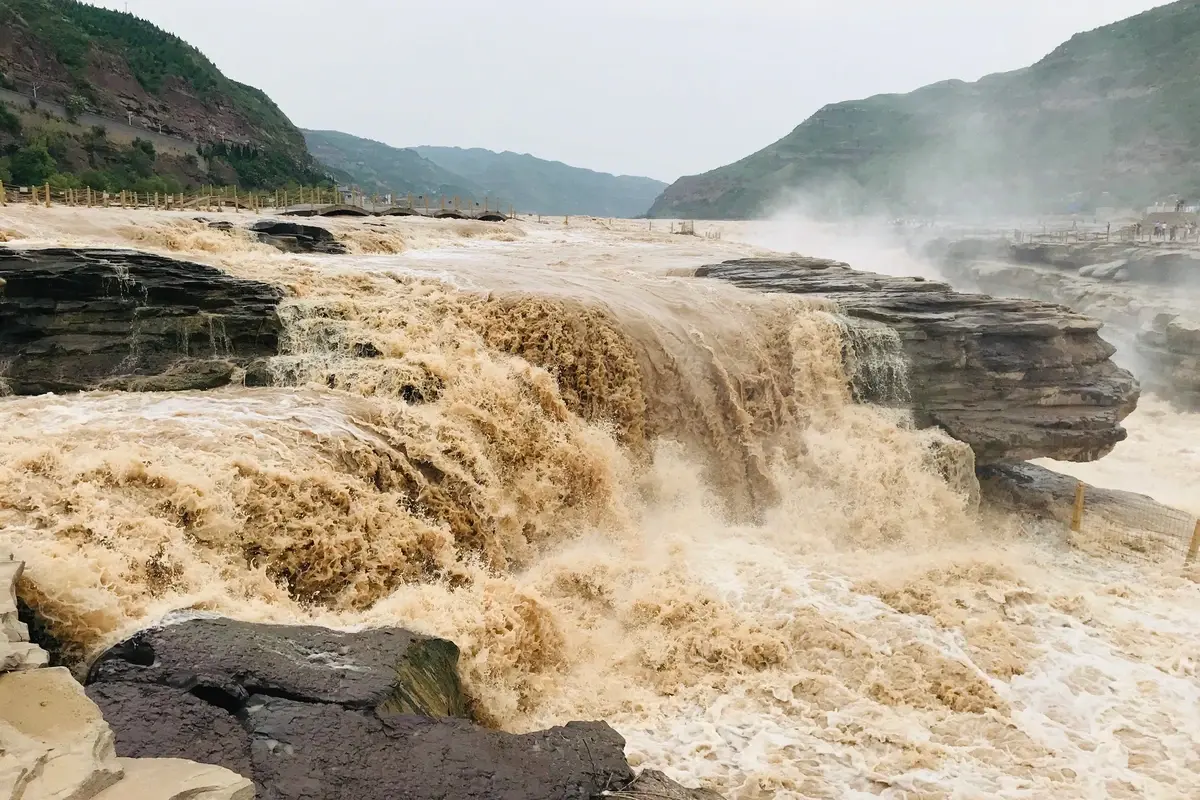
After a dozen minutes driving along the river valley, we arrived at the Hukou Waterfall scenic area. Before even reaching it, the thunderous roar of surging waves echoed in our ears.
Nearby, a yellow dragon roared and surged, appearing and disappearing, charging through the rapids, raising its indomitable head, and racing away toward the sea.
The torrential flow, the unstoppable majestic momentum, the earth-shaking sound of water—these filled the entire valley. Standing on the wild riverbank, listening to the eternal, rolling footsteps of the Yellow River, the beautiful melody of Xian Xinghai's "Yellow River Cantata" echoed in our hearts.
I stand atop the high mountain, facing the Yellow River, expressing my highest respect for you!
This is the Yellow River, the mother river of the Chinese nation. Today, your several children have traveled thousands of miles to come to your side to see you.
The reason Hukou Waterfall is so spectacular is that the wide Yellow River narrows abruptly due to geological changes, forming a shape like a teapot spout, creating the magnificent sight of "the Yellow River collected in one pot." This is the origin of Hukou Waterfall.
I visited Hukou Waterfall in October 2005, viewing it from the Shanxi side. It is said that the Shanxi side is steeper, with faster currents and a more magnificent spectacle.
This time, I deliberately chose to view it from the Shaanxi side, to compare the characteristics of the two sides.
Objectively speaking, both sides have their merits. The Shanxi side has faster water flow, a more vigorous momentum, and a better viewing angle, but the scenery is relatively monotonous, with only the waterfall mouth as a viewpoint. The Shaanxi side allows viewing along the river valley, with multiple scenic spots. Moreover, the scene on the 50-yuan old banknote was taken from the Shaanxi side.
Standing by the Yellow River, your mind and body feel an unprecedented shock. The lightning-fast Yellow River water, with irresistible heroic momentum, surges through the narrow riverbed, roaring forward, gushing onward, filling you with trembling and awe as you stand behind the wire fence.
I led the Dragon Prince and Grandma along the narrow river valley, appreciating this great yellow dragon, taking photos and videos everywhere to capture beautiful memories.
An hour later, we took the sightseeing bus back to the entrance, retrieved our car, and continued driving toward Yuanping Shanghao Jia Express Hotel in Xinzhou City, over 500 km away. We drove for seven hours, arriving safely at 3 AM on the 11th.
This was also our most tiring day. Starting from Xi'an, we covered over 850 km in total, visiting the Huangdi Mausoleum and Hukou Waterfall.
I want to thank my family for their company. My son kept chatting with me to prevent drowsiness, helped me watch the road, peeled candy for me, and opened coffee for me to drink. In the wee hours, he woke Grandma and suggested they take turns to keep me talking.
Grateful for my family's companionship, we drove safely and smoothly all the way. A warm, happy feeling filled my heart and body. How rare and precious it is to see the outside world with my child and to experience a second growth of the mind and spirit together!


