Following Lao Xia to Yan'an's Nanniwan and Hukou Waterfall
According to my itinerary, today we took a long-distance bus—surprisingly, we could haggle over the price. We traveled from Jingbian to Yan'an. During our visit to Yan'an, we also signed up for a small-group day trip to the Hukou Waterfall on the Yellow River and Nanniwan. For those under 65, the cost is 164 yuan per person, including tickets and scenic area shuttle buses. For those 65 and above, the cost is 86 yuan per person. Free hotel pickup and drop-off are included. It's quite affordable, saving both money and effort.
Yan'an is one of the birthplaces of Chinese civilization, with a 5,000-year history. The mausoleum of the Yellow Emperor (Xuanyuan) rests atop Qiao Mountain in Yan'an, revered by all Chinese as the 'First Ancestor of Humanity.' Over the long course of history, Yan'an, with its special strategic position as a 'frontier prefecture' and 'key passage of five routes,' witnessed many ancient Chinese generals such as Wu Qi, Meng Tian, Fan Zhongyan, and Shen Kuo demonstrate their military and political talents, staging one tragic yet heroic drama after another.
This is a view of Yan'an's cityscape from the top of Baota Mountain.
In the first half of the 20th century, Yan'an wrote a brilliant chapter in Chinese history. The Shaanbei revolutionary base founded by national heroes Liu Zhidan and Xie Zichang became the foothold for the Central Red Army's long march. From 1935 to 1948, Yan'an was the seat of the Central Committee of the Communist Party of China and the general rear base for the Chinese people's liberation struggle. During these 13 years, it witnessed a series of major events that influenced and changed the course of Chinese history, including the War of Resistance Against Japan, the War of Liberation, the Rectification Movement, the Great Production Campaign, and the Seventh National Congress of the CPC. In particular, the Yan'an spirit—self-reliance, hard struggle, seeking truth from facts, and serving the people wholeheartedly—fostered by Mao Zedong and other veteran revolutionaries, has become a precious treasure in the spiritual treasury of the Chinese nation and an important spiritual pillar for the whole nation to unite in socialist modernization. In 1982, Yan'an was designated a National Historical and Cultural City by the State Council. In November 1996, the State Council approved the abolition of the Yan'an Prefecture and established the prefecture-level city of Yan'an.
Yan'an Sports Stadium.
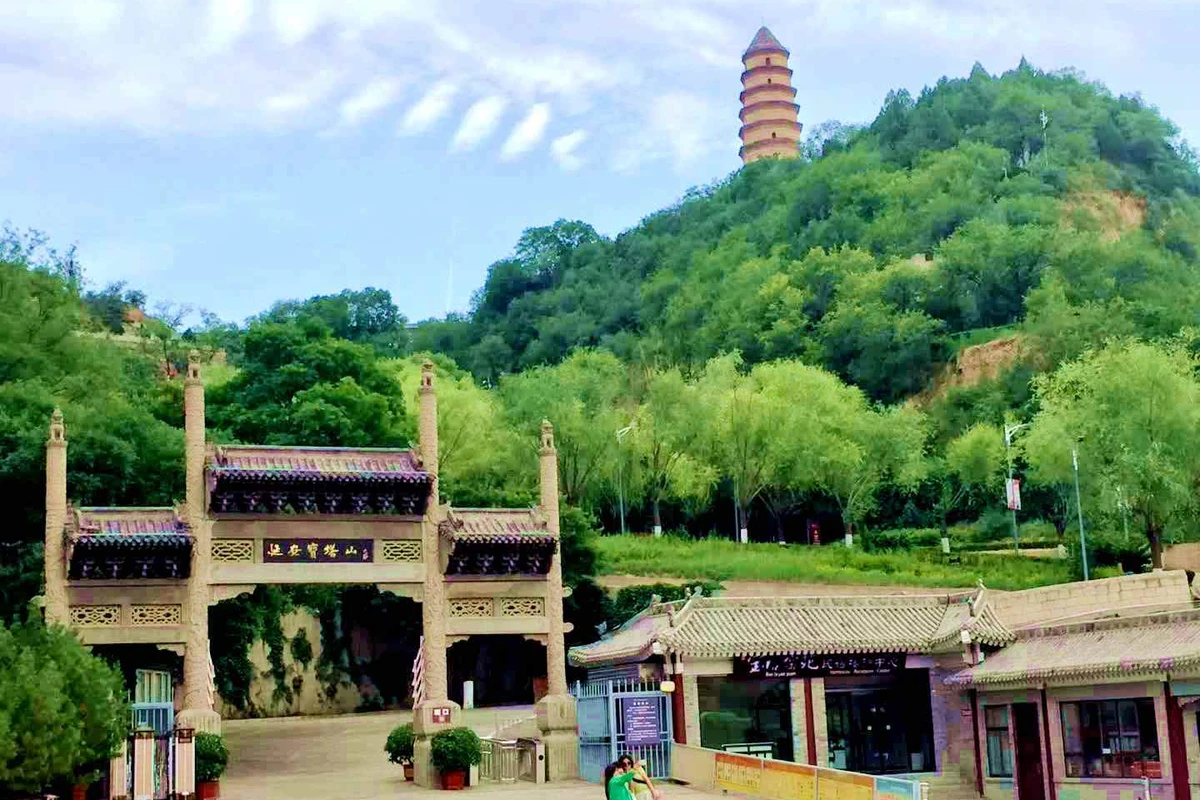
Baota Mountain is located in the center of Yan'an city and is the symbol and emblem of the revolutionary sacred site. Covering an area of 360,000 square meters and with an altitude of 1,135.5 meters, it towers over the surrounding mountains. Baota Mountain integrates historical relics and revolutionary sites, combining cultural and natural landscapes. Ascending to its summit, one can take in the full view of the sacred site and the plateau scenery, making countless visitors exclaim: 'Only when you have climbed Baota Mountain can you truly say you have been to Yan'an.'
Baota Mountain is quite high and steep. However, there is an electric shuttle for 20 yuan, covering both ascent and descent.
The Yan'an Pagoda (Lingshan Temple Pagoda) on Baota Mountain is a national key cultural relic protection unit. The pagoda is 44 meters tall with a base circumference of 36.8 meters, an octagonal nine-story brick structure. It was first built during the Dali reign of Emperor Daizong of Tang (766–779), over 1,200 years ago. Inside the pagoda, there are two gates—north and south. The north gate has a staircase leading to the top. In 1937, when the Central Committee of the CPC and Chairman Mao entered Yan'an, this ancient pagoda took on new life, becoming a blazing torch and beacon guiding the Chinese revolution to victory. Marshal Chen Yi once wrote a poem: 'Yan'an has a pagoda, towering on the high mountain. Rising high into the clouds, the spire points the direction. The red sun shines on white snow, and the masses look up in unison...'
Every day, many Party cadres and members dress in Eighth Route Army uniforms to take oaths here.
Besides the pagoda, the mountain also features Song Dynasty cliffside carvings, Fanzhong Well, Beacon Tower, Star-Picking Tower, site of the Japanese Workers' and Peasants' School, Jialing Academy, ancient city walls, ruins of ancient fortresses, a Ming Dynasty iron bell, and other cultural relics, as well as poetry steles by ancient and modern figures, memorial forests, and other sights.
Baota Mountain, anciently called Fenglin Mountain, was renamed Jialing Mountain in the Song Dynasty. Now it is also called Baota Mountain. Located southeast of Yan'an city, at an altitude of 1,135.5 meters, it is the symbol of the famous city Yan'an and the emblem of China's revolutionary sacred site. Next to the pagoda is a Ming Dynasty iron bell, which was used for timekeeping and alarms during the CPC's time in Yan'an. Additionally, the mountain features a 260-meter-long cliffside carving group and a stele forest, with neatly arranged carvings and intact stone surfaces, representing a rare stone carving art. The mountain has now been developed into Baota Mountain Park, with lush greenery and a pleasant environment. Baota Mountain is a landmark of Yan'an city and once served as the front design of the two-yuan note in the second series of RMB.
Yan'an has a long history and a wealth of cultural relics. From 1935 to 1948, the older generation of proletarian revolutionaries lived and fought here for 13 years, strategizing far and wide, leading and commanding the War of Resistance Against Japan and the War of Liberation, laying a solid foundation for the People's Republic of China.
Yan'an's cultural and artistic heritage, deeply rooted in the loess plateau, is rich and diverse, becoming a new highlight of tourism. Ansai waist drum, Luochuan don't drum, Yichuan chest drum, Huanglong hunting drum, Zhidan fan drum—these constitute Yan'an's 'five drum' arts, which have spread across China. In particular, the Ansai waist drum, with its rough and bold style and Northern Shaanxi characteristics, enjoys international renown. Yan'an's paper cutting, peasant paintings, cloth patch paintings, wool and linen embroidery, and other folk crafts are colorful and have won high praise from Chinese and foreign art masters. Many works have been collected by art museums in France, the United States, and other countries, and have repeatedly won awards in domestic folk art competitions. Yan'an has been named the 'Home of Folk Art' by the Ministry of Culture.
Yan River originates from Zhou Mountain in Tianciwan Township, Jingbian County, Shaanxi Province. It flows from northwest to southeast, passing through Ansai and Yan'an, and joins the Yellow River at Liangshui'an in Nanhegou Township, Yanchang County. The river is 286.9 kilometers long, with a 248.5-kilometer stretch within the county, and a total drainage area of 7,725 square kilometers.
Yan'an has been a strategic military site since ancient times, known as the 'throat of the frontier' and 'important military town,' and hailed as 'the key to Sanqin and the throat of five routes.' Its landmark, Baota Mountain, is the symbol of the revolutionary sacred site, blending natural and cultural landscapes. Other cultural sites include the Yangjialing Revolutionary Site, the Fenghuang Mountain Revolutionary Site, and the Mausoleum of the Yellow Emperor (Huangdi Mausoleum), also within Yan'an city. The magnificent Hukou Waterfall of the Yellow River and the scenic Wanhua Mountain make this red land even more vivid and moving.
Near Baota Mountain is Qingliang Mountain, a historic scenic spot in Yan'an with many poems and inscriptions by past scholars. The Qingliang Mountain landscape is divided into three parts: first, the Buddhist historical relics and monuments centered on the Ten Thousand Buddha Cave and other grottoes; second, the revolutionary relics and sites of the news and publishing units of the CPC Central Committee during the Yan'an period; third, the Taihe Mountain Taoist temple.
The Ten Thousand Buddha Cave was excavated before the Sui Dynasty, with statues or repairs made in the Tang, Song, Jin, Yuan, Ming, and Qing dynasties. The cave contains four main grottoes of grand scale, carved into the mountain. The stone pillars and walls inside are carved with tens of thousands of Buddha statues in various poses, with superb carving techniques, making it a precious historical and cultural heritage. On the same cliff as the Ten Thousand Buddha Cave are attractions such as Poetry Bay, Like Rosy Clouds, Water Reflecting Yan'an, Moon Well, Moon-Imprinting Pavilion, Fan Gong Shrine, Pang Gong Shrine, Yanshou Palace, Immortal Cave, Stele Forest, and Dingjia Spring.
Qingliang Mountain is also the birthplace of New China's news broadcasting and publishing industry. During the Party Central Committee's Yan'an period, it housed the New China News Agency, Yan'an Xinhua Broadcasting Station, Liberation Daily, Border Region Masses Daily, Central Publishing and Distribution Department, and Central Printing Plant, earning it the nickname 'News Mountain.' On the mountain stands the 'Yan'an Qingliang Mountain News Publishing Revolutionary Memorial Hall,' in front of which stands a white marble statue of three people symbolizing news, broadcasting, and printing, with a stone tablet inscribed with the words: 'Go deep among the masses, no empty talk.'
Du Gong Shrine is located east of Qilipu in Baota District, Yan'an City, facing west, overlooking the great river, with National Highway 210 passing below and the Xing River flowing slowly in front. In the past, this place was a stone bay. Legend has it that the great writer and poet Du Fu, upon arriving in Yan'an, rested here with his shoes as a pillow, and later generations built a shrine by carving into the stone to commemorate him. According to records, 'At the mouth of the river is a Tang poem, Du Shiyi Shrine, with a stone chamber, and the Wang Du Pavilion built on a high and airy spot overlooking the river. The shrine has stone inscriptions, and many scholars have come to pay homage.'
Yan'an Revolutionary Memorial Hall was established on July 1, 1950, located on the banks of the Yan River northwest of Yan'an city, at Wangjiaping. It is a memorial hall displaying revolutionary relics and reflecting the history of the Chinese Communist Party's leadership of the Chinese revolution in Yan'an. It is also the earliest revolutionary memorial hall established after the liberation of the whole country. The exhibition hall has been rebuilt four times. The new hall, completed in August 2009, is the core project of the 'No. 1 Project' of the Ministry of Central Propaganda's National Patriotism Education Demonstration Base. Its construction area is nearly 30,000 square meters, the exhibition area is 14,300 square meters, and the square area is 38,000 square meters. In the center of the square stands a bronze statue of Mao Zedong, 16 meters tall, with a 7-meter base, designed by renowned sculptor Cheng Yunxian. The exhibition includes more than 2,500 cultural relics and over 1,400 historical photographs. In 2002, it was awarded the 'AAAA' level tourist attraction by the National Tourism Administration; in 2004, it was named the 'National Advanced Collective of Patriotism Education Demonstration Bases' by the Central Propaganda Department, Ministry of Civil Affairs, Ministry of Personnel, and Ministry of Culture; in 2008, it was rated as one of the first national first-class museums; in 2009, the new building was selected as one of the '100 Classic and Quality Projects in 60 Years of New China.'
Walking around the center of Yan'an.
Nanniwan is the cradle of the Chinese Communist Party's military reclamation cause and the birthplace of the Nanniwan spirit. Today, Nanniwan offers visitors the large terraced fields reclaimed in those days, the Nanniwan Great Production Campaign Exhibition Hall, the Nine-Dragon Spring, and the Martyrs' Monument, among others. The 'Nanniwan Great Production Campaign Exhibition Hall' details the process of the Nanniwan Great Production Campaign through objects and photographs.
In the spring of 1941, due to the Nationalist government's economic blockade of the Shaanxi-Gansu-Ningxia Border Region and the anti-Japanese bases, outside supplies could not be brought in. Therefore, the Central Committee of the CPC ordered the 359th Brigade of the Eighth Route Army to station in Nanniwan and engage in military reclamation to produce for self-sufficiency. Without houses, they dug their own cave dwellings; without vegetables, they collected wild greens; without tools, they made their own hoes and shovels. With astonishing perseverance, they planted crops on barren mountains. In just three years, the 359th Brigade, upholding the revolutionary spirit of 'self-reliance and hard struggle,' transformed Nanniwan from a thorny, uninhabited wasteland into 'a fine southern Shaanbei with crops everywhere and cattle and sheep everywhere.'
The Hukou Waterfall Scenic Area of the Yellow River is located 47 kilometers northeast of Yichuan County town, Yan'an City. It lies on the main stream of the Yellow River, 130 kilometers from Yan'an city and 360 kilometers from Xi'an.
The Yellow River roars and surges into the Qin-Jin Gorge, where the river surface suddenly narrows from over 400 meters to 50 meters, and then plunges into a huge stone trough with a drop of 50 meters. Because its shape resembles a teapot pouring water, it is named 'Hukou' (teapot mouth). According to the 'Book of Documents? Tribute of Yu,' 'When Yu controlled the flood, he managed the Liang and Qi mountains,' thus Hukou was recorded in history. The scenic area is planned to cover 100 square kilometers, mainly composed of four types of surface landforms: the Loess Plateau, the Yellow River, the Yellow River Gorge, and the waterfall. It is a natural scenic area formed by river erosion of sedimentary rock riverbeds. Here, the Yellow River and the loess complement each other, and the gorge and high mountains set off each other, embodying the regional characteristics of southern beauty and northern grandeur. The Yellow River is the birthplace of Chinese civilization and the mother river of the Chinese nation. Because of its unique geographical location, Hukou is hailed by the Chinese as the 'Heart of the Yellow River, Soul of the Nation.' It integrates majestic natural landscapes with deep human history, becoming a spiritual symbol of the Chinese people's diligence, bravery, self-improvement, indomitability, and courage to advance.
After finishing the tour of Yan'an, the very memorable Yucha Grand Canyon provokes deep thought. The Ganquan Yucha Grand Canyon is located in Yucha Village, Ganquan County, Yan'an City, Shaanxi Province. About a hundred million years ago, a strong earthquake occurred in northern Shaanxi, splitting the loess mountains into cracks of varying widths. Later, heavy rains caused flash floods, cutting and scouring the surface, gradually forming this unique canyon landform. Entering the canyon, the walls are uneven with smooth lines, like waves passing by. In wide parts, several people can walk side by side; in narrow parts, only one person can pass. Experts call it a 'natural geological wonder of the Loess Plateau,' a unique geological beauty in northern Shaanxi. The canyon is somewhat similar to Antelope Canyon in the United States. One imagines that after development, high ticket prices might follow, while without development, there may be chaos, congestion, and even safety issues—a difficult dilemma. Regardless, I hope the Yucha Grand Canyon remains beautiful for a long time to come.


