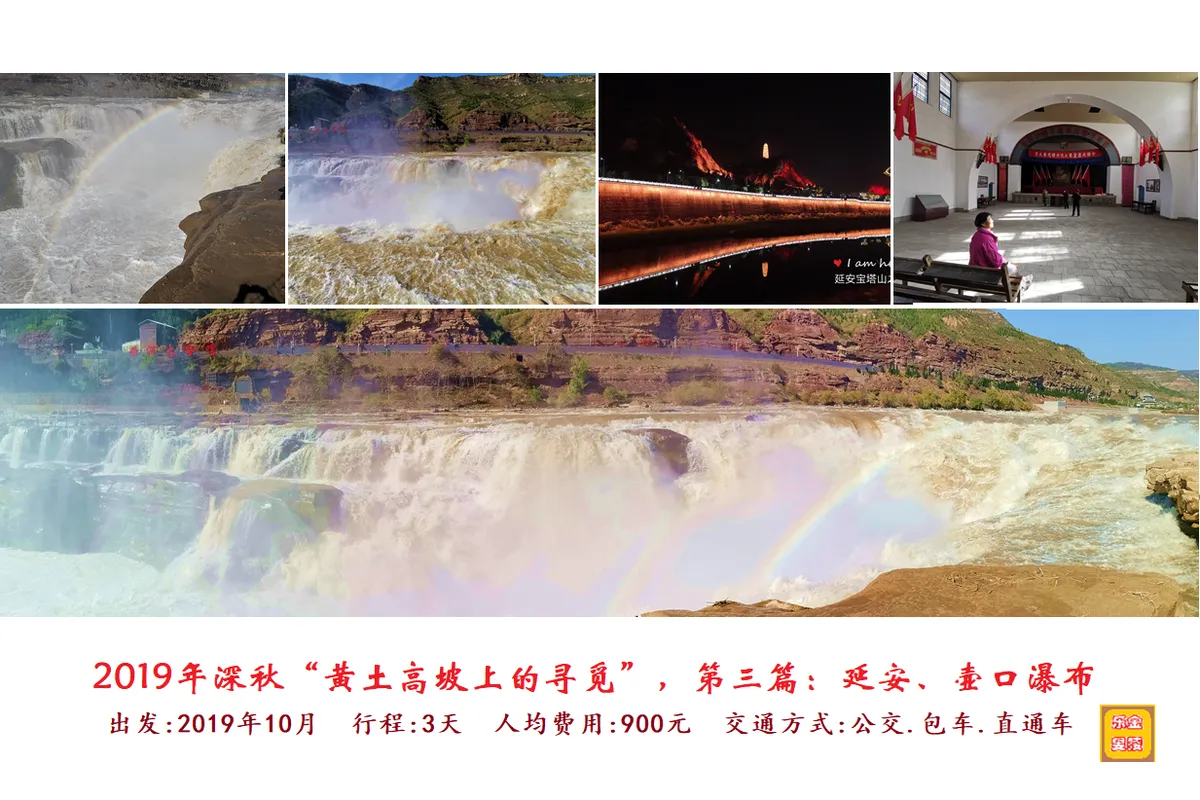
Searching on the Loess Plateau in Late Autumn 2019, Part III: Yan'an and Hukou Waterfall.
On the afternoon of October 29, we returned early from Yucha Grand Canyon to the Starway Hotel in Yan'an. We had visited Yan'an in the 1990s. At that time, there were no hotels, only guesthouses, providing one bottle of hot water per person per day, and no private bathroom. If you want to know how much this revolutionary sacred city has changed, just look at the accommodation today!
Back at the hotel, we rested a bit, then took Bus No. 1 at the hotel entrance, 1 yuan per person, about 25 minutes, and arrived at the Yangjialing Revolutionary Site. Entering Yangjialing again, what changed was the years we have added; what remained unchanged were the familiar old buildings in our memory.
Walking into the former Central Auditorium, the furnishings still retain their original style. In the center of the rostrum are large portraits of Mao Zedong and Zhu De; on the back wall of the venue hangs the phrase 'Tongxin Tongde' (United in Heart and Spirit); on the side walls hang two slogans: 'Uphold Truth' and 'Correct Mistakes'; above the rostrum hangs the most eye-catching banner: 'Advance Victoriously Under the Banner of Mao Zedong'!
In the very seats we sat, there once gathered a group of elites of the Republic. They were all great in wisdom and courage, with extraordinary boldness; they were born for the Republic and fought for the Republic; they went through fire and water, forging ahead without hesitation, turning the once-arrogant great powers into defeated opponents; they beat the invaders so badly that they discarded their armor and fled in panic; they are the heroes of the Republic, the backbone of the Chinese nation! The people will not forget them, and history will forever remember!
The cave dwelling sites and old photos seem to tell the hard life of the great leaders back then. At the same time, they exude the spirit of the great leaders seeking the future for the country and nation, worrying about the world's worries, and daring to be the first in the world. They had foresight, despised all reactionaries, and in these humble cave dwellings right before our eyes, they outlined a great era, created a great country, gathered the great spirit of the Chinese people, and led the Chinese nation toward great rejuvenation!
After finishing the visit to Yangjialing Revolutionary Site, we returned to the bus stop the same way, took Bus No. 3, got off at Yan'an Fenghuang Plaza Station, walked about 500 meters, and arrived at the Yan River at the foot of Pagoda Hill. 'Endless Yan River waters, lofty Pagoda Hill.' As contemporaries of New China, we are a generation that grew up listening to revolutionary stories, so our Yan'an complex is self-evident! We have been here before, and standing here again today, that deeply moved feeling can only be understood by ourselves.
In the afternoon, the Yan River Bridge Square was very lively. Nearby elderly men and women were entertaining themselves, dancing and singing Qin opera. Enjoying their own happiness, they also became a scene along the Yan River. It is clear that the life of Yan'an people today is full of charm.
The popular story 'The Marriage of Xiao Erhei' appeared before our eyes again. Loving each other freely, pursuing happiness without being bound by property, and for the rise and fall of the nation, wives sending their husbands to the battlefield—this is probably part of the Yan'an spirit. May this spirit be passed down from generation to generation!
Yan River Bridge, Pagoda Hill—the red sacred site, the cradle of revolution.
We walked from the Yan River to Erdao Street Food Street, searched on the map for a highly-rated pastry shop and roast chicken shop, and bought some food to prepare for the upcoming trip to Hukou Waterfall. Then we found a well-known restaurant specializing in donkey meat over rice, 30 yuan per person, and ate to our hearts' content.
Yan'an at dusk with lights on has changed greatly from the Yan'an in our memory. On that night in the early 1990s, we also took a walk here. Now, it is no different from any city in the mainland—both quiet and bustling. It is a city, but more like a book, recording the extraordinary journey of a country and nation from poverty and weakness to prosperity and strength.
Yan'an Erdao Street combines northern Shaanxi ethnic customs and local specialty foods, a place for out-of-town visitors to linger at night in search of delicacies.
We walked from Yan'an Erdao Street along the Yan River to Pagoda Hill, then toward the Yan River Bridge. At this time, Pagoda Hill under the lights looked like a brazier, and the pagoda on the hill like a torch, illuminating the night sky of Yan'an and also the hearts of the Chinese people. This is the revolutionary sacred site, Red Yan'an! Only by coming here can one have a profound feeling!
The mountain before us is Yan'an Qingliang Mountain. The former headquarters of the Xinhua Daily was located in cave dwellings halfway up the mountain. The bridge before us is the famous Yan River Bridge. Decades ago on that night, we passed by this same mountain and walked on this same road; everything here seemed familiar. Not far from the bridge is the hotel we stayed at tonight. At this moment, we didn't feel like we were walking on a street in Yan'an thousands of miles away; it felt like 'going home'!
On the morning of October 30, our ride-sharing driver and guide came early to the hotel to pick us up and head to Hukou Waterfall. The cost was 100 yuan per person. The route was: Nanniwan — Yellow River Viewing Platform — Shanxi Hukou Waterfall. Traveling with us were the three ladies from Baotou, Inner Mongolia, whom we had met the previous afternoon at Qiankun Bay.
With the driver-guide's jokes along the way, we drove over 40 kilometers in about an hour and arrived at the red sacred site Nanniwan. We had been to northern Shaanxi twice, but this was our first time in Nanniwan. The scene before us was quite different from our imagination. Nanniwan is vast, with fertile land and a flat plain. It is said that this is the only place in northern Shaanxi that grows rice (due to abundant water resources). The hills around Nanniwan also produce high-quality apples. It is a place where 'whatever you plant, you harvest,' just like the song says, 'Nanniwan is a good place!'
According to historical records, a hundred years ago, Nanniwan was densely populated, with abundant water and fertile land, with prosperous production and economy. But in the early years of the Republic of China, due to ethnic conflicts between the Hui and Han peoples, mutual fighting and vendettas, people fled one after another, turning it into a desolate land overgrown with weeds and thorns, with few human traces.
In the hall of the Nanniwan Former Site Memorial Hall, many old photos are preserved, recreating the scenes of production, life, and military training of the older generation of revolutionaries and Red Army soldiers in Nanniwan back then. Nanniwan is an important part of the Yan'an red spirit. Its core spirit of self-reliance and hard work inspires generations of Chinese children to overcome difficulties and forge ahead. In the new century, Nanniwan is the spiritual home where the Chinese nation continuously achieves one success after another, and also an important stop for tourists to experience the red tour in northern Shaanxi.
This year, Nanniwan had a bumper apple harvest. The apples here are very delicious but can't fetch a good price. Good apples are about 2 yuan per jin, and inferior ones are only 1 yuan or even lower. While celebrating the harvest, the people of Nanniwan are also worried about the sales of apples.
The famous Nanniwan apples are large, thin-skinned, fresh, sweet, and crisp. The Loess Plateau has abundant sunshine, long daylight hours, and little rain, creating the good taste of Nanniwan apples.
Nowadays, Nanniwan's apple orchards have also become a tourist attraction. The fruit farmers here are still traditional, simple and generous. Visitors can eat for free in the orchard. This kind elder sister not only acted as a model for us when we took a photo of the orchard, but also gave us two good apples. We felt a bit embarrassed! Everyone, hurry up and buy Nanniwan apples!
The second stop today was the Yellow River Viewing Platform, but to see the Yellow River, you have to walk down a long plank road along a steep hillside, which is quite taxing. Yesterday we had already seen enough of the wonders of the Yellow River at Qiankun Bay, so we all chose to skip it. Instead, a former residence of Beijing educated youth (zhiqing) beside the viewing platform caught everyone's attention. The past is like a song, and it also evoked our memories of the zhiqing life.
It is said that this is a gathering place integrating accommodation and dining, founded by several Beijing educated youth. Now, it is also a place where many Beijing zhiqing come back to gather and reminisce. It has become their spiritual home. Many people invest and start businesses here for their 'second hometown,' contributing money if they have it, or effort if they don't. It is said that 'hardship is wealth.' Perhaps only those with similar experiences can have such a profound understanding.
The last stop today was Hukou Waterfall, which we had longed for. This was the first time we saw Hukou Waterfall in the deep canyon from the winding mountain road. We couldn't help but feel excited. We had come twice because of its reputation, but both times we missed it. Now, we are standing right in front of you, and we won't miss it again!
Regarding transportation to Hukou Waterfall: Hukou Waterfall belongs to Yichuan County in Shaanxi and Ji County in Shanxi. Both Yan'an, Shaanxi (departing from the South Bus Station, one-way 42.5 yuan per person, with stops at Nanniwan and Yellow River Viewing Platform) and Linfen, Shanxi (departing from Linfen Railway Station, one-way 72 yuan per person, with a stop at Linfen West Railway Station) have direct buses to their respective Hukou Waterfall scenic areas. The journey takes about 2.5 hours each way. The frequency generally depends on the number of tourists. Online ticket purchase is very convenient.
Both Shaanxi and Shanxi sides allow viewing of Hukou Waterfall, but to truly see its magnificent spectacle, tourists usually choose the Shanxi side (pictured above). Shanxi Hukou Waterfall ticket is 100 yuan per person, free for those aged 60 and above. The round-trip scenic bus costs 20 yuan, limited to one ride.
We arrived at Shanxi Hukou Waterfall around 11 a.m. that day, which was just the right time (rainbows at Hukou Waterfall mostly appear around noon). At this time, the waterfall was surging with immense force. The rushing roar and the rare rainbow instantly transported people into a state of ecstasy.
'The Yellow River's water comes from the sky, rushing to the sea never to return' — this is how the Tang Dynasty poet Li Bai described the magnificent scene of Hukou Waterfall. Some vividly liken it to 'swallowing thousands of ravines with a mighty torrent, surging and billowing into the Hukou, gathering countless streams and nine bends, with a rainbow hanging even without rain in the universe.'
This is Hukou Waterfall. At this moment, standing beside it, you can feel it churning and surging in your heart, yet you find it hard to express in words!
This is the famous 'smoke rising from the water' at Hukou Waterfall. It has a magnificent momentum, steaming upward. It is hailed as the soul of the Chinese nation, and some people are moved to tears. It symbolizes the unceasing and forward-charging spirit of the Chinese nation! No force can stop its indomitable advance! Only by standing here can you feel its broad and profound feelings as the mother river of China!
This is the famous 'Ten Mile Dragon Trough' of Hukou Waterfall. Coming here, you can truly feel that we are descendants of the dragon!
Hukou Waterfall is my country's second largest waterfall after Huangguoshu Waterfall, and also my country's largest yellow-water waterfall. Its geological origin is extremely unique. Since the reform and opening up, the ecology of the upper Yellow River has improved year by year, and annual precipitation has continued to increase. Therefore, entering October, Hukou Waterfall is no longer full of mud and sand, and has almost become a clear-water waterfall. It is said that its frozen waterfall in winter is the most spectacular and beautiful, like a gorgeous fairy tale world. Although we didn't see its most beautiful scene, we came for you after all!
After visiting Hukou Waterfall that afternoon, we returned to the scenic area parking lot, took the direct bus (booked on Ctrip, ticket price 72 yuan, departing at 2 p.m.) to Linfen, Shanxi, and that evening returned from Linfen to Nanjing. Thus ended the entire trip of 'Searching on the Loess Plateau.' (The End) Jinling Lesou
Travelogue Contents: 1. [Yan'an Chapter] 2. [Nanniwan Chapter] 3. [Hukou Waterfall Chapter] Travel Information Hotel Index Guide Index Airfare Index Site Navigation Travel Index Cruise Index Business Travel Index Franchise Cooperation Distribution Alliance Friendly Links Corporate Gift Card Procurement Insurance Agency Agency Cooperation Hotel Franchise Destination and Scenic Area Cooperation More Cooperation About Ctrip About Ctrip Ctrip Hotspots Contact Us Careers User Agreement Privacy Policy Business License Security Center Ctrip Content Center Intellectual Property Trip.com Group Algorithm Disclosure


