Northern Shaanxi Trip (III) – Ganquan Yucha Grand Canyon, Four Bends of the Yellow River, Hukou Waterfall
Ganquan Yucha Grand Canyon has always been my motivation for repeatedly visiting northern Shaanxi, as I wanted to perfectly observe the mysterious geological wonder hidden within the loess land, ideally at sunny noon. The recent fine weather made it possible. This trip not only allowed us to appreciate the colorful light and shadow deep within the earth's fissures, but also let us experience the most thrilling section of the Yellow River Sightseeing Highway. We completed aerial filming of the Yellow River flowing through three major bends to Hukou, enjoying a spectacular visual feast.
Attractions: Ganquan Yucha Grand Canyon – Taiji Bay – Panlong Bay – Qiankun Bay – Qingshui Bay – Hukou Waterfall
Itinerary: 1100 kilometers
Day 1: Xi'an – Ganquan – Yan'an, stay overnight in Yan'an.
Drive: 5 hours 33 minutes, 391.1 km.
Attractions: Ganquan Yucha Grand Canyon – Yan'an New District
Northern Shaanxi is located at the center of China's Loess Plateau, including Yulin City and Yan'an City in Shaanxi Province. The basic landform types are loess yuan (tablelands), liang (ridges), mao (hills), gou (gullies), and yuan (platforms), which are plateau surfaces left after the Loess Plateau was dissected by modern ravines.
The Ganquan Yucha Grand Canyon is located in Yucha Village, Ganquan County, Yan'an City. For years, it remained hidden and unknown until early 2017 when a geology enthusiast accidentally discovered it while photographing loess landforms, attracting attention. Due to its striking resemblance to the Antelope Canyon in the United States, it has drawn photography enthusiasts from all over the country, and in recent years has quickly become famous as the 'Antelope Canyon of the East.' According to research, about ten million years ago, a strong earthquake occurred here, splitting the mountains of the Loess Plateau into cracks of varying widths. Over hundreds of years, rain erosion and wind weathering gradually formed a canyon landscape with beautiful wavy curves. The Yucha Grand Canyon consists of seven canyons: Huashu Gully, Mudan Gully, Yixiantian, Shehe Gully, Fenghuang Gully, Huabao Gully, and Longba Gully. Today, only Huashu Gully and Mudan Gully are open.
The scenic area shuttle bus took us to Mudan Gully – to see the uniquely varied arched bridge.
Mudan Gully Canyon is named after the wild peonies (mudan) that grow nearby. The canyon is about 100 meters long and about 1 meter wide. Inside, the formations are vivid and natural.
Huashu Gully Canyon – to view the powerful and vigorous rock formations.
Huashu Gully is one of the most unique and classic canyons among all, and the most famous, known as the 'photographer's paradise.' It is about 300 meters long, 20–25 meters high, and 1–2 meters wide, with the narrowest part at the bottom being only 20 centimeters.
Stepping into the canyon, colors, textures, curves, green moss, red rocks...
Only with light are there colors. As the sunlight moves, the cave interior becomes iridescent, with light and shadow interweaving.
The narrowest part of the canyon allows only one person to pass sideways.
The charm of a single beam of light.
Amazing! Shocking! An ordinary gully on the surface hides a sleeping wonder of nature—the Danxia landform, which has been formed over hundreds of millions of years. I marvel at the wonderful gift nature has given to humanity.
I remember that during my second visit to northern Shaanxi, a friend suggested we should go see Yan'an New District, but we didn't have time. This time, we included Yan'an New District in our itinerary and planned to stay one night.
The construction of Yan'an New District is undoubtedly a 'grand plan' and a 'bold move.' The project of 'cutting mountains to build a city' in Yan'an is equivalent to creating two old city areas on the mountains. It is the largest geotechnical engineering project in the collapsible loess region in Asia and even the world, and is also a first in the history of city building.
When we crossed several loess mountain ridges and arrived at Yan'an New District, dusty and tired, it was already dusk. The imposing rows of high-rise buildings urged us to rush to the Guirenmao Observation Deck to get a bird's-eye view of the new city before sunset.
As night fell, we found the 'Lu Yi Garden Hotel' in the city center, checked in, and then went to a uniquely decorated restaurant in a nearby commercial center to taste northern Shaanxi cuisine.
'Zichang Pancakes' is a famous Han snack from Zichang County, Shaanxi. The pancakes are as thin as paper, silvery white and translucent. Types include tofu-dried pancake, hot tofu pancake, cold dish pancake, crispy meat pancake, chicken pancake, etc. When eating, you can pair them with vinegar, garlic soup, chili oil, or cold soup according to your preference.
'Yangyu Chacha with Scrambled Eggs' is a northern Shaanxi specialty. It can be eaten as a main dish or as a side dish with a chewy texture.
'Minjie' is a unique type of noodle dish.
After dinner, we enjoyed the night views in the city center.
Day 2: Yan'an – Qingjian – Yanchuan, stay overnight at Qiankun Bay.
Drive: 4 hours 48 minutes, 220.0 km, via: Baonan Line, Yellow River Sightseeing Road
Attractions: Yan'an New District – Taiji Bay – Panlong Bay – Qiankun Bay
Morning exercise in the park next to the hotel.
Hotel breakfast – strong northern Shaanxi flavor.
Start of the second day's journey.
Driving through the city, we experienced this modern city sitting on half a loess mountain up close.
The 'Yellow River Sightseeing Highway' can be called China's 'Highway No. 1'. It is a scenic road running along the west bank of the Yellow River, connecting 4 cities, 12 counties, and over 50 scenic spots in Shaanxi, with a total length of over 800 kilometers. Along the way, it links more than 50 famous historical and cultural sites, including Huashan Mountain, Hukou Waterfall, Hechuan Wetland, Sima Qian's Temple, Dangjia Village, Hancheng Ancient City, Yellow River Snake Bend National Geopark, Qiankun Bay, Chuangwangzhai, and Wubu Ancient City.
From Yan'an New District to Taiji Bay, we did not take the expressway; instead, we traveled through villages on the loess slopes, raising dust all the way as we traversed the gullies and ridges of the loess land. After about half the distance, we finally reached the Yellow River Sightseeing Road. From there, we would follow this scenic road along the Yellow River into the most magnificent and spectacular snake-bend geological landform area in the Qin-Jin Grand Canyon.
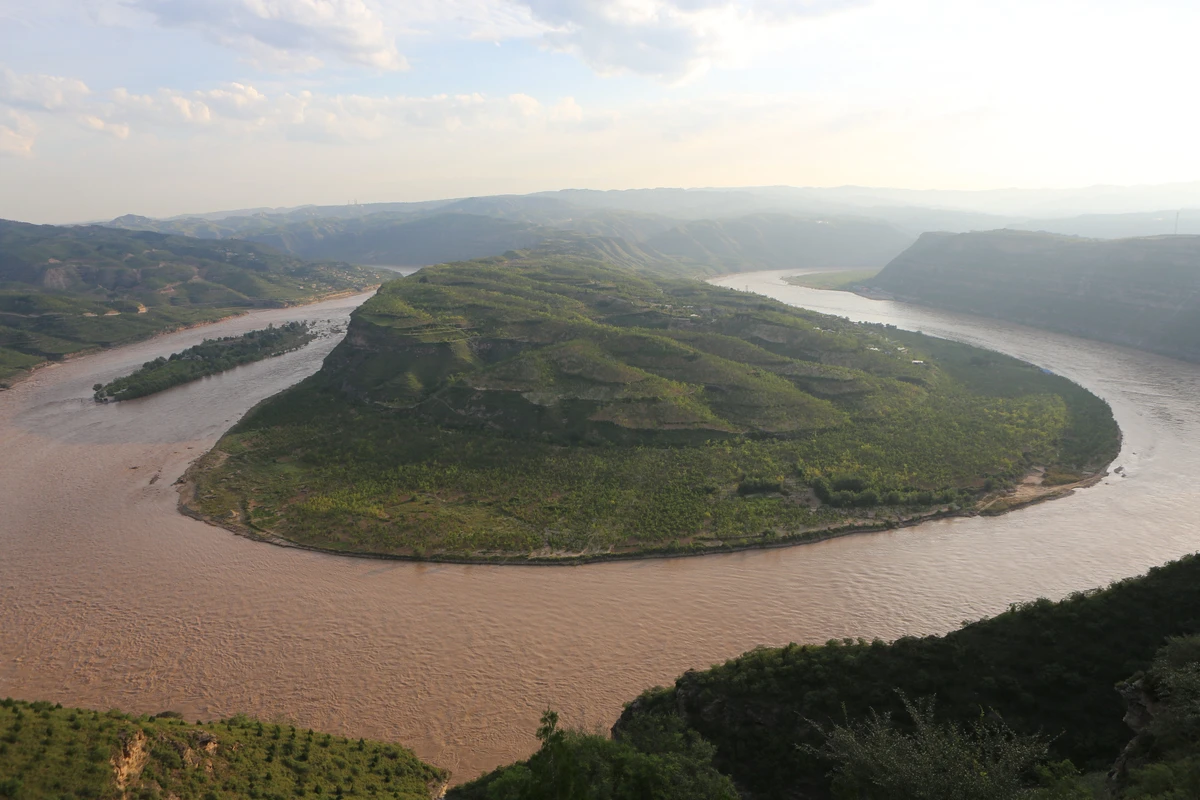
The Yellow River, roaring all the way, slowed down when it reached Yanchuan County in Shaanxi, forming five winding, majestic bends with curves exceeding 300 degrees. Extending from north to south, it winds through the Shanxi-Shaanxi Gorge, drawing a beautiful arc. It flows through Yanchuan County for only 68 kilometers, yet it is the section with the most, largest, most imposing, and most poetic bends, writing five magnificent large 'S's: Qiankun Bay, Taiji Bay, Qingshui Bay, Panlong Bay, and Xuanwo Bay.
Taiji Bay is located in Qingjian, closely resembling the ancient Chinese Taiji diagram. The yin pole is the winding Yellow River, and the yang pole is the loess slope. It is both spectacular and gracefully delicate. This landscape embodies many aesthetic elements: curve and straight, high and low, steep and gentle, full and empty, wide and narrow, sky and earth, mountain and water, soil and stone, yellow and green, grandeur and elegance, simplicity and wonder, history and reality, humanity and nature, achieving a high degree of harmony.
The geopark near Taiji Bay.
Panlong Bay, also known as Suya Bay or Fusi Bay, is where the 'Yellow River Sightseeing Highway' happens to pass through. The Yellow River, like a dragon, meanders through the deep canyon, leaving a stroke of genius—a relatively regular semicircular geometric shape, enclosing the east bank into a peninsula. Looking down from the observation deck, its shape is like a symbol in physics and also the logo of a world-famous watch: 'Ω'. Standing on the observation platform, looking down: there is a mountain within the bay, and a bay within the mountain; the bay surrounds the mountain, and the mountain encircles the bay; mountain and bay depend on each other, reflecting each other; one mountain, one bay, one yin, one yang, harmonious and wonderful. Fusi Bay is one of the five major bends left by the Yellow River in Yanchuan County, Shaanxi, and a classic bend in the Yellow River's Qin-Jin Grand Canyon, representing the beautiful scenery of the canyon.
Snake bends are winding geological landforms formed by river erosion, resembling snakes. The Yanchuan Yellow River Snake Bends in Shaanxi are large-scale deeply incised meandering snake bends developed in the Qin-Jin Grand Canyon. The Yanchuan Yellow River Snake Bends are the largest, most intact, and densest group of snake bends on the main channel of China's rivers. The Yanchuan Yellow River Snake Bend National Geopark is located along the Yellow River at the southern section of the border between Shaanxi and Shanxi.
We passed the service center of the 'Yellow River Snake Bend National Geopark' without buying tickets (there are ticket offices at each bay scenic area). With the staff's permission, we drove straight to the Qiankun Bay scenic area.
Passed by 'Niuweizhai'.
Arriving at Qiankun Bay scenic area near dusk, we found a farm stay nearby to settle for the night and dinner. The host suggested we visit other spots at Qiankun Bay that day and come back to Qiankun Bay at dawn to photograph the sunrise.
Ancient Yellow River ferry – Fuxi Dock.
Fuxi Village is said to be the hometown of Fuxi in legend. According to legend, in ancient times, Taihao Fuxi looked up at the sky, observed the earth, studied birds and animals, distinguished yin and yang, and drew the Eight Trigrams to understand the virtues of the gods and classify all things, depicting a vast and profound world. An ancient myth left behind the peculiar landscape of Qiankun Bay – Nüwa Peak.
At sunset, we arrived at Qiankun Bay scenic area, launched our drone, and took an aerial view of Qiankun Bay in the evening glow.
Day 3: Yanchuan – Xi'an
Drive: 10 hours 14 minutes, 480.4 km
Attractions: Qiankun Bay – Qingshui Bay – Hukou Waterfall
Taking sunrise photos always comes at a price. We got up at 5 a.m., drove 5 minutes to the scenic area observation deck, where many people were already waiting.
We stayed there for a full two hours, at a speed of 'sitting on the ground to travel 80,000 li per day,' observing the changing light and shadow of the canyon, the Yellow River, and the clouds during sunrise, as well as the shifting colors.
On the left channel of the big bend, a shoe-shaped sandbar rises, known as Shoe Island, a rare island in the Yellow River in the middle of the river.
Due to the heavy cloud cover, the sunlight was completely blocked, but against the sunlight, the changing clouds and shapes became elements we captured.
After the sun rose, we moved to the 'Eagle Beak Stone' viewpoint to admire the wonderful formation from both front-lit and back-lit angles.
The silhouette of the 'Eagle Beak Stone' against the backlight seemed even more vivid, resembling an eagle spreading its wings to fly.
We proceeded to another observation deck to capture different views.
Closer to 'Shoe Island'.
From here, Qiankun Bay looked different.
From the Temple of Heaven (Tiantan), we overlooked Qiankun Bay and Qiankun Pavilion.
Looking closely at Qiankun Pavilion, the ground was paved with stones forming a yin-yang Taiji diagram corresponding to Qiankun Bay below. The pavilion pillars were inscribed with two lines: 'Nature created Qiankun Bay, Fuxi deduced the Taiji diagram.' This conveys the legend that 'Ancestor Fuxi observed the heavens at Qiankun Bay and invented the theory of Taiji and the Eight Trigrams of yin and yang.'
Sunlight bathed the earth. Standing at Qiankun Pavilion, the panoramic view was clear. The Qiankun Bay, shaped like a Taiji diagram, was fully visible. The bend has a curvature of over 320 degrees, making it 'the first bend of the Yellow River under heaven.'
Looking far into the distance, mountains undulated, ravines crisscrossed, and the Yellow River galloped like a giant dragon. The villages of Hehuai and Fuyihe beside the S-shaped ancient course of the Yellow River resembled the 'yin-yang fish' in the embrace of the Yellow River dragon. The entire scene seemed like a natural Taiji diagram created by heaven and earth. Here, the Yellow River is as kind, gentle, plump, beautiful, and benevolent as a mother. It can be said that Qiankun Bay is a reach that embodies the 'soul of the Yellow River' and reveals another aspect of its character.
After fully appreciating Qiankun Bay during the most beautiful time of the day, we left the scenic area and took a photo at the landmark sign—seemingly an afterthought, but it is also important to have a label in memory.
Back at the farm stay, the host had prepared a hearty northern Shaanxi farmhouse meal for us.
We set off promptly at 9 o'clock.
The adjacent Qingshui Bay has a similarly peculiar mystique. It looks like a huge straw hat covering the Yellow River. It is said that this was where Yu the Great lived. We did not enter the scenic area, as the shape seemed similar, so we took a few photos outside and hurried on.
The next attraction was Hukou Waterfall on the Yellow River. We planned to take the 'Yellow River Sightseeing Road.' The distance from Qiankun Bay to Hukou Waterfall was 143.9 km, the entire route winding through mountainous areas with steep slopes and sharp turns, offering stunning views. It should have taken over three hours, but due to road construction, we had to detour around a closed section through a loess mountain ridge path. It took over 4 hours to reach our destination, but we enjoyed the thrilling and crazy driving fun.
The clear Yanhe River water.
Although there were no gas stations along this section, there were two nice observation decks.
The Yellow River – the fifth longest river in the world, the second longest in China, and also known as the river with the highest sediment load in the world. The Yellow River is the most important birthplace of Chinese civilization, and Chinese people call it the 'Mother River.'
Hukou Waterfall is the second largest waterfall in China and the largest yellow waterfall in the world. Having lived in the Yellow River basin, I have visited Hukou Waterfall many times. This time, I came specifically for aerial photography.
The three-day trip filled the gaps in my exploration of northern Shaanxi. After visiting northern Shaanxi three times, I have basically covered all the attractions I was interested in. I saw, played, ate, drank, and felt a great sense of fulfillment. Northern Shaanxi is a place with character, flavor, and warmth.


