Yongning Ancient Fortress: From Wealthy Villa to Bandit Stronghold to Red Army Bastion
Arriving in northern Shaanxi and entering Zhidan County, visiting Yongning Ancient Fortress was a spontaneous detour.
On October 3, according to the original plan, I was supposed to visit the Yucha Grand Canyon in Ganquan County. When I arrived at the tourist distribution center, Xia Siwan Town, at 2:30 PM, the innkeeper said, "You came too late; they probably won't let you into the Grand Canyon, because before dark, you can only visit one ravine. The Yucha Grand Canyon has three ravines, and they are quite spread out. I suggest you go to Yongning Ancient Fortress, about forty kilometers away. It's free of charge and a great place. You can go to Yucha tomorrow."
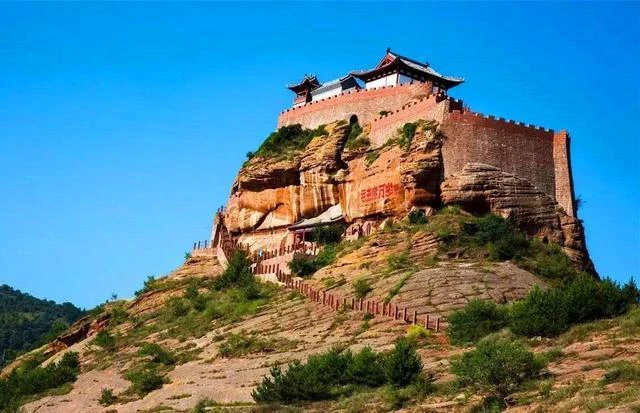
Following the innkeeper's advice, I drove westward along the winding Luo River on the Ganzhi Highway connecting Ganquan County and Zhidan County. An hour later, I arrived at Yongning Mountain in Yongning Village, Yongning Town, Zhidan County, on which stood a stark castle.
Yongning Mountain, also known as Dashilou Mountain, is 1,312 meters above sea level. The mountain is made of red sandstone, with a towering peak and steep cliffs on all sides. Inside the mountain, three layers of cave dwellings were excavated, stacked on top of each other. Initially, it served as a treasury for wealthy officials and gentry to store valuables and silver. Because it was cool in summer and warm in winter, it also served as a mountain villa for these families to escape the cold and heat.
Due to its strategic location, Yongning Mountain has been a contested military site throughout history. As early as the Song Dynasty, it was developed into a fortress to guard against bandits. Over successive generations, the interior was expanded. During the Song Dynasty, over 100 stone chambers, caves, and caverns were carved into the mountain, capable of housing about a thousand people. It could conceal people, soldiers, and grain with ease. The Luo River forms a huge S-bend here, leaving the fortress surrounded by water on three sides. With guards posted at the mountain entrances, it was an impregnable stronghold, and via the three layers of caves, one could descend directly to the Luo River to fetch water. Regrettably, it was later seized by bandits and became their lair for harassing passing villagers and merchants.
Yongning Mountain is not only legendary but also records the red history of General Liu Zhidan leading the laboring masses in revolution in northern Shaanxi. After the failure of the Weihua Uprising, Liu Zhidan secretly returned to what was then Bao'an County (now Zhidan County) and in 1928, he secretly established the first party branch of Bao'an County—the Yongning Mountain Party Branch—organizing the people to resist grain levies and taxes, demanding that the authorities reduce taxes and relieve the victims of famine. This marked the beginning of the "Red Revolution," preserving precious revolutionary sparks and a solid fortress for the Chinese revolution, laying a foundation for the Central Red Army's strategic shift—a spark that could start a prairie fire.
After the founding of the People's Republic of China, the fortress was reinforced several times, and it still retains deep marks of the era.
Times have changed. Today, the ancient fortress no longer needs to serve as a defensive bastion. It has become a treasured site for people to explore the past and seek history. The beautiful landscape attracts visitors from all over, and its red legacy carries forward the spirit of revolutionary traditional education.


