The Loess Plateau in Early Spring – A Nine-Day, Eight-Night Travel Diary of Northern Shaanxi and Shanxi in April 2021 ● By Liujuanzhilang
April 19 – After a year's gap, our family and friends set off again. Today we took the high-speed rail to Huayin, Shaanxi, and visited the Xiyue Temple. The Xiyue Temple is a Taoist sacred site where emperors of past dynasties worshipped the god of Mount Hua. The temple complex covers over 120,000 square meters, with nearly half being gardens. The entire layout is rigorous, enclosed by a wall over 1,800 meters long, earning it the nickname 'Little Forbidden City.' Within the temple, there are a number of ancient cypress trees over a thousand years old, immersing the temple in over 2,100 years of heavy history. Perhaps because there were few visitors, a Taoist priest seized the guide's opportunity to speak, talking eloquently about everything from the shape of Mount Hua to traditional Chinese culture and even the current pandemic fight, praising Chinese civilization and winning our repeated applause. In the evening, we stayed at the Huayin Xinyuan International Hotel.
April 20 – Thirty years ago, I climbed Mount Hua with some friends from Zhejiang. We started at one in the morning, each carrying a flashlight. Taking advantage of the night, fearless and bold, we climbed several nearly vertical ladders made of iron chains and spent 11 hours going from the North Peak to the West Peak. Because we had to rush back to Xi'an for a meeting, we didn't climb the highest peak—the South Peak. This time, of course, I wanted to fulfill that regret. Today, we took the cable car to the West Peak. When we reached the summit of the West Peak, it started raining. The mountains, already shrouded in clouds and fog, disappeared from our sight. As someone focused on photography, I could only helplessly return to the meeting point—the West Peak cable car station. The two elderly gentlemen in our group, aged 77 and 74, along with four heroic ladies, marched straight to the South Peak! Bravo. That night, we stayed at the Huangling Hotel, which had an air of a state guesthouse.
▲ The cable car to the West Peak of Mount Hua rises and falls sharply along the mountain, a bit thrilling. Some women closed their eyes, feeling the strain on their hearts.
▲ The only way to the beautiful summit of the West Peak—Fish Ridge.
April 21 – In the morning, we paid homage to the Yellow Emperor, the first ancestor of Chinese civilization. In the afternoon, we visited China's Antelope Canyon. At the end of 2017, a renowned photographer from Beijing reportedly accidentally discovered in Yan'an that the Danxia landform here rivaled the Antelope Canyon in the United States. The photos he released caused a sensation in the photography world. Because this geographical discovery was made in Yucha Village, Yan'an, it was initially called Yucha Grand Canyon. Since the seat of government is in Ganquan County, all local signage now reads 'Ganquan Grand Canyon.' The tourism industry, placing it on a global geographical stage, calls it 'China's Antelope Canyon.' Different groups view it from different perspectives, but one thing is certain: it is beautiful and a world-class tourist attraction. I have visited the Antelope Canyon in the US—though only 150 meters long, it is absolutely 150 meters of perfection. Today, we walked the 300-meter Huashu Gully, which already has basic walking conditions, with excellent water patterns and momentum. The 800-meter Longba Gully we visited is still in its original state. As for the other gullies, many remain in uninhabited areas awaiting development. It is said that similar geological structures have also been found near Ansai (where the waist drum originates), and there may be a considerable number of such 'antelope canyons' throughout the Yan'an area—a precious gift from the revolutionary holy site of Yan'an to the world's tourism industry. The local tourism slogan is: 'World's Living Danxia, China's Dream Valley.' In the evening, we stayed at the Fanhua·Yue Boutique Hotel in the Golden Yan'an Scenic Area. A miniature landscape garden was moved into the bedroom; there were projection TVs, large rooms, and smart sensors—highly praised by everyone.
▲ After the liberation, at the request of the local government, Chairman Mao asked Guo Moruo to inscribe the Mausoleum of the Yellow Emperor, replacing the original inscription by Mr. Chiang Kai-shek.
▲ A 5,000-year-old cypress planted by the Yellow Emperor himself.
▲ The scene of this year's public memorial ceremony.
April 22 – In the morning, we visited Zaoyuan in Yan'an. In the display room of the Central Archives Bureau, we had a lively discussion centered on the theme 'self-reliance, ample food and clothing.' It was through such arduous and extraordinary struggles that the Chinese Communist Party finally achieved the liberation of the country. In the afternoon, we visited the Jingbian Wave Valley. Our group of 11 people spent nearly three hours covering all the scenic spots. At the Flame Danxia area, my wife and I finally fulfilled our regret of not having visited the Wave Valley in the US. The US Wave Valley allows only 20 visitors per day: half are selected by lottery from worldwide applicants, and the other half from on-site registrants. We were not among the lucky ones, but as a consolation, we could visit similar scenic spots with only 10 spots per day. Comparatively, the wave formations in the US are a bit more undulating. At the Red Cloud Danxia area, one side was steep red mountains, and the other was wetlands and slopes. The croaking of frogs came and went; some trees were completely bare, struggling to welcome spring. The hundreds-of-meter-long canyon was extremely quiet. Everywhere in the scenic area, we heard Shanghai dialect. Shanghai people, always chasing novelty, certainly wouldn't miss China's Antelope Canyon or Wave Valley. In the evening, we stayed at the Jingbian Wave Valley International Hotel.
April 23 – Yulin's Hongshi Gorge, known as the 'Little Forest of Steles on the Frontier,' was the burial site of several generations of Western Xia kings. The scenic area is a loop of less than 1,000 meters, featuring Xiongshan Temple, an ancient Song dynasty temple, and numerous grottoes and stone carvings left by past dynasties on the east and west cliffs. A clear Yuxi River flows through the middle of the gorge. The scenic area is highly concentrated and exquisite. Zhenbeitai is a watchtower on the Great Wall, yet it is listed alongside Jiayuguan and Shanhaiguan as one of the Three Great Wonders of the Great Wall, praised as 'a tough vertebra of the Great Wall.' In front of the gate of Zhenbeitai, there is a couplet: 'South shields Qinlong, overlooks Hetao, Yulin strongholds shake the nine borders; East connects Shanhai, west reaches Jiayu, the first platform of the Great Wall.' What impressed me most today was the transformation of the Mu Us Desert. Due to an unexpected closure, we did not drive through China's first desert expressway. But on the national highway, both sides of the vast Mu Us Desert were planted with Salix and other vegetation. Historical records show that even in the early Qing dynasty, this area was a lush and picturesque pasture. Then, the sand advanced and people retreated; Yulin was forced to move south three times, and the Mu Us Desert became one of China's four major deserts. Now, Yulin has built four large shelterbelts totaling 1,500 kilometers. By last year, over 93% of the Mu Us Desert had been stabilized or semi-stabilized. Perhaps in another 20 to 30 years, the name 'Mu Us Desert' will disappear from China's map. The dramatic changes in the Mu Us Desert are part of the 'Three-North' Project, which I came to understand firsthand through the TV series 'The Beauty of Youth.' I look forward to seeing more of the Mu Us transformed into farmland. In the evening, we stayed at Yulin Yinxing International Hotel. This was the only hotel where we stayed two nights—the accommodation and breakfast were good.
▲ Our itinerary was proposed by ourselves, and we hired a gold-medal customizer from one of the travel agencies recommended by Ctrip. The average age of our family and friends group was nearly 70.
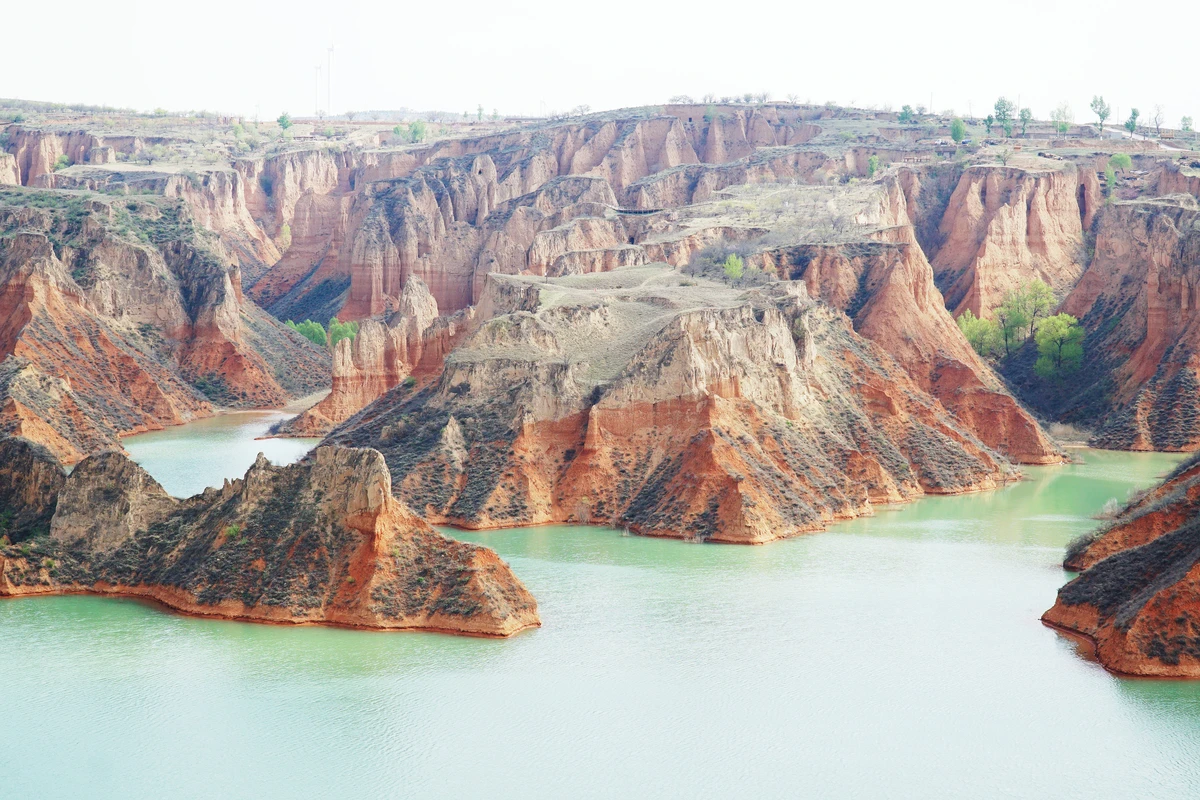
April 24 – The Yulin Mahuangliang Geopark, officially opened on September 30 last year, is now basically complete. Everyone was amazed by the first scenic spot: the loess plateau had been eroded by water into peaks standing in light green waters, like miniature landscape paintings—a three-dimensional painting, a silent poem. During our visit, we happened to meet the park's leadership and local officials. They warmly introduced the park's situation and arranged a shuttle bus to take us to the mountaintop. There, we saw the internet-famous cave dwellings, still inhabited by some villagers. On the way back, the straightforward young driver sang authentic northern Shaanxi folk songs for us. Although Mahuangliang Park is new, it has long been famous in photography circles. The park features a unique mix of loess and sand, clear water and ruggedness. The TV series 'Ghost Blows Out the Light: The Lost Caverns' was filmed here. Give it some time—when more visitors come and the park's shuttle buses operate, allowing visitors to tour the 37-square-kilometer scenic area in a few hours, everyone will surely be delighted. In the afternoon, we visited Gaojiabu Ancient Town, the filming location for the TV series 'The Ordinary World.' The shops and slogans from over 40 years ago remain, making us feel as if we had traveled through time. A few streets had only a handful of small shops. Some elderly people were chatting. We asked them, 'Do people still live in such run-down houses?' They replied, 'We live here ourselves.' 'What about the young people?' they answered, 'They've all left.' In such an ancient town, like in the eighth photo, a lonely old man walks down a deep alley with a faltering step, filled with helplessness...
April 25 – Today, our family and friends group ended our trip in northern Shaanxi, crossed the Yellow River, and entered the ancient town of Qikou in Shanxi. For 200 years since the Qing dynasty, the town's dock was almost the most important hub for commercial exchange among merchants throughout the north. At its peak, Qikou saw 150 boats daily, with over 300 types of warehouses, banks, taverns, and inns. 'A small metropolis of water and land docks, the first town on the winding Yellow River.' It also became one of the birthplaces of Shanxi merchants. Someone described Qikou as: a hall for thinkers, a paradise for tourists, a gold mine for entrepreneurs, and a cradle for artists. On the Yellow River bank at Qikou, there is a 'gallery' where years of water erosion have created strange patterns in the loess. The boat captain narrated the meaning of each scene as he steered. The famous painter Wu Guanyin made three major discoveries, and Lijiashan Village was one of them. The village looks like a phoenix spreading its wings from afar. Since the Ming and Qing dynasties, cave dwellings built from the bottom of the mountain to the top are stacked in 11 layers, forming a three-dimensional integrated vernacular architecture that attracts countless artists and tourists. In the evening, we stayed at the H Hotel.
April 26 – Mianshan Scenic Area is the birthplace of China's Qingming Festival (Cold Food Festival). The existing scenic area covers 54 square kilometers, with 14 tour zones and over 360 scenic spots. Today, we could only visit three of them. Shuitao Gully is a leisure spot with clear springs and countless waterfalls—a great place to cool off. Yunfeng Temple was first built in the Three Kingdoms period and has a long history. We climbed 120 steep steps on hands and knees, gasping for breath, showing our sincere devotion. Daluo Palace, 110 meters high and 13 stories, was built starting in the Tang dynasty, standing majestically on a cliff edge. It was burned down by Japanese troops in 1940 and rebuilt in 1998. We took an elevator to the 6th floor, then passed through the 12th-floor Hall of Immortals to reach the 13th-floor Sutra Library. Without a key, we couldn't browse the precious scriptures or learn the martial arts secrets. Daluo Palace is known as 'the first Taoist palace under heaven' and the 'Little Potala Palace' of the north. Some question Mianshan Scenic Area for having many man-made structures, but which scenic area doesn't have human traces? Some are superfluous, others add icing on the cake. Let our eyes seek the beauty of the landscape, and our mouths tease the disappointments—isn't travel about feeling joy? The Pingyao Hotel in Qi County, built about two years ago, has an antique charm. Square tables, round chairs, and sofas—for us book lovers, it's extremely comfortable.
▲ Climbing the 120 steep steps of Yunfeng Temple
April 27 – Since the release of the movie 'Raise the Red Lantern' and the TV series 'Qiao Family Courtyard,' the over-200-year-old fully enclosed castle-style building in the shape of the double-happiness character—Shanxi's Qiao Family Courtyard—has become world-famous. It is difficult to maintain traditional style while dealing with capital. Since the beginning of capital operations this century, the commercialization trend of Qiao Family Courtyard has become increasingly serious. In 2019, the national authority revoked its 5A-level scenic spot designation. Today, what we felt at Qiao Family Courtyard was more of the Qiao family's character, wisdom, will, and strength. I think this was also the original intention of the Qiao descendants who donated the courtyard. In the evening, we flew from Taiyuan back to Shanghai.
▲ A Qing dynasty rosewood screen, one of the treasures of Qiao Family Courtyard, carved with 81 interrelated large and small dragons.
▲ A Qing dynasty rosewood mirror called 'Rhinoceros Gazing at the Moon,' a house-protecting treasure.


