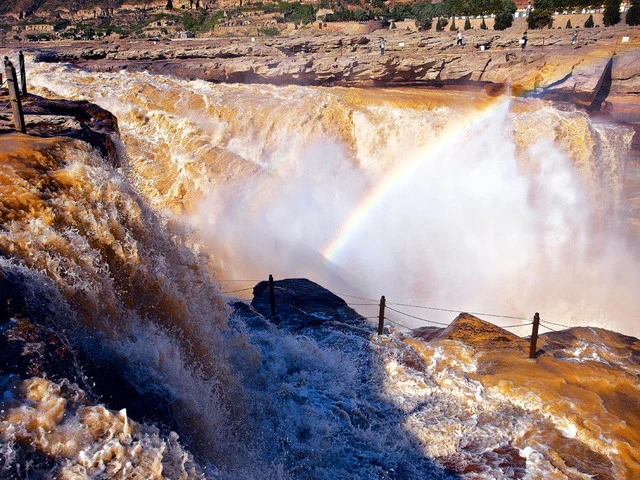
Singing the Yellow River at Hukou Waterfall: A Peerless Duet Between Shanxi and Shaanxi!
1. Origin of the Waterfall – Geological Changes
Hukou Waterfall, the world's largest yellow waterfall,
connects Shaanxi to the west and Shanxi to the east.
The Yellow River, racing from the Qinghai-Tibet Plateau,
narrows here from 300 meters to just 30 meters,
plunging over a 20-meter cliff,
creating the majestic sight of 'the Yellow River gathered into a single pot.'
The waterfall's formation is a result of geological changes. In the steep gorge,
when the vertical flow meets alternating hard and soft rock layers,
hard rock forms a rock sill or waterfall layer,
while soft rock erodes into steep steps.
The torrent leaps over these steps, and when a certain drop is reached,
a waterfall is formed.
Summer at Hukou Waterfall
A deep pool forms below the waterfall. As the waterfall layer erodes,
the waterfall gradually retreats upstream.
Hukou Waterfall originally was near present-day Mengmen.
The 5-kilometer stretch from Mengmen to the current Hukou position, called the Ten-mile Dragon Trough,
is a canyon formed by past deep pools.
Winter at the Ten-mile Dragon Trough
2. Mengmen Mountain – River Islands
Two river islands (massive rocks) downstream of Hukou Waterfall,
from a distance they look like boats, up close like mountains, and from above like gates.
On Big Mengmen Island stands a statue of Yu the Great riding a divine turtle.
Legend says the two islands were originally one mountain that blocked the Yellow River and caused floods.
When Yu the Great controlled the floods, he split the mountain in two to dredge the river.
Once an official stayed overnight here and wrote the poem:
'The mountain moves with the shadow of waves, moonlight floats on ripples,'
giving rise to the scene of 'Mengmen Moonlit Night.'
3. Longwangchan – Yellow River Dock
Before the railway opened, shipping was the main transport along the Yellow River.
Longwangchan was the largest land-and-water dock and commercial town here.
It flourished in the Ming Dynasty, prospered in the Qing, and began to decline before the Anti-Japanese War.
During the Qing, there were 60 commercial firms,
including banks, fur shops, pawnshops, salt stores, and pharmacies.
Except during summer flood peaks and winter freeze,
shipping continued without interruption.
People upstream would fell trees and build boats in winter;
in spring, they loaded local grains, medicinal herbs, furs, and other specialties,
transporting them via Hukou to downstream Fenglingdu and Mengjin.
After selling both boat and cargo, they returned on foot.
Each year nearly 5,000 boats passed the dock,
and at its peak, over 1,000 boats could moor in a single day.
This prosperity lasted over 400 years,
gradually fading away in the 1950s.
Remains of cave dwellings at Longwangchan
4. Dry-land Boat Hauling – Intangible Cultural Heritage
Because of the great drop at Hukou Waterfall and the long, narrow, deep river channel below,
the current is swift. When boats reach this point, they must unload cargo
and switch to manpower or animal transport.
The empty boat is pulled ashore, round logs are placed underneath,
and the boat is rolled along the riverbank to bypass Hukou and reach the downstream dock,
where it is pushed back into the water and reloaded.
This transfer method is called 'dry-land boat hauling.'
It resembles the work of the Three Gorges trackers.
Hauling boats on land is extremely difficult, requiring hundreds of people to pull together.
At that time, Longwangchan had hundreds of boat haulers for dry-land operations.
In the early 20th century, as roads and railways gradually opened,
and the Yellow River Bridge connected Shaanxi and Shanxi, river shipping declined.
Dry-land boat hauling transformed from a trade necessity into intangible cultural heritage.
Performance of dry-land boat hauling
5. Military Defense – Qing Dynasty Great Wall
From Hukou to Longmen, the Yellow River forms a natural moat,
with steep cliffs on both sides creating a natural barrier.
Successive dynasties established military and administrative institutions along this stretch.
During the Qing Dynasty, a Great Wall was built on the east bank of the river
to prevent anti-Qing peasant armies from crossing.
The wall stretched from Pingduguan in the north to Yumenkou in the south, 75 kilometers long,
with bastions, crenellations, passages, and fortress gates.
East Longwangchan served as the command center, with 3,500 troops stationed there.
Five kilometers upstream on the east bank,
was once the headquarters of the Second War Zone of the Kuomintang
and the seat of Shanxi Provincial Government,
occupied for five years with over 20,000 troops.
Suspected remains of rammed earth layers
6. Shaanxi Side – Transportation
From the Shaanxi side, Hukou belongs to Hukou Township, Yichuan County, Yan'an City.
There are direct buses from Yan'an to Hukou Scenic Area:
three in the morning and one in the afternoon.
A direct bus is recommended; otherwise, it costs extra.
There are more buses from Yan'an to Yichuan, but once at Yichuan...
Hukou is about 40 km from the county seat, with no bus service.
During peak season, local minivans offer shared rides, about 25-30 yuan per person.
In the winter off-season, you have to charter the whole van alone.
After some bargaining, I ended up paying 120 yuan.
No other option.
Visiting here in winter means admiring the ice features.
7. Shaanxi Side – Tickets
On the Shaanxi side of Hukou,
the ticket hall is far from the waterfall. Admission is 90 yuan.
You must buy or exchange tickets at the hall and then take the scenic area bus,
which costs 40 yuan and is mandatory – no alternative.
There is no scenery along the way; the road is only for tourist vehicles.
All the goodwill from Shaanxi's carefully planned people-friendly policies evaporates here.
The ice near the waterfall is yellowish.
There are no amenities at the ticket hall or outside the scenic area,
making it feel like a desolate, uninhabited place.
In winter, the Yellow River has frozen over.
Some unmelted ice formations are quite beautiful,
but the unfrozen water lacks the momentum of the surging Yellow River.
In the off-season, there is no chorus performance,
just sandy banks, scattered ice holes,
and a bleak, cold wind.
Experience: not worth mentioning. Scenery: three stars.
Small water holes scattered on the bank
8. Shanxi Side – Facilities
Leaving the dull Shaanxi section,
I took the overpriced 40-yuan bus and got off at the Yellow River Bridge.
Crossing the bridge brought me to Shanxi.
The sight of twinkling lights ahead
instantly warmed the cold wind from the opposite bank.
Accommodation and dining are complete, with various standards available,
and prices are normal, even lower than many urban areas.
Viewing lights on both banks from the Yellow River Bridge
Shanxi's Hukou Waterfall belongs to Hukou Town, Ji County, Linfen City.
After the disappointment, it seemed especially wonderful.
Admission is 100 yuan, and the sightseeing car is 20 yuan (optional).
The entrance is 2 km from the waterfall,
with a dedicated footpath separate from the vehicle road,
planned like a park.
Along the way, you pass the Great Wall ruins; there are owls in the woods,
making the walk interesting.
Near the entrance to the waterfall section, there is a cultural corridor
detailing Hukou and Yellow River culture,
with shops selling local specialties.
Yellow River Guardian on a hill by the river
9. Shanxi Side – Scenery
On the Shanxi side of Hukou, you hear the roar before you get close.
Even in winter, it thunders like a wild beast.
Standing on the bank for just a short while,
your hair is tousled and your face covered with yellow sand.
When you walk to the railing closest to the water,
you worry that a sudden surge might sweep you away,
but you can't bear to leave, despite the spray and cold wind,
wanting to take one more look at this unmatched magnificent waterfall,
marveling at the power of water and the wonders of nature!
Viewing the plunging torrent up close
On the riverbank, there is a natural cave called Dragon Cave,
which leads directly below the waterfall for a close-up view.
But it's closed in winter due to danger.
There are also donkeys offering paid add-on services for tourists.
Even on a cold winter day with few visitors and no customers,
the donkey handlers persist in walking back and forth on the bank.
Small streams in the Dragon Trough
10. Shanxi Side – Transportation
All restaurant and accommodation staff know about bus schedules,
either to Ji County or Linfen,
and the ticket office staff are also happy to help.
The Hukou Restaurant often hosts tour groups;
you can ask the guide if there are empty seats.
11. Other Info – Tips
I recommend the Shanxi side more,
as it far surpasses Shaanxi in facilities, policies, and transportation.
The area outside the Shanxi scenic area is like a small town.
Buses depart from outside the scenic area,
with one bus back to the city around 10 a.m. daily,
and a return bus from Linfen in the afternoon.
You can call ahead to reserve a seat.
On the Shaanxi side, there is a 'Yellow River Chorus' performance during peak season.
The Shaanxi side has restored Longwangchan dock town, but it's all newly built.
Heaping bowls of knife-cut noodles in restaurants
In this world, there are no dead ends – only journeys yet to meet. See you on the road.
Thank you, dear readers, for taking the time to read.
One wine, one world; one person, one horizon.
If I happen to meet you, it's not by chance – I've been waiting for you.
Photos by Yu Shu Text by Yu Shu
Life | Travel | Food | Cities | Hanfu


