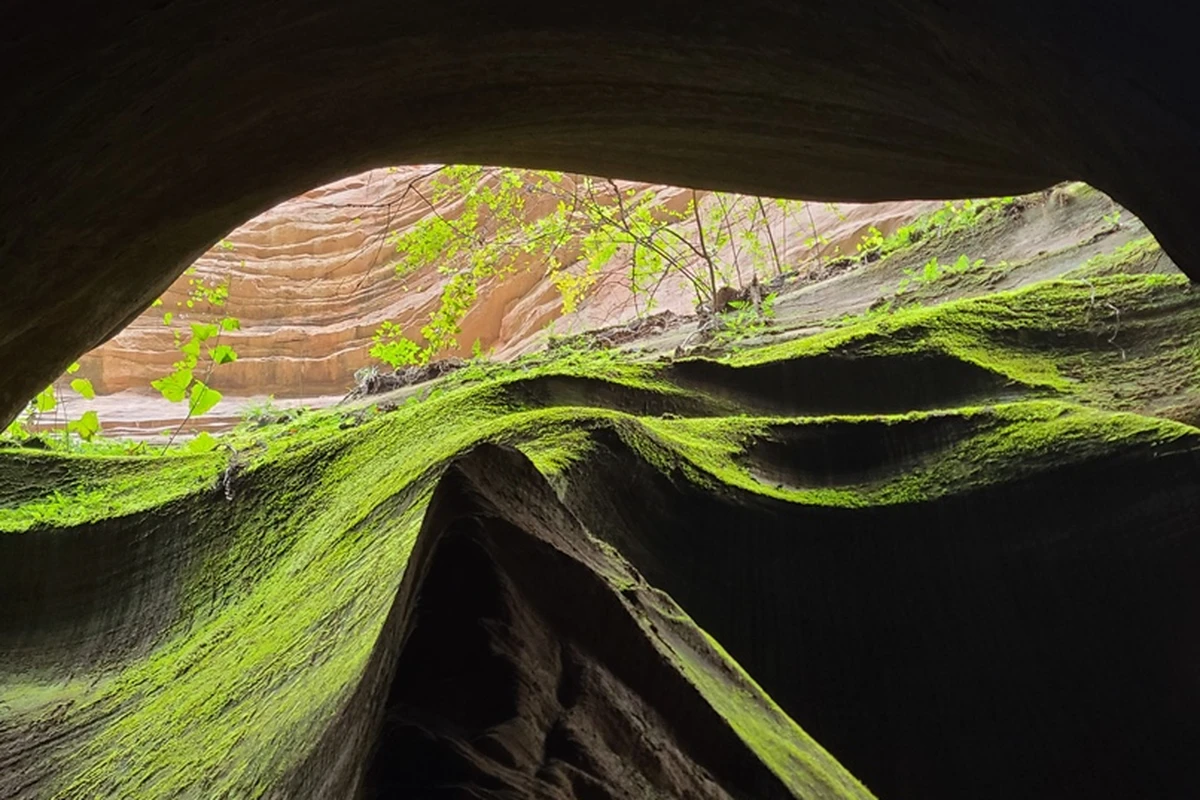
National Day Northern Shaanxi Self-Driving Tour — Ganquan Grand Canyon
On the way to Ganquan Grand Canyon, we passed by Ganquan Tofu Town.
Ganquan tofu is a local specialty, made from local spring water and local green soybeans called Lvgundou, which is why Ganquan tofu is green. At Shuntian Ancient Method Tofu in the tofu town, we tasted various Ganquan tofu dishes.
The green soybeans used to make Ganquan tofu.
The couplet on the restroom door in the town is very interesting: "All heroes and good men bow their heads here; all heroines come in to undress and take off their skirts."
Ganquan Grand Canyon is located in Ganquan County, Shaanxi Province. Hundreds of millions of years ago, a powerful earthquake split this loess mountain into a large crack. After hundreds of years of rain erosion, it gradually formed such a canyon. This magical geological landform is known as China's "Antelope Canyon", attracting countless photography enthusiasts. Like Wave Valley, it is a paradise for photographers.
Ganquan Grand Canyon ticket price is 98 yuan, transportation service fee 70 yuan, parking fee 10 yuan. Seniors aged 60-64 get half-price tickets, and those over 65 are exempt from ticket fees.
Ganquan Grand Canyon consists of scenic spots such as Yueya Valley, Huashugou, Butterfly Valley, Peony Valley, Yixiantian, Longbagou, and Huabaocha. Among them, Huashugou has the most outstanding scenery. Normally, the scenic area only opens Yueya Valley and Huashugou; during holidays when there are many visitors, one additional route is opened. There is also a VIP customized route that visits Butterfly Valley and Longbagou. In addition, about 20 km ahead from the scenic area, you can reach Love Valley, which is under construction. Along the way, you can also visit the roadside Shigong Temple.
When you step into this magical canyon, the interwoven curved and straight lines flow smoothly, the light and shadow change unpredictably, and the enchanting shadows are stunning, making people sincerely marvel at the wonders of nature. Words cannot describe it as well as pictures, so let the images directly show the beauty of nature.
The best time to photograph Ganquan Grand Canyon is at noon on a sunny day, when sunlight can directly enter the canyon.
About 20 km ahead from Ganquan Grand Canyon, you can reach Love Valley, which is under development and construction. Love Valley is located on the west side of Fangjiahe Village, Qiaozhen Township, Ganquan County. Currently, parking lots and related facilities are being built at the entrance of the canyon, and the road into Love Valley is still a rugged path.
Love Valley is a short canyon. Follow the rugged mountain path to the end of the canyon. Standing in front of the cliff at the end and looking back up, a heart shape formed by the valley cliffs appears before your eyes. The magical craftsmanship of nature is truly astonishing. People have love, and mountains do too.
The colors of the rock walls in Love Valley are very similar to the colors of Peruvian alpaca shawls. The canyon draped in alpaca shawls presents a sky of love.
When we went, it was a cloudy day. If it were sunny, the blue sky and white clouds against the sky of Love Valley would have been more impressive.
Ganquan Grand Canyon is a long river valley. On both sides of the valley, there are many small branch valleys, and these branch valleys are where the scenic spots of Ganquan Grand Canyon are located.
In the river valley of Ganquan Grand Canyon, there are remains of the Qin Straight Road built during the Qin Dynasty under Qin Shi Huang. The Qin Straight Road is 34.8 kilometers long within Ganquan County. It is known as the "First Road Under Heaven" and is considered the world's first highway. In 2004, the Qin Straight Road was declared a National Key Cultural Relic Protection Unit by the State Council, and it is currently preparing to apply for UNESCO World Cultural Heritage status.
The Qin Straight Road was a military passage built after Qin Shi Huang unified the six states, to resist the invasion of the northern Xiongnu. In 212 BC, he ordered General Meng Tian to lead 300,000 men to build it in two and a half years. It is over 2,200 years old. According to the "Annals of Qin Shi Huang": "He cleared the road, from Jiuyuan to Yunyang, cutting through mountains and filling valleys to make it straight." The "Records of the Grand Historian: Biography of Meng Tian" also records: "The First Emperor wanted to tour the empire, going to Jiuyuan and directly reaching Ganquan. He had Meng Tian build a road from Jiuyuan to Ganquan, cutting through mountains and filling valleys, a distance of 1,800 li."
The Qin Straight Road starts from the Qin Liguang Palace on Ganquan Mountain in Chunhua County in the south, goes north along the Ziwu Mountain Range, passing through Xunyi, Huangling, Fu County, Ganquan, Zhidan, Ansai, Jingbian, Yulin, crossing the southern edge of the Mu Us Desert and the Ordos Grassland, to the Qin Jiuyuan Commandery (now Baotou City) at the foot of the Yinshan Mountains, with a total length of over 700 km. Because the road is roughly straight north-south, it is called the "Straight Road". The southern end of the Qin Straight Road is directly towards Xianyang.
With this passage, the mighty army of the Qin Empire could depart from the capital Xianyang and reach the foot of the Yinshan Mountains in three days and three nights, causing the Xiongnu to "dare not go south to graze horses, nor dare to draw their bows in anger." The Xiongnu fled deep into the desert and dared not show their faces for decades.
The section of the Qin Straight Road within Ganquan County is well-preserved, with roadbed width generally between 30 and 50 meters, reaching up to 58 meters at the widest point. Along the way, there are multiple pass gaps and military station ruins, earning it the title of "Qin Straight Road Museum".
On the way from the grand canyon to Love Valley, there is a Shaanxi Provincial Key Cultural Relic Protection Unit—Shigong Temple Grottoes.
Shigong Temple Grottoes are located in Xiasiwan Town, Ganquan County. The specific excavation date is unknown. Based on the analysis of the existing grotto forms, the grotto was excavated in the Northern Song Dynasty, with additions in the Ming and Qing Dynasties.
Shigong Temple Grottoes are a grotto that combines Buddhism and Taoism. Buddhist cave of Shigong Temple Grottoes.
Taoist cave of Shigong Temple Grottoes.
Leaving Ganquan Grand Canyon, heading to Hukou Waterfall on the Yellow River.


