Traveling North to Henan, Shanxi, and Shaanxi in April: Spring Splendor Rivaling Jiangnan
From April 7 to 18, 2025, Ah Li joined a tour group to visit Henan, Shanxi, and Shaanxi provinces. When our bus departed from Wuhan, the cherry blossoms, apricot blossoms, peach blossoms, pear blossoms, and peonies of Jiangnan had mostly withered away, leaving Ah Li with a sense of loss. To his surprise, when we arrived in Henan, Shanxi, and Shaanxi, the cherry blossoms, apricot blossoms, peach blossoms, pear blossoms, and peonies were in full bloom, just like the spring of March in Jiangnan, bringing Ah Li unexpected joy.
Our first stop was Linzhou in Henan. In the morning, we visited the Taihang Grand Canyon, and in the afternoon, we toured the Red Flag Canal on the Taihang Mountains. Ah Li did not expect that at the northern edge of Henan Province and the southern end of the Taihang Mountains, there would be such a beautiful landscape of clear pools, green waters, white waterfalls, and deep gorges. Nor did he expect that red peach blossoms and snow-white pear blossoms could be seen from time to time along the canyon, while golden forsythia flowers covered the mountains. What surprised him even more was that the people of Lin County, using only their hands, had carved an artificial river—the Red Flag Canal—into the steep cliffs of the Taihang Mountains over ten years. Today, this canal winds around the mountainside like a green silk ribbon, becoming the most magnificent scenery of the southern Taihang.
Luoyang in Henan was the last stop of our entire trip. In this ancient capital of thirteen dynasties, we only visited the Luoyang Peony Garden. There, Ah Li saw rows of peonies still in bud, peonies in full bloom of various colors, and peonies past their prime, their petals falling one by one. The life of the national beauty, the graceful and luxurious peony, was vividly displayed before our eyes. Ah Li could not help but sigh: Peonies in bloom are beautiful! Peonies in decline are also beautiful!
Continuing north from Linzhou in Henan, we entered Shanxi Province. In Shanxi, we visited the Wang Family Compound in Lingshi County, the Ancient City of Pingyao, Mount Wutai in Wutai County, the Former Residence of Yan Xishan in Dingxiang County, the Fogong Temple Sakyamuni Pagoda in Ying County, the Datong Museum and the Yungang Grottoes, and the Qikou Ancient Town and Li Village in Lin County.
The Wang Family Compound and Pingyao Ancient City are outstanding representatives of Shanxi's ancient architecture and the living embodiment of the Jin merchant culture. As Ah Li strolled through them, he was deeply impressed by their grand scale and orderly layout, amazed by the exquisite wood, brick, and stone carvings, and delighted by the blooming crabapple, peach, and pear flowers. The tall lilacs in the Erlang Temple of Pingyao Ancient City left a particularly lasting impression on Ah Li—against the backdrop of exquisite ancient architecture, the purple lilacs bloomed vigorously under the bright sun, exuding a delicate fragrance without any hint of melancholy, becoming a bright spot in the ancient city.
Mount Wutai is the bodhimanda of Manjushri Bodhisattva, one of the five sacred Buddhist mountains in the world, with over eighty monasteries. We only visited a few temples: Dailuo Peak, Wuye Temple, Xiantong Temple, Yuanzhao Temple, Guangzong Temple, and the Bodhisattva Peak. Each temple was bustling with incense and worshippers. It was already mid-April, but Mount Wutai had not yet turned green, with the mountains mainly in brown hues. To Ah Li's delight, as our bus drove through the Mount Wutai scenic area, the hillsides along the road were covered with patches of white flowers. The contrast between the white flowers and the brown mountains was striking, and the vibrant vitality announced the arrival of spring here. Ah Li did not know what kind of flowers they were, so he asked the locals after returning to the hotel. The answer was that they had not noticed the flowers on the mountains, but they guessed they might be wild apricot blossoms, as there were many such trees in the area and they were in full bloom at that time.
The day after visiting Mount Wutai, we planned to go to the Hanging Temple on Mount Heng in Hunyuan County, Shanxi, and had already bought tickets online. However, a cold wave hit with strong winds, forcing major scenic spots to close, including the Hanging Temple. We had to cancel the tickets and first visited the Former Residence of Yan Xishan, then went to the Fogong Temple in Ying County—which was also closed. That day, the sky was blue with white clouds, and the sun shone brightly, but the wind was biting and fierce, threatening to blow people away. Standing in the square outside the Fogong Temple, we braved the wind and looked up at the Sakyamuni Pagoda, separated from us by only a wall. From the outside, the pagoda appears to have five stories, but internally it has nine stories (five visible and four hidden). It is entirely made of wood without a single iron nail, earthquake-resistant and wind-resistant, standing unharmed for over a thousand years. It is the tallest and oldest existing pure wooden structure building in China, and together with the Leaning Tower of Pisa and the Eiffel Tower, it is known as one of the "Three Great Towers of the World."
After viewing the wooden pagoda, we prepared to return to the bus because the wind was too strong and cold. However, a cherry tree full of brilliant blossoms beside the square caught everyone's eyes. This cherry tree had double petals, with large, dense flowers covering the entire tree, creating a lovely contrast with the thousand-year-old pagoda in the background. Although we missed the Hanging Temple on Mount Heng and couldn't enter the Fogong Temple to get close to the eleven-meter-tall painted clay statue of Sakyamuni, a masterpiece of the Liao Dynasty, we felt that the trip was not in vain because of this vibrant cherry tree and the photo of it with the ancient wooden pagoda.
The Yungang Grottoes are located at the southern foot of Wuzhou Mountain in Datong. They were carved in 460 AD during the reign of Emperor Wencheng of the Northern Wei Dynasty and are the largest royal Buddhist cave complex in China, hailed as "the crown of Chinese stone carving art in the 5th century." On the morning of April 13, around 8 o'clock, we arrived at the Yungang Grottoes. The sky, which had been clear throughout our journey, began to snow. The swirling snowflakes warmly welcomed us and patiently accompanied us from one cave to another. Around 10 o'clock, we had a quick look at the grottoes, and the snow gradually stopped, and the sky cleared. Ah Li did not expect that at the end of the grottoes, several peach trees were in full bloom, greeting us with their brilliant smiles. The snowflakes and peach blossoms at Yungang Grottoes were truly full of human warmth!
The Qikou Ancient Town and Li Village in Lin County were the last two attractions of our Shanxi tour.
Qikou Ancient Town was once a major commercial hub in northwestern Shanxi during the Ming and Qing dynasties. It faces the Yellow River to the west, leans against Wohu Mountain to the north, and is bordered by the Qiushui River to the south. The Qiushui River once carried a large amount of sand and gravel into the Yellow River at Qikou, forming a gravel shoal hundreds of meters long, known as the Datong Shoal. The Yellow River channel suddenly narrows here, creating rapids and shoals with hidden reefs. Merchant ships from the upper reaches of the Yellow River had to unload at Qikou and then transport goods overland to various destinations. Qikou thus became a water-land transfer center, known as the "First Town of the Nine Bends of the Yellow River."
Li Village is located a few miles south of Qikou Ancient Town, backed by the Lüliang Mountains and facing the Yellow River. According to legend, two wealthy Li merchants from Qikou chose Li Village to establish their estates. They hired craftsmen to build the East and West Manor houses. The houses were built along Phoenix Mountain, from the foot to the peak, layer upon layer, forming a terraced architectural complex. Due to its resemblance to the Potala Palace in Lhasa, Tibet, Li Village is known as the "Potala Palace on the Loess Plateau."
Later, road and rail transportation emerged, and water transport lost its advantage. Qikou Ancient Town, which had thrived on water transfer, gradually declined, and Li Village also fell into decline. However, beautiful things do not disappear with time. Today, Qikou Ancient Town and Li Village have become famous tourist attractions in Shanxi, drawing visitors from all over. As Ah Li strolled through Qikou and Li Village, he met many tourists and also saw many painters—men, women, young, and old—sketching the ancient houses or the Yellow River. Surprisingly, many lilacs were planted along the streets—they were in full bloom, mostly purple, with some white. Around the houses in Li Village, many pear and peach trees were planted, with white pear blossoms and red peach blossoms adding vitality to the mountain village.
After visiting Qikou Ancient Town and Li Village, we concluded our tour of Shanxi, crossed the Yellow River into Shaanxi, and began our Shaanxi itinerary—the Yellow River forms the boundary between Shanxi and Shaanxi.
In Shaanxi Province, we visited the Wave Valley in Jingbian County, the Yangjialing Revolutionary Site in Yan'an, the Ganquan Grand Canyon in Ganquan County, and the Hukou Waterfall of the Yellow River in Yichuan County.
Both the Jingbian Wave Valley and the Ganquan Grand Canyon are Danxia landforms, known for their unique red rock formations and bizarre gullies. They were formed by nature's master craftsmen—wind and water—carving the sandstone over millions of years, vividly displaying the earth's immense changes over eons, becoming the "red miracle" on the Loess Plateau.
The Jingbian Wave Valley opened in 2020 and is named for its globally rare wave-like Danxia landform. Located in Longzhou Town, it is also called the Longzhou Danxia Geopark. Famous attractions in the Wave Valley include Flame Danxia, Red Cliff Danxia, Core Danxia, One-Line Sky, and a 3D glass bridge. Ah Li spent a whole morning in this red world, fascinated by the red sandstone of various sizes and the countless layered patterns on them. When sunlight fell on the sandstone, the patterns on the layered rocks became even more distinct. Many plants grow in the Wave Valley. Two left a deep impression on Ah Li: in front of a huge, nearly vertical red slope, a cluster of white reeds swayed in the wind—these reeds were probably last year's growth from the wetlands; and in the narrow red canyon, some mature mountain peach trees grew, some with buds ready to bloom and others already smiling, with the rock walls as a backdrop highlighting the delicate pink peach blossoms.
The Ganquan Grand Canyon opened in 2017 and is a natural underground fissure spectacle on the Loess Plateau, consisting of over a hundred narrow buried canyons. We only visited three canyons: Longbagou, Huashugou, and Yueyagu. The three canyons are quite far apart, so scenic area shuttles took us from one to another. Besides roadside trees, the road was lined with forsythia, whose golden, dense flowers gave us a strong sense of spring. Once at the canyons, we just walked along the flat, sometimes narrow, sometimes wide paths, without climbing up and down, enjoying the red rock walls of various shapes and countless streamlined patterns. The cracks at the top of the canyons varied in size and shape. These cracks acted like skylights, letting sunlight spill into the canyon and illuminate the rock walls. In the interplay of light and shadow, the lines on the walls seemed to dance, playing a symphony for us. Looking at these myriad red rocks and lines, Ah Li felt as if he had entered a fantasy world!
At the Yangjialing Revolutionary Site, we visited the former residences of Mao Zedong, Liu Shaoqi, Zhou Enlai, and Zhu De, as well as the site of the Central Auditorium. Ah Li did not expect the living and working conditions of the older generation of revolutionaries to be so simple and austere. Today, Yangjialing is full of vitality, with a continuous stream of visitors, many trees covered in green, and peach blossoms and forsythia blooming brightly along the roadsides.
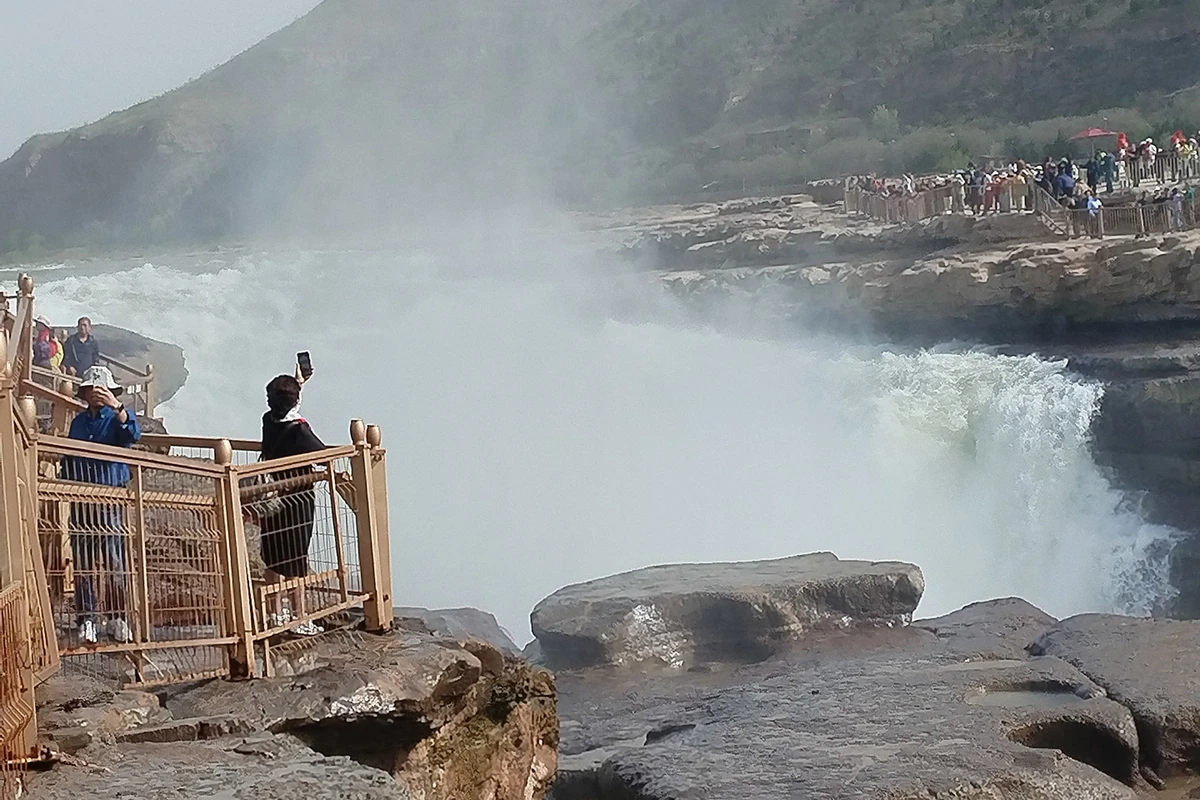
The Hukou Waterfall of the Yellow River was the last attraction of our Shaanxi trip. It is located at the border between Hukou Town in Ji County, Linfen, Shanxi, and Hukou Township in Yichuan County, Yan'an, Shaanxi, and is shared by both provinces. We admired the Yellow River and the Hukou Waterfall from the Shaanxi side.
The Yellow River rushes down from the north, with the upstream water surface hundreds of meters wide. Here, it finds the river suddenly narrowing to just tens of meters, as narrow as a teapot mouth, with steep stone cliffs on both sides, and a twenty-meter-high cliff waiting ahead. Enraged, the Yellow River gathers all its strength and leaps down from this narrow, pot-mouthed cliff, crashing onto the stone trough below with a deafening roar, sending up white mist that fills the air and drifts with the wind. The leaping Yellow River, with rolling white waves, continues along the stone trough, heading toward its poetry and distant horizons.
Previously, Ah Li had seen videos of the Hukou Waterfall taken by others and was moved by its spectacular scene, longing to see it in person. Now, standing right next to the Hukou Waterfall, so close to its majestic figure, how could he not be excited? Although the water volume seemed less than in others' videos, and the width narrower, Ah Li was still deeply shocked by the waterfall's overwhelming power! Listening to its wild roar, Ah Li couldn't help but feel a bit frightened! Indeed, the old saying is true: "Better to see once than hear a hundred times." Experiencing it in person gives a much stronger sense of the Hukou Waterfall's grandeur than watching videos!
There was another difference between the Hukou Waterfall Ah Li saw and what others had filmed: others captured a yellow waterfall, but Ah Li saw a white waterfall!
The color of the Yellow River water that Ah Li saw was also different from legend: the Yellow River he saw at Qikou Ancient Town in Shanxi was blue-green, and at the Hukou Waterfall in Shaanxi, it was also blue-green. Thus, the name "Yellow River" seemed somewhat inaccurate here in the April of Shanxi and Shaanxi.
After enjoying the magnificent Hukou Waterfall, we left Shaanxi and entered Henan. After seeing the peonies in Luoyang, we concluded our twelve-day tour of Henan, Shanxi, and Shaanxi and returned smoothly to Wuhan.
Now, the April trip north to Henan, Shanxi, and Shaanxi has become the past, but what Ah Li saw and heard in the three provinces will remain in his heart forever, becoming beautiful memories. The twelve-day tour allowed Ah Li to understand the Central Plains and the Loess Plateau.
May 5, 2025


