Contending for the Central Plains: Dreaming of Henan (Part 1)
There's an online saying: "Forty years to see Shenzhen, a hundred years to see Shanghai, a thousand years to see Beijing, two thousand years to see Henan, three thousand years to see Shandong, four thousand years to see Shaanxi, five thousand years to see Shanxi." But there are many different versions, even debates over who has the longer history. Nevertheless, Henan is ultimately the ancestral homeland of many Chinese people. Starting from the Partition of Jin by Han, Zhao, and Wei over 300 years BC, China's political and military center shifted to Henan, which had a more advantageous geographical location. Countless dynasties established their capitals here. Humans multiplied here, dynasties changed here. Only by remembering where we come from can we find our way back. Henan's history is no empty boast.
As early as 1996, I had been to Henan for work. At that time, I was helping a local company collect debts there. I also visited Shaolin Temple, crossed the Yellow River Bridge, stayed in Xinxiang, and even caught a football match. From Dengfeng to Yanshi, then through Zhengzhou to Lankao where we exited the highway, there were no food services at any rest stops along the way. It wasn't until three in the afternoon that we found a roadside eatery and wolfed down a meal. Overall, I felt that sanitary conditions in Henan were poor. Many restaurants were swarming with flies, and many people were squatting by the roadside holding large ceramic bowls, dressed in coarse and dirty clothes. The most striking feature of the journey, however, was the rows upon rows of martial arts school students running along the highway.
Another deep impression was the advertising slogan of Henan: "Remember the Central Plains, Henan is your hometown." For a period of time, this phrase was frequently seen on TV. Moreover, throughout history, countless events have taken place in the Central Plains, making it a region that military strategists have always fought over. Hence the phrase "contending for the Central Plains." I also took it as the title of this travelogue.
Another autumn came, and we made an appointment to travel together in Henan. Within a small circle, a total of 12 people signed up. I naturally pre-arranged travel plans, made several versions, and finally settled on the following itinerary:
Contending for the Central Plains, Dreaming of Henan
D1: Depart at 4:30 AM to Nanjing, fly to Zhengzhou at 8:00 AM, arrive at 9:30 AM. Drive 106 km to visit Shaolin Temple, then 75 km to stay at Luoyang Tangyun Holiday Hotel.
D2: 50 m to visit Longmen Grottoes, 26 km to visit White Horse Temple, 165 km to stay at Yuntaishan Hemai Boutique Hotel.
D3: Visit Yuntaishan (Red Stone Gorge, Fenghuang Ridge, Diecai Cave, Tanpu Gorge), 81 km to stay at Wanxianshan Guoliang Maosheng Hotel.
D4: Visit Wanxian Mountain (Guoliang Village) scenic area, 69 km to stay at Linzhou Louquan Renjia Huar Inn.
D5: Visit Linzhou Taihang Grand Canyon, 77 km to stay at Anyang.
D6: Visit Anyang Yin Ruins, 85 km to visit Yunmengshan Scenic Area, 220 km to stay at Kaifeng, night tour of Qingming Riverside Landscape Garden.
D7: Visit Daxiangguo Temple, Kaifeng Prefecture (Bao Gong Shrine), 85 km to Xinzheng Airport, board return flight at 16:20.
Henan Province, abbreviated as "Yu," capital Zhengzhou, located in central China. It borders Anhui and Shandong to the east, Hebei and Shanxi to the north, Shaanxi to the west, and Hubei to the south, with a total area of 167,000 square kilometers. Henan is known as "the hinterland of nine provinces and the thoroughfare of ten provinces," serving as an important comprehensive transportation hub and center for the flow of people, goods, and information.
We set off on schedule, the flight arrived on time, and we landed at Zhengzhou Airport.
We contacted a car rental company, picked up two cars, and started our trip.
First stop: Dengfeng.
Shaolin Temple is the birthplace of Chinese Zen Buddhism and Chinese martial arts. It is named because it is located in the dense forest of Shaoshi Mountain, in the hinterland of Mount Song. It was built in 495 AD (19th year of Taihe, Northern Wei) to honor the Indian monk Bhadra, whom Emperor Xiaowen respected, at the northern foot of Shaoshi Mountain, overlooking the capital Luoyang. Shaolin Temple is a world-renowned Buddhist monastery, the ancestral temple of Han Chinese Zen Buddhism, occupying an important place in the history of Chinese Buddhism, known as "the first temple under heaven." It is famous throughout the world for the Shaolin martial arts that successive generations of Shaolin monks have devotedly created and developed. There is a saying: "All martial arts originate from Shaolin, and Shaolin martial arts are the best under heaven."
The first temple under heaven.
We happened to catch an afternoon martial arts performance in the martial arts performance hall.
Shaolin martial arts are world-famous.
Ancient cypresses were verdant, stone lions were majestic, exuding a strong sense of history. When I was a child watching "Havoc in Heaven," the temple that Sun Wukong transformed into looked like this.
Stone tablets and inscriptions were everywhere.
Hu is a cooking pot used by monks.
The monks' training hall had an uneven floor.
The ancient well was built in the Tang Dynasty, originally for the temple monks to fetch water. Later, as more residents moved around, they also used the well for daily water. It has been repaired several times and remains intact today.
The Pagoda Forest preserves 241 brick and stone pagodas from various dynasties, from the 7th year of Zhenyuan (791 AD) in the Tang Dynasty to the 8th year of Jiaqing (1803) in the Qing Dynasty. The pagodas vary in levels, generally from 1 to 7, all under 15 meters in height, most with inscriptions and foreheads. They come in many types and styles. The Shaolin Pagoda Forest is the largest group of ancient pagodas in China and a valuable material treasury for comprehensive study of the history of Chinese architecture, sculpture, and religion, known as "the museum of ancient Chinese pagoda art."
Leaving Shaolin Temple, we headed to the next stop: Longmen Grottoes.
It was not easy to find the booked hotel. Although it was near the scenic area, the conditions were mediocre. We finally settled in and headed out in groups to find a place to eat. After searching far and wide, we finally found one near our accommodation. After a few cups of wine, we took a walk to digest. In the square near the northwest ticket gate of the scenic area, we saw someone swinging a long whip with cracking sounds. We also tried it and, after finding the trick, each of us managed to crack it with flair. But one person lost his glasses in the process. Due to a bit too much wine, he didn't realize it until we got back. The couple went back to search in the deep night, but how could they find them? Unexpectedly, the next morning, they found them. What luck!
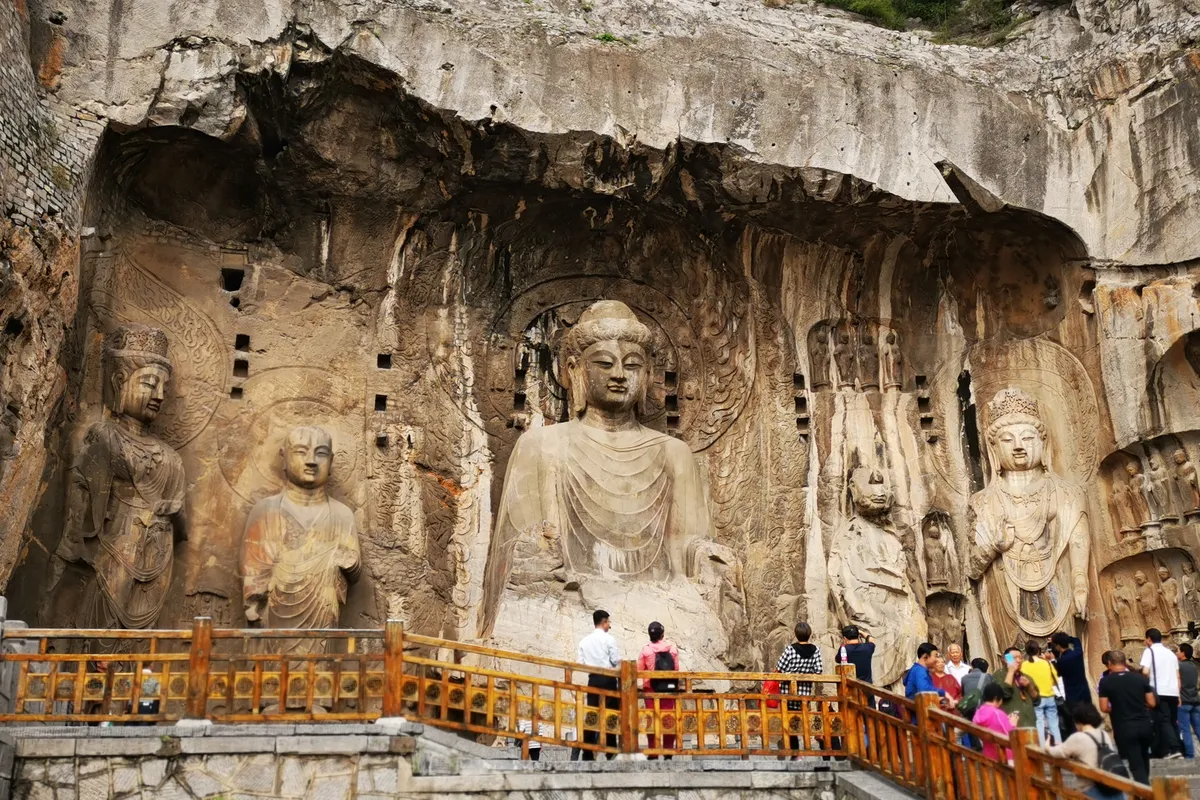
Longmen Grottoes are located in Luoyang City, Henan Province. They rank first among China's major grottoes and are the world's largest collection of stone carvings, acclaimed by UNESCO as "the pinnacle of Chinese stone carving."
Longmen was cut through by Yu the Great during flood control, and the legend of the carp leaping over the Dragon Gate also takes place here. The grottoes began carving during the reign of Emperor Xiaowen of the Northern Wei, flourished in the Tang, and ended in the late Qing. It took more than 10 dynasties and over 1,400 years to create, making it the longest continuously constructed grotto in the world. They are densely distributed on the cliffs of the east and west banks of the Yi River, stretching 1 km from north to south. There are 2,345 caves and niches with more than 110,000 statues. Together with the Mogao Caves and Yungang Grottoes, they are known as the three major grottoes in China; later Maijishan Grottoes was added to make the four major grottoes.
We walked to the spot of "Carp Leaping over the Dragon Gate."
At the entrance, some people offered discount tickets that actually allowed you to view from the opposite bank. Do not be deceived.
Passing the Yi River Bridge head, we walked from north to south, going up and down along the plank road, admiring in order the Yuwang Pond, the Cliffside Three Buddha Niche, the Ten Thousand Buddhas Cave, the Guyang Cave, etc.
Cave No. 1280, called Fengxian Temple, is the Vairocana Buddha carved according to Empress Wu Zetian's own appearance and bearing. The carving is exquisite, dignified, both form and spirit lifelike, vividly expressive.
The rows were grand; we viewed cave by cave. The connotation, the aura, the craftsmanship, the scale—all were deeply shocking.
Cave after cave, statue after statue, we were dazzled and full of awe. Over 1,400 years of accumulation, so many skilled artisans poured their life's work into it.
Crossing the submersible bridge, we arrived at the East Mountain.
A panoramic view of the west mountain of Longmen Grottoes seen across the river.
The cliffs on the east bank are also covered with caves, stretching about 500 meters north to south.
The East Mountain is also known as Xiangshan Mountain.
Although damaged by time, the statues still preserve their form and spirit.
I alone visited the tomb of Tang Shaobo Bai Gong, that is, Bai Juyi.
In the third year of Zhenyuan (787), the sixteen-year-old Bai Juyi came from Jiangnan to the capital Chang'an, with his poems to visit the celebrity Gu Kuang. Seeing the name "Bai Juyi" on the manuscript, Gu Kuang joked, "It's expensive to live in Chang'an!" But when he flipped through the poems and read "On the plain a carpet of grass, each year it flourishes and decays; wild fires cannot burn it down, the spring breeze blows it back to life," he couldn't help but praise, saying, "With words like these, living is easy." Later, Gu Kuang often spoke of Bai Juyi's poetic talent, and Bai's fame as a poet spread.
Bai Juyi was known as the "Poetry Demon" and "Poetry King." He served as a Hanlin Academician and Left Admonisher. He died in Luoyang in 846 AD and was buried on Xiangshan. His famous poems include "Song of Everlasting Regret," "The Charcoal Seller," and "Pipa Song," which we are familiar with. This year in Yangzhou, a cultural activity called "Li Bai Du" was held.
Crossing the Yi River Bridge again, we returned to the exit. So far, I have visited three of the four great grottoes; only Maijishan in Gansu remains. I don't know when I will be able to see it.
The second stop: White Horse Temple.
White Horse Temple is the first ancient Buddhist temple in China and a world-famous sangharama. It is the first officially built temple after Buddhism was introduced to China, with a history of over 1,900 years.
In the 7th year of Yongping (64 AD) of Eastern Han, Emperor Mingdi Liu Zhuang dreamed of a golden man and learned that there was Buddha in the west, so he sent envoys to the Western Regions to seek the Dharma. They arrived in the state of Daxia (Bactria) and met the Indian monks Kasyapa Matanga and Dharmaratna who were preaching there. They saw Buddhist scriptures and a white felt image of Sakyamuni. At the request of the envoys, the two monks returned east, carrying scriptures and images on a white horse to the capital Luoyang. The emperor honored the two monks and the next year ordered the construction of a temple outside the Xiyong Gate, three miles north of the imperial road. To commemorate the white horse's merit of carrying scriptures, it was named White Horse Temple. This is the first temple built by the government after Buddhism entered China. The existing relics and monuments date from the Yuan, Ming, and Qing dynasties. The temple preserves a large number of Yuan Dynasty dry-lacquer statues, including Buddhas of the Three Ages, two Deva generals, and eighteen Arhats, which are extremely precious.
White Horse Temple has an important position in Buddhist history, known as the "Ten Ancients of the Patriarchal Temple":
- China's first official ancient temple—White Horse Temple;
- China's first stupa—Qiyun Pagoda;
- The first "journey to the West for scriptures" by Zhu Shixing began at White Horse Temple;
- The earliest Indian monks in China resided at White Horse Temple;
- The earliest Sanskrit Buddhist scriptures, the Pattra-leaf Sutras, were collected at White Horse Temple;
- The earliest translation site was the Cooling Terrace at White Horse Temple;
- The first Chinese Buddhist scripture, the Sutra of Forty-two Chapters, was translated at White Horse Temple;
- The first Chinese Vinaya text, the Sangha-vinaya, began translation at White Horse Temple;
- The first ordination platform in China was established in Luoyang;
- The first debate between Buddhism and Daoism occurred at White Horse Temple;
- The first Chinese monk Zhu Shixing received ordination at White Horse Temple.
Thus, it is evident that White Horse Temple holds an extraordinary status in Chinese Buddhism.
The main entrance of the temple.
The archway reads "The Holy Teaching Comes from the West."
On the ancient steles and offering vessels preserved in White Horse Temple, the words "Patriarchal Temple" and "Source of Sakyamuni" remain. This distinguishes Luoyang White Horse Temple from any other Buddhist temple, giving it a unique position in Chinese Buddhist history.
Although Buddhism originated in India, it developed in China. After the Han and Wei dynasties, the Dharma flourished in China. From Heluo to Jianghan, from the bustling capital to remote villages, temples rose across the nine provinces, pagodas stood on the five sacred mountains. "Golden monasteries rival the Spirit Tower; vast halls match the grandeur of Epang." All this began with Emperor Mingdi's founding of White Horse Temple.
Later, White Horse Temple spread Buddhism to Korea, Japan, and Southeast Asia, and later to Europe and America, becoming a pilgrimage site for Buddhists worldwide. Since the late 19th century, Japan donated funds to rebuild the Bell Tower and erect a statue of Kukai; Thailand, India, and Myanmar successively funded the construction of their own-style Buddha halls in White Horse Temple, making it the only international temple in the world featuring Chinese, Indian, Burmese, and Thai architectural styles. South Korea, Singapore, and Malaysia have come here for ordination; the United States, Germany, and Canada have attended the temple abbot's consecration ceremony. As the most internationalized temple, White Horse Temple truly deserves the title of "the first temple under heaven."
After devoutly paying respects at White Horse Temple, we drove to the next stop: Jiaozuo Yuntaishan.
After a good meal and a leisurely walk, despite the fatigue, the group, fueled by alcohol, joined the local square dancing.
It was very cozy and quiet, and we slept soundly until dawn.
Morning in the small town at the foot of Yuntaishan.
The town was built for tourism, and the breakfast was also very rich. Every time I visit a place, I usually taste the local specialties on my own, often looking for flavors I haven't tried before.


