Spring Tour of Luoyang, Gongyi, and Kaifeng in April 2021
Luoyang Old Street, Longmen Grottoes, White Horse Temple, White Horse Temple, Longmen Grottoes, Longmen Grottoes, Sui-Tang Luoyang City Yingtianmen Site, Sui-Tang Luoyang City National Heritage Park, Sui-Tang Luoyang City National Heritage Park, Sui-Tang Luoyang City National Heritage Park, Sui-Tang Luoyang City National Heritage Park, Yongzhao Mausoleum, Yonghou Mausoleum, Yongzhao Mausoleum, Yonghou Mausoleum, Yonghou Mausoleum, Kaifeng Baogong Temple, Kaifeng Daxiangguo Temple, Iron Pagoda Park, Dragon Pavilion Park.
After concluding our trip to Shanxi, we spent four nights and five days in Henan, visiting the two ancient capitals of Luoyang and Kaifeng, along with a detour to the Song Dynasty imperial tombs in Gongyi. It was a packed itinerary, but we gained a lot.
Day 1: Huangcheng Xiangfu - Luoyang
From Huangcheng Xiangfu, we took a bus to the Jincheng East Coach Station, then rode a long-distance bus to Luoyang, staying directly near the train station. It rained in Luoyang today. We took the bus to the Old Street, Luoyi Ancient City, and Shizi Street Night Market. Accommodation: Luoyang 7 Days Inn.
We took a bus from Jincheng, Shanxi to Luoyang, Henan. The journey took about two hours.
The Luoyang Coach Station is right next to the train station.
We chose to stay at the 7 Days Inn near the train station, making it very convenient to get around.
After dropping off our luggage, we immediately began exploring Luoyang.
Jiulong Ding (Nine-Dragon Tripod). Luoyang is one of the birthplaces of Chinese civilization, with over 5,000 years of civilization history, more than 4,000 years of city history, and over 1,500 years as a capital. Luoyang was the eastern starting point of the Silk Road and the center of the Sui-Tang Grand Canal. Historically, more than ten dynasties established their capitals here. Today, Luoyang is the second-largest city in Henan after Zhengzhou.
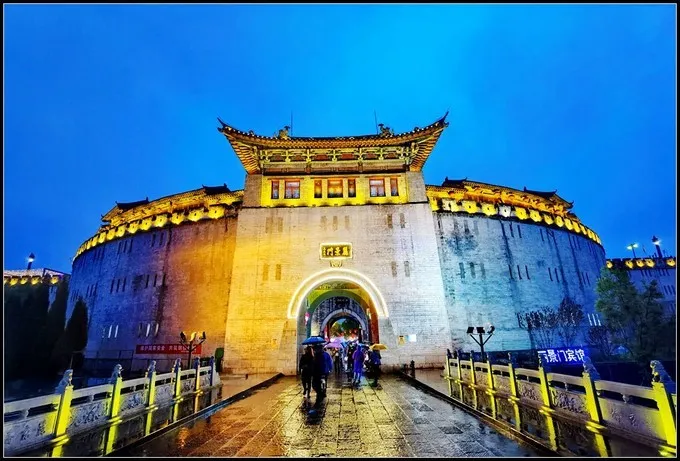
Lijing Gate in Luoyang. Lijing Gate is the western gate of Luoyang's old city, corresponding to the Drum Tower on East Street. It is the most distinctive landmark of the old city, known as the No. 1 Gate of Luoyang and the No. 1 Gate of the Central Plains. Its architectural structure, including the archery tower, gate tower, barbican, and moat, represents the most typical and finest city gates in Chinese history. The city walls are high and thick, the barbican is vast, with multiple gates and passes soaring into the clouds, majestic in scale. There is a poem: "Luoyang's peonies are unmatched, Lijing's gate tower is peerless."
Lijing Gate was one of the eight great scenic spots of ancient Luoyang and was once a place where court officials and common people prayed for blessings. It embodies the solemn layout and majestic atmosphere of the Tang Dynasty capital, reflecting the rich cultural heritage of an ancient capital. Today, Lijing Gate has become a famous tourist attraction in Luoyang.
Luoyang Tang Sancai (tri-colored glazed pottery) is a treasure of ancient Chinese ceramic art, originating in the Southern and Northern Dynasties and flourishing in the Tang Dynasty, with Luoyang as its main production area.
Tang Dynasty female figurines, with plumpness as the standard of beauty.
Luoyang is an ancient capital of a thousand years and a city of peonies. Luoyang's peonies are the finest under heaven.
Luoyang Old Street. West Street is a pedestrian shopping street.
Strolling along West Street, one can see a specialty of Luoyang cuisine - "Bufen Soup" - lining the street. Bufen Soup, also called Jiufu Men Bufen Soup by Luoyang locals, has a history of over 120 years. Luoyang people have the habit of drinking soup and eating bread pieces: in the morning, they drink meat soups like beef, mutton, or donkey soup, which are extremely delicious; in the evening, they eat lightly, usually drinking mian geda (dough drop soup) or rice soup.
"Bufen" is actually a small mung bean pancake, about the size of a child's palm. The mung beans are soaked, ground finely, mixed with water to a batter of medium consistency, then a ladleful is spread on a griddle and heated for a minute until cooked without flipping - hence the name "bufen" (no flipping). Then, the small pancake is soaked in beef or mutton soup to make Bufen Soup.
Luoyang Old Street. The ancient Drum Tower stands at the junction of East and West Streets.
Luoyi Ancient City is located in the old city area of Luoyang. The scenic area includes several protected historical buildings from different periods, such as Wenfeng Pagoda, Henan Prefecture Confucian Temple, Tuoling Temple, Siyanjing (Four-Eyed Well), and the ancient city wall ruins of the Jin and Yuan dynasties. It is a comprehensive cultural tourism area integrating sightseeing, entertainment, dining, accommodation, and shopping.
Luoyi Ancient City. The ancient Wenfeng Pagoda.
Luoyi Ancient City. Luoyang Cross Street Snack Street.
Cross Street is the most famous, largest, and liveliest night market for snacks in Luoyang. Every day from 6 PM, when the lights come on, various specialty snack stalls line the street, attracting many foodies.
Luoyang Cross Street Snack Street.
Although it was raining, there were still many tourists. However, northern night market snacks are generally similar, just with different locations and names.
Luoyang Cross Street Snack Street. Luoyang Old Street.
Besides Bufen Soup, the most famous Luoyang cuisine specialty is the "Water Banquet." Luoyang Water Banquet is a characteristic traditional feast in the Luoyang area, belonging to the Henan cuisine category. It originated in the Tang Dynasty and has a history of over 1,000 years, making it one of the longest-surviving famous banquets in China. The Water Banquet has two meanings: first, all hot dishes have soup; second, dishes are served one after another, like flowing water, with each course replaced by the next. Its features include both meat and vegetables, a wide selection of ingredients, simplicity or complexity depending on preference, and a variety of flavors including sour, spicy, sweet, and salty, making it comfortable and delicious. Luoyang people regard the Water Banquet as the top banquet to entertain distant guests. It is not only popular at grand feasts but also used in folk occasions such as weddings, funerals, birthdays, and festivals. Along with the traditional Peony Festival and the ancient Longmen Grottoes, the Water Banquet is known as one of Luoyang's three wonders, a pride of the Luoyang people.
Lijing Gate looks beautiful and magnificent at night.
Luoyang Old Street. Luoyang.
Day 2: Luoyang
This was my third visit to Luoyang, so I visited the main attractions again. I took a bus from the hotel gate to the White Horse Temple, then another bus to the Longmen Grottoes. Accommodation: Luoyang 7 Days Inn.
After breakfast, I took a bus to visit the White Horse Temple. The temple's mountain gate is a stone arch gate with one entrance and three openings in the style of a memorial arch. The mountain gate is the main gate of a Chinese Buddhist temple, usually consisting of three gates, symbolizing the three gates of liberation: the gate of emptiness, the gate of signlessness, and the gate of wishlessness.
The White Horse Temple was founded in the 11th year of Yongping in the Eastern Han Dynasty (68 AD). It is the first ancient temple in China, a famous sangharama (monastery) worldwide, and the first official Buddhist temple built after Buddhism was introduced to China. It is known as the "ancestral court" and "source of Buddhism" in China, with a history of over 1,900 years. The existing ruins and relics date from the Yuan, Ming, and Qing dynasties. In 1961, the White Horse Temple was listed by the State Council as one of the first batch of national key cultural relics protection units.
The first 200 years of Buddhism's rooting and spread in China were closely linked to the White Horse Temple. It was the result of China's first journey to the West for Buddhist scriptures, the residence of the earliest monks who came to China to preach Buddhism; here, the first Chinese Buddhist sutra and monastic rules were produced, and the first Chinese Buddhist monk was ordained... In short, the White Horse Temple is inseparably linked to many "firsts" in Chinese Buddhism, making it a true ancestral court and source of Buddhism.
In the 10th year of Yongping in the Eastern Han Dynasty (67 AD), two Indian eminent monks were invited and, together with envoys of the Eastern Han, carried Buddhist scriptures and images on white horses back to the capital Luoyang. Emperor Ming of Han was delighted to see the scriptures and images and ordered the construction of a monastery three li outside the Xiyong Gate of Luoyang, on the north side of the imperial road. To commemorate the white horses carrying the scriptures, it was named the White Horse Temple. The character "si" (temple) originated from the word "Honglu Si" (Court of State Ceremonial), and later "si" became a general term for Chinese monasteries.
The "Bell Sound of the Horse Temple" symbolizes good luck and is listed among the "Eight Great Scenic Spots of Luoyang."
The White Horse Temple holds an important position in Buddhist history, with the saying "Ten Ancients of the Ancestral Court": 1. The first ancient temple in China - White Horse Temple; 2. The first stupa in China - Qiyun Pagoda; 3. The first journey to the West for scriptures by Zhu Shixing began at White Horse Temple; 4. The earliest Indian eminent monks to come to China practiced at White Horse Temple; 5. The earliest Brahmi script Buddhist sutras (Palm-leaf sutras) were collected at White Horse Temple; 6. The earliest translation center was at the Qingliang Terrace of White Horse Temple; 7. The first Chinese Buddhist sutra, the Sutra of Forty-two Chapters, was translated at White Horse Temple; 8. The first Chinese monastic rules, the Sarvastivada Vinaya, were translated at White Horse Temple, and the first ordination platform was established in Luoyang; 9. The first Buddhist-Taoist debate occurred at White Horse Temple; 10. The first Chinese monk Zhu Shixing was ordained at White Horse Temple.
The five main halls in the White Horse Temple, from south to north, are the Hall of Heavenly Kings, the Great Buddha Hall, the Mahavira Hall, the Hall of Welcoming, and the Vairocana Hall. Each hall contains statues, mostly from the Yuan, Ming, and Qing dynasties. The Vairocana Hall is on the Qingliang Terrace, where Kasyapa Matanga and Dharmaratna translated Buddhist scriptures. The east and west side halls are symmetrically arranged. The entire complex is majestic and solemn, with a strict layout. In addition, there are more than 40 stone inscriptions, of great value for studying the temple's history and Buddhist culture.
Jade Buddha in the Jade Buddha Hall.
The White Horse Temple is not only the "ancestral court" of Chinese Buddhism but also serves to promote cultural exchange between Chinese and foreign Buddhism. It spread Buddhism to Korea, Japan, and Southeast Asia, popularizing Buddhism in Asia and making it a sacred place in the hearts of Buddhists. At the same time, it receives worshippers from all over the world.
The White Horse Temple spread Buddhism not only throughout China but also to Korea, Japan, and Southeast Asian countries, making Buddhism popular in Asia and later entering Europe and America. "Ancestral court" means the courtyard of the patriarch, and "source of Buddhism" means the birthplace of Buddhism (Sakyamuni's teaching). Therefore, Buddhists from Korea, Japan, and many Southeast Asian countries and regions regard the White Horse Temple in Luoyang, China, as the "ancestral court" and "source" of their own Buddhism. Thus, the White Horse Temple has become a bridge and link between Chinese Buddhism and world Buddhism, a sacred place for Buddhist followers worldwide. After China's reform and opening up, Japan donated funds to rebuild the bell tower of the White Horse Temple. The governments of Thailand, Myanmar, India, and other countries successively funded the construction of Buddhist halls and pagodas in the White Horse Temple, making it the only internationalized temple in the world that simultaneously features Chinese, Indian, Burmese, and Thai architectural styles. Many Buddhists from Southeast Asian countries also come to the White Horse Temple for ordination.
Thai-style temple donated by Thailand.
Myanmar-style temple donated by Myanmar. The main building is a large golden pagoda, built in the style of the Shwedagon Pagoda in Yangon, a national symbol of Myanmar. It is 32.92 meters high, with a base diameter of 51.71 meters; the ground floor serves as an exhibition hall.
Indian-style temple donated by India.
After lunch, I took a bus to visit the Longmen Grottoes.
The Longmen Grottoes are located on the Longmen Mountain and Xiangshan Mountain on both sides of the Yi River in the Luolong District of Luoyang City, Henan Province. They are one of the treasures of Chinese stone carving art and are now a World Heritage Site, a national key cultural relic protection unit, and a national AAAAA-level tourist attraction. The Longmen Grottoes, along with the Mogao Caves, Yungang Grottoes, and Maijishan Grottoes, are known as the four major grottoes in China.
The Longmen Grottoes were first excavated around the time of Emperor Xiaowen of the Northern Wei dynasty's relocation of the capital to Luoyang (493 AD). Subsequently, large-scale construction continued for over 400 years through the Eastern Wei, Western Wei, Northern Qi, Northern Zhou, Sui, Tang, and Song dynasties. The grottoes are densely distributed on the cliffs of the east and west banks of the Yi River, stretching about one kilometer from north to south. Currently, there are 2,345 niches, over 100,000 statues, and more than 2,800 inscriptions. The largest Buddha statue is 17.14 meters tall, while the smallest is only 2 centimeters. UNESCO has rated them as the highest peak of Chinese stone carving art.
The Binyang Three Caves were excavated during the Northern Wei dynasty, built by Emperor Xuanwu of Northern Wei to make merit for his father, Emperor Xiaowen. Construction began in 500 AD, took 24 years, and cost 802,366 workdays. Due to a palace coup and other reasons, only one of the three planned caves (Binyang Middle Cave) was completed; the South and North Caves only had their main statues finished in the early Tang Dynasty.
The Ten Thousand Buddhas Cave is named for the neatly arranged 15,000 small Buddhas carved on the north and south sides inside the cave. The cave has a front and rear chamber structure: the front chamber has two dvarapalas (guardians) and two lions; the rear chamber has one Buddha, two disciples, two bodhisattvas, and two heavenly kings, making it the most complete composition of statues in the Longmen Grottoes. The ceiling has a beautiful lotus flower, surrounded by an inscription: "Completed on the 30th day of the 11th month of the 1st year of Yonglong of the Great Tang, by the Grand Supervisor Yao Shenbiao and the Inner Way Meditation Master Yun, with 15,000 statues in one niche."
On the north and south walls of the cave, 15,000 small Buddha statues are neatly carved, each only 4 cm tall.
The Longmen Grottoes are the most concentrated place where Northern Wei and Tang dynasty royal nobles made vows to create statues, reflecting royal will and behavior with a strong national religious character. The statues of these two dynasties reflect distinctly different styles. The Northern Wei statues here lack the roughness, majesty, and robustness of those in the Yungang Grottoes, becoming more lively, delicate, and gentle. In the Tang dynasty, plumpness was considered beautiful, so Tang Buddha statues have round faces, broad shoulders, prominent chests, and the drapery is carved with the round knife technique, natural and smooth. The Tang dynasty statues at Longmen inherited the excellent traditions of the Northern Wei and absorbed Han culture, creating a vigorous, vivid, and naturalistic style that reached the peak of Buddhist sculpture art.
Fengxian Temple is the largest and most artistically exquisite group of cliff-side sculptures in the Longmen Grottoes. It is commonly called Fengxian Temple because it belonged to the royal temple of the same name at the time. This niche was excavated in the early reign of Emperor Gaozong of Tang. In the 3rd year of Xianheng (672 AD), Empress Wu Zetian donated 20,000 strings of cash from her cosmetics allowance. It was completed in the 2nd year of Shangyuan (675 AD). It measures more than 30 meters in both length and width. The Buddha statues in this niche clearly embody the artistic characteristics of Tang dynasty Buddhist sculpture. The inscription on the north side of the main Buddha's lotus pedestal calls it the Great Vairocana Image Niche. There are nine large statues here. The central main Buddha is Vairocana, the reward body of Sakyamuni. His face is plump, with long ears hanging down; the form is complete, serene, warm, and amiable, deeply moving. According to Buddhist scriptures, Vairocana means "illuminating everywhere."
The Great Vairocana Image Niche is the essence and representative of the Longmen Grottoes, magnificent and majestic. This cliff-side niche, carved according to the Avatamsaka Sutra, centers on the graceful and extraordinary Vairocana Buddha, using vividly expressive artistic group images to fully convey the peaceful and auspicious ideal of the Buddhist world. This group of statues reflects the powerful material and spiritual strength of the Tang Empire and represents the highest achievement of Tang dynasty sculpture art.
The Vairocana Buddha statue is 17.14 meters tall, with a head height of 4 meters and ears 1.9 meters long. The Buddha's face is full and round, with wavy hair on top, eyebrows curved like crescent moons, and elegant eyes gently gazing downward. The nose is straight and high, the mouth small, with a peaceful smile. The ears are long and slightly drooping, the chin round and slightly protruding. The whole image is harmonious, serene, and free. He wears a form-fitting kasaya with simple, unadorned drapery. The concentric circular folds of the robe accentuate the head, making it exceptionally bright and holy. The entire statue resembles a wise and kind middle-aged woman, inspiring reverence without fear. It is said that this statue was carved by Empress Wu Zetian's order, based on her own appearance. On the day of Fengxian Temple's completion, Wu Zetian personally led the civil and military officials to attend the consecration ceremony of Vairocana and performed rituals on the east bank of the Yi River, beating drums and playing music. The Drum Tower still exists there today.
The central main Buddha in the Great Vairocana Image Niche is Vairocana, the reward body of Sakyamuni. To his right is the elder disciple Mahakasyapa, to his left the younger disciple Ananda, followed by Samantabhadra Bodhisattva on the left and Manjusri Bodhisattva on the right, forming a group of highly expressive artistic images.
The peonies blooming at the feet of the Vairocana Buddha were an unexpected delight. Because the weather in Luoyang warmed up early this year, the peonies bloomed early too. After we arrived in Luoyang, a friend told us that the peonies in several peony gardens had already wilted, so we gave up on visiting them. But unexpectedly, at the feet of the great Buddha, we enjoyed various peonies of incomparable beauty. They were truly stunning. These were offerings from devotees, perhaps truly blessed by the Buddha's light. It is said that Wu Zetian loved peonies and ordered them to bloom at her command, and even the peony god dared not disobey. And the Vairocana Buddha is considered to be Wu Zetian's incarnation.
Luoyang peonies began in the Sui dynasty, flourished in the Tang, and were considered "unmatched under heaven" in the Song. They have a history of over 1,500 years. Over this long history, Luoyang peonies have become famous far and wide for their graceful elegance, national beauty, and heavenly fragrance; they also command all other flowers. Luoyang has become the sacred land of peonies in people's hearts. Luoyang is the capital of thirteen dynasties, with the reputation of a millennium capital and a city of peonies. Luoyang's soil is most suitable for peonies, and its peonies are the finest under heaven. They are elegant and noble, with national beauty and heavenly fragrance, magnificent and splendid, symbolizing good fortune, wealth, prosperity, and success, as well as the prosperity and happiness of the Chinese nation.
Brave and mighty heavenly kings and fierce-looking dvarapalas.
Day 3: Luoyang - Gongyi - Kaifeng
The weather was good in Luoyang today. In the morning, we went to the Sui-Tang Luoyang City Yingtianmen Site Museum, Sui-Tang Luoyang City National Heritage Park, and Sui-Tang Luoyang City Jiuzhou Pond Site Park. Originally, we planned to go to Kaifeng in the afternoon. When buying train tickets, we found that the train passed through Gongyi station. Upon checking, we discovered that Gongyi also has Song dynasty imperial tombs. So we decided to spend a few hours visiting Gongyi first, then take a train to Kaifeng. This was a great decision; Gongyi is really worth visiting. Accommodation: Kaifeng 7 Days Inn.
Sui-Tang Luoyang City Yingtianmen Site.
Yingtianmen is one of the most representative buildings of the Sui-Tang Luoyang City. It was the main south gate of the entire palace city. It formed the north-south axis of the Sui-Tang Luoyang City together with Duangmen (the main gate of the imperial city), Dingdingmen (the main gate of the outer city) to the south, and Mingtang, Xuanwumen, and Longguangmen to the north. It was a landmark on the central axis of the Sui-Tang Luoyang City. The ancient Sui-Tang city has long been destroyed. Today, Luoyang has invested heavily to restore Yingtianmen, Mingtang, and Tiantang based on archaeological excavations and research, building site parks and museums.
Yingtianmen was the main south gate of the palace city (Zijiangcheng) of Sui-Tang Luoyang City, commonly known as Wufenglou (Five Phoenix Tower). It was first built in the 1st year of Daye of the Sui dynasty (605 AD), originally named Zetianmen. In the 1st year of Shenlong (705 AD), to avoid the taboo of Empress Wu Zetian's name, it was renamed Yingtianmen. Yingtianmen was the venue for grand ceremonies such as coronations, changes of reign titles, general amnesties, and banquets. It was a huge "凹"-shaped building complex consisting of gate towers, side towers, and east and west watchtowers connected by corridors. It stretched 137 meters from east to west, with side towers 36.4 meters high. There were two tiers of observatories on the gate, inscribed with "Ziji Guan"; five lofty towers were built, resembling five phoenixes, hence the name "Wufenglou"; under the gate tower were three passageways, the central one for the imperial path, left for entry, right for exit; in front of the gate were double three-outward-curving watchtowers symbolizing royal majesty, with a total of twelve towers on the east and west sides, representing the highest level of ancient city gate architecture, the supreme ritual enjoyed by the Son of Heaven. Yingtianmen was the highest standard city gate in ancient China, and its architectural system profoundly influenced later dynasties, occupying an important position in the history of Chinese palace architecture.
The Yingtianmen site protection and exhibition project cost about 210 million yuan. In September 2019, the Yingtianmen Site Museum officially opened to the public. At the end of the same year, it successfully applied for a national AAAA-level tourist attraction.
The interior decoration of the Yingtianmen Site Museum is magnificent.
Based on historical records of the Tang dynasty and archaeological research, Luoyang has restored buildings such as Yingtianmen, Mingtang, and Tiantang. Although these are "new antiques" built in recent years, they are indeed majestic, magnificent, and splendid, showing the prosperity and strength of the Tang dynasty.
On this majestic gate tower, recorded events include: Emperor Yang of Sui initiating the gathering of all nations to pay tribute; Emperor Taizong of Tang issuing an order to burn the city; Emperor Gaozong asking about "Korean affairs"; Empress Wu Zetian delivering her accession speech; and Emperor Xuanzong receiving Japanese envoys.
The distant domed building is Mingtang. On that day, Empress Wu Zetian walked from Yingtianmen along this central imperial path, accompanied by civil and military officials, to Mingtang for her coronation.
Distant view of Mingtang and Tiantang.
Mingtang, meaning "Hall of Bright Governance," was the main audience hall of Zijiangcheng, called the "Palace of All Spirits." It was an important ritual building for ancient emperors to govern and perform sacrifices. It was a landmark of the Tang and Wu Zhou divine capital Luoyang, reaching 98 meters high, covering 12,000 square meters, making it the largest wooden building in world history and a pinnacle of Chinese architecture. Mingtang was built in the 3rd year of Chuigong of Wu Zhou (687 AD) and completed at the end of the following year, named "Palace of All Spirits," allowing commoners to visit. It was destroyed in 695 AD and rebuilt the next year, renamed "Hall of Communicating with Heaven."
Mingtang had three floors: the ground floor was square, symbolizing the four seasons; the middle floor was dodecagonal, following the twelve two-hour periods; the upper part had a round cover supported by nine dragons. The top floor was a 24-sided polygon, corresponding to the 24 solar terms. On the top was placed a golden phoenix (later changed to a fiery pearl, known as a "national treasure"). In the center was a huge wooden pillar ten arm spans in circumference (15 meters in diameter), running through the whole structure.
Tiantang was a Buddhist hall in the Wu Zhou Zijiangcheng, meaning "Supreme Hall." Also known as Merit Hall, Tongtian Pagoda, or Tongtian Tufu. It was built in 689 AD by Empress Wu Zetian in the divine capital Luoyang, located in the core area of Zijiangcheng, north of the main hall Mingtang. Tiantang was the imperial sacred place for Wu Zetian to sense the four seasons and communicate with heaven.
The splendid Buddha hall of Tiantang.
You can take the elevator to the ninth floor to enjoy a panoramic view of Luoyang city.
Sui-Tang Luoyang City Jiuzhou Pond Site Park. Jiuzhou Pond, as the imperial garden of the Sui-Tang Luoyang City palace city, historically existed. Today, the Jiuzhou Pond Site Park covers 288 mu, including three parts: the inner palace residential area in the northwest of the palace city, part of the Taoguang Garden in the north of the palace city, and the Jiuzhou Pond royal garden in the northern part of the western separated city to the west of the palace city. These 12 sites are protected and displayed through various scientific methods. Through in-situ display of ancient sites and ground simulation, more people can learn about the royal garden style of the Sui-Tang period.
The restored Tang dynasty royal garden buildings are grand and magnificent.
Jiuzhou Pond Garden.
After finishing our itinerary in Luoyang, we went to the train station to take a train to Gongyi.
The train ticket cost 11 yuan per person. After about 40 minutes, we arrived at Gongyi Station. We deposited our luggage at the station and then took a bus into the city to explore.
We got off directly at the Song Tomb Plaza. Yongzhao Mausoleum of the Song dynasty is located in Gongyi city. Within Gongyi, there are more than 70 Peiligang, Yangshao, and Longshan cultural sites, including Du Fu's hometown, as well as over 100 national, provincial, and municipal cultural relics protection units such as the Northern Wei Grottoes, Northern Song Imperial Mausoleums, and Kang Million Manor. The six scenic areas include Heluo Confluence, Fuxi Mountain Snow Cave, Northern Song Imperial Mausoleums, Songyin Scenic Area, Qinglong Mountain Ciyun Temple, Du Fu's Hometown, and Kang Million Manor. Gongyi is a famous historical and cultural city in Henan.
Yongzhao Mausoleum is the tomb of the fourth Song emperor, Zhao Zhen (Emperor Renzong). Emperor Renzong, originally named Shouyi, was the sixth son of Emperor Zhenzong. He is the prince in the folk legend "The Case of the Replaced Baby with a Mink Cat." He was born in 1010 AD, made crown prince in 1018 and given the name Zhao Zhen, ascended the throne in 1022, and died in Kaifeng in 1063 at the age of 53. During his 42-year reign, the country was at peace and prosperous, with many civil and military officials and flourishing science and culture, reaching the peak of the Song dynasty.
The Northern Song Imperial Mausoleums are a national cultural relic protection unit. They are distributed in four towns in Gongyi: Xicun, Zhitian, the city area, and Huiguo Town, covering about 30 square kilometers. Among the nine Song emperors, except for Emperors Huizong and Qinzong who were captured by the Jin army and died in Wuguocheng, the tombs of the other seven emperors and their father Zhao Hongyin (moved from Kaifeng, called Yong'an Mausoleum) are collectively known as the Seven Emperors' Eight Mausoleums. In order: Yong'an Mausoleum (Zhao Hongyin), Yongchang Mausoleum (Zhao Kuangyin), Yongxi Mausoleum (Zhao Guangyi), Yongding Mausoleum (Zhao Heng), Yongzhao Mausoleum (Zhao Zhen), Yonghou Mausoleum (Zhao Shu), Yongyu Mausoleum (Zhao Xu), and Yongtai Mausoleum (Zhao Xu). In the Jingkang period of the Song dynasty during the Jin invasion, they were damaged. During the Yuan dynasty, all above-ground buildings were destroyed. In addition, there are nearly a thousand tombs of Song dynasty empresses, consorts, imperial clansmen, and famous ministers such as Gao Huaide, Cai Qi, Kou Zhun, Bao Zheng, Yang Liulang, and Zhao Pu.
Sheep, horses, elephants, civil officials, military officers, and lions at the gate. These weathered stone statues, after a thousand years of cold and heat, witnessing worldly changes, still retain their proud style.
Yongzhao Mausoleum covers over 500 mu, with four gates at the cardinal points. The south gate is the main gate. The mausoleum area is divided into an inner city and an outer city; the inner city is also called the palace city. Entering the south gate, the mausoleum area slopes from south to north. A wide, straight sacred path passes through the high Que Tai (Watchtower Platform) and Ru Tai (Milk Platform), past the solemnly standing stone statues, straight to the palace city. Que Tai is the first gate of the mausoleum area, Ru Tai the second, and Shenmen (Spirit Gate) the third, also the gate of the palace city.
Yongzhao Mausoleum has a north-south axis of 551 meters from the Que Tai to the North Spirit Gate. On the sacred path outside the South Spirit Gate, there are symmetrically arranged pairs of stone figures: 13 pairs of stone men, 2 pairs of stone sheep, 2 pairs of stone tigers, 2 pairs of stone horses, and one pair each of stone horned animals, stone red birds, stone elephants, and stone pillars. These stone carvings are slender in form and finely carved. The warriors are tall and fierce, gazing straight ahead, faithfully guarding the palace gate. The envoys are heavy in build, with concise and clear outlines, hands holding tribute, draped in large robes, folds falling to their feet, both form and spirit present. The stone tigers are majestic and vigorous, while the stone sheep look serene and elegant. The stone red bird at Yongzhao Mausoleum is especially exquisite: the whole screen is rectangular, carved with layered mountain clouds, highlighting the red bird spreading its wings. The beautiful tail resembles a graceful fan stirring the wind. The relief prominently displays the magnificent spirit of the roc and presents a beautiful, romantic picture.
Generally, the stone carvings on both sides of the sacred path of Song imperial mausoleums consist of 23 pairs: from south to north: 1 pair of pillars, 1 pair of elephant tamers, 1 pair of auspicious birds, 1 pair of horned animals, 1 pair of horses, 4 pairs of grooms, 2 pairs of tigers, 2 pairs of sheep, 3 pairs of envoys, 2 pairs of military officers, 2 pairs of civil officials, 1 pair of lions at the gate, and 1 pair of warriors. Outside the other spirit gates of the upper palace, there is also one pair of lions, and inside the gates, one pair of court ladies. Some lower palace gates also have one pair of lions. The stone carvings of the Song mausoleums break away from traditional mysticism, focusing on reflecting the secular life of the time, achieving high artistic skill with both form and spirit.
After visiting Yongzhao Mausoleum, we still felt unsatisfied. Seeing that there was still time, we decided to explore Yonghou Mausoleum. Yonghou Mausoleum is the tomb of Emperor Yingzong Zhao Shu of the Song dynasty. It is less than a kilometer from Yongzhao Mausoleum and is scattered in the vegetable fields of the Gongyi suburbs. Yonghou Mausoleum is not a scenic area. After some searching and asking around, we found that it had been fully enclosed. When we asked several nearby villagers, they didn't know where the entrance was. It turned out that the local government had recently completed land acquisition, and a large area belonging to Yonghou Mausoleum had been enclosed and construction had started two days ago to build a new Song Mausoleum Park, so outsiders were not allowed to enter. Not willing to give up, after much trouble, we finally found a small opening and entered the excavation construction site of Yonghou Mausoleum.
The stone statues of Yonghou Mausoleum were scattered haphazardly in a large area of vegetable fields, wild grasslands, and farmhouse yards, many half-buried in the soil.
This pair of stone lions' bodies were completely covered by yellow soil, leaving only two heads above ground, as if still struggling tenaciously and stubbornly hoping to be saved one day to regain their past glory.
This solitary stone statue, standing for thousands of years, seems still to be faithfully guarding the burial mound of its master behind.
The stone statues lined up, though some were broken and damaged, still retain the solemn style of past imperial power.
The Song mausoleums of yesteryear were once so solemn, luxurious, and magnificent, but now they look so pitiful, truly unbearable. Among the scattered seven emperors' eight mausoleums in Gongyi, except for Yongzhao Mausoleum of Emperor Renzong, which has been protected and restored, the other Song mausoleums are in a similar or even worse condition. I wonder what Emperor Taizu Zhao Kuangyin would think of this underground?
Scattered among the rape flowers, the stone statues seem to have been silently watching the vicissitudes of the world, the changing seasons, sunrises and sunsets, silently waiting...
Under the setting sun, we gently touched these thousand-year-old stone statues, bidding farewell to each, wishing them a new life soon. They will soon become members of a new imperial mausoleum park with a fresh appearance.
After finishing our visit to Gongyi, we returned to Gongyi Railway Station and took an evening train to Kaifeng.
We arrived in Kaifeng around 10 PM and checked into the 7 Days Inn near the train station.
Day 4: Kaifeng
Today we toured Kaifeng city. Since we had been to Kaifeng before, we visited several spots: Baogong Temple, Kaifeng Government Office, Daxiangguo Temple, Iron Pagoda, and Dragon Pavilion.
Accommodation: Kaifeng 7 Days Inn.
After breakfast, we took a bus to start our tour of Kaifeng. The first stop was the famous Baogong Temple.
Baogong Temple in Kaifeng was rebuilt to commemorate the famous upright official Bao Zheng of the Song dynasty. It is the Bao Zheng memorial venue with the most complete materials, largest scale, and greatest influence in China. It is located on the west bank of the scenic Baogong Lake in the ancient capital of seven dynasties, Kaifeng.
Bao Zheng was a famous upright official and political reformer of the Northern Song dynasty. Throughout his life, he worried about the country and the people, was upright and incorruptible, enforced the law strictly, and was honest. Especially when he governed Kaifeng, he held court in the southern government office, suppressed the powerful, and delivered justice for the common people, earning the well-known reputation of Bao Qingtian (Blue Sky Bao) both at home and abroad. Historical records show that Kaifeng Baogong Temple was first built in the Jin and Yuan dynasties, and was renovated through the Ming and Qing dynasties over nearly a thousand years. Due to the Yellow River floods, it was repeatedly destroyed and rebuilt. In 1984, Kaifeng rebuilt Baogong Temple on Baogong Lake.
The bronze statue of Bao Zheng in the main hall. Bao Zheng sits upright, one hand on the armrest, the other clenched as if about to strike the table, with an air of absolute integrity.
The scenic area features undulating rockeries, waterfalls, small bridges, flowing streams, koi fish playing in clear waves, unique stone carvings, and beautiful gardens that make visitors linger.
Kaifeng Government Office, located on the north bank of Baogong East Lake in Kaifeng, was the administrative and judicial office of the capital of the Northern Song dynasty. It was known as the premier government office in the world at that time. Historical records indicate that there were 183 governors of Kaifeng Prefecture in the Northern Song dynasty, with Bao Zheng's tenure making it famous at home and abroad. Today's Kaifeng Government Office is a reconstructed building covering over 60 mu, with a building area of 13,600 square meters. It echoes Baogong Temple on the west side of Baogong Lake, complementing the three lakes, forming a beautiful landscape of eastern government office, western temple, and pavilions and water. It is a national AAAA-level tourist attraction.
Kaifeng, abbreviated as "Bian," anciently known as Bianzhou, Bianliang, Bianjing, is located in eastern Henan, in the hinterland of the Central Plains, on the banks of the Yellow River. It is one of the first national historical and cultural cities. It has a history of over 4,100 years as a city and a capital. It served as the capital for the Xia dynasty, the Wei state of the Warring States period, the Later Liang, Later Jin, Later Han, and Later Zhou of the Five Dynasties, the Song dynasty, and the Jin dynasty, known as the capital of eight dynasties. It nurtured the "Song culture" that inherited from Han and Tang and influenced later Ming and Qing dynasties. Kaifeng is the only capital in the world whose central axis has never changed. Its "city upon city" ruins are rare in world archaeology and capital history. The Song dynasty capital, Dongjing, was the largest city in the world at the time and the setting of the painting "Along the River During the Qingming Festival."
Kaifeng Daxiangguo Temple, originally named Jianguo Temple, is a famous Buddhist temple in China. It was first built in the 6th year of Tianbao of the Northern Qi dynasty (555 AD). In the 1st year of Yanyuan of the Tang dynasty (712 AD), Emperor Ruizong, to commemorate his ascension to the throne from the Prince of Xiang, named it Daxiangguo Temple. During the Northern Song dynasty, the temple was highly revered by the royal family and was expanded many times, becoming the largest temple in the capital and the center of Buddhist activities nationwide. It was later damaged by wars and floods. It was rebuilt in the 10th year of Kangxi of the Qing dynasty (1671). Currently preserved are the Hall of Heavenly Kings, Mahavira Hall, Octagonal Glazed Tile Hall, Sutra Library, and the Thousand-Hand Thousand-Eye Buddha. In August 1992, Buddhist activities were resumed, and buildings such as the bell and drum towers were rebuilt. The entire temple complex is strictly laid out, majestic and magnificent. In 2002, it was rated as a national AAAA-level tourist attraction. The mountain gate of Daxiangguo Temple was originally built in the Qianlong period of the Qing dynasty but was destroyed by artillery fire when Kaifeng was liberated. The current hall-style mountain gate was built by the abbot, Master Xinguang, and the inscription was written by Zhao Puchu, the former president of the Chinese Buddhist Association.
Daxiangguo Temple follows the traditional Chinese axial layout, with main buildings including the gate, Hall of Heavenly Kings, Mahavira Hall, Octagonal Glazed Tile Hall, and Sutra Library, arranged from south to north along the axis. On both sides of the main hall are east and west pavilions and corridors. The Sutra Library and Mahavira Hall are Qing dynasty structures, with double-eaved hip-and-gable roofs, layers of dougong brackets, covered with yellow and green glazed tiles. The bell tower houses a huge bell from the Qing dynasty, about four meters high and weighing over 10,000 jin, known as the "Xiangguo Frost Bell," one of the eight scenic spots of Kaifeng.
The Hall of Heavenly Kings of Daxiangguo Temple was built during the Qianlong period of the Qing dynasty. The hall is five bays wide and three bays deep, with a single-eave hip-and-gable roof and green glazed tiles. The plaque on the lintel was also inscribed by Zhao Puchu.
The story of Lu Zhishen uprooting a weeping willow in "Water Margin" takes place at Daxiangguo Temple.
The main hall of Daxiangguo Temple, the Mahavira Hall, was built during the Shunzhi period of the Qing dynasty. It is seven bays wide and five bays deep, about 13 meters high. Its grand scale makes it a gem of ancient architecture, known as the "First Hall of the Central Plains." Around the main hall and the terrace, there are white marble railings with 58 lions carved on the balusters, exquisitely crafted in various poses. Inside the Mahavira Hall are enshrined statues of Sakyamuni, Amitabha, and the Medicine Buddha.
The Octagonal Glazed Tile Hall of Daxiangguo Temple, also called the Arhat Hall, has an octagonal shape, hence its name. Its unique structure is unparalleled in Chinese Buddhist temples. Built in the Qianlong period of the Qing dynasty, it covers 828 square meters and consists of three parts: a cloister hall, a central courtyard, and a central pavilion.
In the octagonal pavilion at the center of the Arhat Hall is enshrined a four-faced Thousand-Hand Thousand-Eye Avalokitesvara (Guanyin) statue. This statue was carved from a single complete gingko tree by an anonymous folk artist in the Qianlong period, taking 58 years of painstaking work. The statue is over 3 meters tall and weighs about 2,000 kilograms. The four sides are identical in form: each side has six large hands and three to four layers of fan-shaped small hands, each with an eye in the palm, totaling 1,048 eyes. Commonly known as the "Thousand-Eye Thousand-Hand Buddha," it is one of the 32 transformations of Guanyin. This sculpture not only uses precious material but also features exquisite skill, showing divine workmanship. It is the treasure of Daxiangguo Temple.
The five hundred Arhat statues in the Arhat Hall.
The Master Hall, i.e., the Memorial Hall of Master Kukai. In front of the hall stands a monument commemorating the installation of Master Kukai's bronze statue, along with a rare pair of stone six-tusk elephants. Inside the hall are a bronze statue of Master Kukai and an exhibition of his life story and pictures. The bronze statue is 2.5 meters tall and weighs over 3,000 jin, a gift from Japanese friends.
The Drum Tower of Kaifeng was first built in the 12th year of Hongwu of the Ming dynasty (1379). It is one of the landmark buildings embodying the wisdom of ancient laborers. It was repaired five times during the Ming and Qing dynasties and is now the commercial and cultural center of Kaifeng.
At noon, we found Kaifeng's First Restaurant (Diyilou), a century-old establishment. Founded in 1922, it is a time-honored Chinese brand, a national special-class restaurant, a famous Chinese dining establishment, and a national green restaurant. It is famous at home and abroad for its steamed stuffed buns with soup (xiaolongbao) and assorted bun banquets.
The steamed stuffed buns with soup of Kaifeng First Restaurant originated from the Song dynasty capital Dongjing (today's Kaifeng). They use fine ingredients and exquisite techniques, featuring thin skin, large filling, soup that flows, tender and fresh taste, rich but not greasy, and the beautiful shape of being lifted like a lantern and set down like a chrysanthemum. They are praised as "a unique delicacy of the Central Plains" and have received the Golden Tripod Award for quality products from the Ministry of Commerce, as well as honors such as the First Chinese Famous Snack and Chinese Famous Snack.
The two of us ordered a cold black fungus salad, a carp with baked noodles (lǐyú bèimiàn), and a basket of soup dumplings.
After lunch, we visited the Iron Pagoda Park in Kaifeng.
The Iron Pagoda Park covers an area of 51.24 hectares, including 9.62 hectares of water. Within the park, there are successively the "Bonsai Garden," a stone stele reading "The Top Pagoda under Heaven," a memorial archway inscribed "Ultimate Bliss World," the tranquil and elegant "Jingyuan," the majestic "Jieyin Hall" (Hall of Welcoming), and the national key cultural relic protection unit "Iron Pagoda." The people of Kaifeng say: "If you haven't seen the Iron Pagoda, you haven't been to Kaifeng."
The Iron Pagoda was built in the 1st year of Huangyou of the Northern Song dynasty (1049) and has a history of over 900 years. It was designated as a national key cultural relic protection unit by the State Council in 1961. The Iron Pagoda, also known as the Kaibao Temple Pagoda, gets its name because the tower body is entirely inlaid with brown glazed tiles, which look like iron from a distance, hence the name "Iron Pagoda."
The Iron Pagoda in Kaifeng is an equilateral octagon, with 13 stories, 55.88 meters high. The base of the first floor is 4.16 meters wide on each side, gradually decreasing upward. The pagoda body is covered with patterned bricks featuring more than 50 types of decorative motifs, including apsaras, kylins, bodhisattvas, musicians, and lions. These patterns are beautifully shaped and vividly expressive, making them masterpieces of Song dynasty brick carving art. The Iron Pagoda is renowned at home and abroad for its outstanding architectural art. Its design is ingenious and the structure is solid. Despite earthquakes, floods, storms, and human damage, it still stands tall. It is the tallest existing glazed pagoda in China. The pagoda has bright windows on each floor: the first floor to the north, the second to the south, the third to the west, the fourth to the east, and so on, with blind windows on the other sides. The bright windows serve various functions such as lighting, ventilation, observation, and reducing wind pressure on the pagoda body. The bricks used to build the pagoda were specially fired glazed structural bricks of various shapes. There are over 20 types of bricks, each with different specifications, with tenons and mortises, fitting perfectly when built into the pagoda body, making it sturdy and beautiful. The outer iron-colored glazed bricks of the Iron Pagoda have over 50 patterns, including waves, clouds, apsaras, immortals, cloud dragons, seated Buddhas, bodhisattvas, musicians, monks, kylins, lions, and flowers. Each glazed brick is a work of art. According to the "Record of a Dream," the base had south and north gates. The south gate had a plaque reading "The Top Pagoda under Heaven." Under the base was an octagonal square pond. To the north, a small bridge crossed the pond, and entering the north gate via the bridge gave access to the pagoda. Thus, the Iron Pagoda was once a pagoda in the water, a rare and unique architectural style.
The Dragon Pavilion Park in Kaifeng.
The Dragon Pavilion main hall is part of the former site of the Song dynasty palace's imperial garden. The high platform under the pavilion was once a man-made hill in the garden of the Zhou Prince's Mansion of the Ming dynasty. The Dragon Pavilion main hall is the main structure of the entire Qing dynasty architectural complex in the park, built on a platform with 72 steps.
The Dragon Pavilion main hall faces south. In front of the hall is an imperial path carved with blue stone, showing a coiled dragon. The cloud-dragon stone carving still bears the hoofprints of Zhao Kuangyin from that time. On the east and west sides of the imperial path, there are steps and side paths. The Dragon Pavilion main hall is 26.7 meters high, 19.10 meters long from east to west, and 11.90 meters wide from north to south. The ceiling inside is painted with blue clouds and coiled dragon patterns. The eaves are upturned, with wind chimes hanging at the ends, making beautiful sounds in the wind. The Dragon Pavilion main hall stands majestically on a tall base. From the top of the Dragon Pavilion, one can enjoy a panoramic view of Pan and Yang Lakes, the beautiful scenery of the Dragon Pavilion Park, the bustling Song Dynasty Imperial Way, and the elegant ancient capital, evoking endless emotions.