High-Speed Rail Tour of Hunan, Henan, and Shandong
As the temperature rises, my wife and I decided to travel by high-speed rail.
Day 1: Zhuhai - Chenzhou West
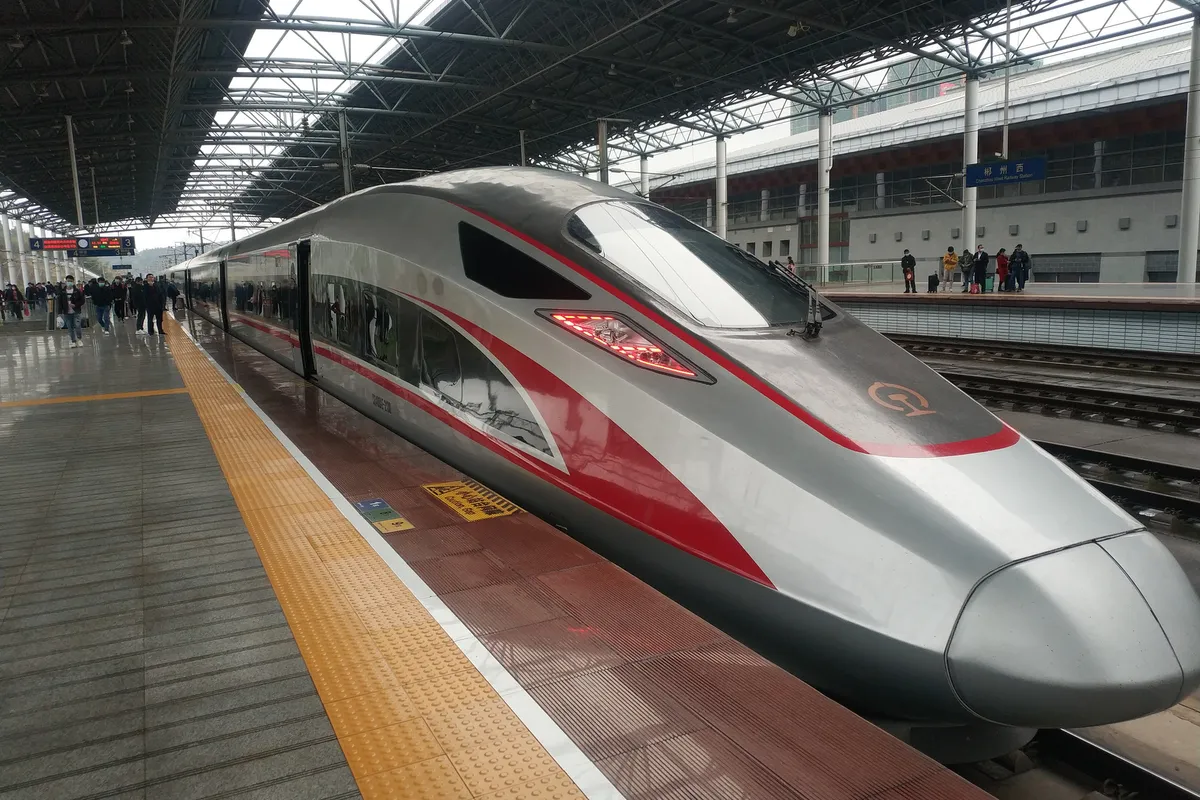
Around eight in the morning, we set off from Zhuhai to Chenzhou. The high-speed rail was very comfortable, with seats much more spacious than airplane seats, very stable, and not too noisy. There were charging sockets under the seats, so we could play on our phones without worrying about running out of power. Time passed quickly, and two to three hours flew by.
When the high-speed train passed through Shaoguan, it was raining heavily outside. By the time we arrived in Chenzhou at noon, it had stopped raining there, and the sky was cloudy. After scanning our health codes and exiting the station, we took a taxi from the high-speed rail station to the pre-booked Dinghe Grand Hotel. The hotel claimed to be four-star standard but wasn't officially rated. The basic facilities were decent, but the elevator and hallways were filled with cigarette smoke, indicating poor management.
After dropping off our luggage, we went to the lively Ziyun Local Cuisine Restaurant next to the hotel for lunch. We ordered the restaurant's signature dish, steamed pork ribs with rice flour, among others. The portions were generous, the taste was great, and it was reasonably priced.
After lunch, we took a taxi directly to Wanhua Rock to sightsee. It felt like Chenzhou was a city built in the middle of a large mountain valley, with mining crystal advertisements everywhere on the streets, indicating rich mineral resources.
When we arrived at the Wanhua Rock scenic area, there were few visitors. The stalactites and stalagmites inside the karst cave were in various shapes and forms. I won't elaborate much on that. Compared to other caves, Wanhua Rock is special because it has an underground river, and in summer, you can go rafting inside the cave. At the entrance of the cave, a guide led visitors and explained things, controlling the colored lights along the way to reveal the colorful scenery.
The rock formations were lifelike and varied. We didn't follow the guide but explored on our own. The main scenic area was about one kilometer long. After the guide's explanation ended, visitors could walk to the rafting area independently.
At the starting point, there were many rafts piled up. After about 800 meters, we reached the exit, which was the Heiya Tiankeng (Black Cliff Sky Pit), with a depth of over 130 meters.
Looking up, we could see a round patch of sky. The cliffs on both sides were as if cut by knives and axes, very majestic.
Near the "Tiankeng," we saw a stele from the tenth year of Xianfeng in the Qing Dynasty (1860) recording the history of the Taiping Heavenly Kingdom, titled "Tanshan Wanhua Rock Narrative." At the bottom of the "Tiankeng," there was also a city wall left by the Taiping Army.
The terrain inside the Tiankeng was very flat and spacious, capable of accommodating thousands of people. We climbed from the bottom of the Tiankeng to the top of the cliff along a winding path, rested for a while at a pavilion with some water, then walked a long path to return to the visitor center, exhausted after a total of over three hours of sightseeing.
It was quite difficult to call a car back to the city from here, but luckily there was a bus every half hour to the city, with a stop right across from our hotel.
The bus was convenient for nearby villagers and schoolchildren commuting. We happened to encounter a group of children after school, and the bus became lively...
We went to a restaurant called Yaojia Eight Bowl Dishes near the hotel, ate some Yao ethnic local dishes, then returned to the hotel to rest.
Day 2: Full-day tour of Dongjiang Lake Scenic Area
It was cloudy today. After a buffet breakfast at the hotel, we took a taxi to Dongjiang Lake Scenic Area, the only 5A-level scenic spot in Chenzhou, located in Zixing City under Chenzhou's jurisdiction. It was about 35 kilometers away, with good road conditions and smooth traffic, taking less than an hour to reach the scenic area entrance.
We bought a combo ticket mainly for visiting Xiao Dongjiang, Longjing Scenic Area, and Doushuai Lingyan. From the visitor center at the entrance, we took a sightseeing bus along Xiao Dongjiang upstream. There were several stops where we could get off and walk along the plank road by Xiao Dongjiang. We could choose a few sections to walk, then continue by bus to the dock next to the Dongjiang Dam.
We were too lazy to walk, so we just sat on the bus and enjoyed the scenery of Xiao Dongjiang. In this season, we couldn't see the legendary misty river scene, but it was indeed beautiful.
The Dongjiang Dam was very majestic. There was a boat dock next to it, and nearby the parking lot were many restaurants and hotels. Not far ahead was the entrance to Longjing Scenic Area.
The staff told us that the boat to Doushuai Lingyan would depart at 11 o'clock. Since it was still early, we first visited Longjing Scenic Area.
Inside, there were multiple waterfalls. According to the map, there were small and large loops for walking.
We only walked the small loop, not having the energy to go deep into the large loop.
At 11 o'clock, we took the boat to Doushuai Island in the middle of the lake to visit Doushuai Lingyan. The lake water was clear and pure, and the mountains on the shore were beautiful.
After about half an hour, we docked at Doushuai Island pier.
After getting off, we gathered at the entrance of Doushuai Cave and were led by a guide to visit the cave.
In front of the cave was an ancient nunnery. Passing through it, we entered the Doushuai Lingyan cave.
The cave was an extra-large limestone cave, characterized by height, grandeur, magnificence, oddity, depth, and spaciousness.
Inside, there was a towering stone pillar 36 meters high. The wide parts of the cave were like squares, while the narrow parts were like corridors. The cave was deep and long.
The entire cave plane was winding and twisted, vertically divided into three layers.
After an hour of sightseeing, we exited the cave and went to another dock to take a boat back to Dongjiang Dam.
After disembarking, we bought two fried golden Dongjiang Lake whitefish from a nearby shop to taste. The meat was delicious. After finishing the tour at around 3 p.m., we took a taxi back to downtown Chenzhou.
For dinner, we went to the Ziyun Local Cuisine Restaurant near the hotel, which we had tried at noon the previous day.
Day 3: Chenzhou West - Hengshan West
We woke up naturally, had a buffet breakfast at the hotel, then took a taxi to the high-speed rail station, heading to Hengshan today.
After arriving at Hengshan West Station, the driver from the pre-booked Manyun Hotel sent us a message telling us where to meet. After exiting the station, we saw a high-end business van waiting in the parking lot. It took about 20 minutes to reach the hotel, which was not far from the Hengshan Scenic Area.
After checking in and resting a bit, we went to a food street opposite the hotel and found a busy restaurant for lunch. After lunch, we walked directly to the nearby Nanyue Grand Temple for sightseeing.
Nanyue Grand Temple is the largest ancient architectural complex temple in Jiangnan, known as "the first temple in Jiangnan" and "the Forbidden City of the South." According to existing records, it was first built in the Tang Dynasty and underwent six fires and sixteen renovations and expansions through the Tang, Song, Yuan, Ming, and Qing dynasties, reaching an area of 98,500 square meters in the eighth year of Guangxu (1882).
Nanyue Grand Temple has nine halls and four courtyards, surrounded by red walls, with high corner towers and mountain springs flowing around the walls, resembling the style of the Forbidden City in Beijing.
Nanyue Grand Temple coexists with Buddhism and Taoism, with eight Taoist temples on the east side and eight Buddhist temples on the west side, making it unique among Chinese temples. A grand temple fair is held here every year, and many overseas Chinese from Southeast Asia, Japanese Buddhist figures, and devout pilgrims travel long distances to worship here, so incense is always burning.
The first hall is the main gate, also called Lingxing Gate, built of granite, with a pair of majestic stone lions in front. Inside the gate, there are upright cypress trees and green grass.
The second hall is the Panlong Pavilion, also known as Kuixing Pavilion, where plays were performed in the old days. The pavilion is square-shaped, with a base about 2 meters high made of granite, with a cross passage in the middle. It is a wood-stone structure with a double-eave hip-and-gable roof covered with yellow glazed tiles, with brackets and painted carvings under the eaves. The caisson ceiling is carved with a large gilded coiled dragon, hence the name Panlong Pavilion. On the north side hangs a horizontal plaque saying "Through the Ages." On the south eaves, there is a vertical plaque "Kuixing Pavilion." To the left of the pavilion is a bell pavilion, and to the right is a drum pavilion, both double-eave hip-and-gable style buildings, now renovated and equipped with new bells and drums. To the south of the two pavilions, there are two hexagonal pointed pavilions. The east pavilion houses the stele "Record of Rebuilding Nanyue Temple" written by Shangshu Shang Lu in the Chenghua period of Ming Dynasty (1460-1487), and the west pavilion houses the stele "Sacrificial Text to Hengyue" written by Fan Chunren of Song Dynasty.
The third hall is three gateways in the style of a city gate, with the middle one called Zhengchuan Gate. Inside the gate is an exquisite imperial stele pavilion, containing a large stone tablet carried by a stone tortoise, erected by Emperor Kangxi in the 47th year of his reign (1708) for the reconstruction of Nanyue Temple, with the inscription written by Kangxi himself.
The fourth hall is the Imperial Stele Pavilion. It has an octagonal double-eave pointed roof, red pillars, and green tiles, with upturned eaves. The brackets under the eaves are exquisitely carved. The pavilion is surrounded by red walls with an arched door on each side. Inside stands a large stone tablet carried by a tortoise-like creature, said to be Bixi in ancient legends.
The stele is 3.2 meters high and 2 meters wide, carved from a single piece of bluestone, inscribed with the "Record of Rebuilding Nanyue Temple" written by Emperor Kangxi himself. The pavilion has a vertical plaque "Imperial Stele Pavilion," and on the lintel are 200 ancient seal characters for "longevity" (Shou), symbolizing Nanyue as the "Longevity Mountain."
The fifth hall is Jiaying Gate, now remodeled to house the Nanyue Cultural Relics Preservation Office, Nanyue Painting and Calligraphy Academy, and Nanyue Temple Guesthouse.
The sixth hall is the Imperial Library Building. It is a brick-and-wood structure with a double-eave hip-and-gable roof, surrounded by a corridor, with a stone step in front featuring a coiled dragon. The upper floor has openwork window grilles, and the brackets are uniquely shaped, rare in ancient times. Under the south eaves is a horizontal plaque "Imperial Library Building." Originally there were five imperial steles on the ground floor, but they no longer exist.
The seventh hall is the Main Hall. In front of it is a large square. The main hall stands on a 17-step stone staircase, with a white marble relief of a swimming dragon in the center. The hall is 7.2 zhang high (about 24 meters), a double-eave hip-and-gable roof structure, with a total of 72 large stone pillars symbolizing the 72 peaks of Nanyue. The roof is covered with orange-yellow glazed tiles, decorated with swords, large and small coiled dragons, and figures of the Eight Immortals. Bronze bells hang from the four corners of the eaves. The window lattices and wall panels under the eaves are carved with various stories of people, flowers, birds, and animals. The back wall is painted with large clouds, dragons, and red phoenixes. The steps around the main hall are surrounded by stone railings, with pillars carved with lions, qilins, elephants, and horses. The railings are inlaid with 144 double-sided white marble reliefs. Inside the hall, there was originally a seat for the Mountain God, who was given various titles by successive rulers. For example, in the early Tang Dynasty, he was named "Sitian Huo Wang," during the Kaiyuan period, "Nanyue Zhenjun," and in the Song Dynasty, "Sitian Zhaosheng Emperor." The current "Nanyue Saint Emperor" is a replica made in 1983.
The eighth hall is the Bedroom Hall, also called Jinshen Hall or Rear Hall. It is a brick-and-wood structure with a double-eave hip-and-gable roof, connected to the main hall's stone step. Inside, there are seated statues of the Saint Emperor, his wife Empress Jingming, and the Saint Emperor's parents, hence also called Shenggong Shengmu Hall. Under the eaves are rough brackets, and the ceiling is beautifully painted.
The ninth hall is the Rear Mountain Gate, also called the North Rear Gate, marking the end of the central axis of the temple. It is a brick-and-wood structure with a single-eave hard roof, red walls, and yellow tiles, with precious tops and walking beasts on the ridge. To the east of the gate is Zhusheng Hall, dedicated to the God of Childbirth, also known as the Goddess of Children. To the west is Xiashen Hall. One gate and two halls are connected in a row, decorated in an elegant and ancient style. Exiting the rear gate, one can climb the mountain.
We spent the entire afternoon at Nanyue Grand Temple, then walked back to the food street, had dinner at another restaurant, and returned to the hotel to rest. The hotel had many pilgrims staying who came to burn incense at Hengshan, and the front desk even sold complete sets of incense bags.
Day 4: Climbing Hengshan
It was cloudy. After breakfast at the hotel, we took a taxi to the entrance of Hengshan Scenic Area, scanned our health codes, entered the visitor center to buy tickets, and then took the scenic area shuttle to Nantianmen (South Heaven Gate).
Hengshan is a famous sacred site for Taoism and Buddhism in China, with over 200 temples, nunneries, and monasteries around the mountain. The shuttle made multiple stops for visitors to sightsee, but we were too lazy to exert ourselves and went directly to the terminal at Nantianmen.
Hengshan was where ancient emperors Tang Yao and Yu Shun patrolled, hunted, and sacrificed to the gods, and where Xia Yu killed a horse to pray to heaven and earth for flood control methods. The mountain god of Hengshan is the fire god Zhurong, worshiped by the people. He was appointed by the Yellow Emperor to guard Hengshan, taught people to use fire, nurtured all things, and after his death was buried at Chidi Peak of Hengshan, revered as the Nanyue Saint Emperor. Among the "Thirty-six Grotto Heavens and Seventy-two Blessed Lands" of Taoism, four are located in Hengshan. Two of Sakyamuni's relics are enshrined in the Diamond Relic Pagoda at Nantai Temple on Hengshan.
The main peaks of Hengshan include Huiyan Peak, Zhurong Peak, Zigai Peak, and Yuelu Mountain. The highest peak, Zhurong Peak, has an altitude of 1300.2 meters. The main body of Hengshan stretches from northeast to southwest. Zhurong Peak is a mountain commemorating the human ancestor Zhurong.
Due to the year-round clouds and mist, and surrounded by other peaks, Zhurong Peak stands out against the relatively low-lying Xiangnan Basin, making it appear extremely majestic. In ancient Chinese, "Zhu" means lasting forever, "Rong" means brightness, and "Zhurong" means eternal light. There is a cable car station at Nantianmen, but it is now out of service.
Although it wasn't raining, the mist was thick. Many local villagers were selling raincoats to prevent clothes from getting damp. We followed other visitors along the narrow winding mountain road, about 4 kilometers. Some visitors climbed up via stone steps, which were about 2 kilometers but steeper.
Along the way, we visited Lion Rock, a large granite rock shaped like a stone lion.
Further up was Gaotai Temple, and nearby some landscape rocks appeared and disappeared in the clouds and mist.
Continuing upward, we arrived at Shangfeng Temple, one of the oldest ancient temples in Nanyue. Before the Sui Dynasty, it was called Guangtian Temple and revered as the 22nd blessed land by Taoists.
Passing Shangfeng Temple and ascending the "Heavenly Steps," we reached the top of Zhurong Peak and Zhurong Hall. Zhurong Hall was built in memory of the fire god Zhurong. There were buildings there before the Sui Dynasty, initially called Sitian Huowang Temple. Later, the temple was moved down the mountain (the predecessor of Nanyue Temple), renamed Tianchi Nunnery, then in the Ming Dynasty it was called Kaiyun Temple, and finally in the Qianlong period of Qing Dynasty, it was renamed Zhurong Hall.
The entire hall has two sections, all built of granite. The roof is covered with tin-plated iron tiles, each 70 cm long, 30 cm wide, and weighing 15 kg. Among these iron tiles, there are still dozens from the Song Dynasty, which have remained shiny and rust-free for over a thousand years.
Ascending the highest peak of Nanyue, although shrouded in clouds and mist with a biting cold wind, the excitement and devout incense of pilgrims did not diminish. The fragrance of incense filled the entire mountaintop.
We ate the snacks we brought at a rest pavilion on the mountain and rested for a long time before slowly descending to the parking lot at Nantianmen to take a shuttle down. The route down was different from the way up, allowing stops at other scenic spots on Hengshan, but we were exhausted and didn't get off, going directly to the scenic area visitor center, ending our tour of Hengshan. After returning to the hotel and resting for a while, we went to the food street again to find a restaurant for dinner. Hunan cuisine has a wide variety, and over the past two days, we ordered different dishes to try, all quite tasty.
Day 5: Hengshan West - Yueyang East
Today's breakfast was at the nearby Yunji Hotel restaurant. According to the staff, the two hotels are owned by the same boss. Yunji Hotel is five-star standard, and the breakfast was much more abundant than the previous day.
After breakfast, the hotel driver took us to the high-speed rail station. High-speed rail is really convenient.
We arrived in Yueyang at noon. After exiting the station, we took a taxi to Meisu Huanzhi Hotel in the city center to check in. The hotel facilities and service were excellent.
At noon, we took a taxi to "Wangwangxian" restaurant to try handmade fish balls and fresh fish, which were indeed delicious. The handmade fish balls came in a huge pot. The portions were large, and we packed the leftovers.
After lunch, we took a taxi directly to Yueyang Tower Scenic Area. When we arrived at Yueyang Square, we found it was crowded with people, mostly female tourists.
It turned out to be International Women's Day, so women could visit for free, while men had to buy tickets.
In the afternoon, we entered the park to visit Yueyang Tower. The line to ascend the tower was extremely long, and we couldn't find the end of the line, so we gave up the idea of going up and explored other areas of the park.
Yueyang Tower is located on the west city gate of Yueyang's ancient city, close to Dongting Lake, overlooking the lake and facing Junshan Island.
It was first built in the 20th year of Jian'an during the Eastern Han Dynasty (215 AD) and underwent many renovations. The existing building follows the form and layout of the reconstruction in the 6th year of Guangxu of Qing Dynasty (1880).
When Teng Zongliang rebuilt Yueyang Tower in the Northern Song Dynasty, he invited his friend Fan Zhongyan to write "Record of Yueyang Tower," which made the tower famous.
Since ancient times, it has been praised as "the water of Dongting under heaven, the tower of Yueyang under heaven," and is considered one of the "Three Famous Towers of Jiangnan" along with Yellow Crane Tower in Wuhan and Prince Teng's Pavilion in Nanchang.
The main building of Yueyang Tower is rectangular, 19.42 meters high, 14.54 meters deep, and 17.42 meters wide. It is a three-story, four-pillar structure with flying eaves, a helmet-shaped roof, and pure wood construction. Four nanmu golden pillars run straight through to the top, surrounded by corridors, beams, rafters, and purlins joined together as a whole. The roof is covered with yellow glazed tiles, giving it a dignified and generous shape.
Due to the large number of visitors, we toured inside for less than two hours and then came out. We took a taxi to Sheng'an Temple on the south shore of the lake.
This is a temple with a long history in Yueyang. It was first built in the early Tang Dynasty, originally inhabited by the eminent monk Master Wuxing. Prime Minister Yang Yan often visited Sheng'an Temple. Jingzhao Yin Yang Ping donated a huge sum to build it. The famous Tang Dynasty essayist Liu Zongyuan wrote an inscription for Sheng'an Temple, "Beiyin Ji," recording the life of Master Wuxing. Sheng'an Temple, standing on Daguishan Mountain, is magnificent with flying eaves and brackets, resplendent and magnificent.
Entering the temple, the melodious "Great Compassion Mantra," peaceful chanting, and swirling sandalwood incense bring the few visitors into a strong Buddhist cultural atmosphere. Following the path, the temple includes the Mountain Gate, Heavenly King Hall, Mahavira Hall, Buddhist Recitation Hall, Guanyin Hall, and the Ten Thousand Buddha Pagoda.
The Mountain Gate is the main gate of Sheng'an Temple, modeled after the Buddhist Incense Pavilion archway in the Summer Palace, with five gates collectively called the Wisdom Gate. Step by step along the stone foundation, we reached the Heavenly King Hall. The Heavenly King Hall is one of the main buildings of Sheng'an Temple, unique in modern Chinese temple architecture. Inside, incense smoke curls, and a statue of Maitreya Buddha sits with a bare chest and belly, holding prayer beads, always smiling. On both sides are the four protector gods, commonly known as the "Four Heavenly Kings." The statues are tall and majestic, with smooth and beautiful lines, vivid and lifelike.
Following the path, we reached the Buddhist Recitation Hall and Guanyin Hall. Inside Guanyin Hall, the thousand-armed, thousand-eyed, compassionate Avalokiteshvara sits in a lotus position, the largest Guanyin statue in Hunan, covered in real gold, with a kind expression.
The Ten Thousand Buddha Pagoda stands on the top of Daguishan Mountain, serving as the town mountain pagoda. With flying eaves and brackets, and shining glazed tiles, it stands among the green mountains and clear waters, pointing to the sky and standing on the sacred mountain, majestic in harmony with heaven, earth, and people. The pagoda radiates Buddha's light and spiritual energy, making it a true Buddhist treasure. The surrounding pavilions, terraces, flowers, and trees complement each other, creating a scene like the Western Paradise, incredibly beautiful.
It was already evening when we returned to the hotel. We heard that Yueyang's barbecue is famous, so we went to Dingsanmao BBQ restaurant near the hotel for barbecue. It truly lived up to its reputation.
The service at Meisu Huanzhi Hotel was excellent. At around 9 p.m., they even brought us a late-night snack, including wontons and congee.
Day 6: Yueyang Museum - Nanhu Square - Baling Square
The hotel's buffet breakfast was abundant. After breakfast, we took a taxi to Yueyang Museum.
Yueyang Museum is a local comprehensive museum with over 20,000 artifacts. Among them, excavations at the Chegu Mountain Neolithic site in Huarong County, the Huangjiayuan-Fushanyuan Neolithic site in Miluo City, the Tonggushan Shang Dynasty site in Yunxi District, and the Mawangkan Sui Dynasty dragon kiln in Xiangyin County have unearthed a large number of artifacts.
These provide convincing physical evidence for exploring major academic issues such as the origin of primitive agriculture in the Dongting Lake area of the middle Yangtze River, the social economy of the Neolithic Age, the entry of Shang and Zhou cultures into Hunan, and the evolution of southern celadon.
After leaving the museum, we walked along the scenic road by Nanhu Lake to Nanhu Square.
My wife was a bit tired, so she sat on a bench by the square to rest and enjoy the scenery of Nanhu Lake.
I continued walking along the lakeside, all the way to Nanhu Hotel.
Nanhu Lake is a natural lake derived from Dongting Lake. It leans against the mountains, coexists with the city, with undulating peaks, deep shorelines, and beautiful scenery.
Nanhu Lake has a water surface area of 1,200 hectares. The lake is always rippling, quiet and elegant, with many bays and winding harbors, featuring a landform shape of "one dragon chasing nine turtles."
At the north bay of Nanhu Lake, there is a three-arched bridge built in ancient times, located in the middle of Zijing Embankment. For several hundred years past,
Zijing Embankment was the only waterway connecting Yueyang to the outside world.
At noon, we took a taxi to Baling Square. Since it was too crowded there yesterday afternoon, we hadn't explored it carefully.
Today, we came specifically again to enjoy the scenery around Yueyang Tower.
Dongting Lake is the second largest freshwater lake in China. Although it was cloudy, a thin mist hung over the lake, so there were not many visitors, a stark contrast to yesterday's overcrowding.
In the afternoon, we walked back along Baling Avenue to the hotel to rest. In the evening, we went to Dingsanmao BBQ restaurant again for barbecue.
We reinforced our taste buds' impression of Yueyang barbecue.
Day 7: Yueyang East - Zhengzhou
The high-speed rail ride from Yueyang East to Zhengzhou took about three and a half hours.
After arriving in the afternoon, we checked into the Yuehai Hotel near Zhengzhou Railway Station, right next to Erqi Square.
After dropping off our luggage and resting a bit, we went to visit the nearby Erqi Memorial Tower.
Zhengzhou Erqi Strike Memorial Tower covers an area of 352 square meters, with a building area of 1,923 square meters. It is a reinforced concrete structure, shaped like two pentagons joined together, a unique antique twin-tower building. The tower is 63 meters high, with 14 floors (including the basement). The base has three levels of balconies, gradually decreasing in size, each with white cement railings.
The tower body has 10 floors, each with overhanging eaves and upturned corners, covered with green glazed tiles. The exterior is coated with white dry-stick stones, and each side has red square lattice windows. At the top, there is a bell tower with six large bells of 2.7 meters in diameter. At the top of the bell tower stands a 9-meter flagpole with a red five-pointed star.
There is a basement with an underground passage opening to the northwest. The building plan consists of two pentagons connected east to west, appearing as a single tower from east to west and a twin tower from north to south.
The tower is novel, unique, and magnificent, embodying Chinese architectural characteristics. Each floor's top corners feature antique upturned eaves and green glazed tiles. The bell tower at the top plays the "East Is Red" melody on the hour. A red five-pointed star stands high atop the bell tower.
After visiting the exhibition rooms on each floor, it was already evening. Erqi Square is surrounded by tall buildings and many large shopping centers. We ate at the Yellow River Carp Restaurant among them, tasting carp, spicy soup, and braised noodles, then returned to the hotel to rest.
The pedestrian street next to the hotel was brightly lit, with crowds of people.
Day 8: Henan Museum - Bishagang Park
Breakfast at Yuehai Hotel was in a revolving restaurant on the 28th floor. We enjoyed a hearty breakfast while overlooking the cityscape of Zhengzhou, which was very pleasant.
After breakfast, we took a taxi to the Henan Museum, which we had reserved the day before. The Henan Museum is located on Nongye Road in Zhengzhou. The main exhibition hall is in the center of the complex, shaped like a pyramid, with the artifact storage behind it. The overall structure is rigorous, majestic, and elegantly simple, with a unique artistic style that reflects the characteristics of Central Plains culture.
The Henan Museum includes a square, a prelude hall, basic exhibition halls, thematic exhibition halls, temporary exhibition halls, artifact storage, an academic lecture hall, an audio-visual education building, etc. Outside the buildings, there are landscaped gardens, forming a beautiful pattern of "garden in the museum, museum in the garden."
The main exhibition building is modeled after the ancient Yuan Dynasty astronomical observatory, artistically exaggerated into a "crowned pyramid" shape. Its base is a square of 63 meters on each side, 45.5 meters high, with five floors internally, including one underground floor. The crown is a square bucket shape, rising upward and covering downward, symbolizing receiving "sweet dew" from above and absorbing "earth's energy" from below, implying that the Central Plains are the source of Chinese civilization, integrating all directions. The exterior walls are earthy yellow-brown, signifying that the "yellow earth" and "Yellow River" of the Central Plains nurtured Chinese civilization. The front of the main hall has light blue transparent windows from top to bottom and transparent light strips from top to bottom, creating a majestic momentum of "the Yellow River's water comes from the sky." The exhibition halls include "The Light of Ancient Central Plains Civilization," "Central Plains Chu-style Bronze Art Hall," "Henan Ancient Jade Hall," "Ming and Qing Treasures Hall," and "Ancient Stone Carving Art Hall."
The Light of Ancient Civilization is divided into eight halls. Halls 1 to 4 are on the first floor: Primitive Society Hall, Xia and Shang Hall, Western Zhou Hall, and Eastern Zhou Hall. Halls 5 to 8 are on the second floor: Han Dynasty Hall, Han-Jin Hall, Sui-Tang Hall, and Song-Yuan Hall.
Bronze Art Hall: The Central Plains Chu-style Bronze Art Hall displays exquisite bronzes from the Chu noble cemetery in Xichuan County, Henan. Classified by usage, it highlights the beauty of Central Plains Chu-style bronze art.
The ornate decoration and 85-character inscription on the Prince Wu Ding are important physical evidence for studying Chu noble officials. The Cloud Pattern Bronze Restraint is the earliest known cast object using the lost-wax method in China, with five layers of openwork carving and 24 dragon-shaped beasts crawling and supporting, its craftsmanship stunning. Also, the "Wangsun Gao Bianzhong" is grand and magnificent, the bronze mythical beast is eerie and clever, and a large number of other astonishing works dormant for 2,500 years, such as the Cloud Pattern Square Hu, Kehuang Shengding, and Cloud Pattern Filled Lacquer Ding, all gathered in this space.
Ancient Jade Hall: In ancient China, jade was a vessel for communicating with heaven and earth and sacrificing to gods; a material symbol of power and status; a burial tool for pursuing immortality, preserving bodies, and preventing decay; and a personality symbol of pure aspirations and lofty sentiments. The jade artifacts from the Central Plains are mostly fine works from the three ancient dynasties.
Ming and Qing Treasures Hall: The arts and crafts of the Ming and Qing dynasties entered a brilliant development phase, including porcelain, embroidery, ivory carving, lacquerware, enamelware, and gold and silver crafting.
We lingered in the museum until around 3 p.m. before ending our visit. Outside the gate, we took a taxi directly to Bishagang Park to see the crabapple blossoms.
Bishagang Park, as a modern Chinese revolutionary historical site, includes Zhongshan Park, the Martyrs' Shrine, and the Monument Pavilion as historical witnesses.
Marshal Nie Rongzhen inscribed for the monument: "Eternal Glory to the Soldiers Who Died in the Northern Expedition."
The park has special gardens such as the Peony Garden, Magnolia Garden, and Agarwood Garden, with many tree species.
It was exactly the season for crabapple blossoms, and many visitors came to enjoy them. The blooming flowers were pleasing to the eye.
In the evening, we bought food such as Guoji Roasted Chicken, Zhengji Beef, Xinjiang Lamb Skewers, and Baoji Snacks from nearby shops.
We also bought some beer and took everything back to the hotel as dinner.
Day 9: Shaolin Temple - Sanhuangzhai - Luoyang
After breakfast at the revolving restaurant, we checked out and hired a car to visit Shaolin Temple on Songshan Mountain. Due to heavy fog in the morning, the expressway was closed, so we had to take the national road to Shaolin Temple in Dengfeng City.
We arrived at Shaolin Temple after 10 o'clock. Dengfeng City has many martial arts schools, and along the way, we could see groups of people in uniform practicing martial arts on the large playgrounds of various schools.
We had purchased tickets online the day before. After entering the scenic area by scanning our ID cards, we walked about 300 meters to the Shaolin Martial Arts Hall to watch the 11 a.m. Shaolin martial arts performance.
Due to the pandemic, the performance, originally held indoors, had been moved outdoors. The half-hour performance was not spectacular, but it showed the depth of Shaolin martial arts.
Shaolin Temple is the birthplace of Chinese Zen Buddhism and Chinese martial arts, now a World Cultural Heritage site and a national 5A-level tourist attraction. It is located under the Wuru Peak of Songshan Mountain in Dengfeng City, named "Shaolin Temple" because it is nestled in the dense forest of Shaoshi Mountain, deep in the Songshan area.
Shaolin Temple was first built in the 19th year of Taihe of Northern Wei Dynasty (495 AD) by Emperor Xiaowen to accommodate the Indian monk Batuo, whom he admired. The temple was built at the northern foot of Shaoshi Mountain in Songshan, facing the capital Luoyang. The permanent area of Shaolin Temple covers about 57,600 square meters. The current abbot is the 47th generation and 33rd patriarch of the Caodong sect, Shi Yongxin.
Shaolin Temple is a world-famous Buddhist temple and the Zen ancestral hall of Han Buddhism, occupying an important position in Chinese Buddhist history, known as the "Number One Temple Under Heaven."
It is renowned worldwide for the Shaolin martial arts, which were painstakingly created and continuously developed by successive generations of Shaolin warrior monks. There is a saying: "All martial arts under heaven originate from Shaolin; Shaolin martial arts are the best under heaven."
The permanent buildings of Shaolin Temple are located on the north bank of the Shaoxi River, from the Mountain Gate to the Thousand Buddha Hall, with seven courtyards. Mainly including the permanent area, the Pagoda Forest, and the First Ancestor's Temple. The buildings along the central axis from south to north are: the Mountain Gate, the Heavenly King Hall, the Mahavira Hall, the Sutra Library (Dharma Hall), the Abbot's Courtyard, the Snow-Printing Pavilion, and the Thousand Buddha Hall. Additionally, to the west of the temple is the Pagoda Forest, to the north are the First Ancestor's Temple, the Dharma Cave, and the Sweet Dew Platform, to the southwest is the Second Ancestor's Temple, and to the northeast is the Guanghui Nunnery. Around the temple, there are also more than 10 ancient pagodas, including the Pagoda of Master Tongguang, the Pagoda of Master Faru, and the Pagoda of Master Fahua.
The Mountain Gate is the main gate of Shaolin Temple, built in the 13th year of Yongzheng of Qing Dynasty (1735) and renovated in 1974. Above the gate, there are three characters "Shaolin Temple" written by Emperor Kangxi of Qing Dynasty. On the upper part of the plaque, there is a seal with six characters "Kangxi Imperial Brush Treasure." In front of the gate, there is a pair of stone lions, male and female, carved in the Qing Dynasty.
On the east and west sides of the Mountain Gate, there are two stone archways. On the east stone archway, the outer horizontal inscription reads "Zuyuan Diben," and the inner horizontal inscription reads "Batuo Kechuang." The west stone archway's inner horizontal inscription reads "Dasheng Shengdi," and the outer horizontal inscription reads "Songshao Chanlin." The main gate is a single-eave hip-and-gable roof building with three bays, sitting on a 2-meter-high brick platform, flanked by hard-mountain-style side gates and eight-character walls.
Passing the Mountain Gate, there is a walkway. On both sides of the walkway, there is a forest of steles shaded by pines and cypresses, hence called the Stele Forest. There are over 20 steles from various dynasties, such as the "Monument to Zong Daochen's Return to the Mountain" and the "Stele of Master Xixi."
On the east side of the path, there is a long corridor housing over 100 famous steles from the Tang to Qing dynasties, known as the Stele Corridor. The Hammer Hall is on the west side of the Stele Forest inside the Mountain Gate, containing clay sculptures and wood carvings.
Through the walkway and past the Stele Forest, we arrived at the Heavenly King Hall, located at the end of the Stele Forest. It is named after the four heavenly kings symbolizing "wind, harmony, rain, and good harvest." The hall has red walls and green tiles, with colorful brackets. Inside the door, there are two vajra statues in front of the screen. The three-bay double-eave hip-and-gable roof hall has two vajras outside and four heavenly king statues inside, all majestic.
The Mahavira Hall is behind the Heavenly King Hall. It is the central place for Buddhist activities in the temple, together with the Heavenly King Hall and the Sutra Library, known as the three Buddhist halls. Inside, there are statues of Sakyamuni, Bhaisajyaguru, and Amitabha. Above the hall hangs a plaque with four characters "Baoshu Fanglian" written by Emperor Kangxi himself. On the back wall is a statue of Guanyin, and on both sides are statues of the Eighteen Arhats. To the east of the Mahavira Hall is the Kinnara Hall.
To the west of the Mahavira Hall is the Sixth Patriarch Hall. Inside, on the front, there are statues of Mahasthamaprapta, Manjushri, Avalokiteshvara, Samantabhadra, and Kshitigarbha. On the sides are the statues of the First Patriarch Bodhidharma, the Second Patriarch Huike, the Third Patriarch Sengcan, the Fourth Patriarch Daoxin, the Fifth Patriarch Hongren, and the Sixth Patriarch Huineng, known as the Six Patriarchs Worshipping Guanyin.
On the west wall of the Sixth Patriarch Hall is a large colored sculpture "Bodhidharma Returning West with a Single Shoe." On the walkway in front of the hall, there is a large iron bell cast during the Wanli period of Ming Dynasty, weighing about 650 kg. The Bell Tower and Drum Tower are located on the east and west sides of the Mahavira Hall, respectively, each with four stories, ingeniously shaped and majestic, treasures in Chinese architectural history.
"Morning bells and evening drums" are signals for the monks' daily routine and Buddhist activities. In front of the Bell Tower, there is a stele titled "Emperor's Stele at Songshan Shaolin Temple," commonly known as the "Li Shimin Stele," erected in the 16th year of Kaiyuan of Tang Dynasty (728 AD).
The front contains Emperor Li Shimin's edict to the senior monks of Shaolin Temple, commending the temple's monks for their military contributions in helping the Tang dynasty defeat Wang Shichong. The fifth line from the right has the personal cursive signature "Shimin" by Li Shimin. The seven characters "Imperial Calligraphy of Emperor Wen of Tang" were written by Emperor Xuanzong Li Longji. On the back is inscribed Li Shimin's "Imperial Calligraphy Stele Record of Bestowing Baigu Villa to Shaolin Temple," recounting the story of the thirteen stick-swinging monks rescuing the Prince of Qin, which is also the historical basis for the film "Shaolin Temple."
Bodhidharma Pavilion, also known as Li Xue Ting (Standing in the Snow Pavilion), was built in the Ming Dynasty. According to legend, it is where the Second Patriarch Huike stood in the snow and cut off his arm to seek the Dharma from Bodhidharma. Inside the shrine, there is a bronze seated statue of Bodhidharma, cast in the 10th year of Jiajing of Ming Dynasty (1531). On both sides are the Second Patriarch Huike, the Third Patriarch Sengcan, the Fourth Patriarch Daoxin, and the Fifth Patriarch Hongren. The plaque above the shrine with four characters "Xue Yin Xin Zhu" was personally inscribed by Emperor Qianlong of Qing Dynasty, with vigorous calligraphy and heroic style. This hall is now used by the temple monks for daily Buddhist rituals.
The East Wing Hall is on the west side of Bodhidharma Pavilion, housing a stone statue of Amitabha and a "Bodhidharma Facing the Wall Reflection Stone."
The Thousand Buddha Hall, behind the Snow-Printing Pavilion, also known as Vairocana Hall, is the last main hall in the temple. Its murals are very famous, treasures among Shaolin Temple's murals. The back wall and the east and west walls of the hall are covered with colored murals, the most famous being "Thirteen Stick Monks Rescue the King of Tang" and "Five Hundred Arhats Worshiping Vairocana," with brilliant colors, harmonious composition, and flowing robes, showcasing the high level of Tang Dynasty mural art. In the center of the hall, there is a bronze statue of Vairocana and a white jade statue of Sakyamuni, covering an area of several hundred square meters, making it the largest hall in the temple. Additionally, to the east of the Thousand Buddha Hall is the White Robe Hall, and to the west is the Kshitigarbha Hall.
The Abbot's Quarters is where the abbot lives and conducts affairs. Emperor Qianlong once crossed the Luo River to visit Shaolin Temple and stayed here, composing a poem: "Tomorrow I will view Zhongyue, tonight I stay at Shaolin." In the 15th year of Qianlong (1750 AD), Emperor Gaozong Hongli used the Abbot's Quarters as his temporary palace when he visited Shaolin Temple, hence also called the "Dragon Court." The quarters were first built around the early Ming Dynasty and have been maintained through the ages; the existing building is a Qing Dynasty relic.
After touring the temple, we ate the food we brought at a stone table by the square in front of the temple to replenish energy, then walked with the bustling crowd to the Pagoda Forest.
The Pagoda Forest is located about 300 meters west of Shaolin Temple, at the foot of a small hill, covering about 20,000 square meters. It is the largest pagoda forest in China, bordering the Shaoxi River to the south, relying on Longhu Ridge to the north, connecting to Funiu Mountains to the east, and adjacent to Dangyang Slope to the west. The forest is lush, with a beautiful and tranquil environment.
The pagoda forest currently contains 256 pagodas of various types from the Tang Dynasty to the present, including 47 from the Yuan Dynasty, second only to the Ming Dynasty in number. It is said that the existing pagodas are only half of the original number, with the rest destroyed by mountain floods over the years. The 47 Yuan pagodas provide valuable physical evidence for studying Yuan Dynasty architectural art with their building styles and brick and stone carvings.
More importantly, almost every pagoda has an inscription, providing precious materials for studying the history of Shaolin Temple and Yuan Dynasty culture.
Several important Yuan pagodas, such as the Pagoda of Master Yungong, the Longevity Pagoda of Elder Yueyan, and the Pagoda of Elder Huanyuan, are located in the middle of the pagoda forest.
Further west of the pagoda forest, there are two cable cars. One is the Songyang Cable Car, leading to the Second Ancestor's Temple.
The other is the Shaolin Cable Car, leading to Sanhuangzhai on Shaoshi Mountain. We took the Shaolin Cable Car up Shaoshi Mountain.
Each cable car cabin can hold 8 people. It took about 15 minutes to reach the cable car station on Shaoshi Mountain. From there, we continued on foot via the Songshan Plank Road to Sanhuangzhai.
Sanhuangzhai is named in memory of the Three Sovereigns (Heavenly Sovereign, Earthly Sovereign, Human Sovereign) who created the world in the Songshan area. Among all the temples and monasteries on Songshan, only here are the deities beyond the three religions, with human ancestors as the main focus, worshipped devoutly. According to legend, Empress Wu Zetian once came here for a Fengshan ceremony.
Sanhuangzhai is a natural mountain stronghold suspended on the mountainside of Shaoshi Mountain. The entire scenic area has steep slopes and flat wide peaks.
It has the majesty of Mount Tai, the steepness of Huashan, the uniqueness of Northern Mount Heng, and the beauty of Southern Mount Heng, famous in the Central Plains for its strange peaks, dangerous paths, bizarre rocks, and beautiful scenery.
The Sanhuangzhai scenic area has unique natural scenery, rich cultural landscapes, and beautiful forest environments. Natural attractions include Shaoshi Clear Snow, Shaoshi Sunset,
Haohan Slope, Longji Gorge, Monkeys Watching the Sea of Clouds, Tiger Rock, Dragon Head, Dragon Tail, Camel Rock,
Elephant Gate Pass, Yixiantian, Flying Stone, Suspension Bridge, Three Immortals Stone,
Stone Forest, Thousand Buddhas Welcoming Guests, and the Cliffside Plank Road, among dozens.
Main cultural attractions include Lotus Temple, Qingwei Palace, Anyang Palace, Sanhuang Temple, Pangu Cave, Yuhuang Temple,
and the 486-step Haohan Slope stone steps,
the over-50-meter "Liantian Suspension Bridge," the over-500-meter "Sanhuang Plank Road," etc.
Starting from the cable car station, it took over an hour to climb to the suspension bridge. A vendor selling food by the roadside told us it would take another half hour to reach Sanhuangzhai on the other side of the mountain. We had no energy to go further, so we returned and took the cable car down the mountain.
We left Shaolin Temple around 5 p.m. and arrived at Luoyang Zhengsheng Licheng Hotel at 6 p.m.
After checking in and dropping off our luggage, we went to Niuxiangge Beef Soup restaurant next to the hotel for dinner. The beef offal and beef soup were very tasty, and we ate our fill.
Day 10: Longmen Grottoes - Luoyang Museum - Lijingmen Old City
After a buffet breakfast at the hotel, we took a taxi to the Longmen Grottoes scenic area. The driver told us it was more convenient to enter from the southeast gate. The scenic area is large, with the Yi River dividing it into east and west parts.
After arriving at the east visitor center, we took an electric shuttle to the west side of the river, the Xishan Longmen Grottoes, to start our tour.
Longmen Grottoes is the world's largest collection of stone carvings, rated by UNESCO as the highest peak of Chinese stone carving art. Longmen was carved during the Great Yu flood control project, and the legend of the carp leaping over the dragon gate also originated here.
The grottoes were first carved during the reign of Emperor Xiaowen of Northern Wei, flourished in the Tang Dynasty, and ended in the late Qing. They were built over 10 dynasties, spanning more than 1,400 years, making them the longest-built grottoes in the world. Many colored paintings were used in the construction, but most have faded.
The grottoes are densely distributed on the cliffs of the east and west banks of the Yi River, stretching about 1 kilometer from north to south. There are 2,345 existing caves and niches, and over 110,000 statues. Together with the Mogao Grottoes and Yungang Grottoes, they are known as the three major grottoes in China, and with the addition of Maijishan Grottoes, they are called the four major grottoes.
Most of the Longmen Grottoes statues were built for royal and noble families, making them unique royal grottoes in the world.
Here, Wu Zetian carved the Vairocana Buddha according to her own appearance; Emperor Xiaowen carved the Guyang Cave for Empress Dowager Feng; the grandson of Prince Lanling carved statues in Wanfo Cave; Li Tai built Binyang South Cave for Empress Zhangsun; Consort Wei carved Jingshan Temple; and Gao Lishi built the Infinite Life Buddha for Emperor Xuanzong.
Longmen Grottoes made grotto art sinicized, marking a milestone in Chinese grotto art.
They also experienced construction by India, Silla, Tokhara, and Kangju, and feature European patterns and ancient Greek columns.
They can be considered the most internationalized grottoes in the world.
Longmen, also known as Yi Que, is where the east and west mountains face each other, with the Yi River flowing through. From a distance, it looks like a natural gate, hence the ancient name "Yi Que." "Both banks are broken cliffs, facing each other like a gate, only a divine dragon can cross, hence called Longmen."
The most majestic statue on the West Mountain is the Great Vairocana Buddha group, consisting of nine figures. The main central figure is Vairocana Buddha, carved according to Wu Zetian's appearance. To its right is the eldest disciple Mahakasyapa, to the left is the younger disciple Ananda, followed by Samantabhadra Bodhisattva (left) and Manjushri Bodhisattva (right). A valiant heavenly king and a fierce vajra warrior together form a highly emotional and tactile artistic group.
It was first carved in the early reign of Emperor Gaozong of Tang. In the third year of Xianheng (672 AD), Empress Wu Zetian donated 20,000 strings of cash for makeup. The work was completed in the second year of Shangyuan (675 AD). The main Buddha Vairocana is the reward body, meaning light shines everywhere. It is 17.14 meters tall, with a head height of 4 meters and ears 1.9 meters long, famous for its mysterious smile, hailed as the "Oriental Mona Lisa" and "the world's most beautiful statue." The Buddha's face is plump and round, with a wavy hair pattern, arched eyebrows like a new moon, a pair of beautiful eyes slightly looking down, revealing a peaceful smile, like a wise and kind middle-aged woman, inspiring awe without fear.
After touring the West Mountain grottoes, we crossed the bridge over the Yi River and viewed the West Mountain grottoes from the other bank, making them appear even more magnificent.
The East Mountain cliffs also have many grottoes, but their number and scale are incomparable to the West Mountain grottoes.
The East Mountain grottoes are all from the Tang Dynasty, with over 20 large and medium-sized caves.
The eastern part of the scenic area also includes Xiangshan Temple and Bai Garden. Xiangshan Temple was built between 690 and 700 AD. Empress Wu Zetian often visited after she became emperor, once holding court in the stone tower of Xiangshan Temple, giving rise to the story of "Xiangshan Poetry Contest Winning the Brocade Robe."
Bai Juyi donated money to rebuild Xiangshan Temple and wrote "Record of Rebuilding Xiangshan Temple," making the temple famous. It was rebuilt during the Kangxi period of Qing Dynasty, and Emperor Qianlong visited Xiangshan Temple, praising it as "Among the ten temples of Longmen, Xiangshan is the best," and built a stele pavilion that still exists in the temple.
Bai Garden is the tomb garden of Tang Dynasty poet Bai Juyi.
We finished our visit around 2 p.m. and took a taxi to Luoyang Museum. The museum adopts the design concept of "Tripod Standing Under Heaven," with the overall building shaped like a giant tripod. In front of the museum is an observation tower modeled after the "Great Zhou Myriad Kingdoms Virtue-Commending Heavenly Pivot."
Luoyang Museum is one of the first national first-class museums and a local comprehensive history museum, with a collection of over 400,000 artifacts, displaying over 11,000 items, ranking among the top museums in the country.
The He-Luo Civilization Exhibition is on the first floor, divided into three halls. It chronologically displays the development of He-Luo civilization through the prehistoric period, Xia-Shang-Zhou period, Han-Wei period, Sui-Tang period, and Five Dynasties-Northern Song period. The Treasure Hall, a thematic display on the second floor, features selected finest artifacts from various dynasties, each a treasure, each a national treasure.
The Han-Tang Pottery Figurine Hall, a thematic display on the second floor, is divided into four parts: Han, Western Jin, Northern Dynasties, and Sui-Tang, presenting the basic development of ancient sculpture art through over 400 pottery figurines, making it a vivid pottery sculpture textbook. Important exhibits include:
Polychrome Pottery Tripod with Three Acrobats Handstanding: Eastern Han Dynasty. Depicts three acrobats performing handstands, realistically showing the superb acrobatic skills of the time. Polychrome Pottery Figurine of Horseback Musicians: Tang Dynasty. The musicians are in various poses, and their mounts look gentle, vividly reproducing the scene of playing music on horseback in Tang China. Polychrome Pottery Figurine of Horse Tamer and Dancing Horse: Tang Dynasty. Vividly captures the moment of confrontation between a horse and its tamer, combining strength and beauty.
The Tang Sancai Hall of Luoyang Museum, on the second floor, introduces various types of Tang sancai pottery: civil officials, heavenly kings, noble ladies, maids, male attendants, horseback riders, tomb guardians, foreigners, animals, and daily utensils. The variety is extremely rare.
Important exhibits include: Tang Sancai from the tomb of General An Pu and his wife: The joint tomb of Tang Dynasty General An Pu and his wife He was discovered in 1981. The tomb owner had a high status, and the tomb was unrobbed, yielding 129 artifacts, including many exquisite Tang sancai, vivid in form, splendid in glaze, with painted faces lifelike. Polychrome Pottery Female Figurine Kneeling: Tang Dynasty. Elegant posture, serene expression, showing the dignity and reserve of Tang Dynasty women.
Tang Sancai Horse with Blue Glaze and White Spots: Tang Dynasty. A blue-ground white-spotted horse is extremely rare in Tang sancai. The cobalt used for the blue glaze was rarely seen in the Central Plains at the time; it was a precursor to the cobalt used in blue-and-white porcelain, proving that blue-and-white appeared as early as the Tang Dynasty.
Yellow-Green Glaze Actor Figurine: Tang Dynasty. Vividly depicts the moment of a Tang Dynasty performer, an important material object for studying ancient opera figures.
Tang Sancai Three-Legged Plate with Flying Geese and Lotus: Tang Dynasty. Elegant glaze, clear style, a few strokes vividly depict geese soaring in the blue sky.
The Stone Carving Hall of Luoyang Museum, on the first floor, features many stone carvings from various dynasties in the Luoyang area, spanning from Han to Ming and Qing. They have strong time characteristics and local features, occupying an important position in the history of ancient Chinese stone carving art. The exhibition is divided into two parts: stone carvings and tablets/memorial texts.
Stone Carvings: Fine pieces include a stone bixie from Eastern Han, a stone statue of a man from Northern Wei, a stone lion from Sui, and a stone tiger from Song.
Tablets and Memorial Texts: Fine pieces include the Xiping Stone Classic from Eastern Han, the tomb marker of Han Shou from Western Jin, the tomb memorial of Yuan Yi from Northern Wei, the tomb memorial of Zhang Yue from Tang, and the tomb memorial of Fu Bi from Northern Song.
The Painting and Calligraphy Hall of Luoyang Museum, on the second floor, displays works by famous masters from ancient and modern times, including Su Shi, Wang Duo, Zhao Zhiqian, Zha Shibiao, Yun Shouping, Kang Youwei, Wu Changshuo, Ren Bonian, Weng Tonghe, He Shaoji, Qi Baishi, Pu Ru, Yu Youren, Guo Moruo, etc., mainly from the Qing Dynasty and modern periods. Important exhibit: Su Shi's "Calligraphy Poem after He Jing Lin Chu Shi" screen panel.
It was nearly dusk when we left Luoyang Museum and took a taxi to Lijingmen.
Lijingmen, known as the first tower in the Central Plains and the first gate of the ancient capital, is the west gate of Luoyang city during the Jin and Ming Dynasties. It was first built in the first year of Xingding of Jin Dynasty (1217), located at the west gate of the old city of Luoyang, northeast of the Sui-Tang Yingtianmen site.
The entire Lijingmen scenic area includes the gate tower, barbican, arrow tower, city wall, and Lijing Bridge (originally a drawbridge), moat, etc. The city walls are high and thick, the moon city is vast, with multiple gates and barriers, majestic, becoming the leading attraction of the historical and cultural ancient city street in old Luoyang.
Entering the old city street from Lijingmen, it was very lively.
We found a water banquet restaurant in the street and tasted the special local flavor, Luoyang water banquet.
At night, the old city's festive lights were brightly lit and colorful.
We arrived at Luoyi Ancient City, where it was bustling with people and many specialty restaurants.
Too crowded to continue sightseeing, we took a taxi back to the hotel to rest.
Day 11: Mingtang and Tiantang Scenic Area - Guanlin
We woke up naturally, the fatigue of yesterday completely gone. After a buffet breakfast at the hotel, we took a taxi to the Mingtang and Tiantang Scenic Area. The tall Yingtianmen gate tower stood in the square in front of the scenic area. Yingtianmen was the main south gate of the Sui-Tang Luoyang Palace City, also known as the Five Phoenix Tower.
It was first built in the first year of Daye of Sui Dynasty (605 AD), originally named Zetianmen. In the first year of Shenlong (705 AD), to avoid the name taboo of Wu Zetian, it was renamed Yingtianmen. Yingtianmen was the venue for grand ceremonies such as enthronement, changing era names, amnesties, and banquets, similar in function to Beijing's Wumen. It was also where the court received Japanese envoys and delegations from all nations.
Yingtianmen is a huge "concave"-shaped building complex consisting of a gate tower, side towers, and watchtowers connected by corridors. It stretches 137 meters from east to west, with watchtowers on both sides reaching 36.4 meters. The gate tower has two observation levels, with the upper one inscribed "Zizhaoguan"; it has five main towers like five phoenixes, hence called "Five Phoenix Tower."
The gate has three passages: the central one is the imperial path, with people entering on the left and exiting on the right. In front of the gate, there are two-way three-out que towers, with 12 que towers in total on the east and west, representing the highest level of ancient city gate construction and the highest ritual system for the emperor.
The Mingtang and Tiantang Scenic Area was built in the core area of the Zichen Palace site, the most important landscape of the Sui-Tang Luoyang project. It was a key place where Empress Wu Zetian governed, worshipped Buddha, and lived. This was the political power center of Empress Wu Zetian in the divine capital Luoyang. The scenic area mainly includes two buildings: Mingtang and Tiantang.
Mingtang was the main hall of the Tang Luoyang Zichen Palace, known as the "Hall of All Spirits." Tiantang was Wu Zetian's imperial Buddhist hall. More than 1,300 years ago, the only female emperor in Chinese history, Wu Zetian, ascended the throne in Luoyang, changed the Tang dynasty to Zhou, established the Wu Zhou regime, and called herself "Holy and Divine Emperor." She made Luoyang the capital, calling it Shen Du.
On the north-south central axis, she built Mingtang, Tiantang, Tian Shu, and other buildings, forming a magnificent skyline, making the three-dimensional outline and momentum of Zichen Palace more brilliant and grand.
Mingtang was the main hall of the Tang Luoyang Zichen Palace, known as the Hall of All Spirits. Mingtang was a Confucian ritual building for the ancient emperor to enlighten and govern, where major ceremonies such as sacrifices, court meetings, celebrations, and talent selections were held.
Wu Zetian built Mingtang on the site of the Sui Qianyang Hall, and Tiantang on the site of the Sui Daye Hall. They were built according to the specifications and rituals of the imperial palace, not only a major event in Tang palace construction but also influenced later generations.
Mingtang was also the venue for state sacrifices. Wu Zetian personally sacrificed at Mingtang, jointly worshipping heaven and earth. Mingtang was the tallest wooden building built in the Tang Dynasty, a famous large structure, fully demonstrating the high level of architecture in the Tang Dynasty at its peak.
According to records, Mingtang was 300 feet (88 meters) square, polygonal with a round roof; 294 feet (86 meters) high, with three floors: the lower for government affairs, the middle for sacrifices, and the upper a round pavilion with a 1-zhang (about 3.3 meters) high golden iron phoenix. The roof was covered with wood-core lacquered tiles. Mingtang had a giant central wooden pillar running from top to bottom, serving as the main support for the dougong and beams.
Mingtang was burned down in 695 AD and rebuilt in the spring of 696 AD. Both constructions, including cleaning the site, took less than a year with 10,000 laborers per day, reflecting the design and construction capability close to or reaching the highest level of feudal society.
After Wu Zetian's death, the upper floor was removed in 737 AD and restored to Qianyuan Hall. It was probably destroyed during the An Lushan Rebellion after 755 AD.
The Hall of All Spirits displays the majestic scene of Wu Zetian's imperial authority, overlooking the world, making decisions personally, expanding territories, and creating a prosperous era.
This is the main view of the new Mingtang, with performances combining modern song and dance with Tang Dynasty historical features, creating unique near-scene ancient costume performances in western Henan, presented through dance, situational dramas, on-site parades, interactive games, etc. Here, through the flowing dances in Mingtang, we watched a story, understood a chapter of history, and felt the charm of the divine capital.
The central site hall displays the foundation of Mingtang excavated in 1986: a six-circle octagonal rammed-earth platform. At the center of the Mingtang site is a circular giant pillar pit, with a top diameter of 9.8 meters, gradually narrowing to a bottom diameter of 6.16 meters and a depth of 4.06 meters. At the bottom are four large bluestones forming a giant pillar base, with two concentric rings of scale marks: outer diameter 4.17 meters, inner diameter 3.87 meters. Three of them have circular tenon holes on top. Outside the pillar base, there are octagonal brick enclosures and rammed earth.
Looking west from Mingtang, we could see the golden top of Tiantang, revealing it is a Buddhist-related building. This is a protective display building built to protect the Tang Dynasty Tiantang site from Wu Zetian's era.
The Tiantang site is located 155 meters northwest of the Mingtang site, west of the central axis of the palace city, forming the core building complex of the entire palace city together with Mingtang.
Historically, Tiantang had a unique shape, a pavilion-style building, housing a large lacquered Buddha statue, an important imperial Buddhist hall during Wu Zetian's time.
The current Tiantang is a protective building with an internal steel structure and Tang-style exterior, designed to serve both site protection and display. Unlike most Buddhist buildings in China, the imperial Buddhist hall "Tiantang" from the Wu Zhou period was not a complex of buildings but a single prominent, tall structure.
Its purpose was to symbolize the ruler's uniqueness, commanding the four seas, looking down from above, with no one daring to disobey. The building has five floors externally and nine floors internally, alternating light and dark, seamlessly integrated, symbolizing the emperor's supremacy as the Son of Heaven and the turbulent political situation.
We visited Tiantang floor by floor. The weather gradually cleared up. Near the north gate exit of the scenic area, there was a peony garden where many tourists were taking photos.
At noon, we found a restaurant called Kuangjia Old Shop near Lijingmen and had beef soup. The taste was excellent!
From the north gate of the scenic area, we took a taxi to Guanlin Scenic Area. Guanlin is the burial site of Guan Yu's head, the general of Shu during the Three Kingdoms period. It has a temple in the front and a tomb in the back, a classic ancient architectural complex combining tomb, temple, and forest.
Guanlin was first built during the Wanli period of Ming Dynasty and expanded during Qianlong of Qing Dynasty. The existing buildings are mainly from the Ming Dynasty, forming a well-preserved ancient architectural complex. The architectural standards of Guanlin follow the palace style, with a rigorous and majestic layout. In front of the temple is a stage. The central axis includes the main gate, ceremonial gate, walkway, hall of worship, main hall, second hall, third hall, stone archway, forest stele pavilion, and Guan Yu's tomb. On both sides of the central axis, there are other symmetrical buildings. The most distinctive is the dance tower, combining front stage (hip-and-gable roof) and rear stage (hard hill roof) with double eaves and intricate structure. The main gate was built in the 56th year of Qianlong of Qing Dynasty (1791). The middle door has 81 gold studs, the highest level of feudal hierarchical system. On both sides of the main gate are eight-character walls, inscribed with "Loyalty and Righteousness" and "Benevolence and Bravery," summarizing Guan Yu's life of loyalty to the sovereign, righteousness to friends, benevolence, and bravery. The ceremonial gate was built during Wanli of Ming Dynasty, meaning "having manners to emulate," where civil officials dismounted their sedan chairs and military officials dismounted their horses. It was originally the main gate of the Ming Dynasty Guandi Temple and later renamed the ceremonial gate.
The plaque above the gate with four characters "Wei Yang Liu He" was personally written by Empress Dowager Cixi, very precious. On the patterned partition walls on the east and west sides of the ceremonial gate, there are stone carvings. The east side has a painting of "Lord Guan, the Saintly Emperor" by Yue Fei, who admired Guan Yu's bravery and loyalty. The west side has "Guan Yu's Bamboo Poem," painted by Guan Yu himself. The bamboo leaves form a poem: "I don't thank the east wind's favor, but my painting is famous independently; don't mind the faint leaves, they will never wither."
From the ceremonial gate to the main hall, there is a walkway 35 meters long and 4 meters wide, with stone railings, 36 pillars, and 104 stone lions. This stone lion walkway is known as "Luoyang's Little Lugou Bridge." The stone lion imperial path was a special walkway for the emperor or imperial envoys during sacrifices, with hundreds of lions in different poses, lifelike. Because the walkway columns and panels were mostly donated by believers praying for prosperous business and wealth, they are often carved with coin patterns, symbolizing wealth from all directions, hence popularly known as the "Way to Make Money."
The main hall was first built in the 24th year of Wanli of Ming Dynasty (1596), with seven bays in width and three bays in depth, 26 meters high. It has a hip roof covered with glazed tiles, with five ridges and six beasts on top. On the main door, there are 12 Ming Dynasty relief wood carvings, depicting stories like the Peach Garden Oath and the Three Heroes vs. Lu Bu.
The Hall of Worship: Located in front of the main hall and connected to it, it is where officials paid homage during grand spring and autumn sacrifices. Inside, there is a plaque with four characters "Sheng Ling Yu Shuo" written by Emperor Qianlong and a couplet: "Assisting Han dynasty reveals divine merit, Longmen stands tall; Supporting justice extends heroic spirit, Yi River flows together." The Hall of Peace: Also known as Qisheng Hall, it is the main building of Guanlin, at the center of the entire temple complex, with carved beams and painted rafters, magnificent. Inside, there is a gilded statue of Lord Guan, the Saintly Emperor, with Guan Ping, Zhou Cang, Wang Fu, and Liao Hua standing on both sides.
The Second Hall has five bays, a hip roof, also called the God of Wealth Hall. The existing building was built in the 20th year of Wanli of Ming Dynasty (1592), one of the earliest buildings in Guanlin. The door hangs a plaque with four characters "Guang Zhao Ri Yue" written by Emperor Guangxu. Inside, there is a statue of Guan Yu as the God of Wealth, with Guan Ping and Zhou Cang holding seals and swords behind him, and the gods of wealth-attracting child and market child in front. Throughout history, people have come here to pray for prosperous business, good fortune, and successful careers.
The Five Tigers Hall: The west side hall of the God of Wealth Hall, dedicated to Guan Yu, Zhang Fei, Zhao Yun, Ma Chao, and Huang Zhong, hence the name. It was rebuilt in the 20th year of Wanli of Ming Dynasty (1592).
The Lady Hall: The east side hall of the God of Wealth Hall, built in the Ming Dynasty, dedicated to Guan Yu's wife Lady Hu, daughter Hu Nu, and son Guan Xing. Inside, on the east and west walls, there are paintings of "Praying to Remove Illness and Blessing" and "Praying for Children and Fulfilling Wishes." It is said that Lady Hu can cure diseases and give children, so people often burn incense here to cure disasters and sincerely pray for offspring.
The Third Hall, also called the Spring and Autumn Hall or Sleeping Hall, was built in the 22nd year of Jiaqing of Qing Dynasty (1817). In front of the hall, there are two strange cypress trees: the "Swirling Life" and the "Oath of Brotherhood." Inside, there is a statue of Guan Yu reading the Spring and Autumn Annals at night and a sleeping statue of Guan Yu.
"Loyal and Righteous, Martial and Sacred, Benevolent and Brave, Majestic Guan Shengdi Forest" stele: Erected in the pavilion in front of Guan Yu's tomb, it records Guan Yu's life story, titles, and temple construction. It is an important basis for Guanlin to be called "Lin" (forest), reflecting successive emperors' supreme worship of Guan Yu and the continuous history of reverence at Guanlin, also proving Guanlin's leadership among thousands of Guan temples at home and abroad.
The burial place of Guan Yu's head is 17 meters high, covering 2,600 square meters. On the south wall of the tomb, there is a stone tomb door built in the 56th year of Kangxi of Qing Dynasty, with the gate inscription "Zhong Ling Chu" (Where the Spirit Dwells). The couplet on the tomb door reads: "The spirit roams the upper garden riding a celestial crane; the bones rest in heaven hiding a sleeping dragon." The tomb dates back to the late Han and is now covered with green grass, towering and dust-free; though the country has changed, the original tomb remains. "Guanlin Green Cypress" is one of the eight small scenic spots in Luoyang. Thousands of ancient cypress trees, lush and encircling, when after heavy rain suddenly clears, the clouds and mist are like smoke, like mysterious incense, winding around the tomb, a fantastic sight to behold.
In front of Guan Yu's tomb, there is a stone archway 10 meters wide, 6 meters high, with three passages. The main inscription reads "Tomb of Marquis Hanshouting." There are many couplets on the archway, all praising Guan Yu, with calligraphy from Ming and Qing dynasties. Behind the stone archway, there is an octagonal pavilion built in the 5th year of Kangxi of Qing Dynasty (1666), ingeniously constructed and unique. Inside the pavilion, there is a stele on a turtle pedestal, 4.8 meters high, with a carved dragon on the top and the inscription "Imperial Stele Record." The front of the stele reads "Loyal and Righteous, Martial and Sacred, Benevolent and Brave, Majestic Guan Shengdi Forest," the highest title given to Guan Yu by successive emperors.
Coming out of the Guanlin main gate, the two Ming Dynasty stone lions on each side of the gate squat majestically, with a solemn inviolability. Standing in the front square, we admired the "Qianqiu Jian" stage.
It was formerly a stage for songs and dances, combining front stage (hip-and-gable roof) and rear stage (hard hill roof) with double eaves and intricate structure.
We returned to the hotel, had dinner again at the nearby Niuxiangge, then went back to our room to rest.
Day 12: Luoyang Longmen - Kaifeng North
The weather turned from cloudy to sunny in the morning. After breakfast, we went to Luoyang Longmen Station and took a high-speed train, arriving at Kaifeng North Station before noon. We took a taxi to the Atour Hotel near the Qingming Riverside Landscape Garden, checked in, dropped off our luggage, and immediately went to Kaifeng First Building for lunch.
Kaifeng First Building is a century-old restaurant. Its "First Building Xiaolongbao" (steamed buns) is a traditional delicacy originating from the Northern Song Dynasty's "Wang Building Shandong Cave Plum Buns." The First Building Xiaolongbao has beautiful shapes, "like a lantern when lifted, like a chrysanthemum when placed," known as "a unique food in Zhongzhou." The steamed buns are made with carefully selected ingredients: lean pork from the hind leg, fine flour for the skin, and steamed over high heat. They are characterized by their beautiful appearance, small size, thin skin with ample filling, soup inside, and delicious taste, light and refreshing. The food portions were also large; we packed two lunch boxes of leftover dishes and buns.
The First Building is very close to the Drum Tower. Walking south from the Drum Tower along the pedestrian street leads to the main gate of Daxiangguo Temple. Daxiangguo Temple, originally named Jianguo Temple, is a famous Chinese Buddhist temple, first built in the 6th year of Tianbao of Northern Qi (555 AD). In the first year of Yanhe of Tang Dynasty (712 AD), Emperor Ruizong, commemorating his ascension to the throne from the Prince of Xiang, granted the name Daxiangguo Temple.
During the Northern Song Dynasty, the temple was highly favored by the imperial family and was expanded many times. It was damaged due to wars and floods. It was rebuilt in the 10th year of Kangxi of Qing Dynasty (1671).
The temple now preserves the Heavenly King Hall, Mahavira Hall, Octagonal Glazed Hall, Sutra Library, and the Thousand-Hand Thousand-Eye Buddha, among other halls and historic sites.
About one kilometer southwest of Daxiangguo Temple is Kaifeng Prefecture, located on the north bank of Baogong East Lake. It was the administrative and judicial office for officials of the Northern Song capital, known as the premier prefecture under heaven.
Kaifeng Prefecture has a regular layout, dignified and elegant, with high ridges, fine colorful paintings, reflecting the Song Dynasty architectural style.
It takes the prefecture gate, ceremonial gate, main hall, meeting hall, and Plum Blossom Hall as the central axis.
Supplemented by Tianqing Temple, Mingli Academy, Qianlong Palace, Qingxin Tower, Prison, Yingwu Tower, and Guest House, among over fifty large and small halls and buildings.
The huge stone placed in the main hall courtyard is the "Jieshimi" (Admonition Stone Inscription). Its south side is engraved with "Gongshengming" (Fairness creates clarity), reminding officials that only justice and dedication can bring clarity and honesty.
Its north side says, "Your salary and provisions are the people's flesh and blood; the common people are easy to oppress, but heaven is hard to deceive," warning officials to maintain integrity and bring benefits to the people.
Behind the Admonition Stone is the main hall of Kaifeng Prefecture, where the prefect of the Northern Song issued decrees, handled government affairs, held major events, and publicly tried important cases.
The main hall has a solemn atmosphere. In front of it are the well-known three bronze executioner's axes: the dragon head, tiger head, and dog head, intimidating to behold. The Plum Blossom Hall is located in a small courtyard with plum blossoms. It is said to be where Bao Zheng sat in the south hall backwards to hear cases.
The next courtyard is Qianlong Palace. According to records, it was built by Song Renzong to commemorate his father Song Zhenzong, who had served as the prefect of Kaifeng. The main hall is Qianlong Hall, with statues of three emperors who served as Kaifeng prefect or governor before becoming emperor. Hence, some say Kaifeng Prefecture is a place where dragons and tigers lie low.
Mingli Academy is located in the northeast corner of Kaifeng Prefecture, the area for imperial examination education and culture. The building inside is "Gongkui Tower." Its first floor was the examination hall for the prefectural level exams during the Northern Song.
The small building behind is called "Guiji Hall." After each imperial examination, Kaifeng Prefecture would re-list the successful candidates, hold a ceremony in front of Confucius's statue to enter the "Guiji" registry, and then keep the name list here.
Because Taoism was revered as the state religion in the Northern Song, a Tianqing Temple was built within Kaifeng Prefecture. Entering the courtyard, one sees a large Tai Chi Bagua platform and the main Taoist building: the Three Pure Ones Hall.
The main building of Kaifeng Prefecture's drill ground is "Yingwu Tower," the venue for martial arts performances and military officials' imperial examinations.
The southwest corner of Kaifeng Prefecture is the prison culture area, also called "Fu Si Xi Yu." It features a prison god temple, prisoner carts, prison god Gao Yao, and visualizes some scenes of Song Dynasty punishments.
By the time we finished the visit, it was nearly dusk. We went to the halal food street east of the Drum Tower and bought some Kaifeng specialties: peanuts, peanut candy, beef, rabbit legs, etc.
We also bought some fruit and beer from a shop near the hotel. Dinner was in the room while watching TV.
Day 13: Qingming Riverside Landscape Garden
After a buffet breakfast on the fourth floor of the hotel, we walked to the Qingming Riverside Landscape Garden opposite the hotel.
The Qingming Riverside Landscape Garden is quite large. Although the main gate is just opposite the hotel, it was closed due to pandemic control, so we rode a bike to enter the scenic area through the Jinshui Gate.
The Qingming Riverside Landscape Garden is a large Song Dynasty historical and cultural theme park built based on the famous painting "Along the River During the Qingming Festival" by Zhang Zeduan of the Northern Song Dynasty.
The garden covers over 600 mu (about 40 hectares), with 180 mu of water surface, over 50 ancient-style boats, more than 400 houses,
and over 30,000 square meters of landscape architecture, forming the largest restored Song Dynasty building complex in the Central Plains.
The garden has eight functional areas: courier station, folk customs, specialty food street, Song culture exhibition, flowers, birds, fish, and insects, bustling capital, leisure shopping, and comprehensive services.
It also has four cultural areas: drill ground, Rainbow Bridge, folk customs, and Song capital. There are also the Song Dynasty Science and Technology Museum, Song Dynasty Figure Museum, Song Dynasty Jewish Culture Museum, and Zhang Zeduan Memorial Hall.
The main buildings include the gate tower, Rainbow Bridge, street scenes, shops, river courses, docks, and boat houses.
The garden showcases the on-site production of wine shops, tea houses, pawnshops, Bian embroidery, official porcelain, New Year pictures, etc., according to the original layout of the painting.
It gathers folk games, acrobatics, drum performances, etc., presenting the bustling street scene of Bianjing a thousand years ago.
The Rainbow Bridge is an important creation in ancient Chinese bridge history and a major attraction in the garden. It spans the Bian River, shaped like a rainbow, allowing horses and people to cross on top, and boats to pass underneath.
Fuyun Pavilion is the tallest building in the garden, with a structure of four visible and three hidden floors. The three-story red building spirals upward, with four eaves covered in golden tiles. The name "Fuyun" (Touching Clouds) has two meanings: one is touching, meaning the pavilion reaches high into the clouds; the other is cleaning, blowing away the clouds of history.
Shangshan Gate is 21.6 meters high, covering 1,553 square meters, with the gate opening reaching 8 meters. The colorful paintings on the gate tower show its brilliance and grandeur, praised as "carved beams and painted rafters, extraordinary air." In the strictly hierarchical feudal society, even architecture had different grades.
The grandeur of Shangshan Gate reveals its important status. The Hall by the Water consists of Xuanhe Hall and Xuande Hall joined together, with two halls majestic and leaning close, like a pair of lovers whispering by the water.
The two halls in the Song Dynasty were large boxes for male and female guests. Connected with the Water Heart Pavilion, it formed a functional royal opera house.
The Water Heart Pavilion in the garden is surrounded by water, connected by a bridge, translucent and airy; the pavilion top is delicate, beams slender, elegant like a lotus emerging from water. Listening to the music from the pavilion across the water, the sound is ethereal, a joy beyond even the fairy paradise.
For the convenience of today's visitors, this bridge was built. A suspension bridge was set in the middle for boats to pass, with two tiled pavilions on either side for shelter from sun and rain, hence called "Shuangting Bridge" (Double Pavilion Bridge). The bridge is flat without ups and downs, easy to walk, also convenient for visitors with disabilities.
Siyuan Courtyard is a small yard, neither large nor deep, but important. The name "Siyuan" (Four Directions) refers not only to the shape but to the emperor's rule over all directions.
Performances are held all day long in the garden. We watched the following main shows:
"Pangu" (Drum) resonates in the Central Plains, one of China's five major drums, absorbing the profound culture of the Central Plains. The drumbeat surges like the Yellow River flowing east, and the dance is vigorous like Shaolin martial arts. Listening to the drum close up is a soul-stirring impact, with rapid beats matching the pulse, resonating with the heart, making one excited and uncontrollable.
On festive occasions, without "stilt walking" performances, it's as boring as a feast without wine. Walking on high stilts, using free-flowing body language to express the joy of leaving the ground, that's the charm of stilt walking.
Standing so high, if you don't attract attention, you're not skilled. A "golden rooster standing on one leg," a "disco" dance... joy, height, difficulty, that's what makes stilt walking great!
At the foot of the Rainbow Bridge, two people named Zhang San and Li Si are arguing and fighting, pulling a sheepskin, each claiming it's theirs. One says it's for carrying firewood, the other for carrying salt. Who owns the skin? Watch the impartial Bao Zheng to judge wisely!
Gathering street performers with extraordinary skills, collecting wonderful folk arts. Making dough figurines lifelike, painting sugar art vividly, sword swallowing thrilling, climbing a ladder to the sky breathtaking... The most thrilling, entertaining, and rare performances are all here; only by seeing in person can you believe it.
The royal music ceremony "Song Ting·Meng Le" is an audio-visual feast spread out in the Northern Song court yet filled with the wonders of nature. The performance uses Song Dynasty lyrics as a prelude, combining the sounds of xiao, flute, xun, guqin, guzheng, bianqing, and other mainstream Song instruments with the beauty of the changing seasons: spring, summer, autumn, winter. Within twenty minutes, four musical and dance scenes are presented, both grounded and sublime.
Let us, under these multi-eaved and flying eaves, feel the warm temptation of the splendid Song Dynasty culture, as if in a flash, we are back a thousand years!
Eyes flashing like lightning, wings fluttering like wind, two chickens fight like martial arts masters, with varied stances and techniques, swift dodges and attacks, beaks and legs both used, heavy claws and fierce wings, diametrically opposed.
These little creatures are even more persistent than humans in pursuing victory, often not fearing strong opponents until death. Although they are chickens, they are as proud as cranes and as fierce as eagles.
"One person plays both roles of a scholar and a famous minister, with two hands; a small stage can represent the country and the family." This is a vivid portrayal of puppet shows.
Elaborately painted cloth bag is empty like a sack, but once the actor's fingers start moving, it gains life and vivid expression: standing, sitting, lying down, nodding, shaking head, as real as little elves from another world, evoking buried childhood fantasies.
In the elegant pond, puppets display all kinds of postures, lifelike, capable of singing and dancing, performing one show after another. Every move matches the rhythm, every act tells human joys.
Rediscovering lost Chinese arts, combined with modern sound, light, and fireworks technology, the brilliant water puppet show fulfills your thousand-year dream.
In the late Northern Song, the Jin Kingdom invaded massively, and rebellions arose everywhere. With internal and external troubles, the court lost its way, and the strong dynasty that had lasted for over 160 years suddenly teetered on the brink of collapse. Many loyalists, though filled with regret, did not diminish their patriotic passion.
That year's military imperial examination attracted thousands of candidates from all over the country. Yue Fei became a legend for the first time at this moment of universal attention...
Everything else is inferior, only study is high. Without the examination hall, there would be no pride for ancient scholars. After ten years of hard study, once passing the exam and achieving success, one's status instantly multiplies and soars. If you have a wealth of knowledge with no place to display, here you can put on a long gown and a scholar's cap, show off your literary skills, and if you accidentally become the top scholar, enjoying everyone's admiration, your trip will be worthwhile.