A Henan Travelogue: Laojun Mountain in Luanchuan
At nearly 7 PM on May 20, 2020, we arrived at Luanchuan Bus Station. Not far from the stop, on a small street, we found the Hululu Special Hotel. We had booked a special-price room for 69 yuan. After checking in, we realized the hotel had no elevator. We asked to be on the second floor. Once in the room, we put down our luggage and turned on the TV, only to find very few channels—CCTV 1 through 8 were all missing. My wife, who watches a drama on Channel 8 every day, was especially displeased and demanded an immediate refund. I urged that since we had already checked in, it wasn't appropriate to cancel. Eventually, a staff member found a live stream of Channel 8 on her phone, which calmed things down. Of course, we planned to change hotels the next day.
According to our plan, we were to stay two nights in Luanchuan. When booking the hotel, we considered it cheap, close to the bus station for convenience, and it had a decent recommendation score, so we went ahead. But we were cautious and booked only one night, planning to see how it went. As expected, my wife had complaints. While having dinner, we looked around nearby and found a Fuyuan Business Hotel next door. It had good conditions, an elevator, and a full range of TV channels. The online price was 96 yuan per night. We decided to switch to that hotel.
The next day, May 21, we packed our luggage early, checked out, and moved into the new hotel. The hotel also had a buffet breakfast. Although our room rate didn't include breakfast, it was only 10 yuan per person, so we ate there. After breakfast, we found it quite good—better than our previous stay at a Home Inn and cheaper too. So we decided to have breakfast there the next day as well.
After breakfast, we waited for Bus No. 5 at the bus station square to go to Laojun Mountain. The day before, when we went to the bus station to check the departure times for Xixia Taiping Town, the ticket office was already closed. My wife was complaining when a woman nearby asked where we were going. I said Xixia Taiping Town. She said there were four buses a day, and gave the times, which matched what I knew. She also told us we could buy tickets just before departure. My wife guessed she was a station employee who had just finished work. Sure enough, when we bought tickets the next day, she was at the window. I also asked her which buses to take to Laojun Mountain and Jiguan Cave. She pointed out Bus No. 5 and Bus No. 6, both from the station across the street. Her kindness made us feel the warmth and hospitality of the people of Luanchuan.
We took Bus No. 5 and got off at the Cultural Center, also called Laojun Mountain Intersection. We walked south to the end of a street, crossed the road, and saw the Laojun Mountain Visitor Center, which also houses the ticket office. The ticket hall was closed; staff guided visitors to buy tickets at the self-service machines outside. When asked if seniors with free tickets needed to exchange them, we were told to just show the voucher and enter directly. From the ticket office to the ticket checkpoint was about a kilometer. There was an electric cart at the entrance costing 10 yuan per person round trip, but it wasn't the scenic area's shuttle. Since it wasn't too far, we decided to walk there and figure out the return later.
From the checkpoint to the lower cable car station, there was a scenic area shuttle costing 30 yuan round trip per person. This was necessary because the road was 5-6 kilometers long, and walking would be tough, especially given time constraints. The shuttle dropped us at the lower cable car station. There are two cable cars at the foot of Laojun Mountain: the Zhongling Cableway and the Yunjing Cableway. During peak season, both operate; during off-season, only one runs. When we went up, only the Zhongling Cableway was operating. A round-trip ticket for the cable car at 130 yuan was mandatory; otherwise, we couldn't get down before dark. From the upper cable car station to the mountaintop, there is also a Fenglin Cableway, which is optional depending on your stamina. We didn't take it because there were still scenic spots worth seeing along that section.
Once at the top of Laojun Mountain, we followed a circular path from left to right, without backtracking. Note: when you reach a tunnel, remember to go outside, not inside, or you'll miss a beautiful skywalk. The entire loop takes 3-4 hours, so be prepared, though the path is mostly flat and easy to walk.
The main attractions on the mountaintop are the Ten-mile Painting Screen and the Taoist architectural complex. The rugged peaks and winding skywalk are incredibly beautiful, and the Taoist temples on the summit are truly awe-inspiring.
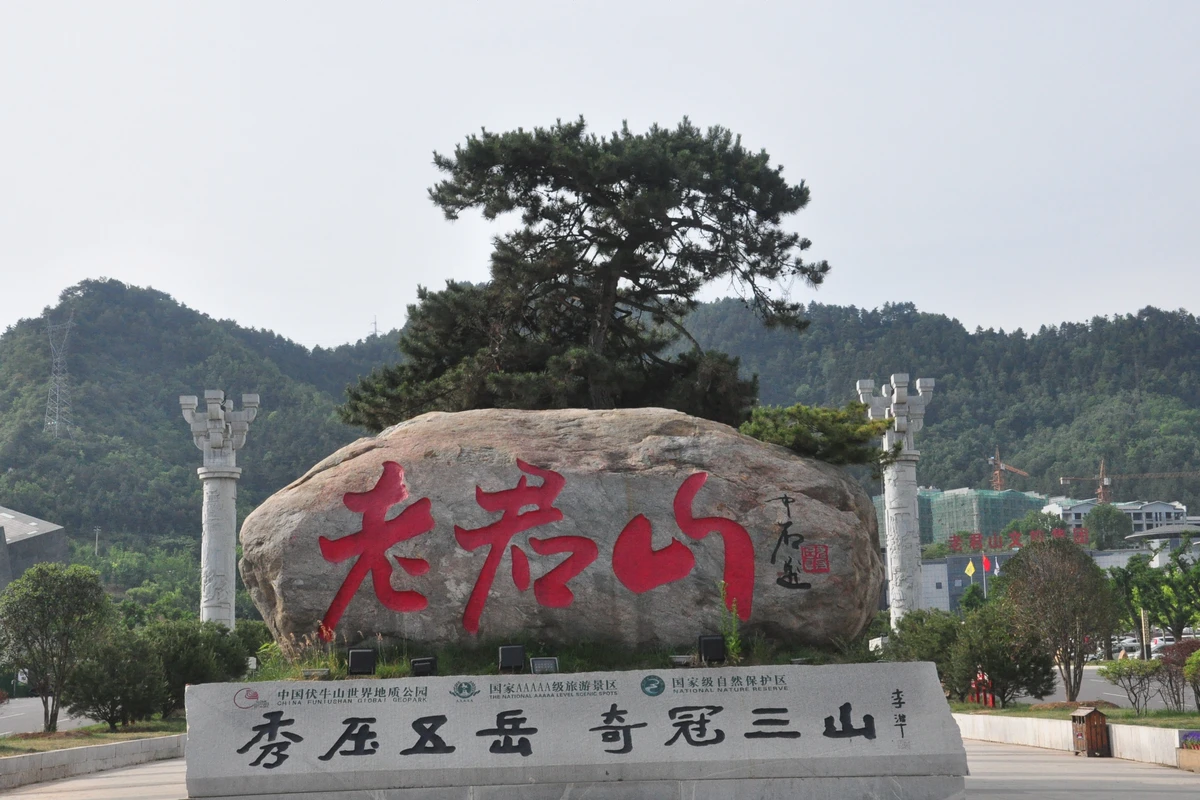
Laojun Mountain, originally named Jingshi Mountain, is a sacred site of the Quanzhen School, the mainstream of Taoism. It is located three kilometers southeast of Luanchuan County, Luoyang City, Henan Province. Laojun Mountain is the main peak of the 800-li Funiu Mountains, an extension of the Qinling Range, with an altitude of over 2,200 meters. Li Er (Laozi), honored as the Supreme Old Lord in Taoism, once cultivated here. Emperor Taizong of Tang renamed Jingshi Mountain to Laojun Mountain in his honor.
Since the Northern Wei Dynasty, Laojun Mountain has been a pilgrimage site for devotees from surrounding counties. The Taiqing Temple at the summit was also first built during the Northern Wei Dynasty. Laojun Mountain is a national AAAAA-level scenic area, a national nature reserve, a world geopark, and a national geopark. It is the main peak of the 800-li Funiu Mountains, an extension of the Qinling Range, with an altitude of 2,297 meters.
As one of the core scenic areas of the Funiu Mountain National Geopark, Laojun Mountain records the geological evolution of orogenic processes over 1.9 billion years. It features unique "detachment peak forest" landforms and spectacular stone forest scenic areas, which are deeply moving. The mountain is lush with trees and picturesque.
The peak forest scenery of the Ten-mile Painting Screen is like chiseled by knives and axes, jagged, draped in green and red, magnificent and colorful. The granite rock body of Laojun Mountain is different from other granites. It is composed of "porphyritic biotite monzonitic granite," a relatively young rock formed during the uplift and orogeny of the Qinling orogenic belt between 1.4 and 0.8 billion years ago. Chinese geologists have named it the "Laojun Mountain Rock Body." Among the peaks, every step offers a different view, each as beautiful as a painting, hence the name "Ten-mile Painting Screen."
The Taoist architectural complex at the Golden Summit of Laojun Mountain relies on the mountaintop terrain, including Laojun Temple, Daode Hall, Wumu Golden Hall, Liangbaotai, Yuhuang Summit, Bell and Drum Tower, Southern Heavenly Gate, Chaoyang Cave, Dadao Courtyard, Divine Path Sky Bridge, and Corridors, all built in the style of Ming and Qing imperial palaces. In particular, the three golden peaks—the Golden Hall, Liangbaotai, and Yuhuang Summit—are the highlights of the Laojun Mountain Taoist temple complex. The complex is still under construction and not yet completed.
Tickets for Laojun Mountain scenic area cost 100 yuan, with free admission for those over 60. The shuttle bus costs 30 yuan round trip, the first cable car 130 yuan round trip, and the second cable car 80 yuan round trip. Even without the ticket fee, the transportation costs alone exceed 200 yuan, making it a pricey trip, but definitely worth it.
When descending the mountain, we took the path via Sheshen Cliff, where there is a glass bridge with almost no one on it. We didn't go on it; many scenic spots are now building glass bridges and glass walkways, which have become too common and will soon be abandoned by tourists.
At 3:30 PM, we took the cable car down the mountain, having spent over six hours on the mountain. We took the shuttle back to the scenic area gate. Outside the gate, an electric cart for 5 yuan per person took us to the Bus No. 5 stop, saving us some walking. Bus No. 5 is a circular route, so we took a long way back to the bus station. We had dinner nearby, and the day's fatigue vanished. After dinner, we returned to the hotel to rest.


