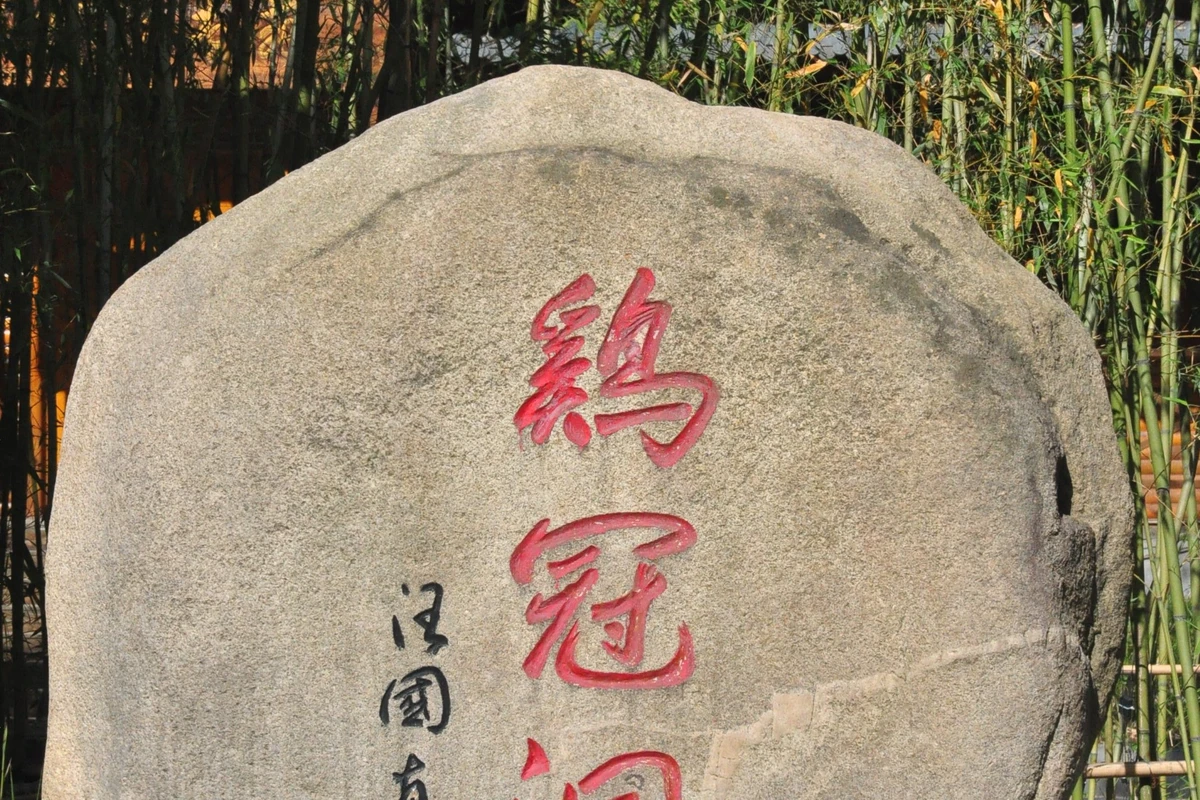
Travelogue of Henan: Luanchuan's Rooster Cave
At 7 a.m. on May 22, 2020, after having the hotel's buffet breakfast, I walked to the bus stop in front of the bus station and took the No. 6 bus to Rooster Cave. While waiting for the bus, a man asked where we were going. We said Rooster Cave, and he asked if we needed a car. I said there was a bus. Then I casually asked which stop the No. 6 bus stopped at, and he answered: San Guan Temple. After boarding, I checked and found it should be the next stop after San Guan Temple, Shuangtang, or it might even stop right at the gate of Rooster Cave. It seems not all Luanchuan locals are reliable.
I told the driver to drop us at Rooster Cave, and he would remind us when we arrived. Across the road was the main gate of the Rooster Cave Scenic Area. It was just before 8 a.m., and a tour group had already arrived and was lining up—a rare sight these days. We asked the ticket office whether we needed to exchange tickets, and they replied that we could just scan our ID cards directly.
Rooster Cave is now a 5A-level scenic spot, with an entrance fee of 80 yuan—quite expensive. Fortunately, we had free admission. There was an electric cart costing 10 yuan round trip, but don't take it; the walk is less than a kilometer.
Rooster Cave is located in Luanchuan County, Luoyang City, Henan Province, three kilometers west of the county seat, halfway up Mount Rooster—a branch of the Funiu Mountains in the remaining range of the Qinling Mountains—at an altitude of 1,021 meters.
Rooster Cave is a large limestone karst cave with a total length of 5,600 meters, a developed section of over 1,800 meters for viewing, and a viewing area of 23,000 square meters. Such caves are rare in the north, earning it the title "Number One Cave in the North."
On January 9, 2012, it was awarded the national 5A-level scenic spot designation by the China National Tourism Administration.
Rooster Cave was discovered during the Qianlong reign of the Qing Dynasty. The old "Luanchuan County Annals" record: "Rooster Cave has four halls, like a dragon or snake's lair," "bats as thick as fabric, dangers lurking everywhere," "a woodcutter, holding a knife and a stick, formed a group with candles and entered," "deep and mysterious, they were afraid and turned back." In August 1992, the county party committee and government decided to develop Rooster Cave. Led by the county cultural bureau and implemented by the county tourism development company, an investment of 1.8 million yuan was made to cut new entrance and exit passages, pave roads inside the cave, install colored lighting, and build pavilions and houses. Construction was completed on March 31, 1993, and it opened on April 10.
Rooster Cave has five layers from top to bottom, with a drop of 138 meters. The developed section is 1,800 meters long, with a viewing time of 50 minutes. Inside, there are eight major scenic areas, named: Jade Pillar Pool, Splendor Hall, Folded Curtain Palace, Cave Heavenly River, Immortal Gathering Palace, Jade Pool Palace, Hidden Beauty Pavilion, and Stone Forest Workshop.
I had heard about Luanchuan's Rooster Cave before, but having visited Zhijin Cave, Furong Cave, and other famous karst caves in China, I didn't think much of it. Now that Rooster Cave has been promoted to a 5A scenic spot, I decided to take a second look and pay a visit.
After actually seeing Rooster Cave, I felt it was just so-so. If some of the stalactites could barely pass as decent, then there were plenty of shortcomings.
First, the visiting time was limited. You had to wait to enter the cave, and if there weren't enough people, the wait could be half an hour. Then a staff member led the group; you couldn't linger. When the guide walked, you walked, and the lights turned off as you left. The total visit was less than an hour. For an 80-yuan ticket, it wasn't even as long as a movie. At Zhijin Cave, you could stay as long as you wanted, taking photos slowly.
Second, if the scenery was lacking, they made up for it with lights. Most of the path had little to see, so they decorated it with animal and flower lighting, which felt tacky and artificial, making things awkward.
Third, the stalactites in Rooster Cave were severely damaged. Perhaps the damage was already done before development. Many stalactites had lost their original form, with broken tips, which greatly affected the viewing experience.
Fourth, it truly couldn't compare with other famous caves in China, whether in quantity, quality, or management. The gap was not small. No wonder some visitors said this 5A rating was somewhat undeserved—there was some truth to that.
The mountain scenery outside the cave was not bad. Inside the scenic area, besides the cave, there were other amusement facilities, mostly for kids. Adults wouldn't be interested.
I had planned to spend the whole morning at Rooster Cave, but I had to finish quickly. Back at the hotel, I decided to catch the 12:40 bus to leave Luanchuan. Originally, I planned to take the last bus at 2:40 p.m., but I had to leave early.
I had lunch near the hotel, then went to the bus station to buy a ticket to Taiping Town in Xixia, 13 yuan per person. Taiping Town is closer to Luanchuan than Xixia. There is a place called Laojie Ridge, also a 5A scenic spot in Xixia County. I originally planned to go to Xixia county town first and then to Laojie Ridge, but I saw on the route that the bus to Xixia passed right through Taiping Town, only a third of the distance from Luanchuan. So I decided to stop at Taiping Town, saving both time and money. For independent travelers heading to Laojie Ridge, going from Luanchuan is more convenient.
We arrived in Taiping Town at 2 p.m. Taiping Town is still 6 kilometers away from Laojie Ridge. We couldn't enter the scenic spot that day—it was too late. Later, I learned that the cable car was also closed, so we couldn't go up the mountain anyway. We had considered whether to stay in the town or at the scenic area. Accommodation at the scenic area was relatively cheap but had limited conditions, and food was expensive. In the town, food was cheap, but there were fewer good hotels. Then I saw a newly opened hotel called Oukai Impression Hotel in the town, which was decent. A standard small room was usually about 110 yuan with breakfast, but that day was Friday, and the price shot up to 149 yuan—unbelievable. I called the hotel, and the front desk said we could come directly and get a better price. The bus stopped on the road next to the town government office; it seemed like a regular stop. We got off and walked to the hotel—not far. The female staff offered a minimum of 139 yuan, not much of a discount, but to save hassle, we took it. The room was actually quite nice, probably close to a four-star standard. But breakfast was so-so. When I later checked the hotel price while writing this travelogue, the weekend and weekday prices were the same: a small standard room was only 98 yuan—really a great deal, definitely good value. I recommend this hotel for any friends going there. As for getting from the town to the scenic area, the hotel said there was a bus, but taking a taxi should also be convenient.
After checking in, we rested well in the room. The next day we would climb the mountain. At 6 p.m., we went to the street, bought some side dishes and beer, had dinner in the room, watched TV, and went to bed early.


