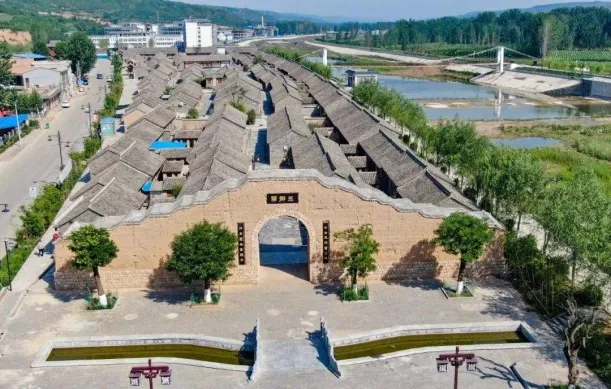
Less than 1.5 hours' drive from Luoyang, this small town unexpectedly harbors Han and Tang historical sites
In recent years, Sanxiang Town, located in the west of Yiyang County, Luoyang City, has become extremely popular locally due to the Sanxiang Han and Tang Cultural Scenic Area. Nearby residents and even tourists from afar have come in droves. In the evening, the place is bustling with visitors strolling through the Sanxiang Post Ancient Town Commercial Street, admiring the Wuhua Temple Pagoda, and visiting the Guangwu Temple, all in a lively atmosphere.
Sanxiang Town is situated in the alluvial valley of the Lianchang River, hence also known as Changgu. It is a thousand-year-old town with profound cultural heritage, long history, and outstanding beauty, earning the reputation that 'half of Yiyang's culture lies in Sanxiang.'
During the Tang Dynasty, Sanxiang was a necessary passage on the main road from the Eastern Capital to the Western Capital (present-day Luoyang and Xi'an). Under Emperor Gaozong of Tang, the 'Sanxiang Post' was established here, and the Lianchang Palace was built. Empress Wu Zetian and Emperor Xuanzong of Tang also stayed here multiple times. Among the eight ancient scenic spots of Yiyang County, 'Tang Palace Mist and Waters' and 'Han Temple Cloud Mountains' refer respectively to the Lianchang Palace of the Tang Dynasty and the Guangwu Emperor's Temple atop Han Mountain.
Sanxiang Town is a place blessed with outstanding people. The hometown of Li He, the 'Ghost of Poetry,' is in Sanxiang Town. He wrote immortal lines such as 'If Heaven had feelings, Heaven too would grow old,' 'The rooster's crow announces the dawn to all under heaven,' and 'Black clouds press down on the city, threatening to destroy it.' His masterpieces 'On the Way to Yanmen as Governor' and 'A Song of Li Ping's Harp' are even included in middle school textbooks. In addition, many other talented figures and celebrities, including Han Yu, Bai Juyi, Yuan Zhen, and Du Mu, once composed poems and essays here.
Based on the Sanxiang Han and Tang Cultural Scenic Area, Sanxiang Town aims to become the premier ancient town in western Luoyang. Many historical sites remain, and in recent years, new attractions such as the Li He Stele Pavilion and Li He Cultural Square have been built, forming a humanistic tourist area rooted in Han and Tang culture.
A local saying goes: 'Sanxiang has a pagoda, almost a zhang and seven or eight feet from the sky,' referring to the Wuhua Temple Pagoda.
The actual construction date of the Wuhua Temple Pagoda is unknown. According to the 'Yiyang County Annals,' it is described as 'Tang foundation, Song pagoda.' Some experts speculate that the pagoda was built in the Song Dynasty, using some Tang Dynasty building materials. It is the oldest and best-preserved brick pagoda in the Yellow River basin. Despite centuries of weathering, the pagoda leans slightly but remains standing, earning it the nickname 'Luoyang's Leaning Tower of Pisa.' It holds high academic research value in architecture, sculpture, and painting. In 2013, the Wuhua Temple Pagoda was selected as a seventh batch national key cultural relic protection unit.
[image: Wuhua Temple Pagoda before restoration]
[image: Wuhua Temple Pagoda after restoration]
Over a thousand years ago, Emperor Guangwu of Han, Liu Xiu, subdued the mighty Red Eyebrow Rebellion army at the foot of Han Mountain in Yiyang. After ascending the throne, he ordered the construction of this imperial temple—the Guangwu Temple—at the summit of Han Mountain to commemorate this significant event. For over a millennium, despite countless dynastic changes, the Guangwu Temple has remained firmly atop Han Mountain, witnessing the vicissitudes of the world.
The Sanxiang Post Ancient Town covers an area of about 57.6 mu (approximately 3.84 hectares). As a commercial service facility for the scenic area, it is rooted in post station culture. By holding the China Post City Cultural Exhibition and the Sanxiang Folk Culture Festival, it provides educational opportunities for tourists while protecting this intangible cultural heritage.
Modern Sanxiang Town has a simple and honest folk style and boasts many local specialties. Sanxiang's Jiudu garlic, known for its large cloves, thin skin, high yield, and easy storage, is famous not only in western Henan but also exported abroad year-round. Sanxiang's watermelons are renowned in western Henan for their thin rind and sweetness. Additionally, Sanxiang Town is a high-quality tobacco leaf production base in western Yiyang County, a high-quality Shalan poplar production base in Yiyang County, and a pollution-free jujube production base in Henan Province. The Han and Tang Cultural Scenic Area also specially provides local farmers with a platform for showcasing and selling specialty agricultural products.
[image: Local people selling agricultural products in the scenic area]
This Han and Tang ancient town is conveniently located, less than 1.5 hours' drive from Luoyang. Have you ever visited it?


