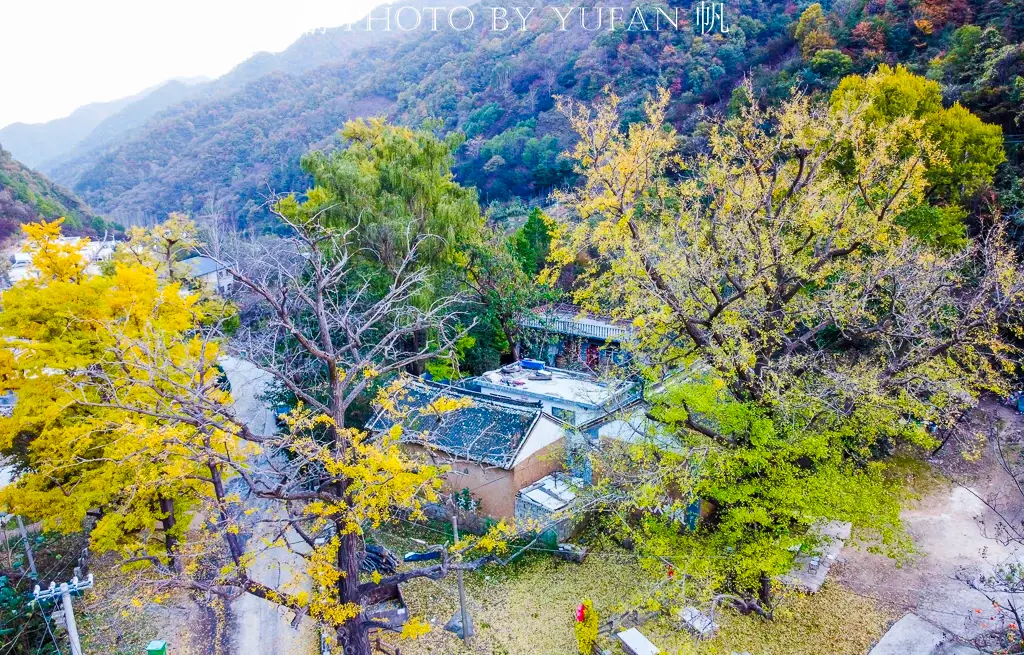
In the Mountains of Luoyang, Dozens of Millennia-Old Ginkgo Trees Surround the Ruins of an Ancient Temple, Creating a Fairy Tale Beauty Rivaling Tengchong
Luoyang, the famous ancient capital of thirteen dynasties in China, is one of the important birthplaces of Chinese civilization. Here, not only is the historical culture dazzling, but the natural scenery is also renowned both at home and abroad. The city has as many as 5 AAAAA-level tourist attractions, surpassing 99% of cities nationwide (ranking fourth after Chongqing, Beijing, and Suzhou, tied for fourth in the country). Xi'an, Shanghai, Guangzhou, Chengdu, Hangzhou, and other famous tourist cities cannot compare, and even many provinces have fewer. Longmen Grottoes, Baiyun Mountain, Laojun Mountain, Jiguan Cave, and Longtan Grand Canyon are all excellent.
Luoyang is a city that Yufan really likes. He has visited it twice. Apart from the long history, profound culture, and beautiful scenery, the local people are also very warm. When I mentioned that I was going to Luoyang, friends I knew promised to take me to play. Just after arriving in Luoyang, I posted a status on social media and soon received over 200 comments, all welcoming me and recommending places to visit. It was truly touching.
This time to Luoyang, the main itinerary was to experience the 'Cloud Top Autumn Tour of Baiyun Mountain' activity. We visited the famous Bailong Grand Canyon, Luhua Valley, Jiulong Glass Bridge, Baiyun Lake, and Forest Oxygen Bar. We also got up at 3 a.m. to climb Yuhuangding to photograph the sunrise, enjoying the layered forests dyed in colors and the colorful autumn scenery of Baiyun.
During our stay at Baiyun Mountain, we heard that there is an ancient temple site not far down the mountain, surrounded by numerous millennium-old ginkgo trees. So under the guidance of local friends, we visited this legendary temple—Wuma Temple. According to local friends, Wuma Temple was originally called Wuman Temple, and its name was changed to Wuma Temple in the 1960s and 1970s due to similar pronunciation. Wuman Temple was once a famous temple in the Funiu Mountain area, built in the Tang Dynasty, reaching its peak during the Jiajing and Wanli eras of the Ming Dynasty. It was destroyed by war at the end of the Ming Dynasty and somewhat restored in the Qing Dynasty, but its scale and influence had greatly diminished. The temple had a Qing Dynasty main hall, which was dismantled after being sold to a private individual in the 1980s. Now, the temple site is occupied by residential houses.
In Wuma Temple Village, there is an ancient pagoda, commonly known as the Wuman Temple Pagoda, also called the 'Shifang Haihui Putong Pagoda.' This pagoda is a hexagonal seven-story dense-eave solid brick pagoda. The first story has a pagoda plaque embedded with the words 'Shifang Haihui Putong Pagoda' and the year 'Jiajing Renzhen Year' (1542), but whether it was stolen or collected by someone, the plaque space is now empty. From the inscription, it is known that this is a 'Putong Pagoda' for collective burial of monks, built in 1542, nearly 500 years old. The pagoda is overgrown with weeds, with a few traces of later repairs in some places, but overall it appears very ancient, bearing the marks of time.
Around the ancient pagoda, there are many tall ancient ginkgo trees, some with protective plaques. The oldest tree has a history of over 2,300 years, making it a genuine millennium-old ginkgo forest. Its scale and history are not inferior to many famous ginkgo villages, such as those in Tengchong, Yunnan; Nanxiong, Guangdong; and Suizhou, Hubei. But the ginkgo forest at Wuma Temple is hidden away, unknown to many.
Although the ancient temple is no longer there, the many ancient ginkgo trees that grew alongside it have become the most beautiful scenery every autumn.
I wonder if you have noticed? Many ancient temples have ginkgo trees. Do you know why? Because ginkgo is called 'China's Bodhi tree' by many foreigners, and it is said to be a plant closely related to Buddhism, much like the Bodhi tree.
The word 'Bodhi' is a transliteration of the Sanskrit word 'Bodhi,' meaning awakening, wisdom, and is used to describe a person who suddenly awakens from a dream, sees the light, realizes the truth, and reaches a transcendent state. According to legend, the Buddha Sakyamuni achieved enlightenment under a large tree on Mount Gaya in the ancient Indian kingdom of Magadha, and this tree came to be known as the Bodhi tree. Later, every Buddhist temple was required to plant at least one Bodhi tree. In Buddhist countries of South Asia, especially in temples, Bodhi trees are widely planted, and Buddhist disciples regard them as the 'sacred tree of Buddhism.'
However, the Bodhi tree is an evergreen plant of tropical and subtropical regions, so it is difficult for it to naturally survive in northern China. Some temples in China do plant Bodhi trees. According to legend, in the first year of the Tianjian era of the Southern Liang Dynasty (502 AD), the monk Zhiyao brought saplings from India and planted them in Guangzhou's Guangxiao Temple. The Sixth Patriarch Huineng was ordained under this tree, reputedly the first Bodhi tree in China, and all other Bodhi trees in China were propagated from Guangxiao Temple.
Because Bodhi trees are not found everywhere, eminent monks of the Tang Dynasty replaced them with ginkgo trees, which are highly adaptable and turn golden in autumn, and widely planted them in Buddhist temples across China. Ginkgo is a rare and precious tree species preserved in China, one of the oldest plants in the world, known as a 'living fossil' among plants. It is also one of the longest-lived tree species, called the 'longevity tree.' Its tall and majestic form best complements the solemnity of temple halls. Meanwhile, ginkgo leaves, like Bodhi leaves, are clean and elegant, carrying a religious connotation of being undisturbed by worldly dust. In autumn, the golden leaves of ginkgo blend harmoniously with the color of monks' robes, creating a solemn and beautiful scene. This is why many famous Buddhist temples in China always plant ginkgo trees.
Under the ancient ginkgo trees at Wuma Temple, a large number of ginkgo nuts have fallen, swept aside like garbage by locals and piled up into heaps. Yufan estimates there are several tons, which seems quite wasteful. If properly collected and simply processed, they could be sold. Ginkgo nuts themselves are a famous medicinal herb, and those from millennium-old trees likely have even higher medicinal value.
It was already late by the time we arrived at Wuma Temple, so we missed the best viewing time. However, the autumn wind blew, and golden ginkgo leaves fluttered down like golden butterflies, covering the ground like a blanket around the trees—an expanse of golden splendor, incredibly beautiful and overwhelming.


