First Day in Luoyang
Day 1 (12th): Guanlin Temple, Luoyang Museum, China National Garden of Peonies, Exterior view of Yingtianmen, Sui-Tang National Heritage Park (Mingtang, Tiantang), Lijingmen, Old Street.
2. Transportation: Exit the hotel and turn right to catch bus 69, get off at Guanlin Hub Station.
Ticket: 40 yuan, free for those aged 60 and above. It seems that scenic spots in Henan are doing well in boosting domestic demand.
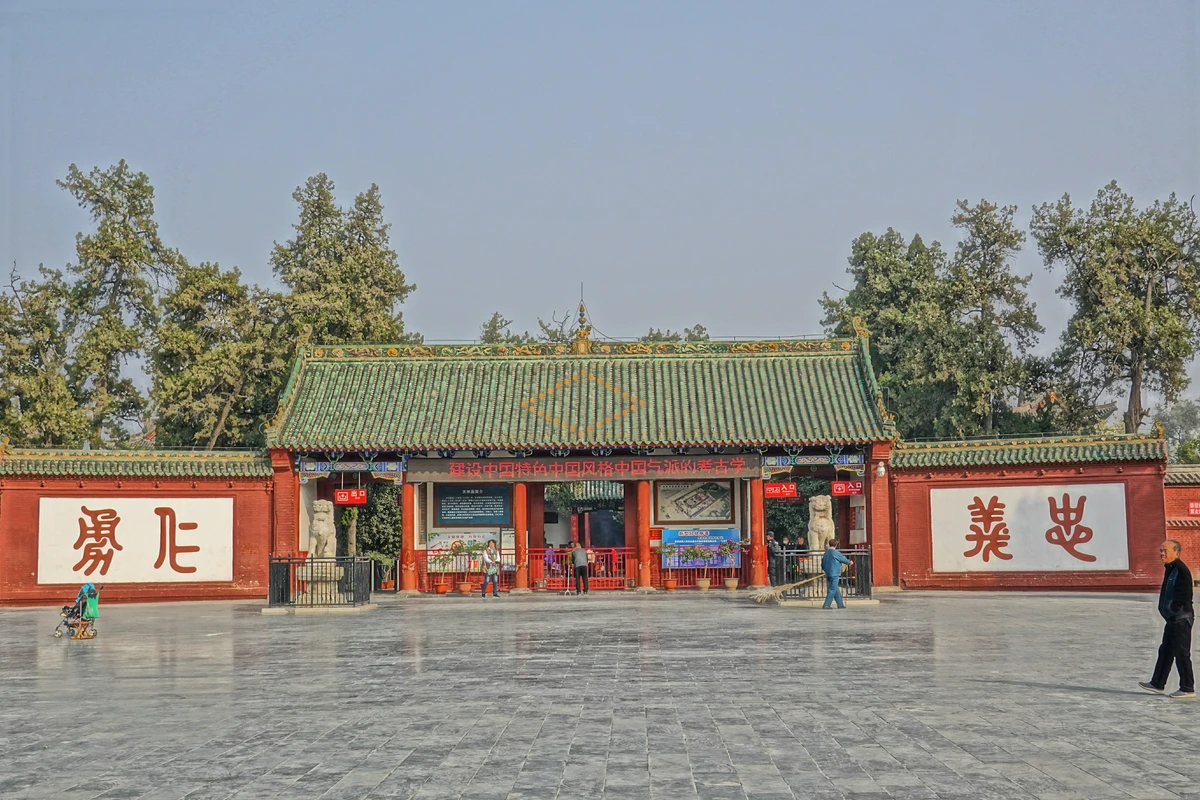
Guanlin is currently a key national cultural heritage site. In the winter of 219 AD, Guan Yu was killed by Sun Quan’s general, and his head was sent to Cao Cao in Wei. In the spring of 220 AD, Cao Cao buried Guan Yu's head here with the rites of a prince and built a temple for worship. Later, according to Confucian rites, it was called Guanlin, covering an area of over 200 mu. It showcases China's only temple and forest combined worship site with a 1700-year history of ancient classical architecture. Currently, it has 180 buildings, with typical temple architectural style. At the gate, the four characters 'Zhong Yi Ren Yong' (Loyalty, Righteousness, Benevolence, Courage) stand out. Notably, the green glazed tiles signify that in the feudal hierarchy, Guan Yu had been elevated to the status of a saint. Regarding tomb names, the hierarchy is: common people's tombs are called 'fen', princes' tombs are called 'zhong', emperors' tombs are called 'ling', and saints' tombs are called 'lin'. Besides Guanlin and Konglin (Confucius' forest), there are also Menglin (Mencius' tomb), Jielin (Jie Zitui's tomb), Yuanlin (Yuan Shikai's tomb), and Marshal Lin (Zhang Zuolin's tomb). Guanlin currently has over 50 murals, which are very beautiful and impressive, and the stone carvings are also distinctive. Overall, this Guandi Temple has more content and the buildings are older.
The current Qisheng Hall, Five Tigers Hall, Wealth God Hall, Bell Tower, and Drum Tower (all built between 1592-1594, the 20th to 22nd years of Wanli reign of Ming Dynasty), and Chunqiu Tower built in 1817 (the 22nd year of Jiaqing reign of Qing Dynasty). The ancient pines and cypresses are everywhere, lush and green, adding a sense of solemnity to Guanlin.
'Xinsu' (folk belief) is now a national intangible cultural heritage. In 2007, Guan Gong belief was included in the national intangible cultural heritage list.
Seeing the slogan 'Thousand-Year Guan Temple, Blessing Holy Land', this official Guan Yu memorial site is a national 5A scenic spot. Unexpectedly, staff were seen purchasing joss paper and then reselling it to tourists, causing ash to fly everywhere. Staff in front of the main halls openly solicited donations for incense, promoting superstition, which disgrace a national 5A scenic spot.
According to the travel agency we checked in advance, we booked a trip to Laojun Mountain for tomorrow, and also inquired about the trip to Longtan Grand Canyon on the 14th. Seniors over 60 get the ticket price deducted from the tour fee.
Transportation: From Guanlin, take bus 15 to Niewan Station, then walk from the back of the museum to the front (a bit of a wrong choice; although it seemed direct, the walk was too long. Better to return to the hotel and take bus 77 from the intersection of Kaixi West Road and Renmin Road, 5 stops to the museum entrance.) During the ride, I learned that all scenic spots in Shanxi are free, while Henan waives tickets for those over 60. This seems to be a unified government policy.
Luoyang Museum is a national first-class museum, a relatively new beige modern building. On the east side of the square in front, there is a Huaxia totem sightseeing tower, 55 meters high, with four golden dragons holding a 3.9-meter-diameter sphere on top, called 'Golden Dragon Holding Pearl'. I don't know its meaning. It is said to have an elevator to a 45-meter-high observation area offering a panoramic view of Sui-Tang City Ruins Botanical Garden and the new district. Probably due to COVID-19, it was not open.
The museum has limited exhibits. It showcases that Luoyang, the ancient capital of thirteen dynasties, peaked during Wu Zetian's reign. The national treasure Tang Sancai (three-color glazed pottery) played a crucial role in the development of Liao Sancai, Song Sancai, and Jin Sancai. Stone carvings like the Han dynasty stone Bixie (a mythical beast) and Tang Sancai tomb guardians show the aesthetic views of ancestors. The White Jade Cup of the Three Kingdoms and various Sancai pottery artifacts tell of our ancestors' superb skills beyond imagination. Particularly, during the Sui and Tang dynasties, Luoyang was the center of China's world, and the herringbone-shaped Grand Canal depicted the magnificent scene of its heyday. Especially, Zheng Wenhan, former Deputy Secretary-General of the Central Military Commission and Director of the General Office, President of the Academy of Military Sciences, promoted to Lieutenant General in 1988, donated 44 calligraphy works, greatly enriching the museum.
3. China National Garden of Peonies
Transportation: Rented a shared bike at the museum bus stop and rode, passing by the China National Garden of Peonies, also a predetermined scenic spot. Got off and entered; no ticket needed.
A large archway of peonies stands at the entrance, with the words 'China National Garden of Peonies' clearly visible. Inside, there were few visitors. Down the steps, some citizens were exercising in the distance. On higher ground, the peony trees had long since withered, leaves almost gone. Various peony trees of different heights were separated by trees like willows and dragon-claw locusts into different gardens built according to the terrain. Even with a camera, I couldn't see the end, showing the vast scale. In the off-season, it's basically a place for locals to stroll and relax.
Before coming, online introductions mentioned peony gardens, and we were confused about whether there were one or two. In Luoyang, we learned that peonies have developed rapidly, and there are multiple peony gardens. Passing by in the morning, we saw the main gate of the China National Garden of Peonies. Now we saw another gate on a different road, showing how large this garden is. If you come during the April peony festival, a tour inside takes at least half a day. Though not in bloom, you can imagine the spectacular sight when in full bloom.
4. Distant View of Yingtianmen
Transportation: Continued riding along the road to the Kaixi Road-Jiefang Road bus stop, then took bus 8 to Yingtianmen Station.
Saw Yingtianmen and thought it was part of the same scenic area as Mingtang. In daylight, it didn't show its colorful brilliance under lights, so we just viewed it from afar and went directly to Mingtang and Tiantang. Later, the night view was beautiful.
5. Mingtang and Tiantang
Ticket: 60 yuan, free for seniors over 60.
Mingtang and Tiantang are part of the Sui-Tang Luoyang City National Heritage Park, located at the intersection of Zhongzhou Road and Dingding Road. This was the core area of the imperial city of Luoyang during the Sui, Tang, and Northern Song dynasties. The sites of Tang Mingtang and Tiantang, as well as Song Taiji Hall, are here. You can see archaeological remains of Tang architecture. Later, looking at a sand table, we understood that the Sui-Tang City Heritage Park covers a large area, from Dingdingmen in the south (in front of the China National Garden of Peonies) to Mingtang and Tiantang in the north, and from Jiuzhou Pool in the west to Lijingmen in the east. However, the currently developed scenic spots are built on the original sites. The Heritage Park is a broad concept; do not navigate to 'Sui-Tang Heritage Park' directly.
Mingtang was an important ritual building for ancient emperors. The present structure is a modern reconstruction on the Tang site, with an octagonal pyramidal roof, square outside and round inside, two stories, 33.52 meters high. The interior decoration can be described as resplendent and magnificent, recreating the unique cultural atmosphere and artistic spirit of Wu Zetian's era. During our visit, we caught a performance: with court music, young actors holding various musical instruments and weapons, either in a runway show or martial arts performance, displaying the flourishing talents and elegant demeanor of the Sui-Tang golden age under Wu Zetian.
Inside Mingtang, the main narrative focuses on Wu Zetian, introducing various influential events during her reign. In 657 AD, Emperor Gaozong Li Zhi moved the capital to Luoyang, called the Eastern Capital. Li Zhi reigned for 34 years, while Wu Zetian held power for 27 years. In 690 AD, Wu Zetian proclaimed herself emperor in Luoyang, establishing the Great Zhou dynasty, the first female emperor in Chinese history. In 705 AD, before her death, she returned power to the Li family, abdicating to her son, Emperor Zhongzong Li Xian. She reigned for 53 years. Economically, she proposed 'Twelve Suggestions' advocating lower taxes, cessation of war, and reduced labor. The Tang economy grew rapidly; the total number of households increased from 3.8 million to 6.18 million. With favorable weather and abundant harvests, the country truly prospered, and Luoyang became an international metropolis.
On the lowest floor of Mingtang and Tiantang, you can see Tang dynasty rammed earth and stone bases. You can climb the stairs to the towers to see interior and exterior views. On each floor, there are introductions to the Mingtang system of the Tang dynasty and of various dynasties. As a venue for political discussion, Mingtang was a governing system instituted by feudal emperors, similar to the modern People's Congress system. From a ritual perspective, it was also a place for ancestor worship.
During Wu Zetian's reign, symbolized by Mingtang, it reached its peak. Wu Zetian appointed people on merit, dared to employ those from humble backgrounds, pioneered the palace examination to select talent, and also originated the military examination to select martial arts champions. From the introduction of Wu Zetian's talent selection, it seemed quite detailed, and the evaluation of her reign was relatively fair. Various periods gave high praise to Tang dynasty's personnel system. Mao Zedong commented: 'Wu Zetian was truly a capable ruler. She had tolerance, insight in recognizing talent, and skill in using people. She promoted many people and also killed many. Some she promoted and then killed soon after.'
Wu Zetian liked creating characters. According to experts, she created 20 characters: 'Heaven, Earth, Sun, Moon, Star, Zai, Chu, Shou, Zheng, Sheng, Guo, Chen, Zheng, Nian, Yue, Wan, Shi, Zhao, Ren, Sheng.' Here, detailed display and explanation were given. However, over a thousand years, the so-called Confucian masters did not recognize her characters, so they were not included in the standard common Chinese character system. Personally, I think some of her characters are quite meaningful.
We toured for 3 hours and just caught the evening lights. Under the lights, the ancient buildings looked especially charming, and photos turned out beautiful. It is recommended to visit in the late afternoon.
6. Lijingmen and Old Street
Lijingmen Scenic Area is about 1 km from Mingtang, a 20-minute walk east. The ticket office at Lijingmen states free admission for 65 and above, not the 60+ policy. Inside Lijingmen is a barbican, all commercial shops, which detracts from the ancient architecture. Luoyang was hazy all day; at night, from the city wall you couldn't see clearly, so we didn't pay to go up.
From Lijingmen, walk forward to the Old Street. Just as the lights came on, we enjoyed the night scenery and sampled local food. The hotel staff recommended 'Guanji Water Feast Old Restaurant', but the queue extended to the door, so we gave up. At other shops on the Old Street, we ordered Bufan Soup and wontons.
On the way back, we walked to the bus stop and took the bus to Wangcheng Square. Ate braised tofu and rice, then returned to the hotel (12th).
Checked online: The newly revised 'Henan Provincial Tourism Regulations' clearly state that from April 1, 2020, scenic spots built on public resources should waive tickets for seniors aged 60 and above. This is great for us and for seniors nationwide, saving a lot of expenses!


