Henan's Underestimated Ancient Capital: Peonies in Bloom, Perfect for May Day Travel, Some Scenic Spots Free
In China's five-thousand-year history, half of it is tied to Luoyang. From the Xia, Shang, and Zhou dynasties to the end of Tang, it served as the capital for thirteen dynasties, enjoying boundless glory. Emperor Gaozu of Han, Liu Bang, once said, 'I have traveled the world far and wide, but only Luoyang have I seen thus.' Sima Guang of the Northern Song praised, 'If you ask about the rise and fall of dynasties, look no further than the city of Luoyang.' Throughout the ages, countless literati and poets have held a special affection for Luoyang.
Today, the Longmen Grottoes, White Horse Temple, Luoyi Ancient City, Hall of Radiance, and Celestial Hall—these well-known historical sites are scattered throughout Luoyang, many of which are UNESCO World Heritage Sites and national 5A-level scenic spots, all serving as the city's resounding calling cards. With its distinct four seasons and pleasant climate, Luoyang inspires boundless yearning.
Among Luoyang's many cultural treasures, the peony stands alone. Originating in the Eastern Jin, developed in the Sui dynasty, its cultivation history spans over 1,600 years. Over the millennia, Luoyang and the peony have forged an inseparable bond. In Luoyang's spring scenery, peonies dominate the landscape with their triumphant beauty, as the saying goes, 'Only the peony is the true national beauty; when it blooms, it stirs the capital.'
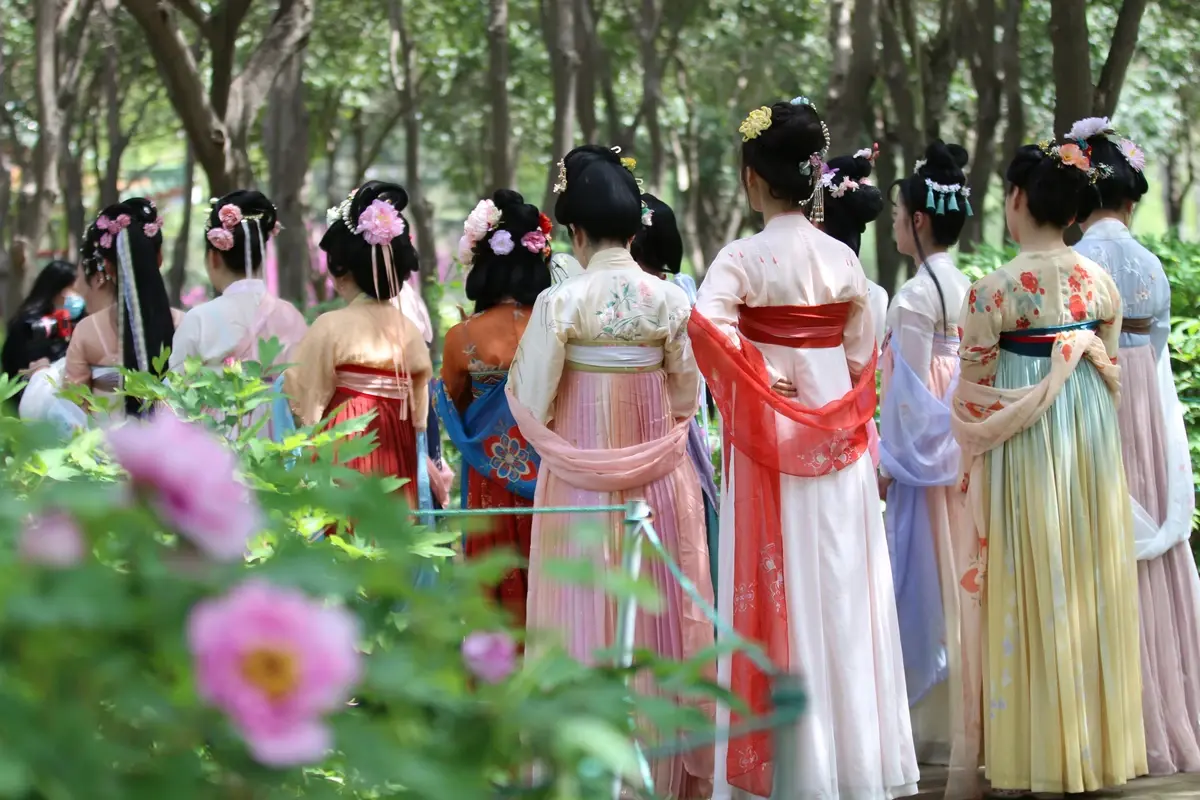
This April, the China Luoyang Peony Culture Festival is being held as scheduled, continuing until May 10th. Multiple varieties of peonies bloom in succession on the streets, gardens, and parks of Luoyang. Standing amidst them, one might suddenly feel as if they have stepped into the spring of the Sui dynasty. Today, I recommend four flower-viewing spots I have visited before, to give you a foretaste of the splendid beauty of peonies set against ancient architecture.
In Luoyang, there are many places to admire peonies, but it seems only the peonies at the White Horse Temple have bloomed continuously since the Eastern Han. If you seek an unconventional flower-viewing experience, the White Horse Temple offers unexpected surprises.
At the White Horse Temple, ancient trees shade the sky, and after spring rain, the peonies look like brocade. The peonies here are not as varied in variety as at other famous viewing spots. The temple monks do not treat them as spring exhibits but cultivate them as spiritual beings before the Buddha. In this incense-filled temple, the colorful peonies appear quite elegant, blending national beauty with Zen lotus heart.
As the first ancient temple in China, the White Horse Temple has stood guard in the ancient city of Luoyang for nearly two thousand years. The white horse stone statue at its entrance has been smoothed by the touch of countless visitors. The red walls and green tiles have weathered through dynastic changes, and most of the ancient structures within the temple have undergone varying degrees of renovation.
Though it no longer retains its original appearance, fortunately, the peonies remain, ever showcasing its lingering charm. With the thousand-year-old chanting of Buddhist scriptures in our ears and the delicate peonies before our eyes, there is an indelible sense of remoteness and vicissitude.
The Shenzhou Peony Garden is located opposite the White Horse Temple. It can be described as an encyclopedia of peonies, featuring splendid fine peonies, rare peony stones formed over hundreds of millions of years, and the world's longest hundred-meter national essence corridor—the Tang Sancai peony screen wall. Strolling through the garden, one feels the long history of peony culture.
My favorites are the 'Bean Green' peony and the 'Blue' peony, which go against the norm. The Bean Green peony is the most typical representative of the green variety, a mid-blooming type with a relatively long flowering period. When in full bloom, it appears blue-green, gradually fading from the inside out, with a unique charm and an elegant beauty. The 'Blue' peony, also called Lan Yu, actually has a blue tint within its pink, giving a wonderful sensation.
Gazing intently at the Tang Sancai peony screen wall, I can't help but let my imagination run wild. It seems as if the peonies under the sunlight come to life, startling travelers who have come from afar, echoing the saying 'Only the real flower in the world is the peony.' For a moment, it's hard to tell what is real and what is illusion.
Wangcheng Park, built in 1955, is named so because it was constructed on the site of the Eastern Zhou royal city. It consists of several parts: peony flower bed area, ancient culture area, and zoo. It is one of the main venues for the Peony Festival and the birthplace of the first Peony Festival.
Wangcheng Park is home to nearly 500 varieties of fine peonies from home and abroad. They are diverse in type and complete in color, especially those with two colors combined in one flower. Some have two colors on one plant, some have two colors on one flower, all are traditional treasures of Luoyang peonies. Additionally, many black peonies can be found in the viewing area, such as 'Black Sea Sprinkled Gold' and 'Pearl Gloss Black Ink,' which dazzle the eyes.
In addition to enjoying peonies at Wangcheng Park, the zoo in the northern part of the park is another highlight. It houses rare animals such as giant pandas, South China tigers, red-crowned cranes, etc. It is suitable for the whole family or for visiting with children, offering a different kind of rustic fun.
The Sui and Tang Dynasty City Site Botanical Garden is one of the most historically significant places in Luoyang. Beneath the park lies the most intact Eastern Li Fang site of the Tang dynasty in the world. When spring arrives, the Thousand-Pose Peony Garden within the park boasts the most varieties of peonies nationwide, forming a picturesque scene with green pine trees, tall metasequoias, and turquoise lake water.
The Thousand-Pose Peony Garden is divided into four sections: the Nine-Color Garden, the Hundred-Flower Garden, the Special Features Garden, and the Science Garden. The Hundred-Flower Garden includes peony cultivation areas for Central Plains, Jiangnan, Southwest, Northwest, and foreign peonies. The Nine-Color Garden is an octagonal terrace with nine levels, each level representing a different color system, totaling nine colors. When the nine-color peonies all bloom together, the scene is magnificent, with large flowers and rich fragrance.
Near the north gate of the Sui and Tang Dynasty City Site Botanical Garden, there is a ginkgo avenue lined with two rows of straight ginkgo trees. Although it lacks the brilliant colors of autumn, spring has a flavor of its own. The small ginkgo leaves have just emerged, like little green palms waving in the air. Sunlight filters through them, sprinkling golden specks, creating a hazy sense of new life. Strolling here at this time feels like being in a painting.
During the China Luoyang Peony Culture Festival, Luoyang offers various travel discounts: some parks are free, parking at some scenic spots is free, discounts for certain groups, etc. For details, please visit the relevant websites.


