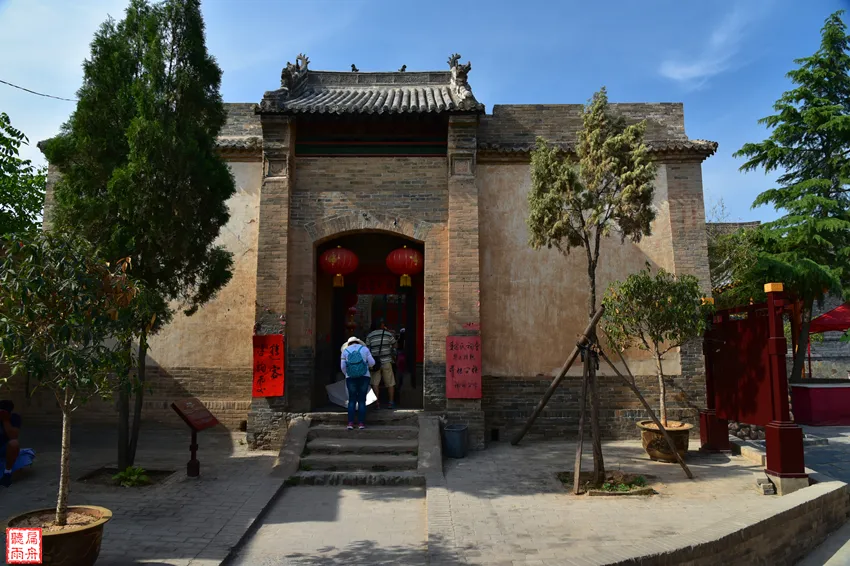
An Ancient Village in Luoyang That Attracted More Tourists than White Horse Temple During Spring Festival
During the 2017 Spring Festival, an ancient village in Luoyang became incredibly popular, to the point that even the world-famous White Horse Temple felt inferior, as the number of tourists here was overwhelming. For a time, the village's name became hotter than that of White Horse Temple. This small village is Weipo Village (also called Weijiapo) in Chaoyang Town, Mengjin County, 15 kilometers north of Luoyang city center.
Weipo Village, also known as Weijiapo, was once the garden of Chancellor Wei Renpu during the Song Dynasty. It was called "Wei's Pond Pavilion," where the Wei family cultivated one of the four most famous varieties of Luoyang peonies—the "Queen of Flowers," Wei Purple.
During the Shunzhi period of the Qing Dynasty, Wei Tianlu, the ancestor of the Wei family, moved here. During the Qianlong period, members of the Wei clan served as officials at court and began building the Wei family compound. After nearly a century of construction, it formed a relatively complete feudal official family estate encompassing an ancestral hall, private school, embroidery tower, and north-south old houses. The existing Qing Dynasty residential buildings consist of 16 houses, distributed north and south along a 180-meter-long bluestone-paved road, with a total floor area of over 5,000 square meters, 248 rooms, 16 courtyards, and 26 cave dwellings.
On the north side of the old street, there are nine uniformly three-courtyard quadrangles. Uniquely, the last row of these three-courtyard quadrangles in Weipo are all cave dwellings built against the mountain. Between each quadrangle, long passageways connect the nine courtyards horizontally, reflecting the unity and dignity of a large family. The layout of the main hall, moon terrace, passage hall, side buildings, upper rooms, and back courtyard is meticulously orderly. Roof tiles, doorsteps, and screen walls are all crafted with exquisite beauty, showcasing the taste and ostentation of a wealthy family.
On the south side of the old street, most quadrangles have five courtyards, awaiting development and renovation. Their gates are locked and not yet open to visitors.
Another major difference between Weipo Village and other ancient villages is the prevalence of the "skywell cave courtyard" common in western Henan. The skywells are spacious and bright, and the cave dwellings are warm in winter and cool in summer. Also known as "sunken courtyards" in some places, the deep and dry loess soil of the Mang Mountain in northern Luoyang provides excellent natural conditions for digging skywells and cave dwellings from the ground downward.
Currently, a new comprehensive plan is being implemented in Weipo Village: "a top-tier traditional village in China, with ancient residential visits as the theme, folk cultural relics display and exchange as a supplement, creation, exhibition, and auction of works by famous calligraphers and painters as a highlight, folk customs demonstrations as a style, and commercial shopping as content, integrating tourism, leisure, vacation, shopping, and tasting of local delicacies." This project has been orderly underway.
The already-started "Chinese Traditional Village and Beautiful Countryside" cultural tourism project in Weipo Village covers an area of 1,300 mu (about 86.7 hectares) with a total investment of approximately 1.5 billion yuan. It includes cultural tourism development themed around the Wei Purple Garden, commercial development of a historical village built in imitation of Ming and Qing styles, special resettlement courtyards for villagers, and elements from various historical periods. Integrating culture, tourism, leisure, and wellness, it has become a new cultural tourism business card for Luoyang.
How to get to Weipo Village: Exit the Lianhuo Expressway at the Luoyang station, go north along Xiaolangdi Avenue for 1,000 meters, then follow the signpost and go west for 500 meters. Starting from Luoyang city center, go north along Wangcheng Avenue for 15 kilometers to the Lianhuo Expressway, then connect to Xiaolangdi Avenue and follow the route above.


