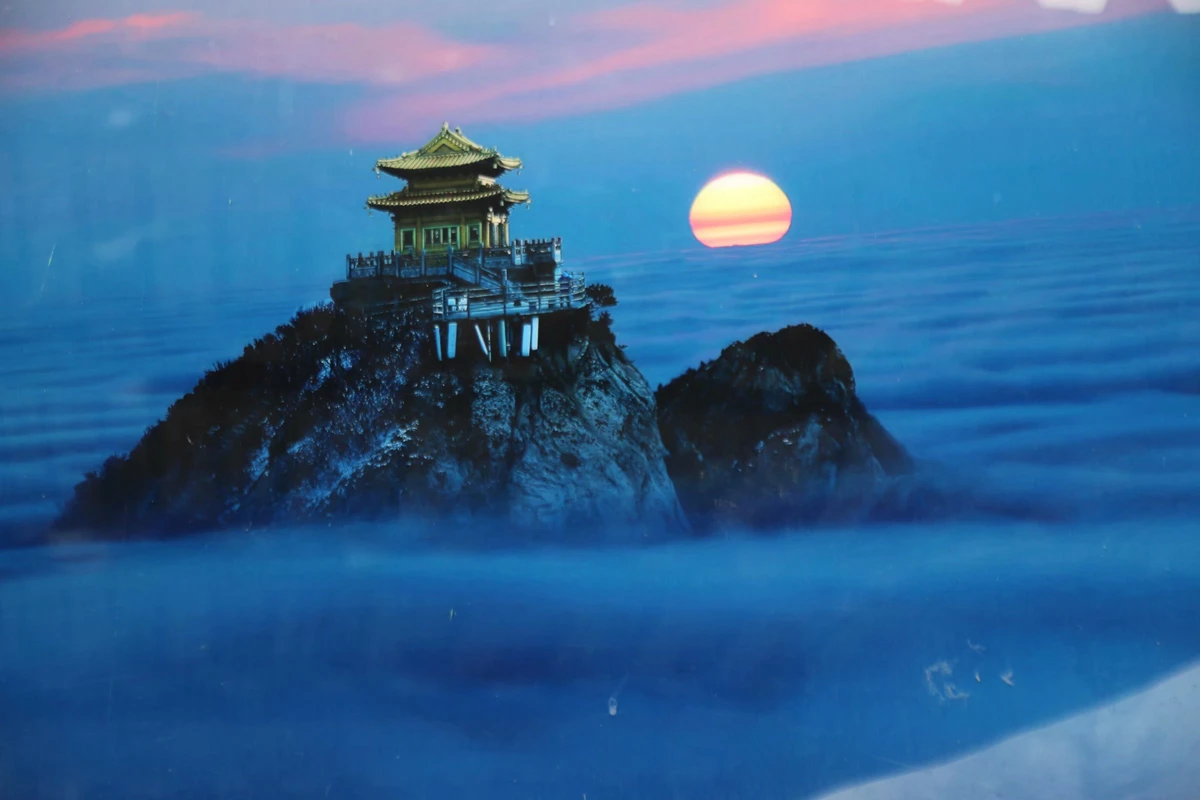
Cloudy Laojun Mountain
Li Er, also known as Laozi, was a great ancient Chinese philosopher and thinker, the founder of Taoism, venerated as the Supreme Patriarch (Taishang Laojun) by Taoism. He was born in Qurenli, Lixiang, Ku County, Chu State (now Taiqinggong Town, Luyi County, Henan), lived between 571 BC and 471 BC, contemporary with Confucius but slightly older. Legend has it that Laozi rode a green ox to Hangu Pass, wrote the Tao Te Ching, then retired with his ox to Jingroom Mountain (Jingshi Shan), where he cultivated himself, refined elixirs, and ascended to immortality. Tang Dynasty emperors recognized Laozi as the ancestor of the Li surname; Emperor Taizong renamed Jingroom Mountain to "Laojun Mountain." In the 19th year of the Wanli reign of the Ming Dynasty (1591 AD), Laojun Mountain was granted the title "Famous Mountain Under Heaven."
Laojun Mountain is located on the outskirts of Luanchuan County, Luoyang City. It is a national 5A-level scenic area, the main peak of the 800-li Funiu Mountains (part of the Qinling Range), with an altitude of 2,200 meters. On March 6, the weather was overcast and rainy. We departed from Zhengzhou at 7:30 AM, drove for over three hours (less than 300 km), and arrived before 11 AM, when mist and clouds shrouded the area, visibility was very low. Though we didn't hesitate and entered the scenic area directly, the freezing cold made us doubtful.
The core attractions of Laojun Mountain are the "Fairy Peak Forest" and the "Ten-Mile Painted Screen." From Zhaigou to the Fairy Peak Forest, two cable cars have been built: the Yunjing Cable Car and the Fenglin Cable Car. The tour only included a ticket for the Yunjing Cable Car. Most visitors take the first cable car to Zhongtianmen, then hike to the Fairy Peak Forest and Ten-Mile Painted Screen. Many young people take both cable cars consecutively to directly explore the Fairy Peak Forest and Ten-Mile Painted Screen. Some hike the entire route. Due to the harsh weather, the visit turned into a mere check-in, losing the meaning of hiking, so we decided on the spur of the moment to take both cable cars and go straight to the core area.
The Yunjing Cable Car starts from Zhaigou and ends at Zhongtianmen, with a total length of 3,327 meters and a height difference of 957 meters. By noon, the clouds and mist had not cleared but grown thicker. The cable car seemed to travel through a veil of smoke; almost nothing was visible except for what was directly ahead and behind. Upon arriving at Zhongtianmen, the biting cold wind made everyone shiver. Laozi, draped in a yellow cassock, rode a green ox adorned with yellow and red ribbons, standing amidst the clouds. This stone carving vividly recreates the scene of Laozi carrying bamboo slips, with a kind and wise expression, riding his green ox into tranquil retirement.
The Fenglin Cable Car starts from Zhongtianmen and ends at the Fairy Peak Forest, with a total length of 1,070 meters and a height difference of 209 meters. After changing to the Fenglin Cable Car at Zhongtianmen, we reached the mountaintop in just a few minutes. As the altitude increased, the clouds thickened and thinned in turns, revealing the majestic, strange, perilous, and beautiful features of Laojun Mountain intermittently.
Stepping out of the Fenglin Cable Car, we followed the crowd along the 1,380-meter-long Yunjing Heavenly Path. This is a scenic area that combines strange peaks, bizarre rocks, a sea of clouds, and deep valleys—the most quintessential and thrilling part. Leaning on the railing and looking into the distance, the clouds and mist filling the sky and earth resembled a huge freehand painting, cascading from the horizon, framing the rolling, mist-veiled mountains in the distance. Looking down, we saw sheer cliffs and winding plank roads, like ribbons clinging to the precipitous walls. The roadside trees, each with icy branches and snowy bark, resembled stretched and curved glass filaments, crystal clear; some looked like clusters of coral in shallow reefs, oddly shaped; others were like Xi Shi washing silk, draped over shoulders, each tree like an exquisite pagoda.
Scattered along the Yunjing Heavenly Path, various sights complemented each other. Before we knew it, we arrived at the Fairy Peak Forest and the Ten-Mile Painted Screen. The peaks of Laojun Mountain are as if cleaved by axes and knives, with myriad postures, all competing in beauty, forming a picturesque scene. Within an area of nearly a thousand mu, there are over three thousand stone peaks of various sizes. The unique granite geological structure creates a spectacular landscape of peaks that "appear as a forest from afar, and as individual peaks up close." Amidst the clouds, strange peaks and ancient pines appear and disappear, like islands of the immortals at sea, called "a miniature fairyland, an enlarged bonsai." Among these bizarre peaks and rocks, the most famous is the Laojun Enlightenment Peak, where a century-old pine still grows in the crevice of a natural stone wall.
A Thread of Sky is a common stone feature in famous mountains, named because the blue sky seen from the gap looks like a single thread. Laojun Mountain's Thread of Sky is related to mountain sliding. It is a small linear gorge formed by long-term erosion along vertical granite joints, under the action of gravity, with rocks falling and collapsing, consistent with the joint direction. It is about 25 meters long, as narrow as less than half a meter, and at most less than 2 meters wide, allowing only one person to pass. Looking up from below, suspended rocks seem to be falling, and the sky appears as a single line.
The Thousand-Year Maple King is a maple tree over a thousand years old. Growing among the peaks, it has absorbed spiritual energy for centuries, becoming the largest maple tree in Laojun Mountain, enjoying the reputation of the Maple King. In spring and summer, its shade is like an umbrella; in autumn frost, its leaves are as red as fire—one of the representative red-leaf sights of the Ten-Mile Painted Screen.
The Qinling Mountains, stretching from Baishishan in Gansu in the west to the Funiu Mountains in Henan in the east, are 1,600 kilometers long, an important east-west mountain range in China. Together with the Kunlun Mountains and the Dabie Mountains, they form the central mountain system running across central mainland China. Among them, the Qinling-Funiu-Dabie Mountains form an important north-south dividing line in China's geology, geography, ecology, climate, and culture. Laojun Mountain, located on the main ridge of the Funiu Mountains, serves as the geographic boundary between the northern subtropical climate and the warm temperate climate. River systems here separate north and south: on the southern slope, waters in Xixia County flow into the Dan River (a tributary of the Yangtze) via the Laoguan River; on the northern slope, waters in Luanchuan County flow into the Yellow River via the Yi River.
Mazongling (Horse Mane Ridge) is 2,217 meters above sea level, shaped like a horse galloping eastward. Its back is covered with Taibai azaleas, resembling horse mane in the distance. This spot offers excellent views and is considered the best observation point of the 800-li Funiu Mountains, known as "Distant View from Mazongling." The heavens did not disappoint; when we arrived at Mazongling after a strenuous journey, the sun gave us a two-quarter-hour smile. Standing on the cliff top, we could admire the layered green peaks in the south and the full view of the mountain town in the north. No wonder writer Li Zhun praised: "Its beauty surpasses the Five Sacred Mountains, its strangeness outdoes the Three Famous Mountains." However, the clouds and mist were not cloud waterfalls; sunrise, sea of clouds, and divine light remained only in our imagination.
The most popular area of Laojun Mountain is the Golden Summit Taoist Complex built on the mountaintop. It mainly includes the Laojun Temple, the Morality Palace, the Five Mothers Golden Hall, the Liangbao Terrace, the Yuhuang Summit, the Bell and Drum Towers, the South Heavenly Gate, the Zhaoyang Cave, the Great Dao Courtyard, the Divine Path Bridge, and the Cloisters. All adopt Ming and Qing imperial palace architecture, especially the three golden roofs: the Golden Hall, the Liangbao Terrace, and the Yuhuang Summit, which are the highlights of the Laojun Taoist complex. Regrettably, the sun played hide-and-seek again, wrapping the Golden Summit Taoist Complex tightly in clouds. Even after waiting a long time, we could not capture the full appearance of the golden roofs.
Yuhuang Summit (Jade Emperor Summit) is 2,197.9 meters above sea level, named for the Jade Emperor Hall on its peak. This building, in double-eave hip-and-gable style, is entirely copper-clad, enshrining bronze statues of the Jade Emperor, Taibai Jinxing, and the Heavenly King Li Jing, with a copper relief titled "The Jade Emperor's Palace Outing." The plaque "Yuhuang Summit" was inscribed by Ren Farong, president of the Chinese Taoist Association. The couplets read: "The earth is wide, the sky is vast; with one heart, one becomes an immortal. Mountains are poems, waters are rhapsodies; ordinary people should be good." Climbing the nearly 60-degree steps to the Yuhuang Summit, we saw many people praying for official success and prosperity.
Morality Palace, originally called Laozi Tower, was renamed after Emperor Wanli of the Ming Dynasty issued an edict to store the Taoist Canon (Daozang) there. It is a three-bay double-eave hip-and-gable roof building, enshrining statues of Hongjun Laozu, Yuqing Yuanshi Tianzun, and Shangqing Lingbao Tianzun, with murals of the "Diagram of the Pilgrimage to the Primordial." Ordinary people go there to pray for the blessings of the gods for the wealth, honor, and well-being of their families.
Liangbao Terrace is 2,197.7 meters above sea level. It and the Yuhuang Summit stand on two separate peaks, facing each other across the sky. Legend has it that this is where the Supreme Patriarch displayed his treasures. The double-eave hip-and-gable building is entirely copper-decorated, enshrining bronze statues of the God of Wealth Zhao Gongming, the Lucky Market Fairy, and the Treasure-Offering Boy, with a copper relief titled "Five Paths of Wealth Offering Treasures." The plaque "Liangbao Terrace" was also inscribed by Ren Farong. The couplets read: "Materialized elixirs, artifacts splendid; love and emotion, the Great Ultimate, able to perfect the sagely spirit." Many young people climb Liangbao Terrace to pray for great wealth.
Five Mothers Golden Hall is located at the Sunning Ground, reputed to be where Nüwa created humans. It is a double-eave hip-and-gable roof with cross ridges, with four side halls, in Qing-style imperial architecture, covering an area of 360 square meters, entirely copper-decorated. Inside, statues of Heavenly Mother, Earthly Mother, Human Mother, Wuji Mother, and Queen Mother of the West sit on a 360-degree automatic altar. Many female believers go to the Golden Hall to worship the Five Mothers, praying for the continuation of descendants and the perpetuation of the incense fire.
The essence of the Tao Te Ching is simple dialectics: "Great perfection seems deficient, yet its use is never spent; great fullness seems empty, yet its use is never exhausted." Our four-plus-hour trip to Laojun Mountain, despite the clouds and mist, felt like being in a fairyland. There was no bright sunshine, but snow and ice provided contrast. As Laozi said, the most perfect appears flawed, the most full appears empty. The opportunity to come again is the best suspense left for us.
(Central Plains Spring Travel Diary 4, Written in Zhuhai on April 2, 2021)


