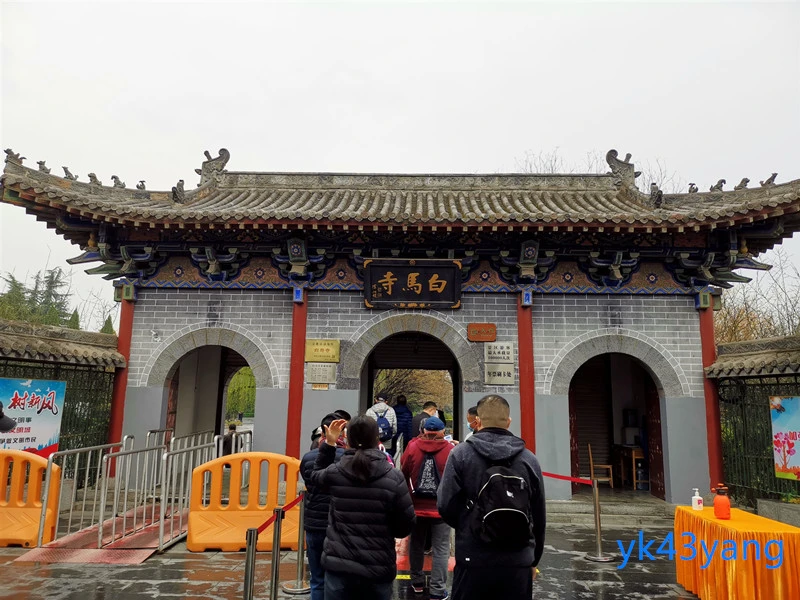
Siblings' Henan Tour (14) — Luoyang White Horse Temple
On March 18, today's plan was to visit the White Horse Temple.
Regardless of controversies, the White Horse Temple has always been recognized as the earliest temple in China.
According to legend, in the seventh year of Yongping of the Eastern Han Dynasty, Emperor Ming dispatched Langzhong Cai Yin and Grand Scholar Qin Jing to seek the Dharma in Tianzhu (India). In the eighth year of Yongping, Cai and Qin set out from Luoyang westward to obtain scriptures. In the kingdom of Da Yuezhi, they encountered the Indian monks Kāśyapa Mātanga and Dharmaratna, and also saw a white felt image of Śākyamuni Buddha and Buddhist scriptures. They earnestly invited the two monks to come to China to propagate Buddhism.
In the tenth year of Yongping, the Eastern Han envoys, along with the two monks, arrived in Luoyang carrying Buddha images and scriptures on white horses. To accommodate the two monks, the court built residences for them outside the Yong Gate. Since the department receiving foreign envoys was called Honglu Si (Court of Dependencies), the residence was also named "Si" (temple). This was the predecessor of the White Horse Temple.
In the eleventh year of Yongping, Emperor Ming ordered the construction of a monastery outside the West Yong Gate. To commemorate the white horses carrying the scriptures, the temple was named White Horse Temple. Kāśyapa Mātanga and Dharmaratna translated the first Buddhist scripture in China here—the Sūtra of Forty-Two Chapters. Subsequently, many other Western monks came to White Horse Temple to translate scriptures. Over the following 150-plus years, 192 scriptures in 395 volumes were translated here. White Horse Temple became a center for the spread of Buddhism.
Buddhism spread from here to Japan and Korea. Therefore, monks from Japan and Korea regard White Horse Temple as the "Source of Śākyamuni" and the "Ancestral Court."
At the end of the Eastern Han Dynasty, warlords vied for power and wars raged. In the first year of Chuping of the Eastern Han, the allied forces led by Yuan Shao attacked Dong Zhuo, and the White Horse Temple was razed. In the twenty-fifth year of Jian'an, Cao Pi proclaimed himself emperor, made Luoyang the capital, and rebuilt Luoyang Palace along with the White Horse Temple.
In the second year of Jiaping of the Cao Wei, the Indian monk Puṇyatara came to White Horse Temple and translated the first Buddhist monastic code in Chinese, the Mahāsāṃghika Vinaya. The Parthian monk Dharmatrata also translated regulations for monastic activities, the *Karmavācanā*. Thus, White Horse Temple initiated the precepts of Chinese Buddhism.
In the fifth year of Ganlu of the Cao Wei, Zhu Shixing ascended the ordination platform and received precepts according to the *Karmavācanā* ritual, becoming the first formally ordained monk in China.
At the end of the Western Jin, political corruption and the War of the Eight Princes shook the rule of the Western Jin, and the White Horse Temple was severely damaged. The subsequent Five Barbarians' Rebellion caused further devastation.
In the first year of Chuigong of Wu Zhou, Empress Wu Zetian expanded the Longmen Grottoes and ordered the restoration of White Horse Temple, marking its zenith in history.
In the fourteenth year of Tianbao of the Tang Dynasty, the temple was again destroyed by the fires of the An Lushan Rebellion, and the wars at the end of the Tang caused further damage.
In the third year of Chunhua of the Song Dynasty, Emperor Taizong ordered the restoration of White Horse Temple. In the twenty-third year of Hongwu of the Ming Dynasty, Emperor Taizu ordered its restoration. The temple was revived. In the thirty-fourth year of Jiajing, the Director of the Directorate of Ceremonial and Supervisor of the Eastern Depot, Huang Jin, undertook a large-scale renovation of the temple, which basically established its current scale and layout.
During the Qing Dynasty, although there were repeated repairs, the Taiping Rebellion brought devastating destruction. It was not until the Guangxu and Tongzhi periods that it was restored. In 1931, the Republican government repaired the temple again. However, the fires of the Japanese invasion once more heavily damaged it. After liberation, in 1952, 1954, and 1959, special funds were allocated to rebuild the temple. But during the ten-year Cultural Revolution, the temple suffered again: Buddha statues were smashed, and scriptures were burned. The more than thirty palm-leaf sutras reportedly brought by Kāśyapa Mātanga and Dharmaratna were turned to ashes. After the reform and opening up, the temple was reborn. The current appearance is the result of the last renovation in 1990.
After breakfast, we took a bus to White Horse Temple.
The front gate of White Horse Temple is a three-eave memorial archway style. Three arched doors open on the red wall, representing the "Gate of Emptiness," "Gate of Signlessness," and "Gate of Wishlessness."
Reflecting on the three gates of the temple, I recall that Daoist temples also have three arched gates, symbolizing the realms of Taiji, Wuji, and the present world. Strangely, Catholic churches generally have three doors: the Door of Mercy, the Door of Judgment, and the Door of Hell.
The mystery of the "three arched gates" traces back even further in history. The two pyramid-building peoples—the ancient Egyptians and the Mayans—though separated by vast oceans, both constructed similar three-arched gate temples. And almost every ancient civilization in the world has had temples with three arches, perhaps for deeper reasons.
Above the gate, the blue stone inscription reading "White Horse Temple" is a relic of the Eastern Han Dynasty, the earliest artifact in the temple. On both sides of the gate are fan-shaped walls inscribed with the characters "To Adorn the Land" and "To Benefit Sentient Beings."
In front of the gate stand two stone white horses. It is normal for the White Horse Temple to have white horses, but these two stone horses were originally placed before the tomb of Wei Xianxin, the husband of Princess Yongqing of the Song Dynasty. In 1935, Master Dejie, the abbot of White Horse Temple, moved them here, giving the temple real white horses.
Entering the gate, we first went eastward. At the end of the eastern wall is the tomb of Master Kāśyapa Mātanga. In front of his tomb stands a stele with his portrait and a monument to the Sūtra of Forty-Two Chapters.
Then we went westward to the end of the western wall, where the tomb of Master Dharmaratna is located. In front of his tomb there is also a stele with his portrait.
At the corners of the east and west walls, there are corner towers. According to the temple introduction, these two towers are also worth seeing.
We returned to the Heavenly King Hall on the central axis. It has a five-bay width and a single-eave hip-and-gable roof. Above the gate, a horizontal board reads "Heavenly King Hall." The couplets on the pillars read: "Year after year the cold gate receives Zhang and Li, always seeing them happy and joyful; Day by day carrying an empty cloth bag, lacking money and rice, yet left with a broad belly embracing the world." Reading it, I find it very meaningful. According to the introduction, the statue of Maitreya Buddha in the hall is a Ming Dynasty "dry lacquer and ramie" sculpture, a technique now lost. It is puzzling that the temple was destroyed many times, so how could a Ming Buddha statue exist here? Perhaps it was brought from elsewhere later.
In front of the Heavenly King Hall, there are a bell tower and a drum tower on the left and right. According to the introduction, they were jointly built with a donation of 4 million yen from Mr. Nakamura Tsuneyuki of Japan and 600,000 RMB from White Horse Temple. Both towers are square, 7 meters high, with double-eave hip-and-gable roofs. The bell tower bears a plaque reading "The Bell Sound of White Horse Temple," while the drum tower's plaque reads "Drum Sound of the Source of Śākyamuni." The large bell in the bell tower can be heard for ten li (5 km) around. Strangely, the large bell on the bell tower of Luoyang's old city, having the same frequency, resonates with it. In the courtyard before the Heavenly King Hall, several ancient steles stand on both sides, but unfortunately, we could not read them carefully.
On the west side stand two steles. One with a broken body is called the "Broken-Text Stele," a major attraction in White Horse Temple.
The broken-text stele is titled "Record of the Restoration of the Western Capital White Horse Temple." In the Chunhua period of the Northern Song, a great drought occurred, and Emperor Taizong sent people to pray for rain before the tombs of Kāśyapa Mātanga and Dharmaratna at White Horse Temple. In the third year of Chunhua, the emperor decreed the restoration of White Horse Temple and ordered Scholar Su Yijian to compose this record, which was carved on a stele placed in the temple.
The "broken text" of the stele does not refer to physical breakage but to the unusual format of its inscription. The characters are not written in continuous lines but segmented horizontally into several sections, with texts arranged in segments. The reason for this layout is indeed puzzling. Perhaps the calligrapher lacked the skill to write in a single stroke all the way down.
Opposite the broken-text stele, on the east side of the courtyard, stands another tall famous stele—the "Stele of the Ancestral Court of White Horse Temple in Luoyang." The text was composed in the second year of Yuanzhen of Yuan Chengzong by the temple's abbot, the Huayan master Zhonghua Wencai. It is said that the calligrapher was the Yuan Dynasty calligrapher Zhao Mengfu, so it is called the "Zhao Stele."
In the seventh year of Zhiyuan of the Yuan Dynasty, Kublai Khan ordered the restoration of White Horse Temple. The abbot at that time was the monk Longchuan, who spent more than 20 years overseeing the reconstruction. After its successful completion, Longchuan was granted the title of the first "Source of Śākyamuni Patriarch." Longchuan passed away in the 30th year of Zhiyuan. Before his death, he bequeathed his entire life savings—100 taels of gold and 15 ingots of silver—for making statues at the source. His successor, the esteemed Zhonghua Wencai, followed Longchuan's will, completed the statues, and wrote this record. Zhonghua Wencai was a Huayan master and was also known for his literary talent. He later became the founding abbot of the Youguo Temple on Mount Wutai.
Although the calligraphy on the Zhao Stele is elegant and indeed resembles Zhao Mengfu's style, the stele was erected in the first year of Yuantong (1333), eleven years after Zhao Mengfu's death. So the attribution to Zhao remains doubtful.
Behind the Heavenly King Hall is the Great Buddha Hall. It has a five-bay width and a single-eave hip-and-gable roof. The couplets on the gate read: "A speck of worldly dust brings the Vulture Peak close to the Dharma realm; The three thousand worlds, through the sea of kalpas, recognize the lotus seat." I have always believed that "where the mind is at peace, there is the Vulture Peak"—the Vulture Peak is actually in our hearts. So this couplet does not go far enough.
Inside, there is one Buddha, two disciples, and two bodhisattvas. The combination of Śākyamuni Buddha and his attendants Mañjuśrī and Samantabhadra is called the "Three Sages of Huayan." In front of the hall stands a stele carved in the 35th year of Jiajing of the Ming Dynasty, titled "Record of the Restoration of the Ancient White Horse Temple," an important artifact and key historical evidence for studying the temple's history.
Behind the Great Buddha Hall is the Great Hero Hall. It has a five-bay width and a flush-gable roof. Inside, the Buddhas of the Three Times are enshrined: Śākyamuni, Amitābha, and Bhaiṣajyaguru. In front of the Three Buddhas, on each side, is a heavenly guardian: on the left is Skanda, and on the right is Vajrapāṇi. Along the walls are the Eighteen Arhats. These statues are the only surviving set of Yuan Dynasty "dry lacquer and ramie" sculptures in China. I suspect they were also brought from elsewhere.
The name "Great Hero Hall" is unpretentious; later temples call it "Mahāvīra Hall," which seems somewhat ostentatious.
Through the window of the Great Hero Hall, I took a photo of the Skanda statue.
Behind the Heavenly King Hall is the Welcoming Hall. It has a three-bay width and a flush-gable roof, the smallest hall on the central axis. The existing structure was rebuilt in the ninth year of Guangxu of the Qing Dynasty. Inside, the "Three Saints of the West" are enshrined: Amitābha and his two attendants, Avalokiteśvara and Mahāsthāmaprāpta.
In front of the Welcoming Hall, there is a stone pedestal holding a large stone shaped like a peach. It is said that touching it can grant longevity. As a result, it has been polished to a high sheen by visitors, which is rare.
Behind the Welcoming Hall is the Cooling Terrace.
On the west side of the Cooling Terrace, there is a statue of the Japanese monk Kūkai. The inscription at the base reads: "25th Anniversary of Sino-Japanese Friendship."
Master Kūkai (774–835) was the founder of Japanese Esoteric Buddhism. In the 20th year of Zhenyuan of Tang Dezong, Kūkai came to China to study Buddhism. He studied under the Chinese Esoteric master Huiguo and is said to have also studied at White Horse Temple. After returning to Japan, he propagated Esoteric Buddhism at Tōdai-ji in Nara, known as "Tōmitsu." This statue was erected in 1997, donated by Japanese Buddhist friends to commemorate the 25th anniversary of Sino-Japanese friendship.
In the courtyard, there are also four remnants of Tang Dynasty blue stone column bases, left after the temple's destruction in the An Lushan Rebellion.
The Cooling Terrace is a high platform with steps leading up. At the top, there is a courtyard gate with a plaque reading "Cooling Terrace." On both sides, there are red paper couplets: "The supreme unsurpassed Bodhi path; The subtle and profound expedient gate."
Inside the gate, it is said to be the place where Emperor Ming studied and read to escape the heat; later, it was used by Kāśyapa Mātanga and Dharmaratna for translating scriptures.
Entering the yard, you can see the Vairochana Pavilion.
The Vairochana Pavilion has a five-bay width and a double-eave hip-and-gable roof. Under the upper eaves, a vertical plaque reads "Vairochana Pavilion." Under the lower eaves, there are three horizontal plaques. The middle one reads "Lion's Den," which is puzzling. The lion is the king of beasts; it is said that when Śākyamuni was born, he pointed one hand to the sky and one to the earth and roared like a lion. Thus, the Buddha is likened to a lion among humans. Later, the abbot's residence in a temple was called the "Lion's Den." The other two plaques read "Eternal Flourishing of the True Dharma" and "Ascending the Highest Seat." The couplets on the gate read: "The terrace sprinkles Dharma rain, the cypress stirs the cool atmosphere; The pavilion encloses the three lights, the pond swallows the moon, all is the Dharmakaya of Vairochana."
Inside, Vairochana Buddha is enshrined, the Dharmakaya Buddha among the three bodies. On either side are his attendant bodhisattvas, Mañjuśrī and Samantabhadra.
On the Cooling Terrace, there are several ancient steles. The taller one on the east side is a Qing Dynasty "Broken-Text Stele." This stele was composed and written in cursive script by Abbot Ruxiu of White Horse Temple in the 52nd year of Kangxi: "Record of the Origins of the Śākyamuni Teaching at White Horse Temple in Luoyang." The article records the transmission of Indian Buddhism and scriptures to China. The carving format imitates the earlier broken-text stele, dividing the stone into seven horizontal sections, each with 20 lines and 17 characters per line, so it is called the Qing broken-text stele.
Regarding this stele, there was an episode. When we visited the Cooling Terrace, we did not notice this stele and came down. Later, during the tour of the Dharma Treasures Hall exhibition, we saw an introduction to this Qing broken-text stele. So I went back to the Cooling Terrace specifically to see it. After taking photos, I was satisfied and returned.
Next to the Cooling Terrace, there are two high platforms. The west one is the Dharma Treasures Hall, now the "Source of Śākyamuni Exhibition Hall." Inside, it houses a copper Buddha statue presented by Indian Prime Minister Rao during his visit to China in 1993, as well as some other collected Buddhist treasures.
The east one is the Sutra Library, now the "Source of Śākyamuni Art Gallery." It contains over ten types of sutras, including the Dragon Sutra, Chinese Tripitaka, Japanese Tripitaka, Tibetan Tripitaka, Dunhuang Tripitaka, etc., and also enshrines an ancient Buddha statue presented by the Thai Buddhist community to White Horse Temple. After visiting these two exhibitions, we completed the tour of the central axis.
To the west of White Horse Temple, there is an International Buddhist Temple Garden. According to the introduction, it was built with funds from the Indian, Burmese, and Thai governments at the beginning of this century. We have visited those three countries and are deeply impressed by their Buddhist temples. Here, we felt a sense of déjà vu. However, placed here, it seems somewhat out of place. Although India is the birthplace of Buddhism, Hinduism, not Buddhism, dominates there. The Indian-style building here is actually a Hindu temple, not a Buddhist hall. Moreover, the Buddhism practiced in Myanmar and Thailand is the "Southern Transmission" of Buddhism, called "Hinayana" (Lesser Vehicle), which differs greatly from the "Mahayana" (Greater Vehicle) of Chinese Buddhism.
"Hinayana" is a derogatory term coined by Mahayana followers. Southern Transmission Buddhists never recognize the term. I have always believed that Southern Transmission Buddhism is the school closest to the original teachings of Śākyamuni. Chinese Buddhism, mainly Chan (Zen), is a perfect blend of imported Buddhism and Chinese culture. China advocates the golden mean; while different Islamic sects war with each other, we have brought all Buddhist schools together.
After the visit, we returned to the front gate of White Horse Temple and then turned east toward Qiyun Pagoda Park.
Facing us was a newly built memorial archway. The central plaque reads "Eternal Brilliance of Wisdom." Passing through the archway, we arrived at the tomb of Di Renjie.
Di Renjie, styled Huaiying, was born in the fourth year of Zhenguan of the Tang in Di Village, Taiyuan. I have visited Di Village, where there are various relics of Di's hometown. Di Renjie was a prime minister under Empress Wu Zetian, an outstanding loyal minister and wise chancellor. Under his governance, Wu Zhou maintained the glory of the early Tang. Additionally, Di Renjie was a master detective, as depicted in the television series "Di Renjie." The Qing dynasty gong'an novel "Di Gong An" describes it in more detail. There is also "Judge Dee" written by a Dutch author, strangely enough. I read the translation and found it excellent.
Di Renjie died in the first year of Jiushi of Wu Zetian's reign. The location of his tomb is controversial, as no official history records his burial at White Horse Temple. It is generally believed that his tomb is at Mount Mang in Mengjin County, Luoyang.
Di Renjie was granted the title "Duke of Liang." However, the "Tomb of the Duke of Liang" at White Horse Temple likely refers to Xue Huaiyi, a favorite of Wu Zetian, who was also titled Duke of Liang. Official records state that Xue Huaiyi's corpse was sent to White Horse Temple on a carriage after his death.
Nevertheless, the stele at White Horse Temple reads "Tomb of Duke Di of Liang" rather than "Tomb of Duke Xue of Liang," so we regarded it as Di Renjie's tomb and paid our respects.
We arrived at Qiyun Pagoda Courtyard. The small gate's horizontal plaque reads "The First Bhikṣuṇī Training Center in the Central Plains." The couplets on the gate read: "Often come to sit a while in the pure land; In peaceful times, go early to meditate." On both sides, there are fan-shaped walls inscribed with the characters "Bodhi Field." On the back of the gate, there are also couplets: "All monks in the temple are like Buddha seals; No guests on the seats are not like Dongpo." Every word in these couplets is a gem, giving much to ponder.
Arriving at Qiyun Pagoda, also known as Śākyamuni Relic Pagoda, it was first built in the twelfth year of Yongping of the Eastern Han, the year after the temple's founding. It is said that the original pagoda was a nine-story wooden pagoda. Later, it was repeatedly destroyed and rebuilt. The current pagoda was rebuilt in the fifteenth year of Dading of the Jin Dynasty, over 800 years ago.
The rebuilt Qiyun Pagoda is a square, multi-eave brick pagoda with thirteen stories, reaching a height of 53 meters. It is hollow inside, with footholds for climbing. On the tenth level, there is a south-facing door, commonly called the "Southern Heavenly Gate."
After 1989, the Qiyun Pagoda Courtyard was rebuilt, including meditation halls, classrooms, dining halls, and monks' quarters, totaling more than 30 rooms. Currently, over 30 bhikṣuṇīs (nuns) study and practice Buddhism here.
White Horse Temple has six scenic spots: Qiyun Pagoda, Cooling Terrace, Tombs of Mātanga and Dharmaratna, Broken-Text Stele, Midnight Bell, and Scripture Burning Platform. Apart from the Scripture Burning Platform, which is not within the temple, we have seen all of them. Thus, our visit to White Horse Temple concluded.


