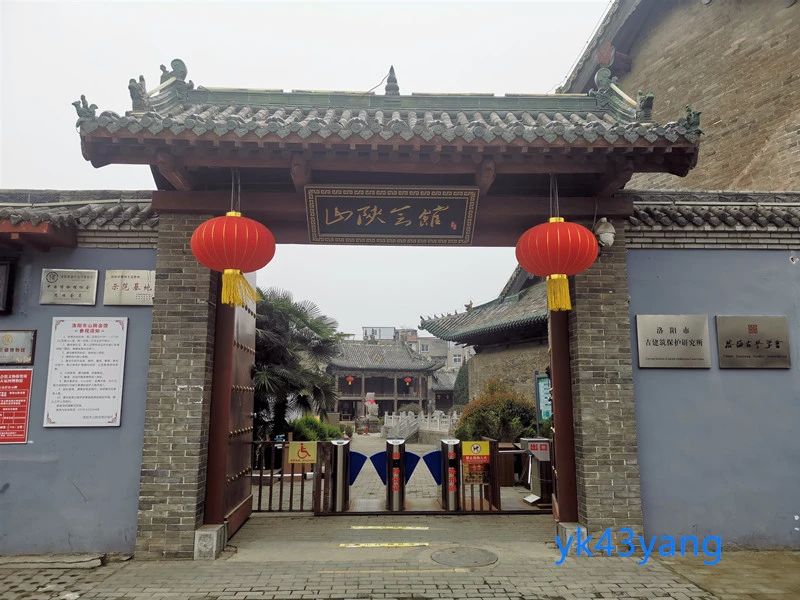
Siblings' Henan Trip (16) – Shanxi-Shaanxi Guild Hall
During the mid-Qing Dynasty, commerce flourished, and a large number of wealthy merchants emerged from Shanxi and Shaanxi provinces, doing business across the country. To facilitate social gatherings, joint business dealings, and celebratory events among fellow townsmen, merchants from these two provinces built many commercial guild halls—Shanxi-Shaanxi Guild Halls—in commercial ports across the country. The Luoyang Shanxi-Shaanxi Guild Hall is one of them.
The Luoyang Shanxi-Shaanxi Guild Hall was first built during the Kangxi and Yongzheng reigns. It underwent several repairs during the Jiaqing and Daoguang reigns. After liberation, the guild hall was occupied by Luoyang No.7 Middle School. In 1986, it was designated as a provincial-level key cultural relic protection unit, and in 2006, it was listed by the State Council as a national key cultural relic protection unit.
Taking the bus, we arrived at the Shanxi-Shaanxi Guild Hall. The hall faces south, but the entrance is at the north end. To visit in sequence, we entered the hall and walked all the way south to the frontmost part.
Due to site constraints, the guild hall does not have a main gate facing south. At the very front of the central axis is a screen wall. On both sides of the screen wall are the east and west ceremonial gates.
The glazed screen wall of the guild hall was built during the Yongzheng reign of the Qing Dynasty. With its unique shape and bright colors, it is a major highlight of the guild hall.
The screen wall is 7.6 meters high and 13.2 meters wide, with a bluestone sumeru base at the bottom and a triple-eave hard roof covered with green glazed tiles. The screen wall is divided into three sections: left, center, and right. The eaves in the middle are higher than those on the sides, forming a "凸" shape. The central circular pattern depicts "two dragons playing with a pearl," surrounded by a square frame featuring the Eight Immortals. The circular pattern on the west side shows "cloud dragon playing in water," and on the east side, "suanni playing with its cub." The three patterns are vivid and lifelike. Although over a hundred years old, they remain dazzlingly bright.
Flanking the screen wall are the east and west ceremonial gates. Due to road reconstruction, the passages at both ends have been blocked and can no longer be used for entry or exit. Both ceremonial gates are wood archways with four pillars and three doors. The plaque on the east archway reads "East Chan Advocates Culture" (东瀍崇文), with the inscription: "Established on an auspicious day in the sixth year of Daoguang, by the Shanxi-Shaanxi merchant community." The plaque on the west archway reads "West Xiao Advocates Martial Arts" (西崤尚武), with the inscription: "Established in the sixth year of Daoguang by the Shanxi-Shaanxi merchant community, rebuilt in the spring of 1999." The character "瀍" in the plaque refers to the Chan River, a tributary of the Luo River, while "崤" refers to Mount Xiao northwest of Luoyang, a branch of the eastern Qinling Mountains.
Directly facing the screen wall is the main gate (Shanmen) of the guild hall. Built during the Yongzheng reign, it has three bays and a triple-eave gable-and-hip roof. Like the screen wall, the middle section is higher than the sides, forming a "凸" shape. Under the eaves, there are intricate wood carvings. The camel hump brackets, hanging lotus columns, and sparrow braces are exquisitely structured and eye-catching. The gate wall features three arched doors. The main door lintel is engraved with the characters "Hedong Master" (河东夫子), referring to Guan Yu (Lord Guan), the God of Wealth known for his righteousness, so Shanxi-Shaanxi Guild Halls all enshrine Guan Yu. On both sides of the main door are stone couplets: "Title chased to emperor, noble or humble all should bow; character is sage, not loyal or filial dare not kowtow" (爵追王帝,无贵贱皆宜顶礼;品是圣贤,非忠孝漫许叩头). The arched doors of the side bays are decorated with "two dragons playing with a pearl." The main gate is flanked by splayed walls, which connect to the east and west ceremonial gates, forming a unified whole.
The distance from the screen wall to the main gate is limited, so it is impossible to photograph the main gate from the front. Passing through the main gate, we used a wide-angle lens from inside to capture its majestic front.
Behind the main gate is the dance pavilion (Wulou). The southern facade of the dance pavilion is quite unusual. Two round windows on either side resemble eyes, a square window in the middle looks like a nose, and the arched door below resembles a mouth. It appears like a human face. The main arched door is adorned with a double-dragon playing with a pearl motif, also very vivid. On both sides of the main door are two arched doors, each with a plaque reading "Emperor's Domain" (帝域) and "Sage's Dwelling" (圣居).
From this side, you can also see the glazed ridge of the dance pavilion, with a lion carrying a vase in the center. The vertical glazed plaque below reads "Shanxi-Shaanxi Temple" (山陕庙). There are also double-dragon patterns on both sides.
Passing through the dance pavilion door and turning back, the dance pavilion appears as a stage. Built during the Qianlong reign, it has five bays, with the protruding stage measuring three bays. The dance pavilion has a hip roof, while the stage is a gable-and-hip roof—a unique architectural form. Additionally, the wood carvings at the stage opening are exquisite and worth seeing.
On both sides of the dance pavilion are side halls, now converted into the "Shangyang Qin Academy." This is likely a folk group dedicated to the art of the guqin.
The courtyard in front is dominated by the main building of the guild hall—the Worship Hall (Baidian), where ceremonies to worship Guan Yu are held every April. The Worship Hall was built during the Yongzheng reign and renovated during the Daoguang reign. It has five bays and a single-eave gable-and-hip roof with glazed tiles. In front of the hall is a high moon platform (yuetai), imposing in scale. In front of the moon platform crouch a pair of stone lions, majestic and eye-catching.
In front of the moon platform stands a remnant stone drum guard stone from a four-pillar, three-door stone archway. The upper part of the stone drum is carved with an upside-down climbing lion, with a rope tied around its body. Since "lion" (狮) sounds like "generation" (世) in Chinese, it symbolizes "ropes linked together, passed down from generation to generation."
On the west side in front of the hall stands a stele recording the renovation of the guild hall in the third year of Xianfeng.
The pillar bases of the front columns of the main hall are carved as lions carrying lotus pedestals, a unique design with great cultural value and visual appeal.
The interior of the hall is solemn. The horizontal plaque on the main beam reads "Lofty Virtue Reaches Heaven" (峻德参天), praising Emperor Guan (Guan Yu).
Behind the Worship Hall is the Main Hall (Zhengdian). It has five bays and a single-eave overhanging roof with glazed tiles. A front veranda is built in front. Several stone steles stand under the veranda.
The pillar bases of the veranda columns also have exquisite stone carvings. The base is a lotus petal at the bottom, a lion passing through in the middle, and a hexagonal prism shape above. The dougong brackets under the eaves are ornately carved, and the horizontal beams between columns are carved with flowers, birds, insects, and animals—worth stopping to appreciate.
On the east and west sides of the Main Hall are three-bay, two-story side halls (Duodian). Both east and west side halls are single-eave overhanging roof two-story buildings with front colonnades.
On the east and west sides of the courtyard in front of the Worship Hall are wing rooms, now serving as exhibition halls for the "Sui-Tang Grand Canal Exhibition." Due to limited time, we could not visit them in detail.
The Sui-Tang Grand Canal was excavated with Luoyang as its center. The canal starts from Zhuojun in the north and ends at Yuhang in the south. Later, it was extended to Kuiji and Ningbo via the Zhedong Canal. It still plays a major role in north-south navigation today—a great feat in Chinese history!
After visiting the Shanxi-Shaanxi Guild Hall, our tour of Luoyang essentially concluded. In the afternoon, we were to take trains to return home. We had lunch at the hotel, which also served as a farewell banquet for the siblings' gathering. After many days together, the bond of brotherhood and sisterhood grew even stronger. Parting was reluctant, so we agreed on the next gathering and trip. This is exactly—
Just toured the eastern capital of Henan's scenery,
Now we look forward to a trip to Shanxi's Northern Peak.
Spring, summer, autumn, winter, flowers have their season,
Siblings always share deep affection.


