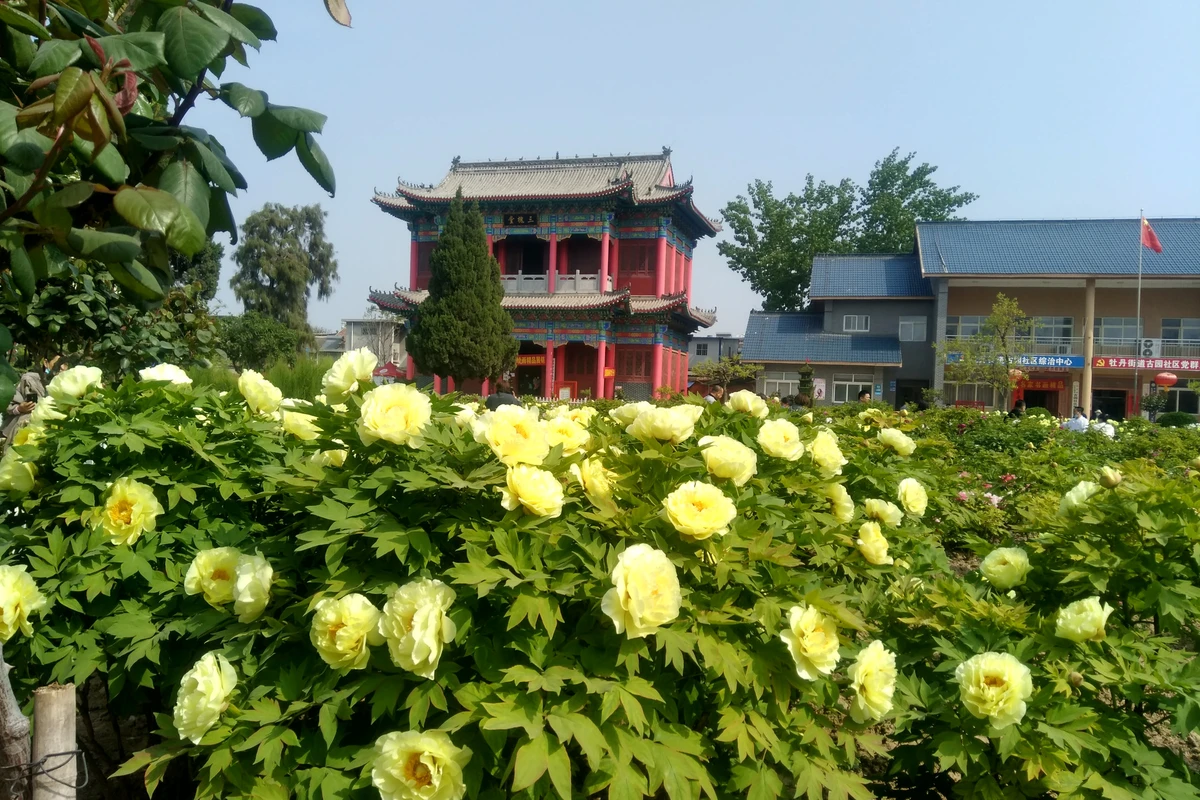
From Heze to Luoyang to See Peonies
In the 2021 peony season, the three of us boarded the train to Heze, heading straight for the opening day of the peony garden on April 15. The number of visitors was not large; perhaps we were among the early entrants. The Peony Fairy inside the garden was already welcoming visitors.
Heze, known as Caozhou in ancient times, is the capital of peonies in China. Heze has a long history of peony cultivation, beginning in the Sui dynasty, flourishing in the Tang and Song dynasties, and reaching its peak in the Ming and Qing dynasties. It has long enjoyed the reputation of "Caozhou peonies are the best under heaven." The peonies in the garden are characterized by large flowers, beautiful shapes, and vibrant colors. The colors include red, white, yellow, black, pink, purple, blue, green, and mixed colors. The flower forms include single petal, lotus, chrysanthemum, rose, crown, golden ring, crown, hydrangea, thousand-layer platform, and tower platform—10 major types. We are not professionals, so a general understanding was enough. However, through on-site observation and inquiry this time, we were able to distinguish the differences between peonies and tree peonies (mudan) and herbaceous peonies (shao yao).
Heze also has a horticultural practice of shaping pine trees into forms such as animals and archways.
The following peony has been blooming for decades.
You can see the glass bridge in the garden, where visitors are taking photos.
This is Peony Square, and the number of tourists has increased.
The next day, we went to the scenic spots of Yuncheng County from the Water Margin.
Although this is a recently built attraction, it contains roasted flatbread, Shandong storytelling, Hu Dalang, Song Jiang's old house, Chao Gai's manor, etc., which vividly reflect the ancient life of Shandong. The half-day visit was worthwhile.
Our trip to see peonies in Heze was coming to an end. We decided to go to Luoyang via Kaifeng, staying in the ancient city of Kaifeng for two days first, then proceeding from Kaifeng to Luoyang. The train quickly arrived in Kaifeng. The hotel we booked on Ctrip was excellent, located right at the intersection of Bell Tower Pedestrian Street, convenient for transportation, with a direct bus from the train station. Although many days have passed, the impression remains strong.
We stayed right next to it, which was very convenient, with a bustling food street just ahead.
We visited some famous scenic spots in the ancient city, such as Dragon Pavilion, Iron Pagoda, Great Xiangguo Temple, Memorial Temple of Lord Bao, and Tianbo Mansion.
We went to Hui Muslim Street to buy pastries and inadvertently came across this East Great Mosque.
Kaifeng is a city we have visited many times; this trip was mainly for peonies, so I won't introduce the attractions in detail. Some new attractions have been added in the city, and overall the impression is good, with little change—perhaps this is a good thing, as the ancient city's appearance has been preserved. The next stop was Luoyang to see peonies. The Central Plains railway network is developed, and the high-speed train took us to the peony city, Luoyang, in no time.
We stayed at a hotel near Wangcheng Park in the city center. After settling in, we headed straight to Luoyang's "China National Peony Garden."
Great disappointment—the peonies had already withered. Only in a shaded area of the garden were there some peonies still in bloom.
We decided to go to Longmen Grottoes first, as it was on the way. A dam was built on the Yi River, forming a lake area. The entrance to the scenic area is far from the grottoes, making it convenient for electric sightseeing cars—a common practice at scenic spots nowadays.
Fengxian Temple is the main attraction. The ankle of that warrior statue used to be smooth and shiny in the past, and visitors could hug it. It is well preserved here. It is surprising that Wu Zetian's cosmetics money from long ago created this famous attraction admired by millions, benefiting the entire city.
We visited Lijingmen Old Street and went to White Horse Temple. This ancient temple has been renovated into a large scenic area.
Was our trip to Luoyang to see peonies only to see fallen petals? The next day, we reluctantly went to Wangcheng Park to try our luck to see late-blooming peonies. Fortunately, our luck held. Heaven helps those who help themselves. Right in Wangcheng Park near our accommodation, we saw some fine peonies.
This area is herbaceous peonies (shao yao). The leaves are different, and the blooming period is a bit later.
There was also an exhibition of fine peonies in the park. Good peonies combined with careful arrangement looked especially beautiful.
Our trip to Luoyang was still worthwhile. We thought that after seeing peonies in Heze, we would have missed the best viewing period in Luoyang. But thanks to the careful care at Wangcheng Park, with shaded shelters that extended the blooming period, we saw the best peonies in both cities.
On the third day, we visited Luoyang Museum. There were many fine pieces, and the set of terracotta figures of horse trainers was truly lifelike.
There were many artifacts, but time was limited. That digging shovel is also called the Luoyang shovel, indicating the abundance of underground relics. I had previously visited Mangshan Museum, which is built on the excavated imperial tomb area, but I didn't go this time.
Our one-week trip from Heze to Luoyang to see peonies has ended. Fortunately, we saw peonies in both places. It is hard to judge which is better; both can be called the hometown of peonies. Originally, the two places are only a few hundred kilometers apart, with no difference in climate or soil conditions. So what difference could there be in peonies? They are of the same species, origin, and cultivation techniques. The only difference is in promotion. In the Heze area, there are more private flower farmers, and they set up stalls selling peonies around the parks and along the roadsides. This is a distinctive feature. Only by visiting both places can one feel this; it cannot be seen from the media alone.


