2021 Henan Tour | Dreaming of the Golden Age
Why choose April for Henan?
April is the peony season. Even though accommodation prices in Luoyang nearly double during this time, it's worth it to witness the spectacular bloom described as 'the capital city stirs at blossom time.'
Actually, I visited Luoyang four years ago. Coming from Beijing, after enduring a baptism of swirling yellow sand, entering Luoyang was a refreshing sight. The streets were clean and tidy, with high greenery coverage, and the roses by the roadside were just beginning to bloom, a feast for the eyes. Unfortunately, it was almost May Day then, and the peonies had already faded, leaving only peonies in full bloom. This time, under the bloom monitoring of my old friend Fanfan in Henan, I finally seized the opportunity to travel through Henan during the peony season!
6-Day Henan Travel Itinerary:
Day1: 'Shanghai' - 'Zhengzhou' - 'Luoyang'
Day2: 'Luoyang' Dingdingmen Site Museum - Sui-Tang City Site Botanical Garden - Luoyang Museum
Day3: 'Luoyang' National Peony Garden - Yingtianmen Museum - Lijingmen - Luoyi Ancient City
Day5: 'Hebi' - 'Anyang' Yin Ruins - 'Hebi'
Day6: 'Hebi' - 'Zhengzhou' Henan Museum - 'Shanghai'
Day1: 'Shanghai' - 'Zhengzhou' - 'Luoyang', stay in Luoyang.
Thanks to the development of the aviation hub, Zhengzhou has numerous flights to all parts of the country at affordable prices. Direct flight from Shanghai to Zhengzhou, non-red-eye, round trip only over 800 yuan. The airport has intercity trains directly to Zhengzhou Station and Zhengzhou East Station, both of which have direct trains to Luoyang, Jiaozuo, Anyang, and Kaifeng, making it very convenient. Highly recommend Zhengzhou as a travel hub for Henan.
Single tickets are very cheap on non-holidays.
Eager to catch the peony bloom in Luoyang, after meeting up with Fanfan, we had a quick late lunch at the food street near Zhengzhou Station and then headed straight to Luoyang. That day we checked into a guesthouse. Except for the slightly cramped bathroom, the room layout, bed linen cleanliness, and facilities were all satisfactory. Fanfan said Luoyang's environment is famously good in Henan, and locals prefer to stay and develop locally rather than seek work elsewhere. Such characteristic guesthouses are still rare in other parts of Henan. Our guesthouse was near Yingtianmen. During the peony festival, Yingtianmen has a light show at night. Complemented by the night view of Luoyi Park, it was gentle and grand, very beautiful. Even though we couldn't enjoy the light show up close, viewing it from a distance was enough to feast our eyes.
Day2: 'Luoyang' Dingdingmen Site Museum - Sui-Tang City Site Botanical Garden - Luoyang Museum, stay in Luoyang.
Today is the weekend, so the peony gardens must be packed. So we first visited Dingdingmen site, Sui-Tang Luoyang City site, and Luoyang Museum. Dingdingmen was the main southern gate of the outer city of Sui-Tang Luoyang, listed as a World Heritage site in 2014. The museum is built on the original site of Dingdingmen, exhibiting rammed earth remains of Tang dynasty city gates and city wall street remains. The museum has transparent glass walkways and overhead corridors for visitors to closely see the grand scale of the Sui-Tang city gates, with wide main roads allowing several rows of carriages, horses, and pedestrians to pass, and horse paths on the city walls leading directly to the gate towers.
Outside the museum are the street ruins of Luoyang city. Some broken walls remain on the ground, having been repaired and protected. The best way to experience it is to climb the reconstructed Dingdingmen gate tower and overlook Luoyang's city layout, 'like a chessboard with hundreds of homes, and twelve streets like vegetable plots.'
Sand table model inside the museum.
Overlooking from the gate tower, the open square in front of the museum gathers small vendors selling art and antiques, including strange stones, wood carvings, and small trinkets, with prices ranging from nearly a million to a few yuan. Those with a good eye can bargain. Given that Fanfan and I are both broke, we didn't buy anything. After the visit, we rode shared bikes to the next spot.
About ten minutes later, we reached the gate of the Sui-Tang City Site Botanical Garden. At the entrance, potted peonies were in full bloom, delicate and bright red, as if calling me to see them. I was so excited I couldn't move. I had to go in and roam. But Fanfan grumbled that the weekend ticket price of 30 yuan was too expensive and didn't want to go in... Never mind, we could meet later at the museum anyway.
Once inside, I didn't see peonies first, but a large field of tulips. I usually don't like tulips; they look fake, like plastic flowers despite being real. But today, in a good mood, even tulips looked pleasing. I happily took several photos and then searched for peonies.
'King of fake flowers' - tulips.
The early-blooming varieties had mostly wilted. After wandering for half an hour, I finally found the peony area in full bloom. Ah, peonies~ you are so beautiful! So big! And so fragrant! I love this bright and elegant temperament. How I wish I could dig up a few to plant in my hometown courtyard, so I could admire your beauty every year.
The botanical garden was built on Tang dynasty ruins, mimicking the original layout. The most unique feature is the network of waterways within the garden. The water originates from a lake in the center and extends to various peony areas through artificial channels. With lush blooms and flowing water, the graceful peonies and lively waterways complement each other, offering a high-quality viewing experience.
Alas, I'm too poor. I could buy a few peonies, but I certainly couldn't build such waterways. Another great regret in life! By the time we finished touring the garden, it was getting late. Luckily, the exit was just across the road from the museum, and Fanfan had already done a round inside. The museum houses a large collection of Tang sancai, Tang and Song ceramics, Wei-Jin portrait bricks, and Buddhist art sculptures, all of high quality. Fanfan was thoroughly impressed, just like I was four years ago. Luoyang's cultural relics are truly abundant. A prefecture-level city, its museums far exceed those of major provincial capitals, and even the famous tomb-raiding tool Luoyang shovel is named after Luoyang. Apart from Luoyang Museum, the Ancient Tombs Museum is especially worth visiting. It displays various tomb forms from Zhou, Qin, Han, Tang, Wei-Jin, lavish, simple, imperial, noble—everything. You can even enter replica tombs to experience them. Reading tomb-raiding novels after visiting the Ancient Tombs Museum would surely be thrilling. There are too many museums; let's talk about them another day.
Day3: 'Luoyang' National Peony Garden - Yingtianmen Museum - Lijingmen - Luoyi Ancient City, stay in Luoyang.
Today's theme is peonies. Luoyang peonies are truly extraordinary. They are even found in street green belts, not to mention the vast patches in city parks and botanical gardens. Luoyang alone has peony gardens like the National Peony Garden, International Peony Garden, Shenzhou Peony Garden, and China National Garden. Peonies have early, mid, and late-blooming varieties. Early ones bloom in early April, peaking around Qingming Festival, and by now they are largely gone, making way for mid-blooming varieties. Among Luoyang's peony viewing spots, the three most recommended by users are Wangcheng Park, China National Garden, and National Peony Garden. The National Peony Garden has many mid-blooming varieties, the most complete peony species, a huge scale, and tickets at only 9 yuan—very affordable. So today we visited the National Peony Garden. [Pretend there is a picture here] Even at the ticket office, we could see the garden overflowing with peonies, almost bursting through the windows, bringing an overwhelming sense of spring's abundance and happiness. So many! So big! So fragrant!! How do the gardeners grow them? It's so touching. Can I take some home~~
Everywhere you look, peonies! The plants are as high as chest level, so proud!
Bright red, dignified and grand.
Coral pink, shyly blooming.
In bud, I wanted to watch them slowly unfold.
This flower was as big as my face (and that's really big)!
Words fail me. Just one word: amazing!
Paired with pines and cypresses, exuding an elegant ancient charm~
I could stay in this pavilion for a week.
The peony garden is huge, divided into two sections by an overpass above the road. We wandered for hours, our step count exceeding 10,000, our feet aching! After eating, we took an afternoon nap to recover. Waking up around 3-4 pm, with a great mood, we set off for Yingtianmen.
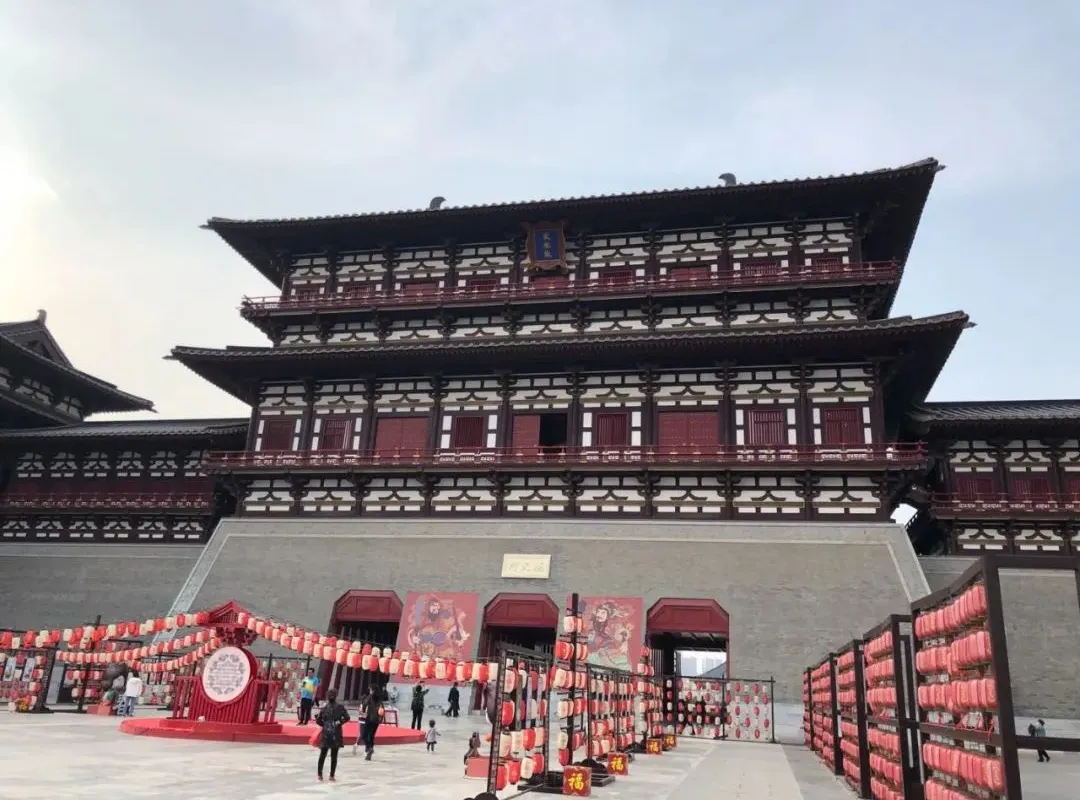
Yingtianmen was the main gate of the Tang dynasty imperial city. The reconstructed gate tower is magnificent, with towering city gates. Historically, ceremonies such as receiving foreign envoys and mustering troops often took place here. At 5 pm, a ceremonial performance reenacting the welcoming of envoys during Empress Wu Zetian's reign was held in Yingtianmen Square. Ladies in Tang-style Hanfu gracefully performed, recreating the golden age of a thousand years ago.
Hanfu ladies surrounded by tourists.
From Yingtianmen, you can walk to Lijingmen and Luoyi Ancient City. Lijingmen was a gate of the Sui-Tang imperial city, historically a bustling commercial area. Today, from Lijingmen to Luoyi Ancient City, it's lively and crowded with many vendors, making it the perfect place to eat street food. Grilled sausages are 10 yuan for three, stinky tofu and stone-grilled tofu are 10 to 20 yuan a serving, and there are water feasts, meatball soup, eight bowls... Prices are touching; you can eat all the way through and spend very little, as long as your stomach can handle it.
Bustling food street.
Luoyi Ancient City is a modern reconstruction of an ancient city, with beautiful night scenery. The soft yellow lighting matches well with the antique-style buildings. Many ladies in Hanfu take photos here. There are many guesthouses in the ancient city, seemingly of good quality; I might stay here next time I visit Luoyang.
Day4: 'Luoyang' Tianzijia Liu Museum - Wangcheng Park - 'Hebi' Qishui Golden Beach, stay in Hebi.
Today we change locations. In the morning, I purposely got up a bit earlier to visit the Tianzijia Liu Museum and Wangcheng Park before leaving. Once again, I am amazed by Luoyang's rich cultural relics! The Tianzijia Liu Museum is a burial complex of the Eastern Zhou royal family. It doesn't display artifacts from a single tomb but rather various burial objects from hundreds of tombs. However, Luoyang has also suffered severe looting and loss of artifacts. These tombs were heavily plundered during the Republic of China, with a large number of cultural relics lost overseas, leaving very few in China. Yet even the 'few left' include a considerable scale of chariots and horses, confirming the historical record of the 'Six Horses for the Son of Heaven' ritual. Wangcheng Park is also on the site of the Eastern Zhou capital. Now just a city park, it was built on the ruins of the Eastern Zhou city and is also a venue for the peony festival. Today, Wangcheng Park is peaceful and serene; due to its long history, few remains are visible, but it's a pleasant place for leisure. The peonies are in full bloom, nestled among the urban gardens, offering a unique charm.
After a quick tour, it was already noon. We took a high-speed train directly from Luoyang to Hebi. We would stay at Fanfan's home for the next two days, visiting Hebi and Anyang. After arriving, we had a simple meal at the Wanda mall near the train station and then headed to the Qishui River. Yes, the same Qishui mentioned in the Classic of Poetry: 'The Qi River's waters vast, wetting the carriage curtains.' The best place to visit Qishui is probably the Qishui National Wetland Park, but it was a bit far from Fanfan's home, so we went directly to the nearby Qishui Golden Beach.
Perhaps due to water scarcity, the hydrological environment in the north is much better than in the south. The Qishui River is clear and shallow, transparent like glass, with green aquatic plants swaying gracefully. The evening was cool and comfortable. The riverside had a large stretch of fine, clean sand, perfect for a family beach outing or spending time with children.
Day5: 'Hebi' - 'Anyang' Yin Ruins - 'Hebi', stay in Hebi.
Thanks to the developed railway network, it's only a half-hour high-speed train from Hebi to Anyang. Right at the station square, there's a direct bus to the Yin Ruins. The famous Shang dynasty capital—Yin Ruins, here I come! Pool view at the entrance of Yin Ruins Museum, with imitation tortoise shells in the water. Yin Ruins ticket: 70 yuan, covering two exhibition areas: Yin Ruins Palace and Ancestral Temple Site, and Yin Ruins Royal Tombs. The palace and ancestral temple area includes palace ruins, ancestral temple sacrifice remains, Fuhao's tomb, and the Yin Ruins Museum.
How many national treasures have been unearthed from Yin Ruins~
The Shang dynasty's palace and city construction were already quite large in scale. The Shang people emphasized sacrifices and divination, so there are many sacrificial pits in the site area. Besides oracle bones, bronze ritual vessels, weapons, and livestock, these pits also contain large numbers of human skeletons. These people were officials or servants of the dynasty—young charioteers, women, children, and oracle bone administrators... The sight of full pits of skeletons was truly horrifying. Ordinary people's lives were so cheap; I'm glad I didn't live in that era.
A ground full of skulls.
A free shuttle bus runs between the palace area and the royal tombs. The royal tomb area contains large, medium, and small tombs. In the excavated and opened exhibition halls, the cruelty of the slave society is once again confirmed. Each tomb passage is piled with human skulls, and the waist pits at the bottom of tombs also contain human skeletons, all intended to clear the way and ward off evil for the tomb owner in the afterlife. People were like ants. It left me with mixed feelings. Coming out of the exhibition hall, the sky was clear, a gentle breeze blew away the oppression, and the world felt so bright. The Shang dynasty was truly a cruel regime. For an ordinary person like me, living in the present is much happier.
I encountered a little deer in the park. So cute~
Day6: Hebi—Zhengzhou: Henan Museum—Shanghai, end of trip.
On the last day, I deliberately set aside half a day for the Henan Museum.
Exterior of Henan Museum.
After arriving at Zhengzhou East Station by high-speed rail, I headed straight to the museum. The museum's exterior resembles a 'crowned pyramid,' designed after the Yuan dynasty astronomical observatory. It didn't look grand, but once inside, I was stunned. The whole room was filled with bronze artifacts, pottery, and porcelain. Most importantly, their quality and quantity were so impressive that it was awe-inspiring. In one display case, a complete set of large unearthed bronzes—nine tripods, eight gui vessels, and a set of bells—preserved in such good condition with color intact and clear patterns. These were just the ritual vessels of the small state of Zheng during the Zhou dynasty, already of such a high standard. One can imagine how prosperous the Five Hegemons of the Spring and Autumn period and the Seven Warring States must have been.
Ritual vessels unearthed from Zheng state.
Cute, awkwardly cute, embarrassingly cute...
The museum also has white porcelain, black porcelain, and celadon from the Sui and Tang dynasties, Ru kiln, Jun kiln, Guan kiln, and a sculpture art gallery... The Henan Museum is truly a national treasure-level museum. Visiting here makes you believe in the majestic Chinese civilization. No wonder Henan's recent galas have produced outstanding works like 'Tang Palace Banquet' and the underwater flying dance 'Qi.' Henan indeed has such confidence. Luoyang, the ancient capital of thirteen dynasties; Anyang, the capital of the Shang dynasty; Kaifeng, the capital of the Northern Song; Shangqiu, the early capital of the Shang; and Zhuxian Town, one of the four famous towns of the Ming and Qing... A trip to the 'Center of the World' is enough to experience a condensed version of Chinese civilization. Half a day was far from enough to see everything. The remaining collections and the mountains and cultural landscapes I didn't have time to visit will have to wait for next time.
I quit my job, and this first half of the year I set aside over a month to travel around China, mainly in the north. So, continuing from the last trip, I'll visit the Henan Museum and the Taihang Mountains, which I still had lingering desires for from April. Henan is located at the boundary between the second and third topographic steps, with half mountains and half plains. To the west, it borders Shanxi along the Taihang Mountains; the alluvial plains east of the mountains nurtured the brilliant Yin Ruins in Anyang. The eastern extension of the Qinling Mountains stretches from the west to the southwest, including the famous Mount Song, Mount Laojun, and Mount Xiao; the plains below nurtured Luoyang, the capital of thirteen dynasties. The Nanyang Basin between the southern mountains is one of the cradles of Chu culture. The Yellow River, cutting through the obstacles of the Taihang and Qinling, flows across the central-eastern plains, creating fertile land and developed waterways that gave rise to the world-renowned capital of the Northern Song, Kaifeng. Today's Zhengzhou is also rising. The best route to travel through Henan is naturally to follow the main line of its historical geography for a complete tour.
Henan Travel Guide.
Should have made a map; bear with the text for now.
But as a working person, I don't have that much time to do it all at once, so I'll spread it out over a lifetime of slow travel. Travel is a way of life; being on the road is the norm, I suppose.
Day1: 'Hefei' - 'Zhengzhou' Henan Museum
Day2: 'Zhengzhou' - 'Jiaozuo' Yuntai Mountain
Day3: 'Yuntai Mountain' Red Stone Gorge, Zifang Lake, Tanpu Gorge, Quanpu Gorge, Macaque Valley
Day4: 'Yuntai Mountain' Zhuyu Peak - Depart Henan
Day1: 'Hefei' - 'Zhengzhou' Henan Museum, stay in Zhengzhou.
In April, I toured the Xia, Shang, and Zhou dynasty halls, but didn't have time for the later exhibits. The pre-Qin artifacts are mostly from 'great affairs of the state' like sacrifices, military affairs, and burials. Once I entered the Tang and Song halls, everyday secular items appeared in large numbers. Beautifully crafted daily utensils and entertainment objects made me feel a connection.
So beautiful~ If I could own one, my FIRE dream could become a reality~~
From the bowls, plates, pots, and bottles from famous kilns to the exquisite gold, silver, and jade ornaments, the bustling worldly life came rushing at me, lifting my spirits. Indeed, the pleasure of eating, drinking, and having fun makes people happy.
Model of Kaifeng city, showing a clear difference from the chessboard-like layout of Luoyang.
Especially the Song dynasty. The model of Kaifeng city, recreated from the 'Along the River During the Qingming Festival,' shows houses built along the river, boats coming and going, pedestrians bustling, and vendors lining up. It's no wonder it was the world's largest city at the time. If I could travel back in time, the Song dynasty would definitely be high on the must-visit list~
Day2: 'Zhengzhou' - 'Jiaozuo' Yuntai Mountain, stay in Yuntai Mountain.
In the morning, I went to the Zhengzhou Shang dynasty site to wander around. The site is located inside Zijin Mountain. In the morning, elderly people practicing tai chi and exercise, wearing bright clothes, walked the catwalk in the park, and some were recording short videos. Retirement life is truly colorful. I want to retire too, but unfortunately, I'm too poor, sigh~ The city wall ruins are enclosed in transparent glass boxes, allowing visitors to walk on top. Beneath the glass are rammed earth remains. As a layman, I couldn't make much sense of them, but I found it very harmonious that the 3000-year-old ruins coexist with people exercising in the park. It's also a great place for locals to come and cool off. A ten-minute walk from the park, I found a local hulatang old shop called 'Fangzhongshan Hulatang.' At ten in the morning, there were still many customers, clearly locals. I ordered two buns and a bowl of hulatang. Oh my, it was delicious! One bowl made me sweat from the spiciness, but also refreshed me~
I swear, it was better than any snack I had in Luoyang!
After eating, I went back to pack and catch the bus. Yuntai Mountain is located in Jiaozuo City. From Zhengzhou, take a high-speed or regular train to Xiuwu or Jiaozuo, then take a direct tourist bus to Yuntai Mountain Scenic Area. There is a scenic area bus loop that stops at various attractions and service areas, very convenient. Yuntai Mountain is suitable for a two-day trip, allowing you to comfortably visit the main attractions. The mountain was misty and rainy, slightly cool, with layered peaks. It's nice to sit on the balcony and daydream.
Day3: 'Yuntai Mountain' Red Stone Gorge, Zifang Lake, Tanpu Gorge, Quanpu Gorge, Macaque Valley, stay in Yuntai Mountain.
Yuntai Mountain belongs to the Taihang Mountain range, and you can see the unique peak forest landscape of the Taihang here. It is also one of the first global geoparks in the world. It features the unique Red Stone Gorge landform, the tallest waterfall in Asia—Yuntai Waterfall, and abundant flora, fauna, and hydrological landscapes. The scenic area is well-managed with reasonable prices. Just slow down and wander leisurely for two days in the oxygen-rich mountains. My two favorite spots: Red Stone Gorge and Quanpu Gorge. At the entrance of Red Stone Gorge, there is a large patch of climbing roses spreading over wooden trellises. In May, it's the peak bloom, with bright red flowers everywhere, very pleasing to the eye. Inside the gorge, there are ochre-red rock formations with emerald rivers flowing through, rich in negative oxygen ions, making the scenery quite beautiful.
I also want a piece of land to plant a wall of roses.
Artificial water mist, like something from Journey to the West.
Quanpu Gorge has winding paths leading to secluded spots. Along the way, the roadside flowers, grass, and pools bring many small joys. At the end is the famous Yuntai Waterfall. Amidst mist and clouds, the source of the waterfall rises into the sky, as if flowing from heaven. 'Flying down three thousand feet, as if the Milky Way has fallen from the nine heavens,' the poet's verses truly capture the essence of Yuntai Waterfall.
Doesn't it look like a furry turtle?
Day4: 'Yuntai Mountain' Zhuyu Peak - End of Henan trip.
Zhuyu Peak is the main peak of Yuntai Mountain, at an altitude of 1297.6 meters. At the top, there is a temple and a glass plank road for viewing. However, this mountain isn't particularly outstanding compared to the famous mountains in Jiangnan. What got my heart racing was the winding mountain road to the top. The road took half an hour, consisting of countless nearly 180-degree turns and one tunnel after another. I sat by the window, next to steep slopes and cliffs, afraid the car might fall off. I was nervous the whole way. So for the descent, I decisively chose the cable car. After visiting Yuntai Mountain, my Henan tour in the first half of 2021 concluded for now. Next stop: Shanxi.


