If my friends in Luoyang ask about me, tell them I'm busy viewing cultural relics
In mid-October 2021, I used a weekend to visit a number of sites in Luoyang, Henan Province, including the Luoyang Museum, Longmen Grottoes, Sui-Tang City Ruins Botanical Garden, China National Garden, and the site of the broken Linsen Bridge. The rich cultural relics and splendid treasures of Heluo made me once again feel the profound and long-standing nature of Chinese civilization.
Luoyang is located in the middle reaches of the Yellow River, in western Henan Province. It gets its name from being north of the Luo River. With a history of more than 5,000 years of civilization, over 4,000 years of urban history, and more than 1,500 years as a capital, it is one of the birthplaces of Chinese civilization and one of the four great ancient capitals of China. Since ancient times, Heluo has been rich in talent, and too many historical stories have taken place here: King Cheng of Zhou establishing the central plains, the story of "Luoyang paper becoming expensive" due to the "Three Capitals Fu," Yang Guishan standing in the snow at Cheng Yi's door, Liu Shan being content in his new home and forgetting about Shu, Zhao Zilong beating a retreat... Half of the writings of the Han and Wei dynasties came from Luoyang. Countless literati left their marks here: "If my friends in Luoyang ask about me, tell them my heart is like a piece of ice in a jade pot" (Wang Changling), "Only the peony is the true national beauty, at the time of blooming it shakes the capital" (Liu Yuxi), "Whose jade flute secretly sends its sound, scattered in the spring wind filling the city of Luo" (Li Bai), "How to get a strong man to pull the Milky Way, clean the weapons and never use them again" (Du Fu), "Where the body and mind feel at ease is my homeland, why limit it to Chang'an or Luoyang" (Bai Juyi), "If you want to ask about the rise and fall of past and present, please just look at the city of Luoyang" (Sima Guang)...
As a national historical and cultural city and an excellent tourist city in China, Luoyang has many tourist attractions, such as Longmen Grottoes, White Horse Temple, Guanlin Temple, Lijing Gate, Luoyang Museum, Tianzi Jia Liu Museum (Museum of the Imperial Carriage), Sui-Tang City Ruins Park, Luoyang Peony Garden, Laojun Mountain Scenic Area, etc. Due to time constraints, this time I visited five attractions in the city area along the Luo River, Yi River, and Longmen Avenue, including Luoyang Museum and Longmen Grottoes. The itinerary was tight but rewarding.
After taking a taxi from Longmen Railway Station, I felt the atmosphere was off. When I asked, the driver said he had waited in line at the high-speed rail station for more than two hours only to get this 15-yuan fare, which left him very frustrated. I said he could pick up more passengers after this trip, but he replied that there weren't many passengers. The city has at least ten thousand taxis and ride-hailing cars, both legal and illegal, but the population is only this size, so business is tough. Alas, people's livelihoods are hard, and living in a big city is not easy. I saw many taxis on the streets these two days, many of them brand-new new-energy vehicles.
Along Longmen Avenue, I saw the tall golden-top "Tianshu" tower, and then arrived at the Luoyang Museum.
The Luoyang Museum, founded in 1958, is one of the first national first-class museums. It houses over 400,000 cultural relics, ranking among the top in the country. Among them, bronze ritual vessels from the Xia, Shang, and Zhou dynasties, pottery figurines from Han and Tang, Tang Sancai glazed pottery, and Song dynasty porcelain have strong regional characteristics and hold a certain position in China's cultural relic world.
The overall appearance of the building is a large ding (tripod) shape, consisting of a main building and an annex. The main building has two floors. The first floor houses the basic exhibition "Heluo Civilization" and the thematic exhibition "Stone Carving Hall." The second floor houses thematic exhibitions: Jewelry Hall, Tang Sancai Hall, Palace Relics Hall, and Calligraphy and Painting Hall. The highlights are on the second floor. If you have limited time, I suggest going straight to the Jewelry Hall on the second floor, where you will see a wealth of fine pieces, all of which are treasures of the museum.
Bronze Square Lei (wine vessel) with "Mu Gu" inscription, Shang Dynasty. Height 50 cm, shoulder width 33 cm. Inscriptions reading "Mu Gu" are cast on the lid and neck wall, indicating that this was a marriage vessel for a woman from the Gu state marrying a man from the Mu clan.
Bronze Square Ding with beast-face pattern, Western Zhou. Height 36 cm, length 33 cm, mouth width 25 cm. The body is cast with a huge taotie (ogre) pattern, using alternating high and low relief to highlight the majesty of royal power.
Bronze vessels were entirely handmade, so no two are exactly alike. The beast-face pattern on this square ding is unique, and it is also called the "Luoyang Ding."
Bronze Square Yi (ritual vessel) of Shu Pin, Western Zhou. Height 32.6 cm, fully decorated with half-relief beast-face and phoenix bird patterns. The inner wall is inscribed with 12 characters in three lines: "Shu Pin bestowed cowries by Wang Si, used to make this precious Yi." Shu Pin was the son of King Wen of Zhou, and Wang Si was King Wen's consort Tai Si. The inscription means that Shu Pin used the cowries granted by his mother Wang Si to make this square Yi to express gratitude. This royal vessel is very precious and is the only one of its kind in China.
Bronze Ding with "Wang Zuo" inscription, Spring and Autumn period. Height 40 cm. Inside the ding is cast the inscription "Wang Zuo Ding" (King made ding), the only Zhou royal self-made vessel found in the Luoyang area to date.
Bronze Ding with gold and silver inlay, Warring States period. Flat spherical shape, height 16.5 cm. Decorated with gold- and silver-inlaid four-petal flowers, triangular cloud patterns, and persimmon stem patterns. On the center of the lid is a ring-shaped knob with a beast-head holding a ring, flanked by a pair of gilt toads.
Gold and silver inlay is a technique where gold and silver patterns are applied to bronze vessels using painting or inlaying methods to make the vessels more colorful.
Proto-porcelain Lei (jar), Western Zhou. Height 27.3 cm. Dense body, crystal glaze, high hardness, low water absorption, close to modern porcelain standards.
Clay facial mask, Northern Wei. Residual height 25 cm. The face is thin and beautiful, gentle and approachable, reflecting the revival of Han Chinese indigenous consciousness in Buddha statues after Emperor Xiaowen moved the capital to Luoyang.
White jade cup, Cao Wei period. Height 11.5 cm. Carved from Hetian jade, warm and white all over, simple and natural, reflecting the prevailing trend of simplicity and frugality during the Three Kingdoms period.
White-glazed black-design Mei vase with ducks playing in water, Song Dynasty. Height 42.8 cm. Inside depicts a scene of two ducks playing in water, outside decorated with peony patterns, with a strong folk art style.
Gold and silver pingtuo mirror with flower and bird designs, Tang Dynasty. Diameter 30.5 cm. The production process: gold and silver sheets are hammered into extremely thin foils, cut into flower and bird patterns, pasted on the back of the mirror with lacquer, then coated with multiple layers of lacquer. After drying, it is finely polished so that the gold and silver patterns are flush with the lacquer surface but have distinct layers, making the bronze mirror glittering.
Bronze jue (libation vessel), Xia Dynasty. Length 13.4 cm, width 8 cm, height 11.4 cm. Unearthed in 1973 from the Erlitou site in Yanshi, Henan. Many artifacts were unearthed at that time, including bronze plaque inlaid with turquoise beast-face pattern, bronze jue with nipple pattern, etc., but they were not seen this time, reportedly displayed at the Erlitou Xia Capital Museum.
Bronze zun (wine vessel) with taotie pattern, Shang Dynasty. Height 25.5 cm, mouth diameter 21 cm. Decorated with cloud and thunder patterns, linked bead patterns, and beast-face patterns. There are three "ten"-shaped holes on the circular foot.
Painted pottery horse and horse tamer figurine, Tang Dynasty. Pottery horse height 40 cm, length 47 cm. Its front legs are raised in the air, mouth open and neighing, as if trying to break free. The horse tamer figurine has wide eyes and a focused expression, right hand clenched, left hand extended outward, looking confident. The confrontation between man and horse, the rhythm of stillness and motion, reproduces the strength and beauty of a horse training performance.
Tri-colored glazed camel, Tang Dynasty. Height 88 cm, length 76 cm. The camel has its neck curved upward, head raised high, a flower blanket on its back, and a beast-face carrying pouch between its two humps. In front and behind the pouch are silk fabrics, with small-mouthed bottles, chicken-head pots, dry food bags, and pieces of meat tied to the ends of the silk.
Tri-colored black-glazed horse, Tang Dynasty. Height 73 cm. Tang Sancai is a low-temperature polychrome glazed pottery, mainly with yellow, green, and white colors. Black tri-colored pieces are extremely rare. Later I would visit the thematic exhibition hall of Tang Sancai and see more treasures.
Tri-colored lamp, Tang Dynasty. The only tri-colored lamp in China with a bowl at the top. Total height 44.5 cm, glazed in green, brown, and white, gorgeous and colorful. Tri-colored lamps discovered so far basically have a candle holder at the top for placing candles. But the top of this tri-colored lamp has a bowl; add a wick and pour oil into it to use.
Stone sutra pillar of Nestorianism of the Great Qin, Tang Dynasty. The bottom is damaged, residual height 84 cm. A sutra pillar is a stone pillar inscribed with scriptures, usually erected in temples or along sacred paths to propagate the true Dharma and eliminate calamities. Nestorianism originated in the Syria region, a Christian sect that split from Greek Orthodox. The middle part of this pillar is inscribed with regular script, and the top is carved with a cross and "heavenly gods," witnessing the important role of Luoyang in Sino-Western cultural exchange.
Gilt bronze Avalokitesvara (Guanyin), Qing Dynasty. Height 90 cm. Han-style statue, depicting the natural demeanor of Avalokitesvara preaching on Mount Potalaka.
Silver-gilt statue of the Sixth Panchen Lama, Qing Dynasty. Height 74.1 cm.
Zhengshi Stone Classics, Cao Wei period. Length 75.4 cm, width 50 cm. Inscribed stone scriptures carved during the Zhengshi reign of the Wei state during the Three Kingdoms period. Together with the Xiping Stone Classics of the Eastern Han and the Kaicheng Stone Classics of the Tang, they are known as the "Three Great Stone Classics" of Confucian texts.
Stone classics are scriptures carved on stone. In ancient times, errors often occurred in the transcription of Confucian classics. To correct them and restore the original texts, the government organized the carving of official "textbooks" for copying and collation. The oldest extant stone classics are the Eastern Han Xiping Stone Classics, dating back more than 1,800 years. The largest in scale are the Qing Dynasty Qianlong Stone Classics, which took 12 years to complete, with 190 carved stones and over 600,000 characters.
Jade ge (dagger-axe), Shang Dynasty, length 47.7 cm. It looks like a dagger but was actually a ritual object used for warding off evil and making wishes.
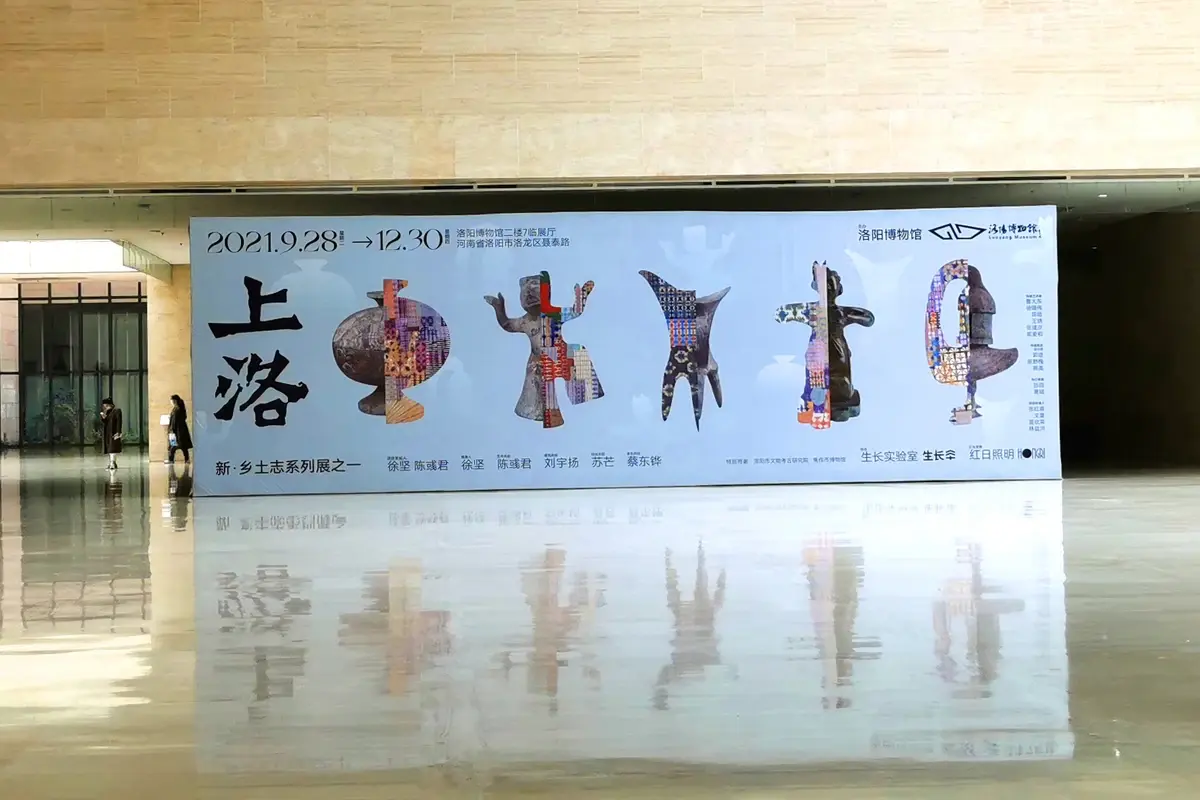
The special exhibition "New Local Chronicles Series I: Shangluo" displays Luoyang unearthed artifacts alongside contemporary artworks, encouraging viewers to reflect on Luoyang as a local place, a Chinese city, and a world heritage site, on hometown and foreign lands, on history, artifacts, and modern life.
Interestingly, Japanese has a specific term "Shangluo" (jōraku), which means going to the capital. Before the Meiji Restoration, Japan was heavily influenced by China. Imitating the practice of the Central Plains dynasties often making Luoyang the capital, the Japanese called the capital Kyoto "Raku" (Luo), and going to the capital was "Shangluo."
Bronze lamp stand in kneeling human form, Warring States period. Kneeling (ji) means a long kneel.
Pottery figurine with small cap, Northern Wei.
Painted pottery dou (vessel), Warring States period.
Pottery figurine of a Hu (non-Han) person, Northern Wei.
Painted pottery figurine of a Kunlun slave, Northern Wei. In ancient China, the term "Kunlun" not only referred to the Kunlun Mountains but also meant black. People with black skin were generally called Kunlun people.
Contemporary artworks displayed alongside.
The Tang Sancai Hall is a thematic exhibition hall of the Luoyang Museum, divided into five units: "Astonishing Discovery," "Humanistic Style," "Silk Road Imprints," "Spiritual Homeland," and "Crafts of Heavenly Colors." It exhibits nearly a hundred Tang Sancai artifacts, displaying the open, diverse, and rich social landscape of Tang Dynasty Luoyang from multiple angles such as humanities, trade, and religion.
Tang Sancai is a general term for Tang Dynasty lead-glazed pottery, named for its main three colors of yellow, green, and white. It represents the artistic level of the heyday of ancient China in terms of shape, decoration, and firing techniques. Currently, unearthed Tang Sancai is concentrated in the two capitals of the Tang Dynasty: Chang'an and Luoyang.
Tri-colored figurine of a woman in Hu costume.
Tri-colored figurine of a woman with half-turned bun.
Tri-colored figurine of a woman riding a horse.
Tri-colored figurine of a Hu man on a horse wearing a futou cap.
Tri-colored jar with pearl pattern.
Tri-colored covered jar with appliqué decoration.
Tri-colored pillow with carved reclining deer pattern.
Tri-colored three-legged box with flying geese and lotus pattern.
Continue to visit the Palace Relics exhibition on the second floor. These artifacts originally belonged to the Cining Palace Grand Buddha Hall in the Forbidden City and were transferred to the Luoyang Museum from the Beijing Palace Museum in 1973. The collection mainly consists of court Buddhist objects, supplemented by daily utensils, including various Buddhist statues, shrines, ritual instruments, offering vessels, and utensils for worship, as well as furniture, decorative screens, wall screens, calligraphy, paintings, and ceramics.
Gilt-bronze five offerings to Bodhisattvas.
Avalokitesvara in robe and shawl.
Three-story gold-thread nanmu pagoda. Height 6 m, weight 4 tons, with 304 niches on the body, each enshrining a different gilt-bronze Bodhisattva. The entire pagoda uses mortise and tenon structure, without a single iron nail. Except for the Bodhisattvas, the rest is precious gold-thread nanmu wood.
The Heluo Civilization Exhibition is on the first floor and is the basic exhibition of the Luoyang Museum. Taking the five capital sites of Luoyang—Xia Dynasty capital, Shang Dynasty capital, Eastern Zhou royal city, Han-Wei ancient city, and Sui-Tang Luoyang city—as the main thread, and with representative unearthed artifacts from Luoyang as the main body, it comprehensively displays the glorious history of the ancient capital of thirteen dynasties.
Fossilized tusk of an ancient mammoth, Paleolithic period, length 2.4 m.
Yichuan jar. According to research, it is a burial container dating back about 7,000–5,000 years, named because it was first discovered in Yichuan County.
Bronze ding with inscription "Zi Shen Fu Ji," Shang Dynasty. Named after the four-character inscription on the inner wall: "Zi Shen Fu Ji." "Zi" was the surname of the Shang royal family; "Shen" and "Ji" are names. This bronze ding was made by Zi Shen for his elder Ji. Exquisite patterns, fine craftsmanship, especially the unique bird-shaped flat legs.
Bronze gui (food container) with beast-face pattern on square base, Western Zhou. A vessel for serving food.
"Nei Bai" bronze you (wine vessel) with swing handle, Western Zhou. A vessel for holding wine. I searched online for a long time but couldn't find the meaning of "Nei Bai."
"Shao Bo Hu" bronze xu (food container), Western Zhou. A vessel for holding food. Height 25 cm, length 35 cm, width 20 cm. Most xu have a ring foot on the lower part; this one with pillar-like feet is relatively rare. Inside the wall is inscribed "Shao Bo Hu used this to make for my deceased father," indicating that this was a vessel used by the famous late Western Zhou minister Shao Bo Hu when offering sacrifices to his deceased father.
Pottery xun (ocarina), Western Zhou. The oldest closed-mouth wind instrument in China, used for luring prey.
"Kao Mu" bronze lei (wine vessel), Western Zhou.
Bronze zhi (wine cup) with rabbit pattern, Western Zhou. The middle of the vessel is decorated with a rabbit, vivid and expressive.
Too many artifacts; I began to feel aesthetic fatigue.
Glass bottle, Eastern Han. Glass first appeared in ancient Egypt more than 6,000 years ago, mostly made of silicate, called soda-lime glass. China began making glass (liuli) more than 3,000 years ago during the Shang Dynasty. Because it contains a lot of lead, it is called lead-barium glass.
This artifact belongs to Western soda-lime glass, with spiral stripes of milky white, dark brown, bluish gray, orange-yellow, and dark purple evenly distributed. This colorful little glass bottle bears witness to the great history of Ban Chao's mission to the Western Regions during the Eastern Han, promoting East-West exchange.
Banquet scene of a Han dynasty couple.
Painted pottery figurine of a variety show entertainer, Eastern Han.
Glazed pottery censer, Eastern Han.
Openwork agate bi (disc), Western Jin.
Yang Guozhong silver cake, Tang Dynasty. Irregular cake shape, maximum diameter 14 cm. On the front is inscribed: "Tongzhou tax office silver paid to official Zhu Yi, 23 liang." "Tongzhou" is a place name, under Shannan Circuit in the Tang Dynasty, now Dazhou, Sichuan, indicating the origin of the silver cake; "Official Zhu Yi" is the local official in charge of tax payment; the character "Yun" is believed by experts to refer to the quality or grade of the silver cake; "23 liang" is the weight, equivalent to about 940 grams today. On the back is inscribed the name of the powerful Tang minister Yang Guozhong, hence the name "Yang Guozhong Silver Cake."
White-glazed cut-out peony pattern porcelain jar, Song Dynasty.
Jade bixie (mythical beast), Northern Dynasties. Height 4.3 cm.
The artifacts are so rich, many fine pieces with distinctive features. Come see them for yourself when you have time.
Across from the Luoyang Museum is the Sui-Tang City Ruins Botanical Garden. When the museum closed at 5:00 p.m., it was still light, so I went in for a look.
The Sui-Tang City Ruins were the location of the capitals of the Sui, Tang, Five Dynasties, and Northern Song periods. In order to promote historical culture and show the charm of the ancient capital, Luoyang City built this comprehensive botanical garden in December 2005 based on the native plants of western Henan and the site culture.
The botanical garden is very large, covering an area of more than 2,800 mu. It has 17 themed areas including Peony Garden, Osmanthus Garden, Herb Garden, Plum Garden, and Bamboo Garden. I really wanted to see the peonies, the city flower of Luoyang, renowned as "national beauty and heavenly fragrance," but October is not the blooming season, so I just strolled in the Wild Water Scenery Garden. Although it was just a corner, the vegetation was lush and full of autumn charm, allowing me to appreciate the careful landscaping and natural wild beauty.
This time I stayed in Longmen Village, Longmen Town, Luolong District, mainly because it is close to the Longmen Grottoes scenic area, making it convenient for two visits that evening and the next day, saving travel time. The homestay conditions were good, clean and quiet.
In the evening I tasted the local specialty "Luoyang Water Feast" (Luoyang Shuixi). Originally I thought that because Luoyang has many rivers, the Water Feast meant eating on a boat on the water. Later I learned that the "Water Feast" has two meanings: first, every dish has soup or broth; second, dishes are served one after another, like flowing water.
Authentic Water Feast is very ritualistic, with 24 dishes in total, including 8 cold dishes and 16 hot dishes. The 8 cold dishes consist of 4 meat and 4 vegetable dishes; the 16 hot dishes are divided into major items, medium items, and closing dishes.
The Water Feast is best enjoyed with many people sitting around a table. Today I was alone, so I ordered a serving of braised spare ribs (46 yuan) to get a taste.
Longmen Grottoes are located on the cliffs of Longmen Mountain (West Mountain) and Xiangshan (East Mountain) on both sides of the Yi River in southern Luoyang. It is the largest stone carving art treasure trove with the most statues in the world, and together with Mogao Grottoes, Maijishan Grottoes, and Yungang Grottoes, they are called the Four Great Grottoes of China. The carving began in 493 AD when Emperor Xiaowen of Northern Wei moved the capital to Luoyang, and continued through the Eastern Wei, Western Wei, Northern Qi, Sui, Tang, and Five Dynasties, spanning more than 400 years. It has formed a grotto site stretching 1 kilometer from north to south, with over 2,300 niches, more than 100,000 statues, and over 2,800 inscribed steles.
The Longmen Grottoes Scenic Area consists of four main attractions: the West Mountain Grotto Area, the East Mountain Grotto Area, Xiangshan Temple, and Bai Garden (Bai Juyi's Tomb Park). It is a World Cultural Heritage site, a national 5A-level scenic area, and a key national cultural relic protection unit. The attractions are concentrated in the West Mountain Grotto Area. Main highlights: the "V-sign" Amitabha Buddha of Binyang North Cave, the 15,000 small Buddhas of Wanfo Cave, the large lotus relief on the ceiling of Lianhua Cave and the smallest Buddha statue only 2 cm high, and the Vairochana Buddha of Fengxian Temple; at Xiangshan Temple, the Qianlong Imperial Stele Pavilion and the Jiang Song Villa; at Bai Garden, the Poetry Corridor and the Japanese Calligraphy Corridor.
There are two ways to visit: daytime tour and nighttime tour, both priced at 90 yuan per person per visit. Daytime route: Northwest Service Area Visitor Center → Longmen Ancient Street → Big Stone Gate (West Mountain entrance) → West Mountain Grotto Area → Yi Que Bridge (Ford Bridge) → East Mountain Grotto Area → Buddha-worshipping Viewing Platform → Xiangshan Temple → Bai Garden → Longmen Bridge/Northeast Service Area. The total distance is about 4 km, taking about 4 hours. The nighttime tour omits East Mountain Grottoes and Bai Garden, reducing the distance by about 1.5 km and the time by 2 hours.
Two points to note while visiting: First, the scenic area is one-way; once you go to the East Mountain Grottoes, you cannot return to the West Mountain Grottoes. Second, many spots are on the mountainside, requiring climbing up and down steps, so take appropriate breaks in between, otherwise it is quite strenuous. It's best to arrange half a day for the tour.
The Longmen night tour is fantastic! Some say: if you don't want to be disappointed in a city, you must arrive at night. The night lights cleverly highlight the brilliance and hide the roughness. I think this also applies to tourist attractions: daytime is noisy and chaotic, while the light and shadow at night bring tranquility and a different experience. The Longmen Grottoes night tour was launched in April 2020; currently not many people know about it or go on it, so I recommend trying it. Strolling leisurely among the Buddha light and mountain colors, slowly appreciating the charm of the stone statues under soft lighting, and savoring the ethereal beauty of the vast Yi River will surely leave an unforgettable impression. Night tour hours: 19:00–22:30 (last entry at 21:00).
I visited twice, once during the day and once at night. For ease of reading, I will combine the daytime and nighttime tours.
Most people go from the Northwest Service Area Visitor Center to the scenic area entrance. You can walk or take the scenic area electric cart (10 yuan per person).
These ancient-style buildings are Longmen Ancient Street. The Longmen Grottoes are still ahead; it takes 10 minutes to walk to the Big Stone Bridge at the entrance.
The Northwest Service Area Visitor Center is inside Longmen Ancient Street. If you want a physical ticket as a souvenir, go to the ticket window. Tickets bought through Ctrip and other platforms can be printed at the self-service machine, or you can just scan the QR code to enter without printing. But if you take a ticket, keep it safe as you need to show it at four points: West Mountain Grottoes, East Mountain Grottoes, Xiangshan Temple, and Bai Garden.
Big Stone Gate (West Mountain Grotto entrance).
Longmen Bridge, a stone arch bridge spanning the Yi River, completed and opened to traffic in May 1962. The two characters "Longmen" were inscribed by Marshal Chen Yi.
The first cave you see in the West Mountain Grotto Area is Binyang Cave, also called the Three Binyang Caves (South, North, Middle). It was built by Emperor Xuanwu of Northern Wei for the merit of his father Emperor Xiaowen, started in 500 AD, took 24 years, and employed over 800,000 workers. Due to court coups and the death of the director Liu Teng, only the middle cave was completed; the main statues in the south and north caves were not finished until the early Tang.
▲ Binyang North Cave: "V-sign" Amitabha. The Buddha originally had three fingers extended, but the thumb was damaged, resulting in the current appearance.
The hand gestures of Buddha statues are called "mudras," representing different meanings and identities, symbolizing special vows and causes. Common mudras include the Dharma teaching mudra, meditation mudra, earth-touching mudra, wish-granting mudra, fearlessness mudra, palms-together mudra, protection mudra, and wisdom fist mudra. The mudra in Binyang North Cave is a rare one, possibly related to Tang Dynasty esoteric practice.
▲ Binyang Middle Cave: The main Buddha Shakyamuni, with the fearlessness mudra, wearing a loose robe and wide-sleeved kasaya. The costume differs from the right-shoulder-baring kasaya of Yungang Grottoes because after Emperor Xiaowen moved the capital to Luoyang, he implemented a series of sinicization policies.
▲ Binyang South Cave: The main Buddha Amitabha, with a full face, broad shoulders, and a plump body, reflecting the Tang Dynasty's aesthetic preference for plumpness.
3D image collection. The Longmen Grottoes Research Institute is using digital technology to virtually restore cultural relics in order to "return to history and reproduce glory."
Chen Tuan Stele. The famous saying handwritten by the early Northern Song hermit Chen Tuan: "Opening the sky as a horse on the shore, roaming freely among men as a dragon." The calligraphy is distinctive: the character for "shore" is missing one stroke, the character for "free" is missing a dot, and the character for "middle" is written upside down. Truly the calligraphy matches the person—elegant, free, and unrestrained. Legend has it that Song Taizu Zhao Kuangyin once played chess with him, losing Mount Hua as a result. This stele was originally written by Chen Tuan during his seclusion on Mount Hua; during the Tongzhi reign of the Qing Dynasty, Luoyang prefect Chen Zhaoyong had a monk copy it here.
Some unnamed caves.
The two dvarapala (guardian) statues on both sides are very distinctive.
▲ Moya Three Buddha shrines. Built during the Wu Zhou period of the Tang Dynasty, but carving was halted because the regime ended. There are seven Buddha statues: three seated and four standing. Although unfinished, they are important materials for studying the process of grotto sculpture.
Main Buddha Maitreya, with the top of the head damaged, only roughly carved without polishing.
Luogu Spring, resurfacing after nearly 10 years of drying up. There are more than ten springs distributed in the Longmen Grottoes scenic area, with clear water and a constant temperature of 24–26°C. They are an important part of the Longmen Grottoes World Cultural Heritage. Due to various reasons, the springs have repeatedly dried up in history. The most recent drying up occurred in 2008, and they gradually recovered in 2011. This Luogu Spring dried up in 2012 and resurfaced in August this year. Experts speculate that this is related to the high rainfall in northwestern Henan this year, and also to the recent strengthening of ecological environment protection, closing of surrounding coal mines, and regulation of geothermal resource exploitation.
Xiangshan Temple on the opposite bank of the Yi River.
Peony stone, also called peony jade. Black marble with white, blue, or green flowers embedded in it, resembling peonies, very lifelike.
▲ Wanfo Cave (Ten Thousand Buddhas Cave), the most complete cave in terms of statue composition at Longmen Grottoes, named for the 15,000 small Buddhas carved inside. The main Buddha is Amitabha, with the fearlessness mudra. On the ceiling is a beautiful lotus. The lotus is inscribed: "Completed on the 30th day of the 11th month of the 1st year of Yonglong, Tang Dynasty. Director Yao Shenbiao, Inner Temple Chan Master Yun, one niche of 15,000 statues."
Behind the main Buddha there are 52 lotus flowers, each with a seated offering Bodhisattva. The north and south walls are neatly carved with 15,000 small Buddhas, each only 4 cm high.
Double caves, two caves side by side north and south.
▲ Huijian Cave. The main statue is Maitreya, with a demeanor similar to the Vairochana Buddha; this cave is also called the Small Fengxian Cave.
▲ Lianhua Cave (Lotus Cave), named after a large high-relief lotus carved on the ceiling. The main image is Shakyamuni in the posture of going out to preach. The small thousand Buddhas on the cave walls are only 2 cm high, the smallest Buddha statues in Longmen Grottoes.
These small Buddhas are less than an inch high. How much effort was spent on carving them!
A huge exquisite lotus, over 3 meters in diameter. The surrounding flying apsaras are light and graceful, with slender waists and long skirts. The lotus ceiling of the Great Hall of the People in Beijing was designed based on this lotus (picture below).
The two characters "Yi Que" were written by Zhao Yan, the governor of Henan during the Qinglong reign of the Ming Dynasty. Yi Que is Longmen: two mountains face each other, the Yi River flows in between, looking like a natural gate from afar.
The stone inscriptions "Fang Gong Lu" and "Guo Gong Lu" commemorate the benevolence of two gentlemen surnamed Fang and Guo during the Qianlong and Yongzheng reigns of the Qing Dynasty, who donated money to build roads for easy pilgrimage.
This car can drive in! Awesome!
The famous Fengxian Temple Vairochana Buddha niche, the largest and most artistically exquisite group of cliff carvings at Longmen Grottoes. There are nine Buddha statues in total. The central main statue is Vairochana Buddha, carved according to the appearance and demeanor of Empress Wu Zetian. To the right is the senior disciple Kasyapa, to the left the junior disciple Ananda, followed by Samantabhadra Bodhisattva and Manjusri Bodhisattva. There are also majestic heavenly kings and ferocious dvarapalas, forming a group of sculptural figures full of vividness and texture.
"Vairochana" is the transliteration of the Sanskrit word, meaning great wisdom and universal illumination, similar in meaning to Wu Zetian's self-created character "Zhao" (shining over heaven and earth).
The great Buddha is 17.14 meters tall, with a head height of 4 meters and ear length of 1.9 meters. The face is full and round, with a serene and mysterious smile, known as the "Eastern Mona Lisa" and the "most beautiful statue in the world."
On the day of the completion of the Vairochana rock-cut shrine, Wu Zetian led civil and military officials to attend the consecration ceremony and beat drums and play music on the east bank of the Yi River to worship the Buddha. The site of the drum platform still exists.
The statues of Kasyapa, Ananda, Samantabhadra, Manjusri, heavenly kings, and dvarapalas standing beside the great Buddha.
Overlooking the Yi Que Bridge (ford bridge).
▲ Guyang Cave, which is under repair, is the earliest carved cave in the Longmen Grottoes group, with the richest Buddhist content and the highest calligraphy art. The carving decoration is very splendid, with hundreds of Buddhist niches of various sizes. It is the most concentrated place where the Northern Wei royal family and nobles made vows. Among the "Twenty Items of Longmen" calligraphy treasures, nineteen are in Guyang Cave (the other is in Cixiang Kiln). The Twenty Items of Longmen are twenty stele inscriptions selected from the Northern Wei period that record the time, figures, and purposes of the carving of niches. The characters are upright, generous, vigorous, and plain, representing the essence of the "Wei Stele Style" in Chinese calligraphy. Unfortunately, it was not open this time, so I couldn't see it.
▲ Huoshao Cave. The main Buddha has been destroyed. On the cusped lintel with flame pattern are carved the King Father of the East and the Queen Mother of the West.
Yaofang Cave (Medicine Prescription Cave), named for the hundreds of medicinal prescriptions carved on both sides of the corridor.
Longhuasi Cave (Dragon Flower Temple Cave), one of the Longmen music caves, with ten musician and two dancer statues.
Besides these famous niches, the West Mountain Grottoes also have many small caves. If you look at them one by one carefully, it would probably take a day.
West Mountain Grottoes exit. Reminder again: the scenic area is one-way. Once you leave the West Mountain Grottoes, you cannot return.
Yi Que Bridge (ford bridge).
The railings are decorated with images of carp leaping over the dragon gate and flying apsaras.
The large and small caves stretch continuously, spectacular.
East Mountain Grotto Area is located on the cliffs of East Mountain (Xiangshan) on the eastern bank of the Yi River. It has 20 large and medium-sized caves, smaller in scale than the West Mountain scenic area. Main attractions are the Three Caves of Leigutai, the Thousand-Hand Thousand-Eye Guanyin Niche, the Gaoping Commandery Prince Cave, and the Kanjing Temple.
Dawanwufo Buddha Niche is located on the south side of the Wanfogou of East Mountain, also known as Leigutai Middle Cave. The subject of the statues is "15,000 Buddhas" for repentance and elimination of sins. The main deity is Maitreya sitting in a posture of relaxation with legs down.
Leigutai building ruins. Legend has it that when Fengxian Temple was completed, Wu Zetian personally led the officials to Longmen to preside over the consecration ceremony. The grand band played drums here to add excitement, and later generations called it Leigutai (Drum Platform).
Tang Dynasty pottery drum, height 50 cm, diameter 55 cm, thickness 0.5–0.7 cm, excavated from the site of Fengxian Temple.
▲ Dangye Cave, named after the travelogue of Tang Dynasty censor Dang Ye and others carved above the cave entrance.
The caves on both mountains face each other across the river.
▲ Thousand-Hand Thousand-Eye Guanyin Niche.
▲ Western Pure Land Transformation Niche, funded by the famous Tang poet Bai Juyi. The "Record of the Spiritual Strange Events of the Sixteen Contemplations" records his vow when making this niche: "The pure land of the Western Paradise has no evil paths and no suffering. May those like me, who are old and sick, be reborn in the place of the Buddha of Infinite Life." The niche was carved from the reign of Wu Zetian to Xuanzong (684–756). The composition follows the carving of the "Amitabha Sutra" and "Infinite Life Sutra." In the center is Amitabha of the Western Three Saints, flanked by Guanyin and Mahasthamaprapta Bodhisattvas. Surrounded by other sages and many Bodhisattvas, it depicts the scene of the Western Paradise where Amitabha resides.
▲ Gaoping Commandery Prince Cave. The donor was Wu Chonggui, nephew of Wu Zetian, Prince of Gaoping. Carved from the first year of Tianyuan to the first year of Shenlong (690–705), it stopped due to Wu Chonggui's death. The main statue is Amitabha, flanked by two disciples and two Bodhisattvas. The five statues are all on lotus seats, with ten seated Buddhas carved below. Outside the cave are two guardian dvarapalas.
▲ Salvation Guanyin Niche, named for the "Stone Statue Inscription and Preface of Salvation Avalokitesvara" carved in the 7th year of Zhenyuan, Tang Dezong (791). The vow-maker was Tang official Lu Zheng, also known as Lu Zheng Niche. The cave contains only one Guanyin statue, with a full face and rough style. It is the only Tang dynasty niche with a dated inscription in Longmen Grottoes. On the left side wall below the statue is the inscription "The Stone Statue Inscription and Preface of Salvation Avalokitesvara" written by Lu Zheng, recording what he encountered and experienced when passing Longmen. Lu Zheng had a bumpy official career and was once wrongfully implicated and demoted. In the spring of 786 AD, when passing Longmen on his second demotion, he met a man in white clothes who sang: "When you left, the flowers bloomed; when you return, the fruit will be ripe." That autumn, Lu Zheng was promoted. Passing Longmen again on his return trip, he recalled the lyrics and suddenly realized that the man in white was an incarnation of Avalokitesvara. To thank the Bodhisattva for protection, Lu Zheng and his family came to Longmen to fulfill a vow and specially carved this niche of Avalokitesvara. After that, his official career flourished, and he was promoted to Deputy Minister of Revenue, Prefect of Huazhou, Defense Commissioner of Tong Pass, and Military Commissioner of Zhenguo.
Kanjing Temple (Sutra-Viewing Temple) is under repair. This is the largest cave on East Mountain. On the east, south, and north walls are relief carvings of 29 arhats, and there are also three round-carved seated Buddhas from the Song Dynasty.
Gate tower couplet: (Left) The chicken garden continues to pass the lamp, Bodhisattva said wide, Bodhisattva said ferry, long pines and fine water are also meritorious. (Right) The vulture peak first opened the path to enlightenment, the original is such, the present is to come, green bamboo and yellow flowers are not fixed wisdom.
At the Buddha-worshipping Viewing Platform, I paid homage to the Vairochana Buddha on the opposite bank.
The covered walkway leading to Xiangshan Temple is very distinctive, with lotus patterns symbolizing Buddhism on the translucent bricks. From south to north, there are also five statues of ancient eminent monks who contributed to Longmen Grottoes and Luoyang: Shandao, Shuwumwei (Subhakarasimha), Xuanzang, Shenhui, and Vajrabodhi.
Xiangshan Temple, a famous Buddhist temple, was first built in the Northern Wei Dynasty (516 AD). When Empress Wu Zetian proclaimed herself emperor (690 AD), she renovated it and gave it the name "Xiangshan Temple." In 832, Bai Juyi, Governor of Henan, donated money to rebuild it and wrote "Record of the Reconstruction of Xiangshan Temple." He also styled himself "Xiangshan Hermit" and formed the "Xiangshan Nine Elders Society" with Master Ruman and others, thus making the temple famous. It was renovated again in the Kangxi reign of the Qing Dynasty. When Emperor Qianlong visited Xiangshan Temple, he praised it: "Among the ten temples at Longmen, Xiangshan is the best." The temple we see now was rebuilt for the fifth time in 2002. The main buildings include the Mountain Gate, Drum and Bell Towers, Zizai Yuantong Hall, Three Saints Hall, Mahavira Hall, Imperial Stele Pavilion, and Jiang Song Villa.
Jiulao Hall (Nine Elders Hall) was a gathering place for the nine elders to sing and express their feelings. After Bai Juyi retired at seventy, he indulged even more in landscapes, enjoying springs, stones, wind, and moon. At the age of seventy-four, he formed the "Elderly Society" with retired elders Hu Gao, Ji Jiao, Zheng Ju, Liu Zhen, Lu Zhen, Zhang Hun, Li Yuanshuang, and Master Ruman, calling themselves the "Nine Elders of Xiangshan."
Three Saints Hall, enshrining Amitabha, Avalokitesvara, and Mahasthamaprapta.
Jiang Song Villa, a two-story building built by the local government of the Republic of China in 1936 for Chiang Kai-shek's 50th birthday. Chiang and his wife Soong Mei-ling lived here for 36 days.
In 1936, China was on the eve of war and turmoil. To supervise the policy of "stabilizing the interior before resisting external threats," Chiang Kai-shek went to Luoyang under the pretext of "avoiding birthday celebrations" to deploy military affairs. To win the favor of Chiang and his wife, Zhu Shaozhou, director of the Luoyang Branch of the Central Military Academy and commander of the Luoyang District Security Command, collaborated with the Henan provincial government to build this Sino-Western architectural style building at Xiangshan Temple in Longmen Grottoes.
Imperial Stele Pavilion, inscribed with the stone tablet of two poems written by Emperor Qianlong when he visited Longmen Xiangshan Temple in Luoyang in 1750.
Bai Garden, the tomb park of the Tang poet Bai Juyi, is 500 meters north of Xiangshan Temple. Attractions in the park include Qinggu District, Letian Hall, Poetry Corridor, Japanese Calligraphy Corridor, and Daoshi Bookstore.
Qinggu District is located between two mountains, with attractions such as Bai Pond, Tingyi Pavilion, and stone slab bridge.
Tingyi Pavilion, where Bai Juyi often played chess, drank, tasted tea, and discussed poetry with his close friends Yuan Zhen and Liu Yuxi in his later years.
Japanese Calligraphy Corridor, built for Sino-Japanese calligraphy exchange, opened in March 2000.
Letian Hall, where the poet composed poetry and met friends. The couplet on the door: "For the people, love straight talk and bold remonstrance; get joy from landscapes, drink wine and write poems," summarizes Bai Juyi's life.
Stone inscription "Cherry Offering": "Do you not hear the pipa's strings sound out all emotions, under the moon the peak's valley opens; do you not see the cherry blossoms blooming like brilliant clouds, scattering and floating a cup of Bai Juyi."
Poetry Corridor, with 38 of Bai Juyi's famous poems carved in running, cursive, seal, and clerical scripts.
The full text of the "Pipa Song" carved in stone.
Daoshi Bookstore originally displayed Bai Juyi's poems, but now sells tourist souvenirs such as "plum blossom jade."
After the visit, I left from Longmen Bridge.
Again saw the image of flying apsaras.
Architecture is a carrier of culture. Buddhist grottoes bear witness to the eastward spread of Western culture and Sino-foreign cultural exchange. I hope to have more opportunities to travel and experience the wonders of the vast world.
China National Garden is a peony-themed park located on the ruins of the Sui-Tang ancient city on the south bank of the Luo River. Covering an area of 1,500 mu, it has six major scenic areas: West Gate Area, Peony Culture Area, Peony History and Culture Area, History and Culture Area, East Gate Area, and Production Management Area. It is planted with over 1,000 varieties of peonies, totaling 500,000 plants, along with more than 100 varieties of trees, shrubs, and other plants, totaling over 2 million plants.
I came for the "national" title, but after walking around, I found it somewhat overrated. Apart from being large, its features didn't seem very distinctive, and the service could be improved. For example, the Epigraphy and Stone Inscriptions Museum that I was most interested in was not open when I arrived; the "Flower Wonderland" competition and bonsai exhibition, following the signs for a long time, I didn't see the flower fairies. If these things had been announced at the entrance or online in advance, visitor satisfaction would certainly increase.
"Kaiyuan Wealth" Square.
The museum guarded by an "iron general" (locked gate).
The bonzai exhibition that left me "directionless."
I didn't see the national beauty peonies, but the freely blooming small red flowers were also beautiful.
Last stop: the site of the broken Linsen Bridge.
The broken bridge is on the east side of Luoyang Bridge. It was originally a reinforced concrete structure completed in August 1937, named after Lin Sen, Chairman of the National Government. It was destroyed on May 7, 1944, to block the Japanese invaders from advancing into Luoyang.
A broken bridge, a piece of history. Famous broken bridges include the Yalu River Broken Bridge in Dandong, the Broken Bridge on West Lake in Hangzhou, the broken bridge in the Old Summer Palace in Beijing, the Chuihong Bridge in Suzhou, and the Hailar Broken Bridge.
Besides the Linsen Bridge site, there is also a site of "Tianjin Bridge" with the Xiaoyue Pavilion.
Luoyang Tianjin Bridge was built in the Sui Dynasty, located downstream of Linsen Bridge. When Linsen Bridge was built in 1937, it was converted into a pavilion. After the completion of Linsen Bridge, Shang Zhen, then chairman of the Henan provincial government under the Nationalist government, wrote "Record of Building the New Tianjin Bridge Pavilion," which was inscribed on a stele in the pavilion.
Luoyang TV Tower in the distance.
The Luo River water quality seems good, attracting not only many white egrets but also people washing clothes by the water.


