Eastern Han Imperial Tombs in Luoyang
Liu Xiu (January 15, 5 BC – March 29, 57 AD), founder of the Eastern Han dynasty (reigned for 32 years). In 8 AD, Liu Xiu, along with his brother Liu Yan, raised an army in Nanyang Commandery. In 25 AD, Liu Xiu restored the Han dynasty, establishing its capital in Luoyang, which historically became known as the Eastern Han. The Eastern Han lasted 196 years and had twelve emperors: Emperor Guangwu (Liu Xiu), Emperor Ming (Liu Zhuang), Emperor Zhang (Liu Da), Emperor He (Liu Zhao), Emperor Shang (Liu Long), Emperor An (Liu Hu), Emperor Shun (Liu Bao), Emperor Chong (Liu Bing), Emperor Zhi (Liu Zuan), Emperor Huan (Liu Zhi), Emperor Ling (Liu Hong), and Emperor Xian (Liu Xie). Emperor Xian was buried in Xiuwu County, Jiaozuo, Henan, while the other eleven imperial tombs are located near Luoyang City, Henan. The Eastern Han imperial tombs are divided into two tomb areas: the Northern Tomb Area on Mangshan and the Southern Tomb Area south of the Luo River. These two areas generally followed the principles of 'near the ancestral graves' and 'no same-generation emperors sharing a tomb area.'
The Northern Tomb Area of the Eastern Han imperial tombs is located on Mangshan, a high and open area with deep soil. After the Eastern Han, Mangshan became the ideal burial ground for emperors, generals, and nobles. After its establishment, four emperors were buried in the Northern Tomb Area. It includes large mounds such as Dahan Zhong, Erhan Zhong, Liujiajing Dazhong, Zhucang Dazhong, and Zhucang Shengzi Zhong. The Northern Tomb Area was initiated by Emperor Guangwu (Liu Xiu), the founding emperor. After its establishment, five Eastern Han emperors were buried there: Emperor Guangwu's Yuanling, Emperor Gong's Anling, Emperor Shun's Xianling, Emperor Chong's Huailing, and Emperor Ling's Wenling. Dahan Zhong is Liu Xiu's Yuanling, located at the watershed of Mangshan, its highest point. From this commanding height, one can look down, with a broad view north to the Yellow River, seeing its waters and boats, and south to the Han-Wei Luoyang city. Today, what is known as Liu Xiu's Tomb is at Tiexie Village, Baihe Town, Mengjin County, Henan. There is a legend about Liu Xiu's tomb: it is said that Liu Xiu's son liked to contradict his father—if his father told him to go east, he would go west. When Liu Xiu was dying, he told his son, 'Bury me at the bottom of the Yellow River.' Liu Xiu's intention was for his son to bury him in the Northern Mangshan. But his plan backfired. His son suddenly had a change of heart, realizing he had never once obeyed his father; now that his father was dying, he would have no more chances to listen. So, in the rolling Yellow River, Liu Xiu's son built a water-bound underworld city for him. Over nearly two thousand years, the Yellow River changed its course and moved northward, leaving Liu Xiu's tomb between Mangshan and the Yellow River. This legend is clearly false—consider that an imperial tomb took years to build; Liu Xiu must have chosen his burial site during his lifetime. Liu Xiu's Tomb is not his Yuanling. The real Yuanling is Dahan Zhong. This fact has been confirmed by the CCTV documentary 'Crane Dance over Mangshan.' Several hundred meters north of Dahan Zhong, at Xinzhuang, Mengjin, Henan, a Han dynasty kiln site was discovered. This site revealed 127 kilns, with an exploration area of 98,200 square meters. The Xinzhuang kiln site is located in the Eastern Han tomb area of the Mangshan tomb complex. The bricks and tiles unearthed there are large in size, rich in variety, and finely made, generally corresponding to architectural components found at the Zhucang Eastern Han tomb site. It was an important production base for building materials needed for the Eastern Han imperial tombs and tomb complexes. Evidence of coal use was also found there.
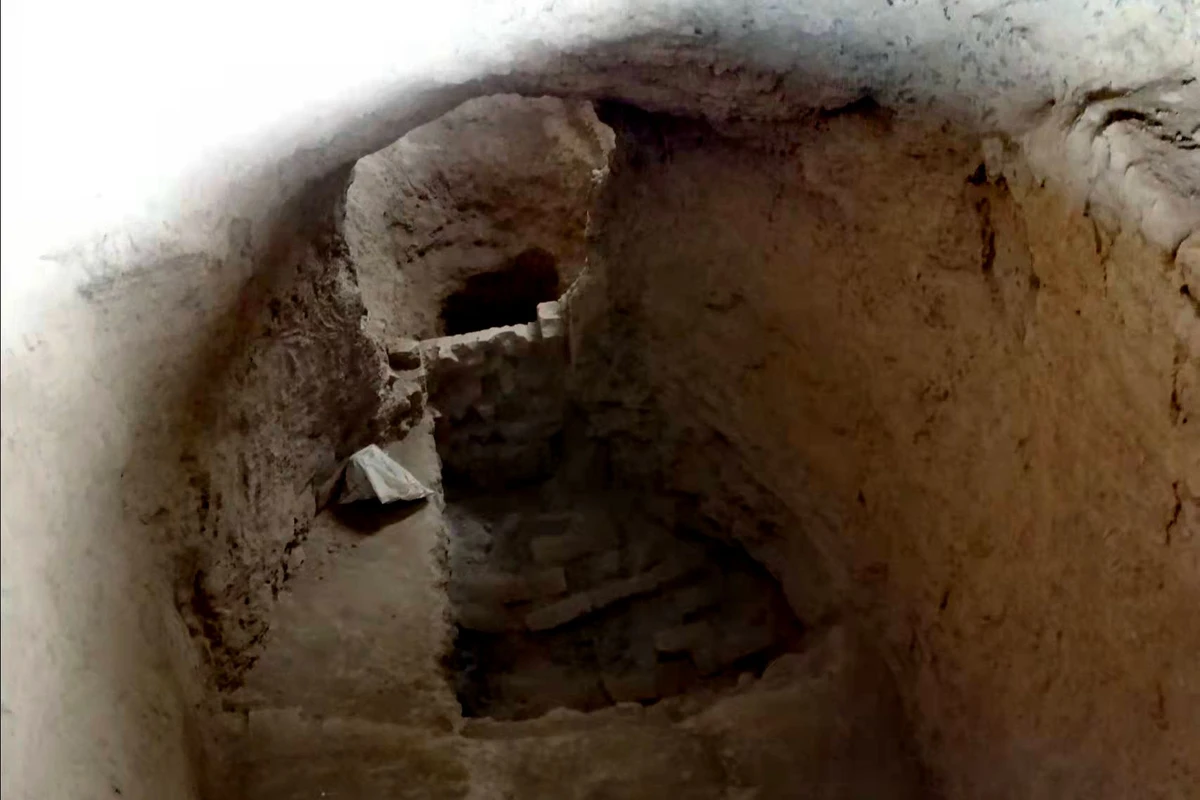
The Southern Tomb Area of the Eastern Han imperial tombs lies at the northern foot of Wan'an Mountain in the Yibin District, covering areas such as Baicaopo, Guojialing, Ningcun, and Yanlou Village. The Southern Tomb Area was initiated by Emperor Ming (Liu Zhuang). After its establishment, six emperors were buried there: Emperor Ming's Xianjie Ling, Emperor Zhang's Jingling, Emperor He's Shenling, Emperor Shang's Kangling, Emperor Zhi's Jingling, and Emperor Huan's Xuanling. Baicaopo Village in the Yibin District is located on the south bank of the Yi River, south of the Eastern Han Luoyang city, on a terrace at the northern foot of Wan'an Mountain. Baicaopo is an ordinary small village in western Luoyang, traditionally with three large earth mounds. Local legend says they bury an emperor and two empresses. Villagers often unearthed ancient bricks and tiles while farming. Residents frequently used the soil and bricks for building, and over nearly a decade, they gradually flattened the largest mound near the village into a level soccer field. In 2007, to prepare for the upcoming high-speed railway, the Luoyang archaeological team conducted surveys and excavations around Baicaopo. They excavated and discovered the 'Siyuan Lishè' (rest and work quarters for tomb management and guardians) and un-mounded underground tombs. Archaeologists descended more than ten meters to the tomb entrance and saw the tomb passage. After reporting to higher authorities, the state did not approve the excavation of the imperial tombs. The cultural relics team backfilled the site. In 2008, 164 Eastern Han tombs were discovered, 41 with remaining earth mounds. In the core area of the imperial tombs, seven exceptionally large mound tombs were found through prospecting, plus the Baicaopo large tomb, totaling eight exceptionally large tombs of imperial-level status.


