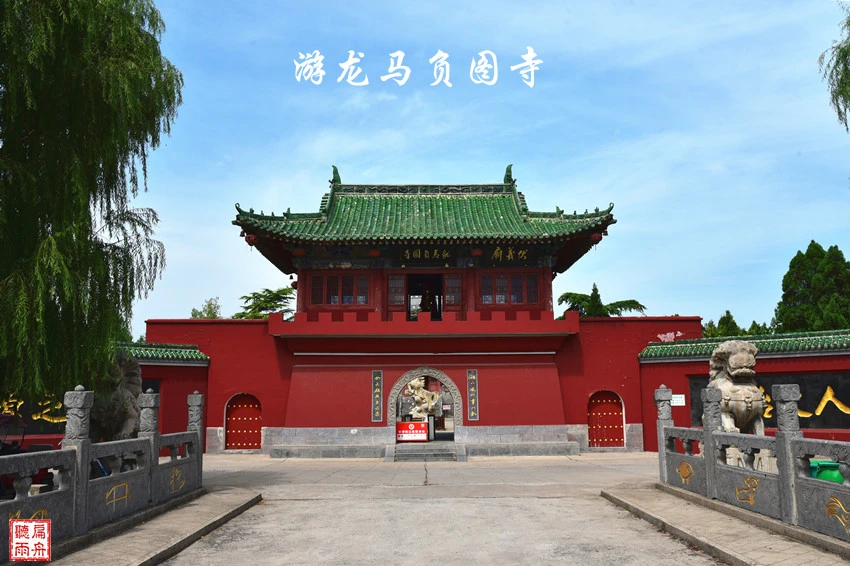
A Visit to Longma Futu Temple
The humanistic ancestors of China can be traced back to the ancient Three Sovereigns and Five Emperors, with the Three Sovereigns being more ancient than the Five Emperors. Because of the vast span of time, there are multiple different combinations of the Three Sovereigns and Five Emperors in mythology, but no matter how they vary, Fuxi is always one of the Three Sovereigns, revered as the first of the Three Sovereigns and the foremost of all kings.
Fuxi was born in Tianshui, drew the trigrams in Mengjin, and was buried in Huaiyang. Therefore, Tianshui, Mengjin, and Huaiyang are the three most important nodes in Fuxi's life.
Tianshui has the grand Fuxi Temple, Huaiyang has the majestic Taihao Mausoleum, and Mengjin has the enduring Longma Futu Temple (Dragon Horse Carrying the Diagram Temple).
Longma Futu Temple is located in Leihe Village, Huimeng Town, Mengjin District, Luoyang City, Henan Province, on the banks of the Yellow River—the very place where the Dragon Horse presented the Diagram to Fuxi.
Wang Duo, a famous calligrapher of the late Ming and early Qing dynasties and a native of Mengjin, wrote an essay titled "Record of the Dragon Horse." In it, he said: "When I was a child, I played by the river ruins. The elders said, 'In this river, there are many pebbles that make sounds, and a dragon once emerged—it was considered strange.' I was also amazed by this. Decades later, reading the stone stele records, I learned that this is where Fuxi drew the Eight Trigrams, inspired by the diagram carried by the Dragon Horse, and the river where the Dragon Horse emerged—today's Mengjin (now Huimeng Town, which was the county seat of Mengjin in the Ming and Qing dynasties). To the northwest, where the river's whirlpool flows backward, is that very spot."
There is no clear record in known historical texts of when Longma Futu Temple was first built. The earliest written record dates to the fourth year of Emperor Huai of Jin, over 1,600 years ago, when it was called Futu Temple, later also known as Futu Temple, Hetu Temple, Longma Temple, Xingguo Temple, etc. In the 19th year of Qianlong's reign (1754), it was renamed Xihuang Temple. After the Republic of China, it was changed back to Futu Temple. On January 4, 1932, Chiang Kai-shek and Soong Mei-ling visited Futu Temple and inscribed the words "He Tu Luo Shu" (River Diagram and Luo Writing).
According to information, the Longma Futu Temple we see today was rebuilt and restored in 1998. The temple name on the mountain gate, "Longma Futu Temple," was inscribed by Professor Liu Dajun, a renowned contemporary I Ching scholar and president of the China Zhouyi Society.
On both sides of the mountain gate, eight large golden characters are engraved on the red walls: "Human Ancestor" and "Source of the River Diagram."
Inside the gate, a large stone statue greets the eye: the mysterious Dragon Horse, supported by surging Yellow River waves, leaps up majestically. Flanking the Dragon Horse statue are the Bell and Drum Towers with red walls and yellow tiles. In front of these towers stand two large steles, one inscribed "Place Where the Dragon Horse Carried the Diagram" and the other "Ancient Course of the Tu River."
The "Shangshu • Gu Ming" records: "When Fuxi ruled the world, a dragon horse emerged from the River, and he then followed its patterns to draw the Eight Trigrams." The "Hanshu • Biography of Kong Anguo" provides a more detailed description: "The Dragon Horse is the essence of heaven and earth; its form has a horse's body and dragon scales, hence it is called Dragon Horse. It has red markings and a green color, stands eight feet five inches tall, resembles a camel with wings, walks on water without sinking. When a sage is on the throne, it emerges from the Meng River carrying a diagram."
Legend has it that when the Dragon Horse first emerged from the Yellow River, it was fierce and unruly, a monstrous beast that often stirred up trouble and brought harm to the region. Through constant observation and interaction, after seven days and seven nights of struggle, Fuxi mastered its habits and tamed it into his own divine mount. During the process, Fuxi noticed that the spots formed by the hair whorls on the Dragon Horse's back created a regular pattern: one and six are below, two and seven above, three and eight on the left, four and nine on the right, and five and ten in the center. He realized that this pattern seemed to be a revelation and inspiration from heaven. Thus originated the story of the Dragon Horse carrying the diagram from the river.
Inspired by the River Diagram, Fuxi drew the Eight Trigrams, now hailed as the "Cosmic Cube." Through the Eight Trigrams, Fuxi observed heaven above and earth below, comprehending and explaining the laws of evolution of all things and human ethical order. He then created written characters, established marriage, taught fishing and hunting, "to understand the virtues of the divine and to classify the conditions of all things," ending the era of primitive life, knotted cords for recording, and the indistinction of yin and yang, ushering in the enduring Chinese civilization. The first trigram is the Qian trigram, represented by three solid lines, with Qian symbolizing heaven. This is the origin of the Chinese idiom "One stroke opens heaven."
The "Yijing • Xici, Part I" says: "The River produced the Diagram, the Luo produced the Writing, and the sages took them as models." In modern Chinese, this means: The Yellow River produced the "Diagram," the Luo River produced the "Writing," and the sages used them to create trigrams and deduce theories of the changes in heavenly and earthly phenomena—namely the yin-yang and Eight Trigrams that have flourished for millennia.
What we often call "He Tu Luo Shu" (River Diagram and Luo Writing) seems like a unified concept, but in reality, the River Diagram appeared much earlier than the Luo Writing. The River Diagram was a celestial diagram presented to Fuxi by the Dragon Horse leaping from the Yellow River, located in Mengjin, Luoyang; the Luo Writing was a precious book presented to Yu the Great by a divine turtle emerging from the Luo River, located in Luoning, Luoyang.
Later, King Wen of Zhou, Ji Chang, built upon Fuxi's Eight Trigrams, integrating the heavenly secrets of both the River Diagram and the Luo Writing, composed the hexagram judgments and line statements, and created the commonly seen 64 hexagrams, which formed the "Yijing." Later generations called Fuxi's diagram the "Former Heaven Eight Trigrams" and King Wen's diagram the "Later Heaven Eight Trigrams."
Subsequently, Confucius and his disciples composed the "Ten Wings" to interpret the "Yijing," which is the "Yizhuan." Together, the "Yijing" and "Yizhuan" are known as the "Zhouyi."
Passing the Dragon Horse carrying the diagram statue, the main buildings in the second courtyard are three great halls: the Fuxi Hall in the center, the King Wen Hall on the east, and the Confucius Hall on the west.
Inside the main Fuxi Hall stands a statue of the sage Fuxi, with a three-meter-tall colored statue of the Dragon Horse reverently serving on his left side.
Behind the main hall is the Nüwa Palace. In Chinese myths and traditional murals, both Fuxi and Nüwa have human upper bodies and serpent tails, embracing each other above and intertwining below, together creating humanity and establishing a civilized society. This hall's structure once again proclaims the content of ancient myths.
To the east and west, the King Wen Hall and Confucius Hall record and display how King Wen and Confucius inherited the mantle of Fuxi's civilization and contributed to the development of the "Zhouyi."
The third courtyard houses the main hall of Longma Futu Temple—the Sanhuang Hall (Hall of the Three Sovereigns). The Sanhuang Hall stands on a high platform, 21 meters high and 30 meters wide, with a double-eave hip roof structure, seven visible and five hidden beams, richly carved and painted, resplendent. Inside, Fuxi sits in the center, with the Yellow Emperor and Yan Emperor flanking him. According to the "Yijing" saying "Observing heavenly phenomena from heaven," the ceiling's background is sky-blue, painted with the 64 hexagram positions, the hexagrams alternating in black and white. In the center, the golden handle of the Big Dipper turns, indicating the four seasons. On each side are painted three flying dragons, four golden dragons, two black dragons, and at the four corners are the auspicious characters "Yuan" (origin), "Xiang" (enjoyment), "Li" (benefit), and "Zhen" (perseverance).
As the source of the River Diagram and the birthplace of Chinese Yijing studies, and as a site for commemorating the human ancestor Fuxi, Longma Futu Temple was historically a vast architectural complex. After being repeatedly damaged and rebuilt through wars, the current three-courtyard complex covers only about 40 mu (about 2.67 hectares), far from its former scale, but its radiance will not be obscured by time.
Within this repeatedly destroyed and rebuilt ancient temple, there remain more than 20 steles from the Song, Ming, and Qing dynasties, inscribed with essays, inscriptions, poems, and rhapsodies by famous Neo-Confucian scholars and calligraphers such as Cheng Yi, Zhu Xi, Shao Kangjie, Wang Duo, and Zhang Han. These steles are of great value for the study of the "Yijing" and calligraphic art.
The legend of He Tu Luo Shu was inscribed on the fourth batch of National Intangible Cultural Heritage List by the State Council on November 11, 2014.
"The Dragon Horse exactly serves heaven and earth; the River Diagram first captured the sage's heart." The Dragon Horse that appears in this local myth combines the forms and spirits of dragon and horse, becoming a symbol of good fortune and happiness for the Chinese people. The "Dragon Horse Spirit" derived from this has been endowed with the excellent quality of the Chinese nation's enterprising and enduring vitality.
The splendid civilization born from this place has long illuminated the land of China, filled with the philosophical dialectics of the unity of heaven and humanity. The profound Yijing studies have also spread worldwide, becoming a way of thinking for understanding and changing the world, and have yielded fruitful results in the collision of Eastern and Western civilizations, glorifying both at home and abroad.
Richardson Wilhelm, a Nobel laureate and world-renowned information economist, said: "The knowledge economy is changing our era, but many people do not know that this revolution, which has brought us such a huge impact, actually benefits from the great ancient Chinese classic—the 'Yijing.' The information theory contained in the 'Yijing' not only inspired our scientists to create the computer but is also becoming a guide for decision-making in the daily lives of more and more ordinary Westerners."
The Longma Futu Temple on the banks of the Yellow River has been quietly listening, remembering, and witnessing all this...
(Some images in the text are from the Internet; if there is infringement, please contact us for deletion.)


