The Grand Canal of Luoyang
"If you wish to know the rise and fall of dynasties past and present, just look at the city of Luoyang." In 1071 AD, Sima Guang, disheartened after opposing Wang Anshi's reforms, retreated to Luoyang. Passing through the ruins of the Han-Wei Luoyang city, he borrowed the scene to express his feelings, writing a poem titled "Passing the Old Luoyang City" filled with infinite emotion.
In the eyes of Sima Guang—statesman, historian, and writer—the rise and fall of Luoyang was far more than just the Han-Wei ancient city. That city was merely a glimpse of a fragment of Luoyang's past and present. Only by linking together the Xia capital, Shang capital, Western Zhou Luoyi, Eastern Zhou Wangcheng, Han-Wei capital, and Sui-Tang imperial city can one clarify the magnificent history of the Central Plains.
In the "Zizhi Tongjian" (Comprehensive Mirror for Aid in Government), there is this passage: "In the second year of Daye of Emperor Yang of Sui, the twelfth month, Huiluo Granary was established seven li north of Luoyang. The granary city was ten li in circumference, with three hundred cellars dug to store grain."
This Huiluo Granary, recorded in the text, was built on the day Emperor Yang of Sui moved the capital to Luoyang. Located outside the north gate of Sui-Tang Luoyang city, it was a state-level granary ensuring the stability of the capital. Modern archaeology has found that the original Huiluo Granary stretched 1,000 meters east-west and 355 meters north-south, covering an area equivalent to 50 modern standard football fields. The site lies in today's Xiaoli Village, Chanhe Township, Chanhe District, Luoyang. Historical records indicate that Huiluo Granary was destroyed by peasant uprisings at the end of the Sui Dynasty, but the vast amount of grain stored there continued to feed people well into the Zhenguan era of the Tang Dynasty.
When Sima Guang temporarily retreated to Luoyang to focus on compiling the "Zizhi Tongjian," even though Luoyang remained the Western Capital of the Song Dynasty and had undergone large-scale reconstruction following Sui-Tang patterns, the city's glorious heyday had already given way to Kaifeng (Bianjing).
Today, to envision the unprecedented splendor described by Sima Guang, one must visit the Luoyang Sui-Tang Grand Canal Culture Museum. A green brick inscribed with the characters "Daye First Year" was unearthed at the Huiluo Granary ruins and is now treasured in the museum. Daye First Year (605 AD) was the first year Emperor Yang of Sui moved the capital to Luoyang, and Huiluo Granary should also be considered the foundational project of Sui-Tang Luoyang.
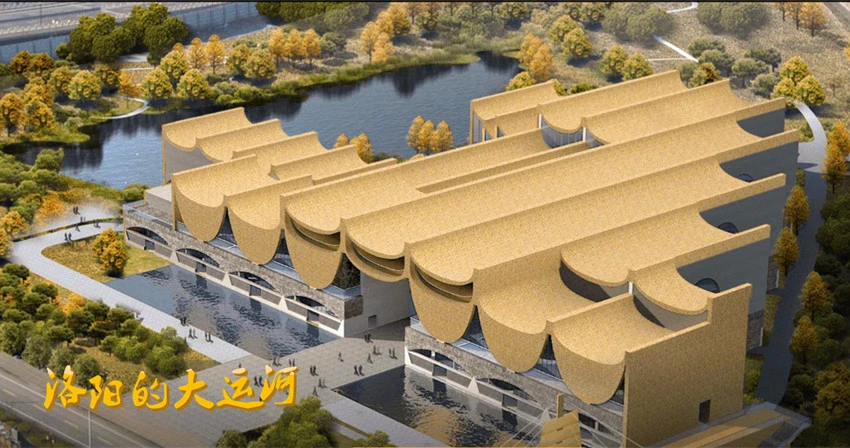
The Luoyang Sui-Tang Grand Canal Culture Museum is located at the confluence of the Luo River and the Chan River. From a distance, its silhouette resembles a Tang Dynasty palace complex. The exterior is decorated with pieces of Sancai (three-color glazed) pottery, highlighting Luoyang's characteristic Tang Dynasty charm. Its golden and shining appearance captures attention, inviting visitors to delve into the depths of history. The interior space uses a unified arched structure to create rich layers, expressing the cultural theme of "Source of the Canal, Spirit of Sui-Tang, Craft of Heluo" and showcasing the profound heritage of the Sui-Tang Grand Canal.
The exhibition "The Flourishing Nation: The Sui-Tang Grand Canal Culture Exhibition" occupies the first and second floors of the museum and is its soul. It is divided into four parts: Part 1 "Heavenly Engineering and National Unity"; Part 2 "The Millennium Canal Connecting All Things"; Part 3 "The Prosperity of the Sui-Tang Golden Age"; and Part 4 "Past and Present Shining Together, Enduring and Far-reaching." Centered on the excavation and operation of the Grand Canal, it uses text, images, artifacts, and videos to vividly narrate Luoyang's advantageous geographical location, the construction of the Sui-Tang capital Luoyang, the canal's grain transport system, the prosperity it brought, the hydraulic engineering legends along the canal, and today's protection and inheritance of the Grand Canal culture.
On the third floor is the interactive exhibition "The Grain Transport Journey of a Single Grain," which tells the entire process from grain collection and transport to storage. It concludes with an immersive wrap-screen film titled "City and Canal," linking together key nodes along the Sui-Tang Grand Canal, reflecting the vibrant vitality and enduring charm of the canal's encounter, interdependence, and companionship with historical and cultural cities. The scenes that ancient writers could only convey through artistic conception have now become tangible and perceptible realities for today's visitors.
In ancient China, the working people excavated many canals, such as the famous Zhengguo Canal, Lingqu Canal, and Hangou Canal. However, only the Sui-Tang Grand Canal and the Beijing-Hangzhou Grand Canal are later called the "Grand Canal." In fact, the Beijing-Hangzhou Grand Canal is a straightened or shortened version based on the Sui-Tang Grand Canal. The Sui-Tang Grand Canal stretched over 2,700 kilometers, while the Beijing-Hangzhou Grand Canal is nearly 1,800 kilometers long.
After more than 300 years of turmoil and war during the Three Kingdoms, Wei-Jin, and Southern and Northern Dynasties, the Sui Empire once again unified the Central Plains. The vast territory and millions of people of the unified empire urgently needed strong political, economic, and cultural cohesion. The ambitious Emperor Yang of Sui, Yang Guang, responded to this historical trend. In 605 AD, he moved the capital from grain-deficient Chang'an (Xi'an) to Luoyang, a city with natural defenses. Over the next five years, mobilizing millions of workers, he excavated, dredged, and renovated canals, building a grand canal system centered on Luoyang, reaching Yuhang (now Hangzhou) in the south and Zhuojun (now Beijing) in the north.
The Grand Canal, stretching over 2,700 kilometers, was divided into four sections: Yongji Canal, Tongji Canal, Hangou Canal, and Jiangnan River. It crossed ten degrees of latitude, connecting for the first time the five major water systems of the Qiantang River, Yangtze River, Huai River, Yellow River, and Hai River. It traverses what are now eight provinces and municipalities: Beijing, Tianjin, Hebei, Shandong, Henan, Anhui, Jiangsu, and Zhejiang, linking more than a dozen historical and cultural cities, including Luoyang, Zhuojun, Bianzhou (now Kaifeng), Songzhou (now Shangqiu), Suzhou, Chuzhou (now Huai'an), Jiangdu (now Yangzhou), Runzhou (now Zhenjiang), Yuhang, and Kuaiji (now Shaoxing).
Such a massive project consumed unprecedented manpower and resources, earning Yang Guang a reputation for exploiting the people. Instead of uniting his subjects around him, it accelerated the collapse of the Sui Empire. However, the benefits the Grand Canal brought to later generations were not buried.
Tang Dynasty poet Pi Rixiu once wrote a poem evaluating it: "Everyone says the Sui fell because of this river, yet for a thousand miles it still relies on its waves. If not for the extravagance of dragon boats and water palaces, comparing its merit to Yu the Great would be no exaggeration." If not for Emperor Yang's extravagance and militarism, the historical achievement of opening the Grand Canal alone would rival that of Yu the Great controlling the floods.
On June 22, 2014, at the 38th World Heritage Committee in Doha, Qatar, the China Grand Canal project was successfully inscribed on the World Heritage List. It was China's 46th World Heritage site, including three main sections: the Sui-Tang Grand Canal, the Beijing-Hangzhou Grand Canal, and the Zhedong Canal, along with 58 related heritage sites.
After the establishment of the Tang Dynasty, the imperial court continued to develop the canal's grain transport function with Luoyang at the core. On the canal, grain boats traveled day and night, "a thousand miles without end." During the reign of Empress Wu Zetian, Luoyang was where "all boats under heaven gathered, often more than ten thousand vessels." The severe congestion on the canal made the empress uneasy, so in 701 AD, she ordered the construction of the Xin Tan (New Pool) to accommodate the rent boats from various prefectures.
Abandoning the Huiluo Granary outside the city, the Tang Dynasty built the more secure Hanjia Granary within Luoyang city. Hanjia Granary measured 612 meters east-west and 710 meters north-south, covering a total area of 430,000 square meters, also known as Hanjia Granary City. It was an important part of the Eastern Capital Luoyang, with a dedicated management agency and troops guarding it day and night. The imperial court stipulated that all grain shipped from east of Luoyang had to be stored in Hanjia Granary, then transported overland through Shanzhou to Chang'an.
According to the "Wenxian Tongkao" (Comprehensive Examination of Literature), in the eighth year of Tianbao of Emperor Xuanzong of Tang (749 AD), the total grain stored in all types of granaries nationwide was 12,656,620 shi... Among them, Hanjia Granary held 5,833,400 shi... This means Hanjia Granary stored nearly half of the national grain reserves, making it the true No. 1 granary under heaven.
Along with the grain sealed in each cellar, there was an inscribed brick. Each inscribed brick was the unique ledger for its cellar, recording the variety, quantity, date, origin of the stored grain, and the names of the managing officials. The museum displays inscribed brick No. 19, which is square, 33 cm on each side, and 6 cm thick. It reads: "Hanjia Granary, East Gate, 23rd row from south, 5th cellar from west, △△, Suzhou, Tongtian Second Year, coarse rice white duo, 13,△△,15 shi, △ inside, right, Shengli Second Year, 11th month, 8th day, received..."
Archaeological discoveries revealed that the Hanjia Granary City had 287 underground cellars arranged densely and orderly. When the No. 160 cellar was uncovered, it still contained about 500,000 jin (250 tons) of millet, mostly carbonized but with grains still clearly distinguishable.
Archaeologists took some seed-like particles from the gaps between wooden planks for cultivation. Three days later, they were delighted to find that the seeds had sprouted! The next year, the plants were transplanted to the Luoyang Institute of Agricultural Sciences for continued cultivation. They grew to knee height and bore fruit. This astonishing performance fully proved the superb skills used in building the cellars and the status of Hanjia Granary in the Tang Dynasty.
The herringbone-shaped Grand Canal had its brain in Luoyang, its heart in Luoyang, its hub in Luoyang, and its miracles in Luoyang. Like a pulsating blood vessel, it surged out from Luoyang, one stroke connecting the southern Yuhang, another stroke connecting the northern Zhuojun, and the western end connecting Chang'an. It nourished the Central Plains and propped up the Tang Dynasty. Why not call it Luoyang's Grand Canal?
During the late Tang Dynasty and the Five Dynasties and Ten Kingdoms period, frequent wars and widespread devastation greatly affected the operation of the Grand Canal. The Yongji Canal had lost its basic function as a canal. When the Song Dynasty restored order, the national command center moved to Kaifeng (Bianjing). The Tongji Canal, mainly relying on the Bian River, was renovated and continued to serve as the main economic water artery. During the period of confrontation between the Southern Song, Jin, and Yuan dynasties, the Bian River was seen by hostile forces as a strategic tool for mutual containment. Due to years of neglect, the river channel silted up, and the Sui-Tang Grand Canal, which had been busy for over 500 years, regretfully ended its historical mission.
Water transport was the irreplaceable primary mode of transportation in ancient times. When the Yuan Dynasty reunited China, it fixed its capital at Dadu (now Beijing). To efficiently transport grain from the south to the north, it took ten years to excavate the Jizhou River, Huitong River, and Tonghui River, connecting natural rivers and lakes between Dadu, Tianjin, and Qingjiang (in Jiangsu), and then linking with the existing Hangou and Jiangnan sections of the Sui-Tang Grand Canal.
A new Grand Canal—the Beijing-Hangzhou Grand Canal—was opened! This canal once again connected the bloodline of northern and southern China. It straightened the herringbone-shaped Sui-Tang Grand Canal that detoured through Luoyang into a straight line, allowing north-south vessels to travel unimpeded between Dadu and Hangzhou without passing Luoyang, shortening the voyage by more than 900 kilometers. To this day, for hundreds of years, the Beijing-Hangzhou Grand Canal has been China's busiest water transport route.
One river spans past and present; one lineage passes through millennia. The Sui-Tang Grand Canal—Luoyang's Grand Canal—China's earliest Grand Canal. Although the Sui-Tang Grand Canal has become history, its successor and replacement, the Beijing-Hangzhou Grand Canal, continues to write its legend. Although Luoyang is no longer the center of canal operations, the Luoyang section of the Sui-Tang Grand Canal remained active for nearly a thousand years. In September 2013, on the floodplain of the north bank of the Luo River in Yijing Village, Yanshi, Luoyang, a sunken ship measuring 20 meters long and over 3 meters wide was unearthed. Archaeological investigation identified it as a Ming-Qing period ship, located precisely on the old channel of the Sui-Tang Grand Canal. This sunken ship was consequently named "Luoyang Canal No. 1."
Upon the completion of the Luoyang Sui-Tang Grand Canal Culture Museum, people placed "Luoyang Canal No. 1" inside the museum. Along with the Sui-Tang Grand Canal collection—including the Bian River cultural stratum, Sui Dynasty stone lion, Western Zhou bronze ding with scroll pattern, Tang Dynasty Sancai figurine of a heavenly king, Tang Dynasty salt and iron commissioner's seal, Tang Dynasty granary cellar remains, Hanjia Granary No. 19 inscribed brick, and Huiluo Granary "Daye First Year" brick—they narrate to visitors distant yet vivid stories about the Grand Canal.
(Some images in the article are selected from the internet. Please contact for deletion if infringing.)


