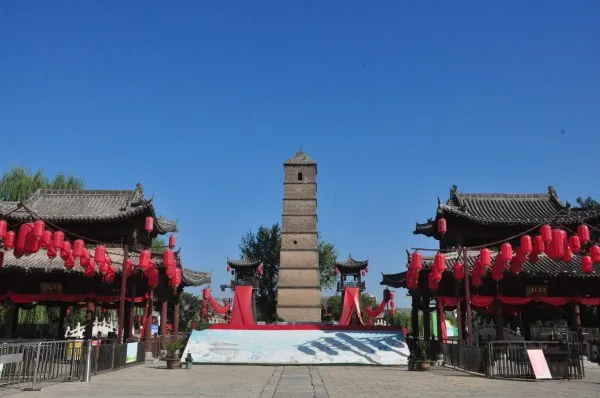
Henan Travel Notes: Luoyi Ancient City in Luoyang
On the morning of September 25, 2022, a little after 7 a.m., after breakfast at the hotel, I took Bus No. 22 to Luoyi Ancient City and got off at the intersection of Xinjie and Jiudu East Road. A short walk west along a small road brought me to the south gate of Luoyi Ancient City. The scenic area had just opened, with very few visitors. Entry required only an ID card, and admission was free.
Luoyi Ancient City, known as the "Central Plains Ferry," is located in the old city district of Luoyang, Henan Province. The scenic area includes several protected buildings from various historical periods, such as the Wenfeng Pagoda, the Henan Prefecture Confucian Temple, the Tuoling Temple, the Siyan Well, and the Jin-Yuan Ancient City Wall site. It is a comprehensive cultural tourism zone integrating sightseeing, entertainment, dining, accommodation, and shopping.
"Luoyi" is the ancient name for Luoyang, representing Chinese civilization from antiquity to the present. Having served as the capital of thirteen dynasties, it is hailed as the "Holy City of Culture." Over thousands of years, nurtured by the people of Henan, the Luoyi region gradually developed a cultural character where Han culture merged with multi-ethnic cultures, northern culture intertwined with southern culture, and rural culture coexisted with court culture. This has added a profound and expansive regional humanistic spirit to the forest of Chinese national culture.
Luoyi Ancient City has now become a popular check-in destination in Luoyang. Many visitors dress up, strike poses, and take photos here. Although the retro landscapes are all artificially constructed later, if you have time, a visit here is still a good choice.
Around 10 a.m., we finished our tour of the scenic area and walked to the road to catch a bus back. Seeing a sign for the Luoyang Folk Museum across the street, and since we still had time in the morning, we decided to take a look. We entered the folk museum through its south gate, and admission was free.
The Luoyang Folk Museum, located at the southern end of Xinjie in Luoyang, is a specialized museum in China. It was built on the basis of the Luze Guild Hall (Luze Huiguan), a national key cultural relic protection unit. The Luze Guild Hall, also known as the Guandi Temple because it enshrines Guan Yu, was built in the ninth year of the Qianlong reign of the Qing Dynasty (1744). Its existing structures include a dance tower, bell and drum towers, crossing rooms, corridor rooms, main hall, rear hall, and side halls, forming a group of ancient buildings with a rigorous layout and unique style. In 1981, it was established as the West Henan Museum, and in 1987 it was renamed the Luoyang Folk Museum, opening to the public the following year.
The museum is grand in scale and imposing in appearance. The existing front hall (with the dance tower at its back) and rear hall are arranged along the central axis, flanked by bell and drum towers, east-west crossing rooms, east-west corridor rooms, and east-west side halls. The original screen wall of the Qilin Gazing at the Moon, Kuixing Tower, Wenchang Pavilion, and some stone carvings were destroyed during the Cultural Revolution.
The museum buildings are majestic and exquisitely carved. The entire structure is covered with blue tiles, trimmed with glazed tiles, and adorned with glazed dragon and phoenix flower ridges. The floors are paved with square bricks and bordered with bluestone. The color paintings in the main hall focus on coiled dragons, the dance tower on dragons and phoenixes, the crossing rooms, bell and drum towers, rear hall, and side halls on floral patterns, while the corridor rooms depict the life of Guan Yu. The wood carvings are mainly seen on bracket sets (dougong) and sparrow braces (queti), with those in the main hall and dance tower being the most exquisite. The column bases are highly distinctive: the front hall column bases feature a qilin carrying a lotus, while the main hall column bases have three layers – the bottom layer depicts birds in flight, the middle layer beasts in groups, and the upper layer coiled dragons. The middle layer, in particular, captures the natural and lively instincts of small animals, which is highly commendable. The inscription on the stele says it "surpasses the marvel of flying eaves and painted rafters, and reaches the pinnacle of carved beams and painted corners," which is not an exaggeration. The museum is currently the largest folk-themed specialized museum in Henan Province. Its basic exhibitions cover five parts: beliefs, marriage customs, birthday customs, folk art, and embroidery. The Belief Hall displays sixty deities commonly worshipped in the Luoyang area. Among them, the "Three Buddhas" are presented in a restored form, while the other deities are displayed in scroll format. The origins of the deities are introduced in detail based on historical materials, combined with folk characteristics.
The entire complex of ancient buildings is well-layered and structurally rigorous, covering an area of 15,750 square meters. It is one of the well-preserved and grand-scale ancient building complexes in the Central Plains region. In terms of architectural design and construction methods, it epitomizes the local architectural techniques of Henan from the Qing Dynasty, serving as an outstanding example of local ancient architecture in the Central Plains during the Qing period. Its architectural decoration is exquisitely crafted, with wood and stone carvings of great beauty, making it a brilliant gem in the treasure house of carving art in the Central Plains.
Next to the museum, there is also a newly built Contract and Document Museum, but most of its exhibits are textual artifacts with limited visual appeal, so we could only pass by quickly.
Around 11 a.m., we finished our visit, took Bus No. 22 back to the hotel, had a bowl of noodles outside, and then took a bus to the railway station. We boarded Train K32 at 1:18 p.m. back to Shangqiu, ending our seven-day short trip. This was our only trip in 2022, during the rampant COVID-19 pandemic.


