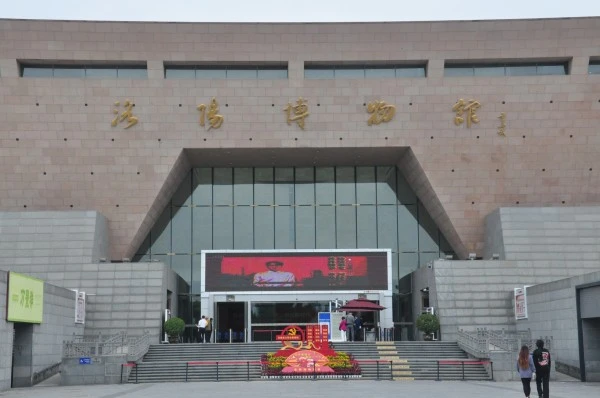
Travel Notes of Henan: Luoyang Museum
On the morning of September 24, 2022, after having a buffet breakfast at the hotel around 7 a.m., I walked to Wangcheng Square and took Bus No. 77 to the Luoyang Museum. We arrived at the museum at 9:15 a.m., just as it opened. A few years ago, we had visited the Luoyang Museum, but my wife didn't take photos at that time. Now that she has a new phone, she wanted to make up for it. I also wanted to revisit it, as museums are always worth seeing anew and never go out of style.
The Luoyang Museum is one of the first batch of national first-class museums and a comprehensive historical museum at the local level in China. It is the only comprehensive historical museum in Luoyang. The museum houses over 400,000 cultural relics, with more than 11,000 on display.
Located in the northwest corner of the Sui and Tang Dynasty Li-Fang District, the Luoyang Museum covers an area of 300 mu (about 20 hectares), with a building area of 62,000 square meters, of which 42,000 square meters are above ground and 20,000 square meters underground. The total investment was 350 million yuan. The building's exterior is shaped like a standing square ding (a type of ancient vessel), symbolizing "settling the capital in Luoyi" and "standing firm under heaven." The museum is bordered by Luopu Park to the north and the Botanical Garden to the south, featuring a beautiful environment and convenient transportation, making it a cultural landmark of Luoyang.
The cultural relics exhibition at the Luoyang Museum showcases the profound and splendid culture of the ancient capital Luoyang. The newly launched "Eternal Civilization: Selected Exhibits of Luoyang Cultural Relics" consists of five major parts: the Prehistoric period, Xia-Shang period, Zhou period, Han-Wei period, and Sui-Tang period, displaying nearly a thousand precious cultural relics. The exhibition highlights include elephant fossils from 50,000 years ago, painted pottery from the Neolithic Age, bronze ritual vessels from the Xia, Shang, and Zhou periods, painted pottery and acrobat figurines from the Han-Wei period, and painted dancing figurines and colorful, diverse Tang Sancai (tri-colored glazed pottery) from the Sui-Tang period. Among them, the Summer Dynasty bronze jue, the Warring States period gold-and-silver inlaid bronze ding, the Northern Wei dynasty pottery sculptures, and the Tang dynasty Sancai lamp and Sancai horse are considered national treasures.
At the same time, the museum uses modern presentation techniques to give the exhibits new vitality, making the exhibition majestic and elegant, reproducing the special historical status of the thousand-year-old ancient capital. It received the "Top Ten Exhibition Excellence Awards of the Country in 1999" from the State Administration of Cultural Heritage.
The Luoyang Museum has many rare treasures, but the most precious include the following:
First: "Xia Dynasty: Bronze Jue with Nipples Pattern." It belongs to the late Erlitou culture in Chinese history and was unearthed in 1975 at Erlitou in Yanshi, Luoyang. It is a drinking vessel. It is 22.5 cm high and 31.5 cm wide. Due to its age and archaic shape, it is elegant and delicate, earning the title "First Jue of Huaxia."
Second: "Eastern Han Dynasty: Stone Bixie (mythical beast)." It was unearthed in 1992 at Youfang Street Village, Laocheng Township, Mengjin County, Luoyang. It weighs 8 tons, is 1.9 m high, 2.97 m long, and 0.9 m wide. It was carved from a single large bluestone from the Han dynasty. It is the largest stone bixie discovered in China.
Third: "Cao Wei: White Jade Cup." It was unearthed in 1956 from a tomb of the Cao Wei dynasty in Jianxi District, Luoyang, dating to the eighth year of the Zhengshi era (247 AD). This white jade cup was carved from a single piece of Hetian jade. It is 11.5 cm high with a mouth diameter of 5 cm. It has a flat rim, straight mouth, deep cylindrical belly, and even wall thickness. The cup body is plain and unadorned, reflecting the austere style advocated during the Cao Wei period. However, its carving is exquisite, with smooth and clear edges at the rim, body, and bottom angles, giving a sense of understated luxury and depth.
Fourth: "Tang Dynasty: Black-Glazed Sancai Horse." It was unearthed in 1981 from the tomb of An Pu and his wife. This black-glazed horse is 73 cm high and 84 cm long, standing on four sturdy legs, with a plump and strong physique and distinct facial muscles. It looks imposing and powerful, staring forward. Unlike other Tang Sancai, the horse is largely black, with only the face, mane, back, tail, and hooves in white, and the saddle in green. It is a perfect representation of the phrase "celestial horse with hooves treading snow" from ancient texts.
Fifth: "Qing Dynasty: Golden Nanmu Pagoda." Unlike the other four treasures, which are from Luoyang itself, this pagoda was shipped from Beijing to the Luoyang Museum in 1973 under the approval of Premier Zhou. The golden nanmu pagoda was built in the early Qing dynasty, with a dark brown body about 6 m high and weighing about 4 tons. It has eight sides, three tiers with double eaves, and 304 niches. Each niche enshrines a gilded bodhisattva. The whole pagoda uses luxurious materials, diverse carving techniques, and exquisite craftsmanship, all constructed with mortise and tenon joints without a single nail. It is a perfect combination of Buddhist art and ancient architectural techniques.
Among Henan's local museums, apart from the Provincial Museum, the Luoyang Museum stands out. Whether in quantity or quality of its collections, it is top-notch and truly deserves the title of national first-class museum.
We spent nearly three hours inside the museum. We finished our visit at noon and left the museum, crossing the road to the Luoyang Botanical Garden. We had planned to spend the afternoon there, but unfortunately, my wife wasn't interested in the botanical garden, and moreover, most flowers had withered in this season. There was nothing else to see, so we gave up and took Bus No. 77 back to Wangcheng Square.
Near Wangcheng Square, there is a Xigong Snack Street with small eateries, so we had lunch there. In the afternoon, we walked back to the hotel to rest.


